Nucleic Acids and Energy Transfer Molecules
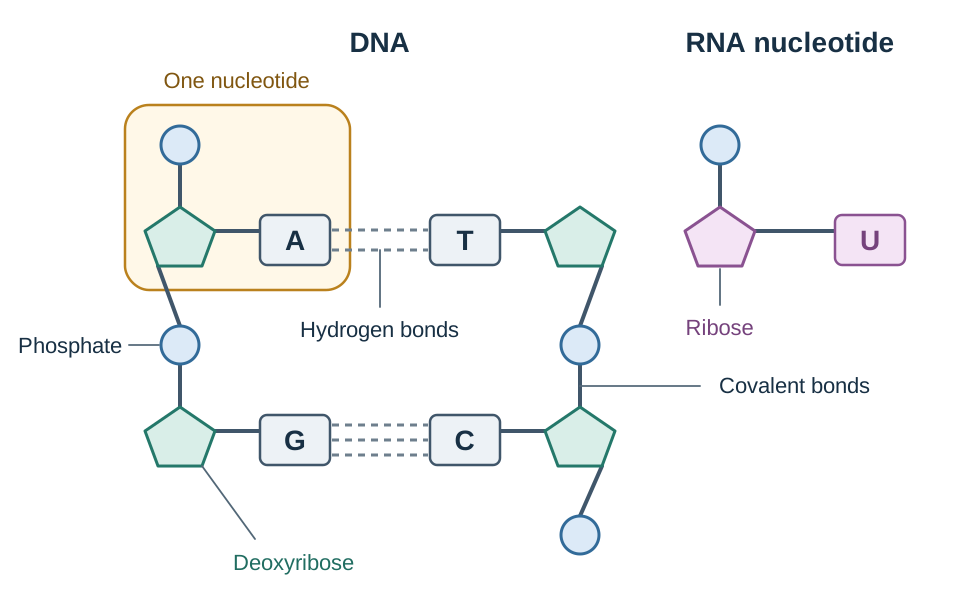
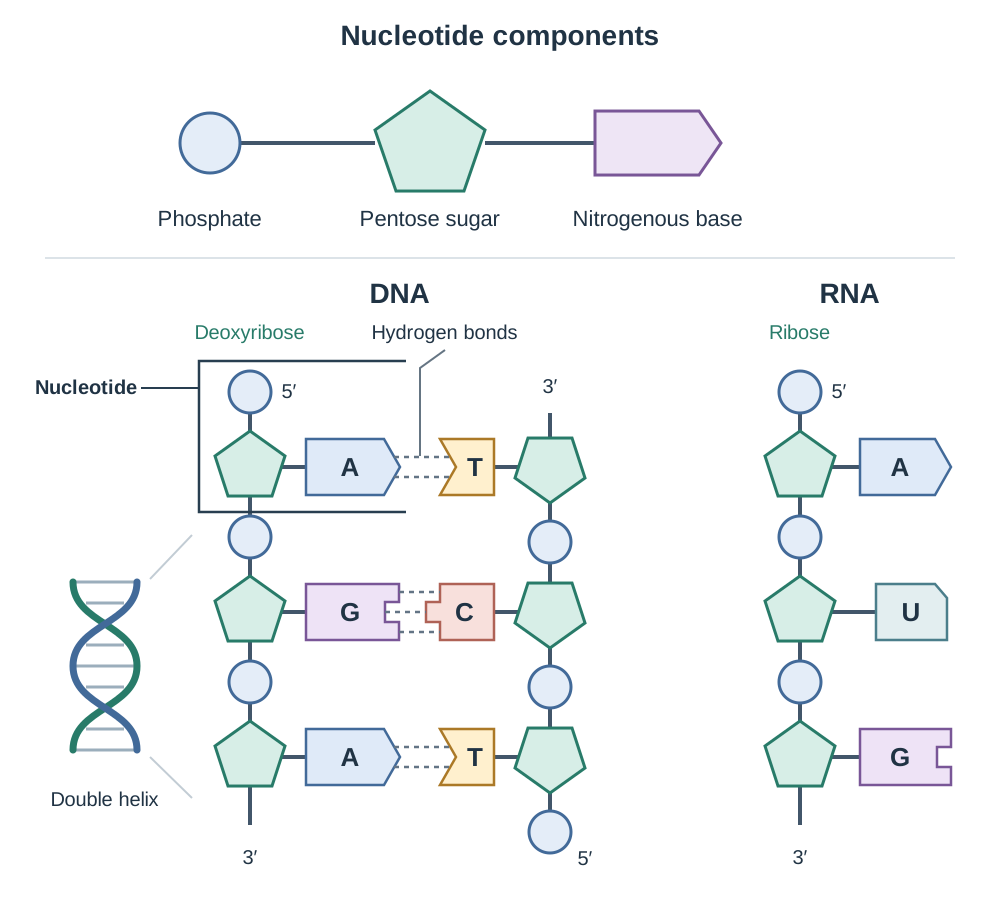
Nucleic acids store and express genetic information. The monomer unit of a nucleic acid is a nucleotide, which consists of three parts:
- A five-carbon pentose sugar (deoxyribose or ribose)
- An inorganic phosphate group
- A nitrogenous base
DNA and RNA
- DNA (Deoxyribonucleic acid): Contains the sugar deoxyribose. DNA consists of two strands wound into a double helix. The strands are linked by hydrogen bonds between complementary base pairs: adenine (A) pairs with thymine (T), and guanine (G) pairs with cytosine (C).
- RNA (Ribonucleic acid): Contains the sugar ribose. RNA is single-stranded, and the base uracil (U) replaces thymine, meaning adenine pairs with uracil.
Cellular Transfer Molecules
Cells use specialized nucleotide derivatives to shuttle energy and electrons between metabolic reactions:
- ATP (Adenosine Triphosphate): The universal energy currency of the cell. It consists of adenine, ribose, and three phosphate groups joined by unstable bonds. When a cell needs energy, ATP is hydrolysed into low-energy ADP and phosphate, releasing energy:
Recharging ADP into ATP requires energy supplied by cellular respiration or light absorption in photosynthesis.
- NAD⁺ / NADH: Nicotinamide adenine dinucleotide functions in cellular respiration. Low-energy acts as an electron acceptor. It picks up two high-energy electrons and a hydrogen ion from respiratory intermediates to form high-energy . carries these electrons to the electron transport chain in the mitochondria, where their energy is used to generate ATP.
- NADP⁺ / NADPH: Nicotinamide adenine dinucleotide phosphate has an additional phosphate group. In this course, is the electron carrier used in photosynthesis. In the light-dependent stage, it captures electrons and hydrogen ions to form . supplies the reducing power in the chloroplast stroma to convert carbon dioxide into glucose during the light-independent stage.
The Genetic Code, Genes, and Traits
A gene is a section of DNA that codes for the production of a specific protein or polypeptide. Genetic instructions dictate an organism's characteristics through a clear chain of cause and effect:
- The sequence of bases along a gene determines the sequence of codons in mRNA.
- The codon sequence determines the sequence of amino acids joined at the ribosome.
- The amino acid sequence dictates how the polypeptide folds into its three-dimensional shape, determining protein function.
- The functional protein produces the physical or physiological trait (characteristic).
For example, the gene for the enzyme tyrosinase codes for the production of functional tyrosinase. This enzyme converts tyrosine into melanin, the pigment responsible for skin, hair, and eye colour. A mutation in this gene can produce an inactive enzyme; without melanin, the organism displays the trait of albinism. This pathway is summarised as: DNA mRNA protein trait.
The Triplet Code and tRNA Structure
Living organisms use 20 different amino acids to construct proteins, but DNA contains only 4 distinct nitrogenous bases (adenine, thymine, guanine, and cytosine). A single-base code could only specify 4 amino acids (). A two-base doublet code could specify only 16 (), which is still insufficient. Cells therefore rely on a triplet code ( combinations), which provides more than enough codons to code for all 20 amino acids as well as start and stop instructions. Because several codons can code for the same amino acid, the code is described as degenerate.
In mRNA, each triplet is called a codon. Transfer RNA (tRNA) acts as the physical adaptor between the codon sequence and the amino acid sequence. Each tRNA molecule is folded into a cloverleaf shape held by hydrogen bonds. At one end, it carries an exposed three-base sequence called an anticodon, which matches a specific mRNA codon by complementary base pairing. At the opposite end, it carries an attachment site for the specific amino acid corresponding to that codon. Because each anticodon is exactly three bases long, one tRNA molecule brings precisely one amino acid for each codon read by the ribosome.
Nucleic Acid Chemistry
DNA and RNA are polymers made of repeating monomers called nucleotides. Each nucleotide contains:
- A five-carbon pentose sugar (deoxyribose in DNA, ribose in RNA)
- A phosphate group
- A nitrogenous base
The bases are divided into double-ring purines (adenine and guanine) and single-ring pyrimidines (thymine and cytosine in DNA; uracil and cytosine in RNA). In DNA, adenine pairs with thymine via two hydrogen bonds (), while guanine pairs with cytosine via three hydrogen bonds (). In RNA, adenine pairs with uracil ().