

Biology is the study of life, but defining what constitutes a living thing is a central challenge in science. Rather than relying on a single, narrow definition, biologists identify life through eleven interconnected characteristics. This topic explores those eleven characteristics, evaluates the scientific debate surrounding whether acellular viruses are living or non-living, and examines how modern taxonomy classifies Earth's biodiversity into three domains and six kingdoms based on evolutionary relationships and genetic evidence.
The Eleven Characteristics of Living Things
Biologists do not define life with a single phrase. Instead, an entity is considered alive when it exhibits a coordinated suite of eleven characteristics across its life cycle.
Note that no mandatory laboratory practical is attached to this introductory topic; your practical skills across Senior Cycle biology are developed and assessed through the Biology in Practice Investigation.
Definitions to Learn Word for Word
- Organisation: The arrangement of living material into a structured order of increasing complexity, from cells to tissues to organs to organ systems.
- Cellular basis of life: All living things are composed of one or more cells.
- Nutrition: The way in which an organism obtains and uses food.
- Metabolism: The sum of all the chemical reactions that take place in an organism.
- Respiration: The controlled release of energy from food in living cells.
- Excretion: The removal of the waste products of metabolism from an organism.
- Homeostasis: The maintenance of a constant internal environment in an organism.
- Response: The ability of an organism to detect and react to a stimulus.
- Growth: A permanent increase in the size and dry mass of an organism.
- Reproduction: The production of new individuals of the same species.
- Heredity: The passing on of characteristics from parents to offspring by means of DNA.
The Hierarchy of Organisation
Living things build complexity systematically: atoms molecules macromolecules organelles cells tissues organs organ systems organism.
A tissue is a group of similar cells modified to carry out a specific function, such as vascular tissue in plants or muscle tissue in animals. An organ is a distinct structure composed of different tissues working together to carry out specific tasks (for example, the leaf in plants or the heart in animals). An organ system consists of a group of organs cooperating together to carry out major bodily functions, such as the digestive system.
These eleven characteristics apply to species and lineages as a whole. A sterile worker bee, a mule, or a dormant seed cannot reproduce, yet each remains fully alive because it possesses a cellular basis, carries out metabolism, maintains homeostasis, and belongs to an evolving biological lineage.
Crucial Biological Distinctions and Homeostasis
Everyday language often blurs scientific terms that examiners expect you to distinguish with absolute precision.
Distinctions Students Confuse
- Respiration versus Breathing: Respiration is an intracellular biochemical process where enzymes release energy stored as ATP from food molecules inside cells. Plants, fungi, and bacteria respire continuously without breathing. Breathing is merely the physical, mechanical ventilation of respiratory organs, such as lungs in mammals, to facilitate gas exchange.
- Excretion versus Egestion: Excretion is specifically the removal of metabolic waste products formed by chemical reactions inside the body's cells (such as urea formed by the liver or carbon dioxide from cellular respiration). Egestion is the discharge of undigested, unabsorbed dietary residue from the digestive tract as faeces. Because dietary fibre never entered body cells or took part in cellular metabolism, passing it out is egestion, never excretion.
- Anabolism versus Catabolism: Metabolism splits into two opposite directions. Anabolism uses energy to build larger, complex molecules from smaller units (such as synthesizing proteins from amino acids or making glucose during photosynthesis). Catabolism breaks down complex molecules into simpler units, releasing energy (such as the breakdown of glucose during cellular respiration).
- Biological Growth versus Physical Expansion: An inflated balloon increases in volume and an inorganic crystal expands in a solution, but neither is biological growth. Biological growth requires the permanent addition of new cellular matter and dry mass through cell division and metabolic synthesis.
Homeostasis and Negative Feedback
Homeostasis keeps the internal chemical and physical environment within narrow limits suitable for cellular function. It relies primarily on negative feedback, where any departure from an optimal set point triggers a physiological response that counters and reverses the disturbance.
When core body temperature rises above 37 °C:
- Thermoreceptors in the brain (hypothalamus) and skin detect the temperature rise.
- The brain coordinates nerve impulses to cutaneous blood vessels and sweat glands.
- Arterioles in the skin dilate (vasodilation), increasing blood flow to the surface to radiate heat, while sweat glands secrete sweat, which evaporates and carries away latent heat.
- Once body temperature returns to 37 °C, the brain ceases signalling, turning off the corrective mechanisms.
Blood glucose concentration works on the same negative-feedback principle: a rise in blood glucose after a meal triggers insulin release from the pancreas, prompting cells to take up glucose and convert it to glycogen, which lowers blood glucose back to the set point and halts further insulin secretion.
Viruses: Structure, Replication, and the Boundary of Life
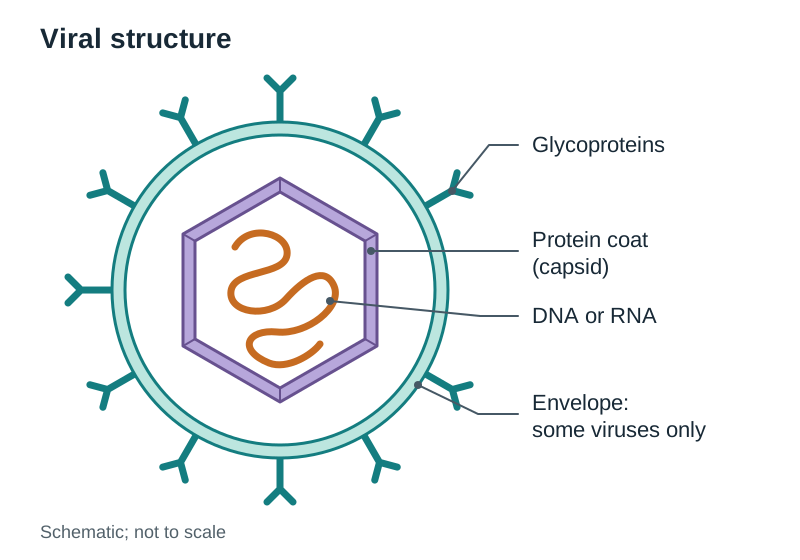
Viruses are minute infectious entities, measuring between 20 and 300 nanometres, visible only under an electron microscope. They possess no cytoplasm of their own, no cell membrane of their own, no ribosomes and no mitochondria, making them entirely acellular (some viruses do carry an envelope, but it is taken from the host's membrane, not made by the virus).
Structure and Function of Viral Constituents
Each viral constituent carries a distinct, examinable function:
- Nucleic acid core (DNA or RNA): Carries the genetic code required to synthesize new viral components. A virus contains either DNA or RNA, never both simultaneously.
- Protein coat (capsid): An outer shell composed of capsomere units. It protects the fragile nucleic acid core from enzymatic digestion and physical damage outside the host, and its surface proteins bind to specific receptor sites on the host cell membrane.
- Envelope (present in some species): An outer lipid bilayer derived from the host cell membrane during viral exit. It contains embedded glycoproteins that assist in recognizing, attaching to, and fusing with subsequent host cells.
Viral Replication
Because viruses lack metabolic enzymes and ribosomes, they cannot generate ATP or synthesize proteins on their own. They replicate solely by invading a compatible host cell, making them obligate intracellular parasites:
- Attachment: Viral surface proteins bind specifically to complementary receptor molecules on the host cell surface.
- Entry: The viral nucleic acid (or the entire virion) enters the host cell.
- Biosynthesis: Viral genes commandeer the host cell's enzymes, ribosomes, transfer RNA, and ATP to synthesize viral nucleic acids and capsid proteins.
- Assembly: Newly formed viral genomes and capsids spontaneously assemble into mature virions.
- Release: New virus particles leave the host cell by budding through the membrane or by lysing (rupturing) the cell, destroying it and releasing particles to infect adjacent cells.
The Living versus Non-Living Debate
When discussing whether viruses are alive, you must present evidence from both sides:
| Evidence That Viruses Are Living | Evidence That Viruses Are Non-Living |
|---|---|
| Contain genetic material (DNA or RNA) and show heredity | Entirely acellular; have no cytoplasm, no cell membrane of its own, no organelles |
| Replicate successfully inside living host cells | Cannot reproduce independently outside a host |
| Mutate and evolve through natural selection | Possess no independent metabolism, cellular respiration, or nutrition |
| Possess a distinct, organised macromolecular structure | Produce no metabolic wastes (no excretion) |
| Direct host cellular machinery to assemble new virions | Can be chemically extracted, purified, and crystallised as inert particles |
Because they reproduce, show heredity, and evolve, yet completely lack independent metabolic machinery and a cellular basis, viruses sit directly on the boundary between living organisms and non-living chemicals.
Why Viruses Fall Outside Domains and Kingdoms
Viruses are not classified into any domain or kingdom. The three-domain and six-kingdom systems classify cellular life, relying on comparative sequencing of ribosomal RNA (rRNA). Because viruses have no ribosomes, carry no rRNA, are acellular, and show no independent metabolism, they cannot be placed in the standard taxonomic tree.
Medical and Economic Importance of Viruses
Viruses exert significant medical and economic impacts across human society, agriculture, and industry.
Medical Importance
- Human Pathogens: Viruses cause severe human infectious diseases, including influenza, measles, mumps, rubella, HIV/AIDS, COVID-19, and chickenpox.
- Antibiotic Ineffectiveness: Antibiotics specifically target bacterial cell walls (peptidoglycan synthesis) or bacterial ribosomes. Because viruses lack cell walls, ribosomes, and their own metabolic pathways, antibiotics have no effect on viral infections. Medical protection relies on vaccines (which stimulate adaptive immunity using attenuated, inactive, or subunit antigens) and specialized antiviral medications that interrupt specific viral replication steps.
- Gene Therapy Vectors: Genetically modified, harmless viral capsids serve as delivery vehicles to transport functional human genes into cells to treat genetic disorders such as severe combined immunodeficiency (SCID) and cystic fibrosis.
- Phage Therapy: Naturally occurring or engineered bacterial viruses (bacteriophages) infect and destroy targeted bacterial pathogens, providing an alternative therapy against antibiotic-resistant bacterial strains.
Economic Importance
- Agricultural Losses: Plant viruses, such as Tobacco Mosaic Virus (TMV) and Potato Virus Y (PVY), stunt crop growth, discolour leaves, and drastically cut crop yields, causing severe financial losses for commercial growers.
- Livestock Epidemics: Viruses such as Foot-and-Mouth Disease, Swine Fever, and Avian Influenza inflict enormous costs on the agri-food sector through mass livestock culling, strict quarantine protocols, and export trade embargoes.
- Biological Control: Specific viruses can control agricultural pest populations without synthetic chemicals. For example, the Myxoma virus was released in Australia to control wild rabbit populations that were destroying crops and pasture. While it initially reduced rabbit numbers sharply, resistant rabbits were selected for and rabbit numbers rebounded, illustrating that viral biological control carries significant ecological, evolutionary, and animal-welfare consequences that must be carefully managed.
- Biotechnology: Viruses are deployed in commercial bioreactors to introduce recombinant genes into cell cultures for large-scale production of vaccines and therapeutic proteins.
The Three Domains of Life
Historically, all living things were divided into kingdoms based on observable physical appearance. In the late 1970s, Carl Woese introduced a revolutionary classification system based on comparative analysis of ribosomal RNA (rRNA) gene sequences.
Because every cellular organism possesses ribosomes to assemble proteins, rRNA sequences provide a universal standard for measuring evolutionary distance. Comparing these sequences proved that single-celled prokaryotes divide into two fundamentally different evolutionary groups that are as distinct from each other as either is from plants or animals. Consequently, Woese introduced the Domain, a taxonomic rank above Kingdom.
| Feature | Domain Archaea | Domain Bacteria | Domain Eukaryota |
|---|---|---|---|
| Cellular Organisation | Prokaryotic (unicellular, no nucleus or membrane-bound organelles) | Prokaryotic (unicellular, no nucleus or membrane-bound organelles) | Eukaryotic (unicellular or multicellular, containing a membrane-bound nucleus and organelles) |
| Cell Wall | Lacks peptidoglycan (composed of protein or pseudomurein) | Contains peptidoglycan | Variable: cellulose in plants, chitin in fungi, absent in animals |
| Membrane Lipids | Unique, chemically different lipids (ether-linked) | Chemically typical lipids (ester-linked) | Chemically typical lipids (ester-linked) |
| Genetic Evidence | Distinct rRNA nucleotide sequence; possesses genetic traits more similar to eukaryotes | Distinct, unique bacterial rRNA nucleotide sequence | Eukaryotic rRNA nucleotide sequence |
| Habitats & Examples | Often found in extreme environments (extremophiles), such as methanogens in bogs and ruminant guts, or halophiles in salt flats | Ubiquitous across soil, freshwater, marine environments, and animal microbiomes (e.g. Escherichia coli, Lactobacillus) | Diverse environments; includes all protists, fungi, plants, and animals |
Prokaryotic and Eukaryotic Cells as a Classification Tool
The single most useful diagnostic question when classifying cellular life is whether the cell's genetic material is enclosed within a true nucleus. This fundamental structural division separates all cellular life into prokaryotes and eukaryotes.
| Feature | Prokaryotic Cell | Eukaryotic Cell |
|---|---|---|
| Nucleus | No membrane-bound nucleus; DNA lies free in the cytoplasm | DNA is enclosed within a membrane-bound nucleus |
| DNA Structure | Single circular chromosome, free of histone proteins; may contain plasmids | Linear chromosomes associated with histone proteins |
| Membrane-Bound Organelles | Absent; lacks mitochondria, chloroplasts, and endoplasmic reticulum | Present; contains mitochondria, and chloroplasts in photosynthetic cells |
| Cell Size | Typically small, approximately 1–10 µm | Typically larger, approximately 10–100 µm |
| Ribosomes | Present, but smaller | Present, larger |
| Examples | Bacteria and Archaea | Protists, fungi, plants, and animals |
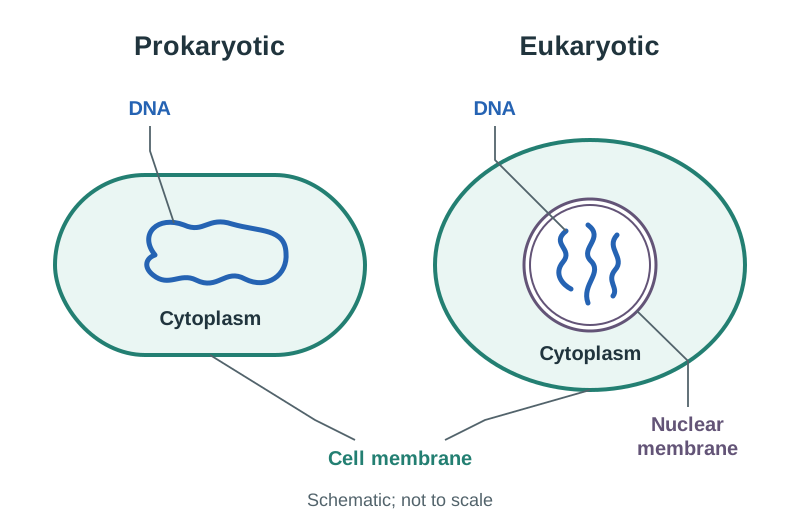
Remember that "prokaryotic" describes a structural cell type rather than a single evolutionary kingdom. Because Archaea and Bacteria share a prokaryotic cellular structure but have completely divergent rRNA sequences, cellular classification serves as the first sorting step, not the final phylogenetic conclusion.
The Six Kingdoms and Diagnostic Keys
Within the three domains, all cellular life is grouped into six kingdoms: Bacteria, Archaea, Protista, Fungi, Plantae, and Animalia.
- Bacteria: Unicellular prokaryotes possessing cell walls containing peptidoglycan. Nutrition is autotrophic (photosynthetic or chemosynthetic) or heterotrophic (saprophytic or parasitic).
- Archaea: Unicellular prokaryotes whose cell walls lack peptidoglycan and possess unique membrane lipids. Many are extremophiles capable of surviving in boiling springs, saturated brines, or anaerobic bogs.
- Protista: Mostly unicellular (or simple multicellular) eukaryotes that do not fit into the plant, animal, or fungus kingdoms. Examples include protozoa (Amoeba) and algae.
- Fungi: Eukaryotic heterotrophs with cell walls composed of chitin. They feed by absorptive heterotrophy, releasing extracellular enzymes to digest organic matter externally before absorbing simple nutrients. Yeasts are unicellular; moulds and mushrooms are multicellular.
- Plantae: Multicellular eukaryotes with cell walls composed of cellulose. They possess chloroplasts containing chlorophyll and manufacture food via autotrophic photosynthesis.
- Animalia: Multicellular eukaryotes that lack cell walls. They exhibit nervous coordination, show active locomotion during their life cycle, and feed by heterotrophic ingestion.
5-Step Diagnostic Guide to Classify Unknown Organisms
When presented with an unfamiliar organism in an exam, determine its kingdom systematically:
- Cellular basis: Is it made of cells? If no, it is acellular (a virus).
- Nuclear structure: Does it have a membrane-bound nucleus? If no, it is a prokaryote (Bacteria or Archaea). If yes, it is a eukaryote.
- Cellularity: Is it unicellular or multicellular? A unicellular eukaryote is placed in Protista (or unicellular yeast in Fungi).
- Cell wall presence and composition:
- Cell wall present and containing peptidoglycan Bacteria.
- Cell wall present but lacking peptidoglycan, often an extremophile Archaea.
- Cell wall composed of chitin Fungi.
- Cell wall composed of cellulose Plantae.
- No cell wall Animalia (multicellular) or Protista (unicellular).
- Mode of nutrition: Autotrophic photosynthesis Plantae; heterotrophic absorption Fungi; heterotrophic ingestion Animalia.
Taxonomy, Phylogeny, and Why Classification Matters
Taxonomy is the science of naming, describing, and classifying organisms. Organisms are classified into hierarchical ranks of increasing specificity:
(Memory aid: Dear King Philip Came Over For Good Soup.)
Species and Binomial Nomenclature
A species is a group of closely related organisms capable of naturally interbreeding in the wild to produce viable, fertile offspring.
A genus is a taxonomic group comprising one or more closely related species that share distinct structural features.
Under Carl Linnaeus's binomial system:
- Every organism receives a universal two-part Latin name.
- The first word is the Genus (always capitalised).
- The second word is the species (always lowercase).
- When printed in text, both words appear in italics (e.g. Homo sapiens). When handwritten in an examination, you must write the words clearly and underline each word separately (e.g. Genus underlined, species underlined).
Why Classification Matters
Classification is an active scientific tool rather than passive cataloguing. Learn four distinct reasons why classification is essential in biology:
- Organisation: It sorts millions of described species into an orderly hierarchy so that biological information can be catalogued, retrieved, and studied.
- Universal communication: Binomial names are identical worldwide, avoiding the confusion caused by local common names (the plant known locally as sea pink in one area and thrift in another is Armeria maritima to every botanist globally).
- Shows evolutionary relationships: Grouping organisms by shared ancestry reveals how closely species are related and which lineages share recent common ancestors.
- Prediction and practical use: Knowing a species' taxonomic position allows scientists to predict its biochemistry and physiology. If an endangered plant yields an anticancer compound, closely related species in the same genus are likely to produce similar biomolecules. Furthermore, species must be formally identified and classified before targeted biodiversity conservation programmes can be designed.
Classification Is an Evolving Model
Scientific models are modified as new data becomes available. Early taxonomists relied solely on anatomy, which frequently misled them due to convergent evolution (unrelated organisms evolving similar body forms under similar selective pressures):
- Fungi were originally placed in the plant kingdom because they are non-motile and have cell walls. Once chemical analysis revealed their cell walls contain chitin rather than cellulose and that they feed by absorption, they were moved to their own kingdom.
- All prokaryotes were once placed in a single kingdom, Monera. Sequencing ribosomal RNA split them into two entirely separate domains: Bacteria and Archaea.
Where anatomical appearance and molecular data disagree, biologists normally give greater weight to molecular evidence (DNA, rRNA, and protein sequences) because similar external body plans can evolve independently in unrelated groups.
Linking Topic 1.1 to the Cross-Cutting Themes
The Leaving Certificate Biology examination assesses your ability to apply core biological principles across three cross-cutting themes: Health, Sustainability, and Technology.
Health
- Vaccine development: Vaccines protect human populations against viral diseases by training the adaptive immune system with attenuated, killed, or subunit antigens, inducing immunological memory without causing full illness.
- Antibiotic stewardship: Antibiotics are ineffective against viral infections because viruses lack bacterial structures like peptidoglycan walls and ribosomes. Taking antibiotics for viral illnesses provides zero therapeutic benefit and accelerates antibiotic resistance among commensal bacteria in the body.
Sustainability
- Conservation and biodiversity: Effective conservation depends entirely on taxonomy. Biologists cannot measure biodiversity decline or enact legal protections for an ecosystem unless they can accurately identify and classify the species living within it.
- Ecological risks of biological control: Introducing viral agents to control invasive agricultural pests reduces chemical pesticide runoff into waterways. However, viruses can mutate, spill over into non-target native species, or select for resistant pests, posing ecological dilemmas that require continuous environmental monitoring.
Technology
- Molecular sequencing: Technological advances in automated DNA and ribosomal RNA sequencing, combined with bioinformatics, allowed Carl Woese to identify the three domains of life, replacing morphological classification with objective molecular phylogenetics.
- Viral vectors in biotechnology: Recombinant DNA technology uses engineered viral capsids as precision tools to deliver therapeutic genes in human gene therapy or to mass-produce vaccines in pharmaceutical bioreactors.
Key terms
- Metabolism
- The sum of all the chemical reactions that take place in an organism.
- Anabolism
- Chemical reactions in which simpler molecules are combined to form larger, more complex molecules using energy.
- Catabolism
- Chemical reactions in which complex molecules are broken down into simpler molecules, releasing energy.
- Homeostasis
- The maintenance of a constant internal environment in an organism.
- Excretion
- The removal of the waste products of metabolism from an organism.
- Respiration
- The controlled release of energy from food in living cells.
- Cellular Basis of Life
- The biological principle that all living things are composed of one or more cells.
- Response
- The ability of an organism to detect and react to a stimulus.
- Growth
- A permanent increase in the size and dry mass of an organism.
- Reproduction
- The production of new individuals of the same species.
- Heredity
- The passing on of characteristics from parents to offspring by means of DNA.
- Obligate Intracellular Parasite
- An entity that is completely dependent on invading a living host cell in order to replicate.
- Capsid
- The outer protective protein coat of a virus that encloses its nucleic acid core.
- Prokaryote
- An organism whose cells lack a membrane-bound nucleus and membrane-bound organelles.
- Eukaryote
- An organism whose cells possess a membrane-bound nucleus and membrane-bound organelles.
- Domain
- The highest taxonomic rank in biological classification, dividing all cellular life into Archaea, Bacteria, and Eukaryota based on genetic characteristics.
- Taxonomy
- The science of naming, describing, and classifying living organisms into structured groups.
- Species
- A group of closely related organisms capable of naturally interbreeding in the wild to produce fertile offspring.
- Genus
- A taxonomic group comprising one or more closely related species, forming the first word of a binomial name.
- Phylogeny
- The classification of organisms based on their evolutionary history, lineages of descent, and relationships through common ancestors.
- Peptidoglycan
- A structural polymer consisting of sugars and amino acids that forms the rigid mesh of bacterial cell walls.
Check yourself
What is the key biochemical difference between anabolism and catabolism?
Anabolism consumes energy to synthesize larger, complex molecules from smaller units (e.g. protein synthesis), whereas catabolism breaks down complex molecules into simpler units, releasing energy (e.g. cellular respiration).
Name the two essential structural constituents found in every virus particle and state the function of the outer coat.
A nucleic acid core (DNA or RNA) and an outer protein coat (capsid). The capsid protects the genetic material from damage outside the cell and attaches to specific receptor sites on the host cell membrane.
Why is egestion not considered an excretory process?
Egestion is the elimination of undigested, unabsorbed dietary food matter that passed through the gut without ever entering cells or participating in metabolic chemical reactions.
Give two pieces of evidence that viruses are living and two pieces of evidence that they are non-living.
Living: they possess genetic material (DNA or RNA) showing heredity, and they replicate and evolve inside host cells. Non-living: they are acellular (lacking cytoplasm and organelles), have no independent metabolism or respiration, and can be crystallised.
An organism isolated from a boiling acidic hot spring is unicellular, has no nucleus, and its cell wall lacks peptidoglycan. Name its domain and give the primary evidence used to define this domain.
Domain Archaea. It is a prokaryote lacking peptidoglycan, and the domain is primarily defined by unique ribosomal RNA (rRNA) nucleotide sequences.
State the difference between the cell walls of Kingdom Bacteria, Kingdom Fungi, and Kingdom Plantae.
Bacterial cell walls contain peptidoglycan, fungal cell walls contain chitin, and plant cell walls contain cellulose.
Why are viruses not placed into any domain or kingdom in biological classification?
The three-domain and six-kingdom systems classify cellular life and rely on ribosomal RNA sequencing. Viruses are acellular, lack ribosomes and rRNA, and possess no independent metabolism, placing them outside the cellular classification system entirely.