

Living organisms share eleven fundamental characteristics, yet viruses sit directly on the boundary between cellular life and inert chemistry. This revision note covers the eleven characteristics of life, the debate over whether viruses are alive, viral structures and societal impacts, and how modern classification groups Earth's biodiversity into three genetic domains and six kingdoms through evolutionary relationships.
The Eleven Characteristics of Living Things
Biology explores the living world, but defining what counts as alive takes more than a simple sentence. The Leaving Certificate specification sets out eleven distinct characteristics shared by living things. An individual organism might not display every single one at every moment. A dormant seed or a sterile worker bee is still alive, but together these eleven features mark living systems out from non-living matter.
First, living things have a cellular basis. Every organism consists of one or more cells. An amoeba is a single cell that carries out every life process on its own, whereas a human body contains trillions of specialised cells working together.
Second, living things show distinct organisation. Biological systems build upward in order: biomolecules assemble into organelles, organelles into cells, cells into tissues, tissues into organs, and organs into organ systems.
Third, all living things carry out metabolism. This is the sum of all chemical reactions inside the body. It includes anabolic reactions that build large molecules from smaller ones and catabolic reactions that break complex compounds down.
Fourth, cells rely on respiration. This is the biochemical process that releases energy from food, usually storing it as ATP. Students often confuse respiration with breathing or ventilation. Breathing is simply the physical movement of gases into and out of the body, while respiration is the chemical breakdown of nutrients inside cells.
Fifth, organisms depend on nutrition. They make or obtain food to supply energy and raw materials for growth and repair. Green plants make food through autotrophic photosynthesis, while animals feed heterotrophically by eating other organisms.
Sixth, cells must perform excretion. This is the removal of metabolic waste products created by chemical reactions inside cells, including urea and carbon dioxide. Be careful to separate excretion from egestion. Egestion is the discharge of undigested dietary food residue out of the gut through the anus.
Seventh, living things show response. They detect changes in their internal or external surroundings and react to them. For example, a young seedling bends its shoot toward a light source, helping it capture light for photosynthesis.
Eighth, organisms undergo growth. This is a permanent, irreversible increase in size or dry mass driven by cell division and the production of new cellular materials.
Ninth, species carry out reproduction. They produce new individuals of the same species. Bacteria reproduce asexually by binary fission, while animals and flowering plants rely on sexual reproduction with gametes.
Tenth, living organisms maintain homeostasis. They keep their internal conditions relatively steady even when external environments swing wildly. In humans, sweating and shivering help maintain body temperature near 37 °C.
Eleventh, living things display heredity. Parents pass genetic traits down to their offspring through genetic material like DNA, giving life continuity over generations.
Viral Structure and Host Dependency
Viruses are microscopic, non-cellular infectious agents. They are tiny, measuring between 20 and 300 nanometres wide. That is far smaller than a bacterial cell, which is usually about 1000–2000 nanometres across, so viruses are roughly ten to a hundred times smaller than bacteria. You cannot view them with an ordinary school light microscope. Biologists had to wait for the development of the electron microscope in the 1930s before they could see viral structures directly.
Every virus particle has two essential parts. The outside is a protein coat, known as a capsid. This shell protects the fragile inner core from hostile enzymes, and its surface proteins recognise and bind to matching receptor molecules on a target host cell. The inside is a nucleic acid core. This genetic material carries all the instructions for making new viral components. A virus contains either DNA or RNA, but never both in the same particle.
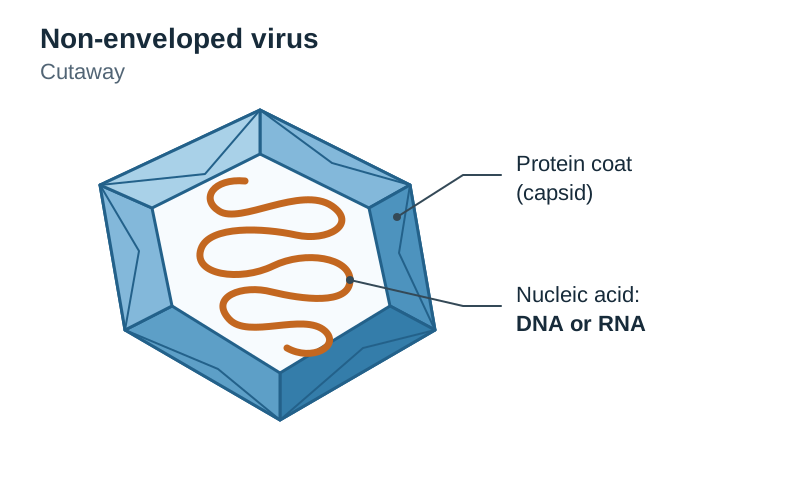
Some viruses, like influenza and coronaviruses, pick up an outer lipid envelope taken from the host cell membrane as they bud off. Yet no virus has cytoplasm, ribosomes, mitochondria, or internal enzymes to generate energy. Viruses that infect bacteria are known as bacteriophages.
Because a virus lacks cellular machinery, it cannot make ATP or assemble proteins by itself. It must act as an obligate intracellular parasite, replicating only after hijacking a living cell. The replication cycle follows five stages:
- Attachment: The virus collides with and binds to specific receptor molecules on the surface of a matching host cell.
- Entry: The virus pushes its nucleic acid across the cell membrane, or the entire virus enters and loses its capsid.
- Synthesis: The viral genome takes command of the host cell's ribosomes, enzymes, and ATP pool, ordering the cell to manufacture copies of viral nucleic acids and coat proteins.
- Assembly: Newly made capsids and viral genomes snap together into complete viral particles.
- Release: The fresh viruses break out of the host cell, often bursting and killing it, and move on to infect neighbouring cells.
The Living-versus-Non-Living Debate
Viruses sit right on the border between living biology and lifeless chemistry. In an exam question asking you to discuss their status, you must present arguments on both sides before reaching a supported scientific conclusion.
When we compare viruses to the eleven characteristics of life, the contradictions stand out:
Arguments for considering viruses living:
- They contain genetic material (either DNA or RNA) that directs their replication.
- They display heredity by passing these genetic blueprints to daughter particles.
- Their genomes mutate, meaning viral strains evolve over time under selective pressures from vaccines or host immune systems.
Arguments for considering viruses non-living:
- They are completely non-cellular, lacking cytoplasm, cell membranes, and organelles.
- Outside a living host, they carry out no independent metabolism. They cannot respire, generate ATP, or digest nutrients.
- They do not grow, divide, or reproduce on their own.
Your final judgment should state that because viruses possess genetic heredity and the ability to evolve, but lack cellular structure and independent metabolism, biologists describe them as non-cellular obligate intracellular parasites rather than true living organisms. For this reason, they do not belong to any of the three cellular domains of life.
Medical, Economic, and Technological Importance of Viruses
Viruses carry major consequences for human health, agriculture, and biotechnology. In exam questions, make sure you can give named examples of both harmful effects and beneficial uses.
Harmful Effects
- Human illness: Viruses cause widespread conditions such as influenza, measles, mumps, rubella, chickenpox, viral hepatitis, and COVID-19. Beyond personal sickness, these infections strain healthcare systems and cause substantial economic losses in working hours.
- Biological cause of mutation: Some viruses insert their genetic code directly into host chromosomes, disrupting normal gene control. A mutation is any change in the structure or amount of DNA or a chromosome, making viruses recognised biological mutagens alongside radiation and chemicals. For example, human papillomavirus (HPV) can trigger mutations in cervical epithelial cells that lead to cervical cancer, which is why HPV vaccination is offered in Irish schools.
- Crop damage: Plant viruses cut crop yields and stunt growth. Tobacco mosaic virus (TMV) causes a mottled yellow pattern on leaves called chlorosis. The loss of green chlorophyll drops the rate of photosynthesis, damaging harvest quality and farmer incomes.
- Livestock diseases: Animal viruses cause devastating agricultural crises. Foot-and-mouth disease virus causes painful blisters on the hooves and mouths of cattle, sheep, and pigs. An outbreak leads to strict animal movement bans, export restrictions, and compulsory culling.
Beneficial and Technological Applications
- Vaccine production: Harmless, killed, or weakened (attenuated) viruses are used to manufacture vaccines, such as the MMR shot. They train the immune system to produce antibodies and memory cells without triggering the actual disease.
- Gene therapy vectors: Genetic engineers take advantage of the viral entry mechanism. They remove the disease-causing genes from a virus and replace them with a working human gene. The virus then ferries the healthy gene into patient cells to treat genetic conditions like cystic fibrosis.
- Phage therapy: Bacteriophages destroy specific bacterial cells without harming human tissue or friendly gut bacteria, making them a promising weapon against antibiotic-resistant superbugs.
- Biological pest control: Viruses can manage invasive pest numbers without toxic chemicals. In the 1950s, Australia released the myxoma virus to slash an overgrown European rabbit population that was stripping grasslands.
Principles of Classification and Taxonomy
Classification is the grouping of organisms based on shared physical features, genetic traits, and evolutionary history. Taxonomy is the branch of biology dedicated to naming, identifying, and sorting these organisms into groups.
Classification matters for several reasons. It brings order to millions of living and fossil species. It gives scientists an agreed universal naming system that avoids confusion across languages. It maps evolutionary lines of descent, showing how modern species relate to extinct ancestors. It also supports conservation work by helping ecologists track biodiversity losses.
The Taxonomic Hierarchy
In the eighteenth century, Swedish botanist Carl Linnaeus built a nested system of categories called taxa. Modern taxonomy places the Domain rank above the traditional levels:
A handy way to remember the sequence is the phrase: "Kids Prefer Candy Over Fresh Green Salad" (Kingdom, Phylum, Class, Order, Family, Genus, Species).
As you move down from domain to species, the number of organisms in each group shrinks, but the individuals inside that group share far more characteristics with one another.
Genus, Species, and Binomial Nomenclature
A genus is a taxonomic group of closely related species that share common structural and genetic traits inherited from a recent common ancestor.
A species is a group of closely related organisms capable of naturally interbreeding in the wild to produce fertile offspring. For example, a male donkey and a female horse can mate to produce a mule, but mules are sterile. Because the mule cannot produce offspring, horses and donkeys remain separate species.
Linnaeus also introduced binomial nomenclature, assigning every species a formal two-part Latin name:
- The first word is the genus, written with an initial capital letter (such as Panthera).
- The second word is the species name, written entirely in lowercase (such as leo for the lion, or tigris for the tiger).
- In typed text, write binomial names in italics (Panthera leo). When writing by hand on your exam paper, underline each word separately (<u>Panthera</u> <u>leo</u>).
The Three Domains and Six Kingdoms of Life
At the cellular level, life divides into two basic body plans:
- Prokaryotes: Single-celled organisms that lack a membrane-bound nucleus and membrane-bound organelles. Their genetic material lies loose as a single circular loop of DNA.
- Eukaryotes: Organisms whose cells contain a true membrane-bound nucleus surrounding linear chromosomes, along with internal membrane-bound organelles like mitochondria and chloroplasts.
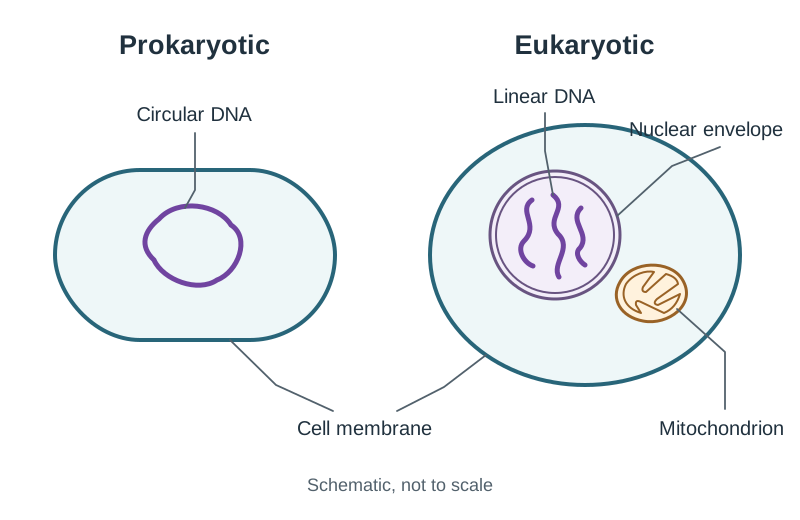
In 1990, Carl Woese reshuffled biological classification by introducing the three-domain system: Bacteria, Archaea, and Eukaryota. Rather than sorting cells by what they looked like under a microscope, Woese compared the base sequences of ribosomal RNA (rRNA) genes.
| Feature | Domain Bacteria | Domain Archaea | Domain Eukaryota |
|---|---|---|---|
| Cell plan | Prokaryotic | Prokaryotic | Eukaryotic |
| Membrane-bound nucleus | Absent | Absent | Present |
| Internal organelles | Absent | Absent | Present |
| Cell wall chemistry | Contains peptidoglycan | Lacks peptidoglycan | Cellulose in plants, chitin in fungi, none in animals |
| Body structure | Unicellular | Unicellular | Unicellular or multicellular |
| Examples | E. coli, cyanobacteria | Methanogens, thermophiles | Amoeba, mushrooms, trees, humans |
These three domains house the six kingdoms of life:
- Kingdom Bacteria: Unicellular prokaryotes with peptidoglycan in their cell walls; they may be autotrophic or heterotrophic.
- Kingdom Archaea: Unicellular prokaryotes with unique wall chemistry lacking peptidoglycan. Many live in harsh environments, such as boiling hot springs (thermophiles) or salty lagoons (halophiles).
- Kingdom Protista: Unicellular or simple multicellular eukaryotes that do not fit the plant, animal, or fungal patterns, such as Amoeba and unicellular algae.
- Kingdom Fungi: Eukaryotes with cell walls made of chitin. They feed heterotrophically by absorbing nutrients after external digestion, such as yeasts and mushrooms.
- Kingdom Plantae: Multicellular eukaryotes with cellulose cell walls and chloroplasts, producing their own food through photosynthesis.
- Kingdom Animalia: Multicellular eukaryotes without cell walls. They take in food heterotrophically and generally possess nervous coordination and active movement.
Phylogeny and Classification as an Evolving Scientific Model
Early classification relied on morphology, meaning physical appearance and body form. But appearances can deceive. Sharks and dolphins share streamlined bodies, grey skin, and dorsal fins because both adapted to swimming after prey in open water, not because they are closely related. Relying on appearance hides their true evolutionary ancestry.
Modern biological classification relies on phylogeny, the study of evolutionary relationships and lines of descent between organisms. A phylogenetic tree diagrams these connections as branching limbs. Each fork in a branch, called a node, marks the most recent common ancestor shared by the diverging groups.
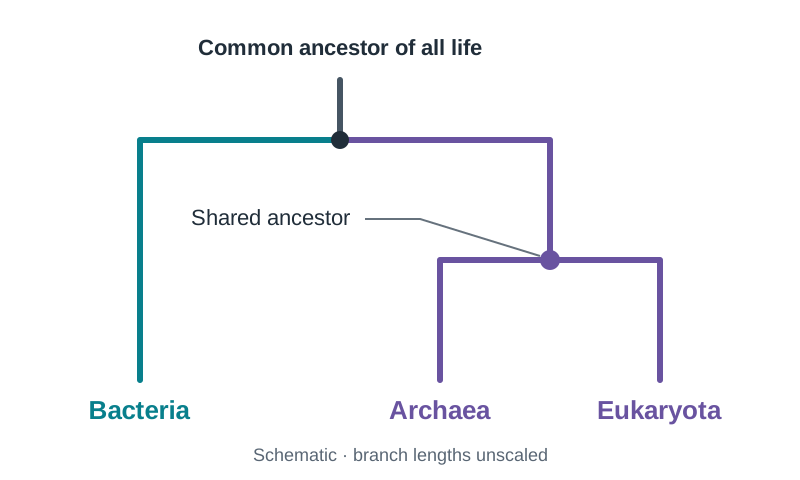
Notice that Archaea and Eukaryota branch from a common junction after splitting away from Bacteria. Even though an archaeon looks like a standard bacterium under a microscope, genetic sequencing reveals that its ribosomal RNA, RNA polymerases, and protein-assembly processes are far closer to eukaryotic cells than to bacteria.
Classification systems are not fixed rules. They are scientific models built to explain real observations using the best evidence available. As laboratory methods develop, scientists collect fresh genetic data that tests existing groupings:
- DNA and RNA sequencing: Comparing base sequences reveals how closely related two species are. Fewer sequence differences point to a more recent common ancestor.
- Whole-genome sequencing: Reading every gene across an organism gives an unbiased map of evolutionary divergence.
- Amino acid sequencing: Comparing mutations in shared proteins, like cytochrome c in respiration, tracks evolutionary time across millions of years.
- Bioinformatics: Specialised computer programs analyse vast genetic databases to construct reliable family trees.
- Environmental DNA (eDNA): Biologists extract and sequence stray DNA from water or soil samples, identifying wild organisms without having to capture or culture them.
Aristotle worked with two groups: plants and animals. Later biologists used light microscopes to build five kingdoms. Then Woese used rRNA sequencing to uncover three domains. This shift shows how science works: when new technology delivers stronger evidence, scientists update their models to reflect the natural world more accurately.
Key terms
- Metabolism
- The sum of all the chemical reactions that take place inside an organism.
- Homeostasis
- The maintenance of a relatively constant internal environment inside an organism.
- Excretion
- The removal of metabolic waste products created by chemical reactions inside cells.
- Heredity
- The transmission of genetic traits from parents to offspring across generations.
- Virus
- A microscopic, non-cellular infectious agent consisting of a nucleic acid core (DNA or RNA) enclosed by a protein coat (capsid).
- Capsid
- The outer protein shell of a virus particle that shields its genetic material and binds to matching host cell receptors.
- Obligate intracellular parasite
- An infectious agent that can only replicate by entering a living host cell and using that host cell's internal machinery.
- Bacteriophage
- A virus that infects and replicates specifically inside bacterial cells.
- Prokaryote
- A single-celled organism that lacks a membrane-bound nucleus and membrane-bound organelles.
- Eukaryote
- An organism whose cells possess a membrane-bound nucleus and membrane-bound organelles.
- Domain
- The highest taxonomic rank in modern biological classification, dividing cellular life into Bacteria, Archaea, and Eukaryota based on genetic traits.
- Peptidoglycan
- A structural polymer of sugars and amino acids that forms the rigid cell walls of organisms in Domain Bacteria.
- Genus
- A taxonomic group of closely related species that share common structural and genetic traits derived from a recent common ancestor.
- Species
- A group of closely related organisms capable of naturally interbreeding in the wild to produce fertile offspring.
- Binomial nomenclature
- The formal two-part Latin naming system for species, combining the genus name with the specific species epithet.
- Phylogeny
- The evolutionary history and genealogical lines of descent of an organism or group of organisms.
Check yourself
What two essential biochemical components make up every virus particle?
A protein coat (capsid) and a nucleic acid core containing either DNA or RNA.
Define excretion and explain how it differs biologically from egestion.
Excretion is the removal of metabolic waste products formed by chemical reactions inside cells, like urea and carbon dioxide. Egestion is the expulsion of undigested, unabsorbed food residue from the digestive tract through the anus.
Name the three domains of life and state the main type of evidence Carl Woese used to establish them.
Bacteria, Archaea, and Eukaryota. Woese established them using molecular genetic evidence, specifically the comparative sequencing of ribosomal RNA (rRNA) genes.
How does the cell wall of an organism in Domain Bacteria differ from that of an organism in Domain Archaea?
Bacterial cell walls contain peptidoglycan, whereas archaeal cell walls lack peptidoglycan.
Distinguish clearly between a genus and a species.
A genus is a group of closely related species that share common structural and genetic traits. A species is a group of closely related organisms capable of naturally interbreeding in the wild to produce fertile offspring.
An unfamiliar organism is single-celled, has a membrane-bound nucleus, swims using cilia, and feeds by ingesting bacteria. Which kingdom does it belong to, and why?
Kingdom Protista. The presence of a nucleus makes it eukaryotic, but being single-celled and lacking plant, animal, or fungal tissue organisation places it in Protista.
On a phylogenetic tree of life, which two domains share the more recent common ancestor, and what evidence supports this?
Domain Archaea and Domain Eukaryota. Their branches meet at a common node after splitting from Bacteria, supported by ribosomal RNA base sequence comparisons and similarities in protein synthesis.