
Post-1960s Art in Ireland marks a decisive break from the romantic, pastoral landscapes that dominated the early twentieth century. Studied under Content Area 2 ('Ireland and its place in the wider world') of the Leaving Certificate Art specification, this section of focus examines how Irish visual artists, sculptors, and architects responded to three decades of the Troubles, secularisation, feminist critique, and international modernism. The syllabus investigates the field through the Visual Studies Framework, questioning what was created, how it was created, and why it was created across fine art, public sculpture, lens-based media, installation, architecture, and design.
The Visual Studies Framework, Examination Skills, and the Revision Matrix
In the written examination (30% of the total marks, 2.5 hours), you answer on one section of focus from 'Europe and the wider world' and one from 'Ireland and its place in the wider world', and you study all four sections of 'Today's world'. Questions on Post-1960 Irish art are typically worth 50 marks. Marking schemes assess four core criteria: Coherence and Focus (10 marks), Subject Knowledge (20 marks), Relevant Examples (10 marks), and Visual Language (10 marks).
The Visual Studies Framework
To secure high marks, you must interrogate every artwork through six elements:
- Context: The historical, political, religious, economic, and social background, including the role of patrons and cultural agencies.
- Artists and Artworks: The intentions and specific recognised works that define the period. A recognised artist meets at least three professional criteria: presence in the art historical canon, solo or group exhibitions, representation in public collections, receipt of public commissions, recognition by peers, or membership of accredited bodies.
- Analysis: Breaking the artwork down by asking What is going on in this artwork? and What do I see that supports what I have just said?
- Art Elements and Design Principles: The building blocks and how they are organised.
- Media and Areas of Practice: The physical properties, technical handling, and limitations of chosen materials across painting, sculpture, architecture, design, and lens-based media.
- Innovation and Invention: The discovery of new materials, tools, technologies, and radical concepts.
Art Elements versus Design Principles
Never combine these into a vague list. Art elements are the visual ingredients: line, shape, form, colour, tone, texture, pattern, and space. Design principles are how the artist organises those ingredients: balance, contrast, rhythm, dominance/emphasis, proportion and scale, unity/harmony, and movement.
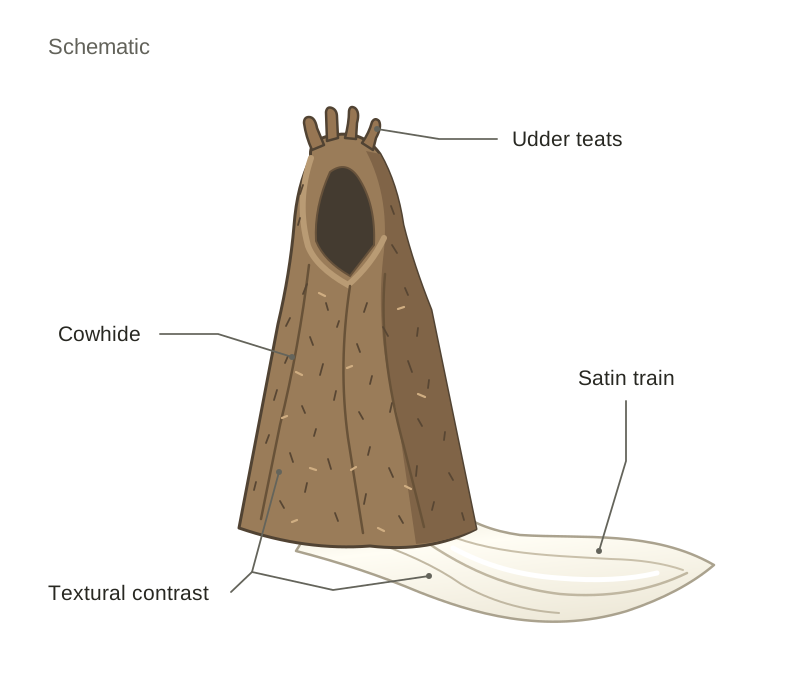
Use this three-part sentence structure in every answer: (1) identify the element or principle, (2) cite the visual evidence from the artwork, and (3) explain its effect or meaning. For example: Cross uses extreme textural contrast—coarse, bristled cowhide set against fluid white satin—so that the animal body and the bridal ideal collide in the same object, making the viewer physically experience the conflict.
Command Verbs and Answer Shapes
- Compare: Give similarities between two works or artists, referring to both throughout the essay.
- Contrast: Set out differences between works, alternating between them within each paragraph.
- Discuss: Offer a considered, balanced review supported by visual evidence, ending with a clear conclusion.
- Analyse: Break down the artwork into parts and relationships to interpret its meaning.
When a question asks you to discuss an illustrated work, name a second work by the same artist, and 'illustrate your answer', provide quick, 90-second labelled sketches. Draw a composition diagram with directional arrows for movement, or sketch a structural detail, adding a written label and title. Sketches carry separate marks and require no artistic polish.
Core Revision Matrix
| Artist | Dates / Base | Two Named Artworks | Core Media | Best Exam Themes |
|---|---|---|---|---|
| Louis le Brocquy | 1916–2012, Dublin / France | Cúchulainn in Warp-Spasm (1969); Study towards an Image of James Joyce (1977) | Brush and black ink; oil on primed canvas | Myth, the body, literary heritage, abstraction |
| Gerard Dillon | 1916–1971, Belfast | The Yellow Bungalow (c. 1954); Pierrot and the Birds (c. 1968) | Oil on board; mixed media, tapestry | Folk style, mortality, transition to post-1960 |
| Rita Duffy | b. 1959, Belfast | Mother Ireland (1989); The Souvenir Shop (2016) | Oil on gessoed wood; mixed-media installation | The Troubles, gender, satire, political kitsch |
| Willie Doherty | b. 1959, Derry | Blue Bank (1991); The Only Good One is a Dead One (1993) | Colour Cibachrome print; two-screen video | Surveillance, contested borders, paranoia |
| Dorothy Cross | b. 1956, Cork / Connemara | Virgin Shroud (1993); Ghost Ship (1999) | Cowhide and satin assemblage; painted lightship | Gender, church authority, memory, public space |
| Alice Maher | b. 1956, Tipperary | The Berry Dress (1994); Bee Dress (1994) | Rosehips, cotton, pins; honeybees | Organic media, folklore, female childhood |
| Public Sculpture | Kelly (1915–1981); Delaney (1930–2009) | Kelly: Children of Lir (1971); Delaney: Wolfe Tone & Famine (1967) | Cast bronze (lost-wax casting) | Commemoration, state patronage, public space |
Context Post-1960: Conflict, Secularisation, and Cultural Agencies
Before 1960, Irish art was largely dominated by a conservative, pastoral vision of national identity. While the Irish Exhibition of Living Art (IELA), founded in 1943, introduced modernism, mainstream institutions remained conservative. From 1960 onward, Ireland opened to international trade, joined the European Economic Community (1973), and saw deep social changes alongside thirty years of sectarian conflict in Northern Ireland.
Socio-Political Drivers
- The Troubles (1968–1998): Civil rights marches, internment, British Army checkpoints, and paramilitary bombings made territorial division part of daily life. Northern artists responded to surveillance, fear, and sectarian narratives.
- Secularisation and Feminist Critique: Scandals and investigations regarding Magdalene laundries and mother-and-baby homes challenged the authority of the Catholic Church. Irish feminist artists began interrogating the legal and religious control of women's bodies, motherhood, and reproductive rights.
Patrons, Agencies, and Institutions
The specification requires students to examine how patrons and agencies shape artistic visibility:
- ROSC Exhibitions (inaugurated 1967): ROSC brought international avant-garde art to Dublin, displaying contemporary painting and sculpture alongside ancient Irish and Celtic artefacts. The early exhibitions faced public protest for excluding living Irish artists, but later editions admitted them. ROSC demonstrated that exposure to global modernism was contested and institutional.
- The Arts Council of Ireland: Expanded bursaries, travel awards, and capital grants, supporting artists working outside traditional commercial sales.
- Aosdána (established 1981): Created by the Arts Council to honour artists who have produced work of cultural merit, providing eligible members with an annual stipend (the Cnuas) that supports full-time practice.
- Irish Museum of Modern Art (IMMA, opened 1991): Housed in the seventeenth-century Royal Hospital Kilmainham, IMMA provided Ireland's first state museum dedicated to modern and contemporary art, supporting large-scale sculpture, installation, and lens-based media.
- Hugh Lane Gallery and the Francis Bacon Studio: In 1998, Bacon's studio at 7 Reece Mews was donated to Dublin City Gallery The Hugh Lane by his heir, John Edwards. Conservators forensically catalogued over 7,000 items before reconstructing the entire studio in Dublin, opening it to the public in 2001.
- Kilkenny Design Workshops (established 1963): A state-funded initiative that employed international and Irish designers to modernise ceramics, glass, woven textiles, and metal tableware, demonstrating how design could support export manufacturing.
Figuration, Myth, and the Human Head: Louis le Brocquy and Francis Bacon
Louis le Brocquy (1916–2012)
Le Brocquy never painted pure abstraction. He stripped the figure down to essential gestures, but always retained the human body. That balance between recognition and dissolution lies at the heart of his practice.
- The Táin Illustrations (1969): Commissioned by Liam Miller of Dolmen Press for Thomas Kinsella's translation of the eighth-century epic Táin Bó Cúailnge, le Brocquy produced a series of brush-and-ink drawings on handmade paper. Moving away from Victorian romanticism, he drew on Japanese calligraphy, Palaeolithic cave painting, and Rorschach inkblots. In Cúchulainn in Warp-Spasm, he depicted the warrior's battle fury (warp-spasm) using dense pools of black ink and spattered marks. The blank white paper is not just background: untouched white cuts into the torso and limbs, leaving the transformation to the viewer's imagination.
- The Portrait Heads (mid-1960s to 1990s): Influenced by the Celtic cult of the severed head, which viewed the skull as a vessel of the soul, le Brocquy painted literary figures including W.B. Yeats, James Joyce, and Samuel Beckett. In Study towards an Image of James Joyce (1977, oil on canvas), delicate flecks of white, grey, ochre, and carmine emerge from a blank white ground. He rejected photographic likeness to capture consciousness as an unstable, evolving presence.
Francis Bacon (1909–1992)
Bacon was born in Dublin but spent his working life in London. Use Bacon as an international comparison or through the Hugh Lane studio reconstruction, rather than as a primary Irish artist, unless the examination question explicitly welcomes Irish-born artists working abroad.
- Working Methods: Bacon worked on the unprimed, matte reverse of raw linen canvas, letting oil washes sink into the fabric while layering heavy, scraped impasto on top.
- Space Frame: He placed figures inside thin, linear geometric cages known as a space frame, isolating the subject in shallow space to build psychological claustrophobia.
- Triptych Format: In Three Studies of Lucian Freud (1969), Bacon arranged three panels against flat, unmodulated orange-ochre grounds. The ground advances toward the viewer, trapping the figure on a bentwood chair inside a linear frame. In the post-1971 'Black Triptychs', painted after the death of George Dyer, black voids and silhouetted figures express grief and mortality.
Satire, Sectarianism, and Gender: Rita Duffy and Women Artists in Non-Traditional Media
Rita Duffy (born 1959, Belfast)
Growing up as a Catholic in the Protestant neighbourhood of Stranmillis during the Troubles, Duffy developed an eye for ideological division. She has described her personal position as republican, pacifist, and feminist, using satire to question tribal loyalties on both sides of the border.
- Mother Ireland (1989, oil on gessoed panel): Duffy reworks the traditional nationalist personification of Ireland as a noble matriarch. Instead, she paints a weary, strained mother holding a wriggling infant while surrounded by domestic and religious icons. Duffy applies oil paint in controlled, enamel-like layers over gesso, combining smooth surfaces with distorted anatomy. Cold greys and muted pinks dominate the palette, presenting motherhood as exhausting physical labour rather than patriotic myth.
- Belfast Cauterized (1993, oil on canvas): Duffy critiques the sectarian divide by painting the city through Magic Realism. Figures with grotesque, caricatured features appear in dark civic streets, with medical and ecclesiastical symbols representing societal wounds. The heavy brushwork and harsh tonal contrasts echo the political satire of Francisco Goya and Otto Dix.
- The Souvenir Shop (2016): Marking the centenary of the 1916 Easter Rising, Duffy transformed a Georgian room on North Great George's Street, Dublin, into a functioning corner shop. She filled retail shelves with mock commodities, including tins of 'Tears of the Motherland' and embroidered linen bandages. The installation showed how political violence and republican sacrifice are packaged as commercial tourist souvenirs.
Women Artists and Alternative Materials
- Alice Maher (born 1956): Maher works with domestic, fairy-tale, and agricultural materials. In The Berry Dress (1994, rosehips, cotton, and sewing pins), she built a small child's dress covered in dried red rosehips held by pins. The garment is small and delicate, yet the hidden pins make it unwearable. The physical material carries the concept: childhood innocence intertwined with physical pain.
- Kathy Prendergast (born 1958): In her Body Map series (1983, pen, ink, and watercolour), Prendergast used the precise visual language of Ordnance Survey maps and contour sections to depict female anatomy. By mapping hills, valleys, and roads onto the female torso, she connected the colonisation of land with the control of the female body.
Lens-Based Media, Sculpture, and Installation: Willie Doherty and Dorothy Cross
Willie Doherty (born 1959): Lens-Based Media and Contested Landscape
Doherty interrogates surveillance, political language, and the Northern Irish border through lens-based media.
- Photo-Text Works (1980s): Doherty paired black-and-white photographs of the Derry landscape with stark words overlaid across the print (such as Undercover / Unseen). By setting image against text, he showed that the same stretch of ground carries opposite meanings depending on who names it—one person's homeland is another's security zone.
- Large-Scale Colour Works (1990s): Around 1990 he moved to large colour Cibachrome prints, such as Blue Bank (1991). The saturated colour and large scale place the viewer directly into wet roads, ditches, and riverbanks laden with military tension.
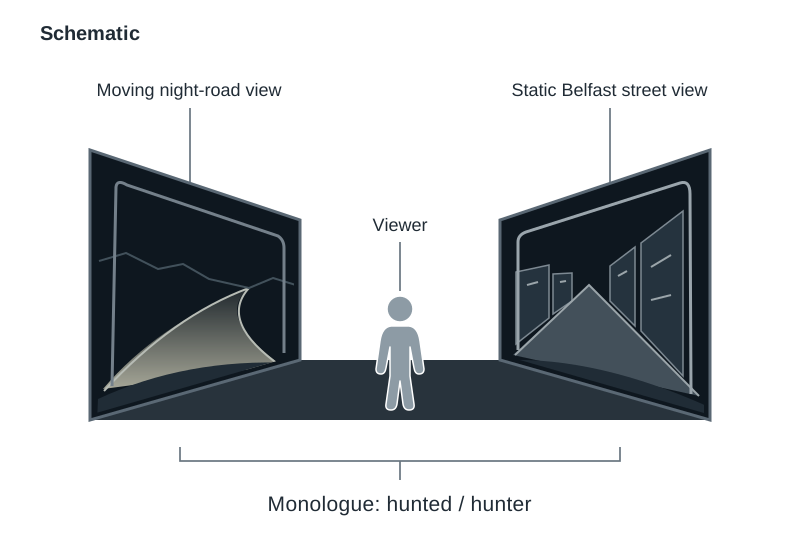
- The Only Good One is a Dead One (1993): A two-screen video installation shown in a dark room. One screen shows footage from a car driving along unlit country roads at night, lit only by headlights. The other screen shows a static view through the windscreen of a car parked on an ordinary Belfast street. An interior monologue plays continuously, shifting between a driver terrified of assassination and a gunman stalking a target. Standing in the dark between the screens, the viewer is placed in the position of both the hunted and the hunter, capturing the paranoia of the Troubles.
Dorothy Cross (born 1956): Gender, Memory, and Assemblage
Cross explores the human body, gender roles, religious authority, and nature through assemblage and site-specific installations.
- Virgin Shroud (1993, cowhide, udder teats, satin, and metal armature): Cross tailored a cured cowhide into a hooded, standing figure reminiscent of a bridal gown or statue of the Virgin Mary. The dried teats of the udder form a crown on the head, while an ivory satin train spills across the floor. Cross juxtaposes rough animal skin with smooth bridal fabric, confronting Catholic ideals of virgin purity with animal reproduction.
- Ghost Ship (1999): Cross painted a decommissioned lightship in coats of luminous phosphorescent paint and moored it in Dublin Bay off Dún Laoghaire as a temporary, sponsored public installation. Charged by sunlight during the day, the ship emitted a spectral green glow at dusk before fading. Light, sea tides, and time served as the sculptural media, commemorating maritime labour and lost coastal traditions.
Public Sculpture, Architecture, Abstraction, and Design
Content Area 2 encompasses public monuments, architecture, abstract painting, and industrial design.
Public Sculpture and Commemoration
- Oisín Kelly (1915–1981): Created Children of Lir (cast bronze, Garden of Remembrance, Dublin, unveiled 1971). The swans break upward from human forms, their long wings providing vertical movement that symbolises national rebirth. His Jim Larkin (bronze, O'Connell Street, 1979) shows the labour leader with arms flung wide, derived from a 1913 Lockout photograph.
- Edward Delaney (1930–2009): For the Wolfe Tone Memorial and adjacent Famine group (bronze, St Stephen's Green, 1967), Delaney used lost-wax casting (cire perdue). He retained the rough, scored, and pitted marks of the original wax model in the bronze, giving the famine figures emaciated, expressive surfaces rather than a smooth academic finish.
- John Behan (born 1938): Cast the National Famine Memorial (bronze, Murrisk, Co. Mayo, 1997), a 'coffin ship' whose rigging is woven from bronze skeletons.
Modern Architecture
- Berkeley Library, Trinity College Dublin (Ahrends, Burton and Koralek, completed 1967): Built in the Brutalist style using board-marked in-situ concrete, where the rough grain of timber shuttering remains visible on the exterior walls. Its heavy, sculptural volumes, elevated plinth, and deep window reveals create strong contrasts of light and shadow, sitting alongside classical Georgian and Victorian stone buildings.
- Carroll's Factory, Dundalk (Ronald Tallon, Scott Tallon Walker, 1970): A pavilion of steel and glass set in parkland, influenced by Mies van der Rohe. The exposed black steel frame, transparent glass bays, and horizontal lines introduced international modernism to Irish industrial building.
Abstraction and Pop Painting
- Patrick Scott (1921–2014): In his Gold Paintings, Scott applied tempera and squares of gold leaf directly to raw, unprimed canvas or jute. The unsealed canvas absorbs thin paint washes, while the burnished gold disc catches light, creating calm, symmetrical compositions that connect twentieth-century minimalism to ancient Irish goldwork and Asian meditative art.
- Robert Ballagh (born 1943): Drew on Pop Art, using flat acrylic paint, unmodulated primary colours, and sharp black outlines. In Liberty Leading the People (1970, after Delacroix), he re-read historical revolutions through contemporary Irish political unrest, using commercial graphic finishes.
- Seán Scully (born 1945): In his Wall of Light series, Scully layers thick oil paint into heavy, interlocking bands and rectangles, scraping back pigment to reveal underlying colours. His work draws structure from stone walls, light, and architectural boundaries.
Content Area 3 Crossover and Long-Term Legacy
Revising Post-1960 Irish art equips you for Content Area 3 ('Today's world'), as the artists and concepts cross over directly:
- Art as Social Commentary or Commentator: Willie Doherty's surveillance landscapes and Rita Duffy's The Souvenir Shop address conflict, propaganda, and state authority.
- Art and the Environment: Dorothy Cross's Ghost Ship, John Behan's famine memorial at Murrisk, and Patrick Scott's bare jute canvases demonstrate how location, weather, and physical setting act as media.
- Artists: Processes and Media: Bacon's unprimed linen, Cross's cowhide, Maher's rosehips and pins, and Delaney's lost-wax casting demonstrate how material qualities communicate meaning.
Long-Term Impact
Post-1960 art permanently altered Irish visual culture by moving past romantic isolation. Through international recognition at the Venice Biennale, the establishment of IMMA, the state support of Aosdána, and the critical exploration of gender, politics, and media, Irish artists ensured that contemporary Irish art engages with the wider world on equal terms.
Key terms
- Visual Studies Framework
- The six-element analytical structure (Context, Artists and Artworks, Analysis, Art Elements and Design Principles, Media and Areas of Practice, Innovation and Invention) mandated by the Leaving Certificate specification.
- Recognised Artist
- An artist who satisfies at least three professional criteria, including presence in the art historical canon, solo/group exhibitions, inclusion in public collections, receipt of public commissions, or accredited peer standing.
- Art Elements
- The fundamental visual building blocks of an artwork: line, shape, form, colour, tone, texture, pattern, and space.
- Design Principles
- The methods an artist uses to organise visual elements: balance, contrast, rhythm, dominance/emphasis, proportion and scale, unity/harmony, and movement.
- Lost-Wax Casting
- A bronze casting method (cire perdue) where molten metal replaces a wax model; Delaney used it to preserve rough, expressive textures on his bronze surfaces.
- Space Frame
- A three-dimensional geometric box or cage drawn or painted around figures, used by Francis Bacon to isolate subjects and compress pictorial space.
- Unprimed Canvas
- Raw linen or canvas unsealed by gesso; used by Francis Bacon and Patrick Scott so that liquid paint washes soak directly into the textile weave.
- Triptych
- A three-panel composition adapted from religious altarpieces, used by modern painters like Francis Bacon to fragment figures across separate spatial units.
- Warp-Spasm
- The mythological battle fury (ríastrad) undergone by Cúchulainn, visualised by Louis le Brocquy using explosive, silhouetted ink marks in The Táin.
- Portrait Heads
- Louis le Brocquy's post-1964 series of oil studies on white grounds, exploring the interior consciousness of literary figures rather than physical likeness.
- Assemblage
- A three-dimensional sculptural practice created by combining everyday, found, or biological materials, as seen in Dorothy Cross's use of cowhide and satin.
- Installation
- Art constructed within a specific physical space that viewers enter and experience, as in Rita Duffy's The Souvenir Shop.
- Site-Specific
- Artwork conceived and fabricated for one exact location, drawing its meaning directly from the site's history, architecture, or environment.
- Lens-Based Media
- Practices using photographic lenses, video cameras, or digital projection to explore time, surveillance, and reality, as developed by Willie Doherty.
- Cibachrome
- A high-gloss, dye-destruction colour photographic print on polyester base, noted for saturated colours and sharpness; used in Willie Doherty's 1990s work.
- Phosphorescent Paint
- Light-absorbing pigment that charges in natural daylight and emits a luminous glow in darkness, used on Dorothy Cross's Ghost Ship.
- Magic Realism
- An artistic style in which fantastical or surreal elements are rendered in realistic detail, central to Rita Duffy's figurative paintings.
- Brutalism
- An architectural style characterised by exposed, unadorned concrete (béton brut) and heavy geometric masses, exemplified by the Berkeley Library.
Check yourself
What is the difference between an art element and a design principle? Give one example of each.
Art elements are the physical visual ingredients an artist uses (such as line, colour, texture, tone, or shape). Design principles describe how those ingredients are organised (such as balance, contrast, rhythm, scale, or harmony).
Name three art elements or design principles at work in Dorothy Cross's Virgin Shroud (1993) and state the effect of each.
1. Textural contrast: coarse, bristled cowhide set against smooth bridal satin highlights the tension between biological nature and religious ideals of chastity. 2. Form/scale: the tall pyramidal form gives the figure monumental, Madonna-like authority. 3. Tone: dark hide contrasting with white satin visually separates earthy animal reality from purity.
If an exam question asks you to compare two Irish artists who use the environment as a medium, which two artists and works could you cite?
Dorothy Cross, 'Ghost Ship' (1999, painted lightship moored in Dublin Bay using tides and darkness) and Alice Maher, 'The Berry Dress' (1994, using organic rosehips and pins) or John Behan, 'National Famine Memorial' (1997, bronze ship sited on the Mayo coastline).
What casting method did Edward Delaney use for the Wolfe Tone and Famine monuments, and what visual texture did it produce?
Delaney used lost-wax casting (cire perdue), which allowed the gouged, scored, and pitted texture of the original wax to transfer into the bronze, creating an expressive, scarred surface.
How did the early ROSC exhibitions in Dublin influence public debate on Irish art after 1967?
ROSC brought international avant-garde art to Dublin alongside historic Celtic artefacts. It provoked widespread debate and protests because living Irish artists were initially excluded, challenging the insularity of the domestic art scene.
Describe the projection setup and sound design of Willie Doherty's video installation The Only Good One is a Dead One (1993).
It features two asynchronous video projections in a dark room: one shows a car travelling along unlit country roads at night, the other shows a stationary car on a Belfast street. An interior monologue plays continuously, alternating between the thoughts of a stalking gunman and an anxious target.