
Art and the Environment is an essential section of focus within Content Area 3 (Today's World) in the Leaving Certificate Art specification. For certification, assessment is divided across three components: practical coursework (50%), a practical examination (20%), and a written examination (30%). For the written paper, you study one section of focus from Content Area 1 (Europe and the wider world) and one from Content Area 2 (Ireland and its place in the wider world). Content Area 3 is different: all four of its focus sections must be studied, including this one, and they connect directly with each other and back to the historical areas. In this topic, 'the environment' means much more than pretty countryside. It covers nature, land that people have changed, towns and buildings, everyday designed objects, and even online spaces. By using the Visual Studies Framework (Context, Artists and Artworks, Analysis, Art Elements and Design Principles, Media and Areas of Practice, and Innovation/Invention), you will learn how artists have shifted from depicting scenery to using the earth itself as a medium, responding to ecological disruption, and designing sustainably.
The Art Elements and Design Principles: Your Marking Vocabulary
Every written analysis in Leaving Certificate Art depends on using precise visual language. The art elements are the basic visual ingredients an artist uses, while the design principles describe how those ingredients are organized.
Art Elements
- Line: Outline, contour, or directional mark (such as the swirling lines of a flock of birds).
- Shape: A distinct flat, 2-D enclosed area.
- Form: A 3-D mass or volume (a sculpture's physical bulk or an illusion of depth).
- Colour: Hue, warmth, coolness, saturation, and complementary relationships.
- Tone/Value: The range of light to dark. Strong light-dark contrast is termed chiaroscuro.
- Texture: The physical tactile quality of a surface (such as rusted steel or rough bark) or its visual simulation in 2-D work.
- Space: Open, crowded, positive, negative, or receding spatial planes (foreground, middle ground, background).
- Pattern: A decorative, regular repetition of an element or motif.
Design Principles
- Balance: Symmetrical, asymmetrical, or radial equilibrium across a composition.
- Contrast: Juxtaposition of opposing qualities (rough versus smooth, dark versus light).
- Emphasis / Focal Point: The specific part of the work that attracts the viewer's eye first.
- Scale and Proportion: Size relationships relative to the human body or surrounding structures.
- Rhythm and Repetition: Repeated visual elements creating regular tempo or movement.
- Movement: The directional pathway the eye travels through a composition.
- Variety: Combining diverse visual qualities to sustain interest.
- Unity / Harmony: The coherent visual wholeness of an entire work.
To secure high marks, follow a strict three-part sentence structure: element/principle + visual evidence + effect. For example: 'The artist uses intense tone to generate dramatic tension: the searing orange furnace light is set against an almost black night sky, pulling the viewer's eye straight to the foundry, which serves as the principal focal point of the composition.'
The Five Roles of the Environment in Art
This five-role grid is a revision tool designed to help you organise your thinking under exam conditions. The exam paper will not ask you to list the roles by name, but markers directly reward students who identify how a work uses the environment as both material and message.
| Role of Environment | Function in Artwork | Key Example |
|---|---|---|
| Subject | The environment is what the artwork depicts or illustrates. | J.M.W. Turner, Rain, Steam and Speed – The Great Western Railway (1844) |
| Source of Inspiration | Natural or built forms stimulate the artist's visual language, motifs, or structures. | William Morris, floral wallpaper patterns drawn from close botanical studies |
| Medium | Physical materials from the earth (rock, soil, ice, vegetation) form the artwork itself. | Robert Smithson, Spiral Jetty (1970), built from basalt rock, gravel, and mud |
| Site | The artwork is inseparable from its physical, cultural, or architectural location (site-specific). | James Turrell, Irish Sky Garden (1992), Liss Ard Estate, Skibbereen, Co. Cork |
| Message | The artwork communicates an active ecological, social, or political statement. | Olafur Eliasson and Minik Rosing, Ice Watch (2014–2018), confronting the climate crisis |
High-scoring essays note when an artwork operates across several roles at once. In Ice Watch, glacial ice serves as the physical medium, a busy civic square functions as the site, and urgent public alarm over polar melting constitutes the active message.
Landscape, the Anthropocene, and Industrial Transformation
While natural settings appeared in medieval manuscripts and Renaissance backgrounds, landscape art only became established as an independent, standalone genre in Western art during the seventeenth century in the Dutch Republic. Following major land reclamation where wetlands and lakes were drained into arable polders by windmills, Dutch painters like Jacob van Ruisdael recorded human-managed terrain with civic pride, depicting a working landscape rather than untamed wilderness.
From the late eighteenth century, the Industrial Revolution triggered profound social and ecological transformation. Artists began responding to what is now often called the Anthropocene—a widely used term for the period during which human activity has become the dominant influence on climate, terrain, and ecosystems:
- The Industrial Sublime and Spectacle: Philippe-Jacques de Loutherbourg's Coalbrookdale by Night (1801, oil on canvas) documents the Shropshire iron foundries powered by coke-smelting. Rather than offering an objective record, Loutherbourg created an image of the Sublime—an aesthetic concept mixing awe, power, and terror. Deep chiaroscuro contrasts hot red, orange, and sulphurous yellow furnace flames against an almost black night sky, dwarfing human figures and cottages beside the blaze.
- Velocity and Modern Infrastructure: J.M.W. Turner's Rain, Steam and Speed – The Great Western Railway (1844) captured a locomotive rushing across Maidenhead Railway Bridge. Turner painted a tiny hare running on the track ahead of the engine—a vivid detail showing fragile nature being outpaced and overwhelmed by mechanical power.
- Design Reform and Environmental Critique: William Morris (1834–1896) became the leading figure of the Arts and Crafts Movement, which grew out of a reaction against industrial mass production. Morris argued that factory systems alienated workers from skilled craftsmanship and polluted the countryside. By reviving traditional hand-block printing, vegetable dyeing, and organic motifs, Morris established an artistic critique closely connected to modern sustainability.
Land Art: The Earth as Medium, Site, and Ephemeral Process
During the late 1960s, artists broke away from commercial galleries to create work directly within open landscapes. This movement, known as Land Art or Earth Art, transformed nature from a painted motif into raw physical material.
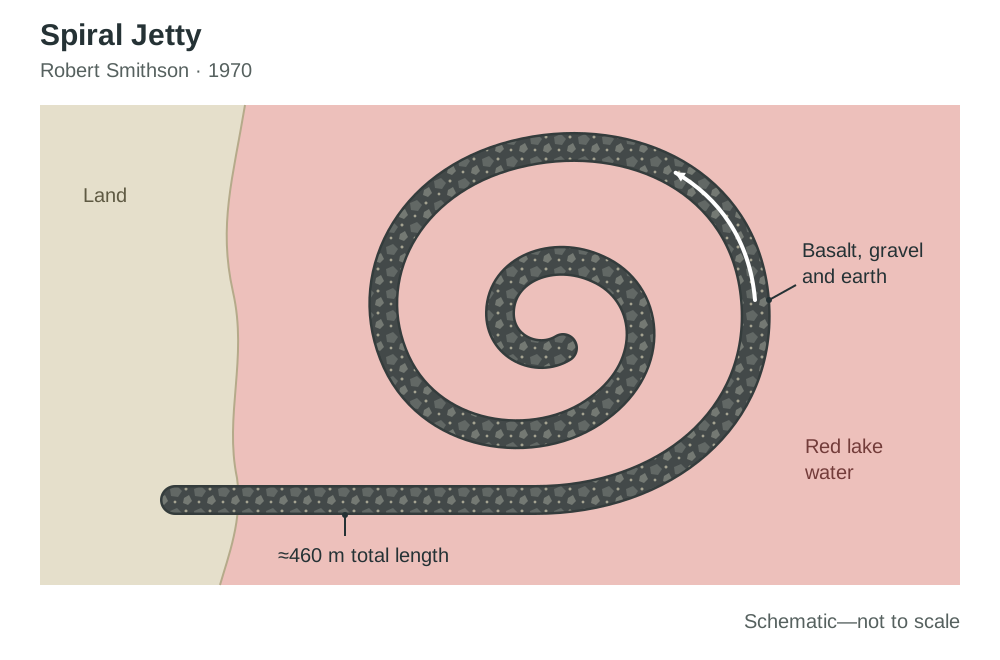
- Robert Smithson, Spiral Jetty (1970): Sited at Rozel Point on the Great Salt Lake, Utah, this earthwork was constructed using 6,650 tons of local black basalt rock, gravel and earth moved by heavy bulldozers; the white salt crust that now coats the boulders formed later as lake water evaporated. The jetty forms a counter-clockwise coil 460 metres long extending into red, algae-rich water. Smithson explored entropy*—the natural tendency of systems to break down into disorder. The jetty's meaning relies on natural weathering: prolonged submersion under rising water followed by re-emergence encrusted in brilliant white salt crystals.
- Richard Long, Minimalist Pathways: In A Line Made by Walking (1967), Long paced a straight line across an English grass meadow until the bent blades caught the sunlight, recording his subtle intervention through black-and-white photography. Long showed that environmental art can be respectful, quiet, and non-destructive.
- Andy Goldsworthy, Ephemeral Assemblages: Goldsworthy works with found organic matter—leaves stitched with thorns, icicles welded with spit, and balanced stones. Because these works are ephemeral (subject to quick decay, wind, or thaw), documentary photography serves as the only lasting record for the public.
Legacy: What Land Art Changed
Land Art shifted artistic practice in three major ways. It took art away from the commercial gallery space, making the physical site central to meaning. It established time, natural weathering, and decay as legitimate media, ensuring ephemeral, camera-documented work became widely accepted. Finally, it laid the foundation for activist eco-art, where the work is an ecological action rather than a permanent object. Agnes Denes's Wheatfield — A Confrontation (1982), in which two acres of wheat were sown and harvested on a Manhattan landfill opposite Wall Street, created the bridge between monumental earthworks and modern environmental protest.
Ireland: Environment as Site, Medium, and Message
The specification requires you to link Visual Studies to Ireland and to experience work directly as a primary source. Key Irish environmental works include:
- Sculpture in the Parklands, Lough Boora, Co. Offaly: Monumental sculptures sited across industrial cutaway bog, land stripped by industrial peat harvesting and remediated for cultural and ecological use. Mike Bulfin's Sky Train curves disused lengths of narrow-gauge railway track upward into the sky. The industrial history of the bog supplies both the physical material and the thematic subject.
- Dorothy Cross, Ghost Ship (1999), Scotsman's Bay, Dún Laoghaire: A decommissioned lightship painted with phosphorescent paint glowed in darkness before fading each evening. This temporary, ephemeral*, and site-specific project depended completely on the sea, coastal darkness, and maritime memory. Its permanent record survives through photography.
- Joe Caslin, Large-Scale Drawings on Buildings: Monumental drawings pasted onto gable walls with biodegradable paper and wheatpaste (such as The Claddagh Embrace, Galway, 2015). The building functions as both site and support. Caslin builds impermanence into the design, allowing rain and wind to wash the paper away over weeks, linking environmental display directly with social commentary.
- Lewis Glucksman Gallery, UCC (2004), by O'Donnell + Tuomey: Raised on a limestone base among mature trees within the River Lee floodplain, the building uses timber, glass, and local limestone. Its windows frame specific views of the tree canopy, demonstrating architecture that respects existing site contours rather than clearing them.
When writing about public works, examiners reward accurate distinction between terms: graffiti (usually unauthorized, lettering-based subculture), street art (image-based visual work in public space, authorised or unauthorized), public art (commissioned, permitted work for public audiences), and site-specific art (work whose form and meaning depend entirely on one exact location).
The Built and Designed Environment: Heritage, Commissioning, and Sustainable Design
Under the Leaving Certificate specification, environmental visual studies encompasses architecture, built heritage, urban design, and sustainable products:
Patrons, Agencies, and Commissioning
Public art and architectural schemes rarely occur without institutional support. In Ireland, public interventions are funded and guided by the Per Cent for Art Scheme (which allocates a portion of capital building funds to art commissions), the Arts Council, local authority arts offices, the OPW, the Heritage Council, or private sponsors. Siting permanent public work requires planning permission, while work affecting protected structures demands conservation consent. Street murals without planning approval are frequently painted over following complaints, highlighting ongoing debates over who controls public streetscapes.
Sustainable Design Criteria
When justifying architectural or product design choices in exam answers, apply these five criteria:
- Site and Orientation: Positioning windows southwards for passive solar gain; working around mature trees and natural topography rather than flattening the terrain.
- Materials: Selecting local, low-carbon, non-toxic, or reclaimed materials (stone, timber, recycled steel) that are durable.
- Energy and Comfort: Incorporating insulation, airtightness, natural daylighting, and cross-ventilation instead of mechanical cooling.
- Water and Ecology: Utilizing rainwater harvesting, porous ground paving, and living green roofs that insulate and encourage biodiversity.
- Whole Life Cycle: Designing products for disassembly, straightforward repair, and component recycling rather than glued, unrepairable disposal.
A recognized architectural benchmark is the Eden Project in Cornwall (designed by Grimshaw, 2001). Its intersecting domes use lightweight ETFE plastic cushions that required far less structural steel than glass, constructed inside an exhausted china-clay pit. The hexagonal pattern and spherical forms demonstrate biomimicry—design inspired by structural solutions found in nature.
Connecting Visual Studies to Practical Coursework
The three strands—Research, Create, and Respond—operate symbiotically. Exploring environmental art should inform your sketchpads and practical coursework:
- Primary Sources from Direct Observation: Avoid relying on internet image searches. Draw directly from your surrounding built and natural environment: peeling paint, rusted farm machinery, shoreline flotsam, or cracked concrete.
- Sketchpad Development Sequence: Markers look for methodical progression. For instance: photograph and sketch a rusted farm gate on your road; produce six close-up tonal studies in graphite and charcoal; experiment with walnut ink, rust-water, and diluted bleach on heavy paper; annotate how each material behaves; then develop a relief linocut print derived from the strongest tonal composition.
- Your Artist's Statement: You must submit an artist's statement alongside both your coursework project and your practical exam piece. Structure your writing directly around the Visual Studies Framework:
- What was created? (State the physical form, scale, and area of practice).
- How was it created? (Detail your techniques, material processes, and design principles).
- Why was it created? (Explain your thematic ideas, environmental concerns, and links to recognized artists).
Key terms
- Anthropocene
- A widely used term for the present period, in which human activity has become the dominant influence on climate, land, and ecosystems. It is not a formally ratified geological epoch, but names an idea to which many contemporary artists respond.
- Landscape Art
- A visual arts genre where natural or human-shaped scenery is treated as the primary, independent subject rather than as a background setting.
- The Sublime
- An aesthetic concept describing an overwhelming feeling of awe, vastness, or terror evoked by the power of nature or colossal industrial machines.
- Land Art (Earth Art)
- An art movement emerging in the late 1960s where natural terrain, soil, rocks, and water are used directly as the artistic medium and site.
- Site-Specific Art
- Artwork designed for a particular location, whose meaning, materials, and form depend entirely on its physical, architectural, or social surroundings.
- Ephemeral Art
- Deliberately temporary artwork intended to decompose, melt, wash away, or degrade naturally over time, usually preserved only through documentary photography or film.
- Entropy
- A scientific and artistic principle concerning the inevitable, natural tendency of physical matter and systems to move from order to disorder, weathering, and decay over time.
- Biomimicry
- The design practice of studying and emulating natural forms, processes, and systems to create sustainable, efficient human structures and products.
- Built Heritage
- Historical buildings, streetscapes, monuments, and engineered structures of cultural significance that communities preserve to maintain local identity.
- Environmental Design
- The practice of designing physical surroundings—including architecture, landscapes, urban spaces, interiors, and objects—with careful consideration of function, human use, and environmental sustainability.
- Visual Studies Framework
- The official Leaving Certificate analytical tool structured around six elements (Context, Artists and Artworks, Analysis, Art Elements and Design Principles, Media and Areas of Practice, Innovation/Invention) to answer What was created, How, and Why.
Check yourself
What is the key difference between an art element and a design principle?
Art elements are the fundamental visual ingredients (line, shape, form, colour, tone, texture, space), while design principles are the ways those ingredients are organized (balance, contrast, emphasis, scale, rhythm, movement, unity).
Why did Dutch seventeenth-century painters place such emphasis on depicting managed landscapes?
Extensive land reclamation using windmills to drain wetlands into fertile polders generated civic pride in human-engineered land, leading artists like Jacob van Ruisdael to celebrate working terrain.
Identify one symbolic detail in J.M.W. Turner's 'Rain, Steam and Speed' that highlights industrial disruption of nature.
A tiny hare running along the railway track ahead of the rushing locomotive, showing fragile wildlife being outrun and threatened by mechanized power.
Why is Robert Smithson's 'Spiral Jetty' considered a study in entropy?
Because the work was designed to submit to natural decay and unpredictable hydrological cycles, submerging under lake water for years and re-emerging encrusted in salt crystals.
Name two things you would consider when siting a permanent sculpture in a town square, giving a reason for each.
Scale relative to surrounding buildings and people, ensuring the work reads as a clear landmark without dominating the space; and pedestrian movement and safety, making certain the structure does not obstruct sightlines or crowd flow.
How does Mike Bulfin's 'Sky Train' at Lough Boora reflect its local Irish environment?
It is sited on an industrial cutaway peat bog and reuses lengths of abandoned Bord na Móna railway tracks, curving them into the air so the site's industrial past becomes its physical material and subject.
What is biomimicry in sustainable architecture, and what is a named example?
Biomimicry is design that copies structural principles from the natural world; an example is the Eden Project in Cornwall, whose geodesic domes use hexagonal cellular patterns inspired by natural bubbles.
When an exam question states 'Illustrate your answer', what is expected?
At least one or two quick, neat annotated line drawings or thumbnail sketches labelled with materials, colours, and key dimensions to support your written proposal.