
Irish Art and Modernism (c. 1880 – c. 1960s) examines how Irish visual culture developed from 19th-century academic realism to international modernism across painting, sculpture, stained glass, graphic design, and architecture. Following the establishment of the Irish Free State in 1922, the political establishment and the Catholic Church favoured conservative, rural imagery that showed a wholesome, pious Ireland, a view championed by the Royal Hibernian Academy (RHA). At the same time, pioneering artists—most notably women such as Mary Swanzy, Mainie Jellett, and Evie Hone, alongside Jack B. Yeats—studied in Paris, Antwerp, and London, bringing home Post-Impressionism, Cubism, and Expressionism. By creating independent exhibiting groups like the Society of Dublin Painters (1920) and the Irish Exhibition of Living Art (1943), these artists broke through national isolation and built a modern visual language that led to Ireland's first pavilion at the 1950 Venice Biennale.
Tradition versus Modernism: The Core Conflict
Between 1880 and the 1960s, Irish artists faced a central question: should a modern Irish art look traditional and rural, or international and experimental?
When the Irish Free State was established in 1922, the new government and the Catholic Church wanted to present a wholesome, respectable image of the country. They favoured art showing hardy peasants, traditional thatched cottages, and western landscapes, arguing that these represented the uncorrupted soul of the nation. The Royal Hibernian Academy (RHA) became the stronghold of this conservative, academic style, dominated by male artists who produced realistic oil paintings with smooth modelling and clear perspective.
At the very same time, a group of progressive artists—mostly women—argued that modern Ireland needed modern visual ideas. Having trained in Parisian studios and worked alongside European masters, painters like Mary Swanzy, Mainie Jellett, and Evie Hone brought home Cubism and geometric abstraction. Because the RHA routinely rejected their experimental submissions, these artists set up their own exhibition societies and championed an international outlook. This clash between conservative national realism and international modernism is the main narrative running through Irish art of this period.
Visual Language: The Art Elements and Design Principles
In the written exam, visual language carries a real share of the marks in art-history essays — recent papers have credited it separately, so use it throughout. You cannot earn these marks by merely listing adjectives; you must explain how the artist handled specific elements and principles to create a deliberate effect.
The Art Elements (The Building Blocks)
- Line: The marks or edges that guide the viewer's eye. Seán Keating relies on firm, continuous outlines to define heroic figures, whereas late Jack B. Yeats dissolves contours entirely into broken, energetic brush marks.
- Shape and form: Flat two-dimensional areas (shape) versus solid three-dimensional volume (form). Mainie Jellett arranges flat geometric shapes across the surface; Keating uses careful shading to build solid, sculptural forms.
- Colour: Described by hue (the colour family), tone (lightness or darkness), and saturation (intensity). Paul Henry uses cool, muted blues, greys, and whites; Roderic O'Conor places vibrant, unmixed complementary colours side by side.
- Tone: The variation between light and dark. Strong tonal contrast is known as chiaroscuro, used by Keating to add drama and solid volume to figures.
- Texture: The physical or visual surface. Thick, raised oil paint is called impasto, used heavily by late Yeats to catch light and convey raw feeling; tempera on panel, used by Jellett, produces a flat, non-reflective matte finish.
- Space: How depth is suggested or denied. Realistic painters use overlapping, scale, and linear or atmospheric perspective. Abstract painters reject illusionistic depth and keep the picture plane flat.
- Pattern: Repeated decorative motifs, seen in the borders of Celtic Revival embroidery and Harry Clarke's detailed illustrations.
The Design Principles (How Elements are Organised)
- Composition: The overall arrangement of visual elements. Describe this using clear shapes: a horizontal frieze (Men of the South), a sharp plunging diagonal (The Liffey Swim), or a central vertical axis (Decoration).
- Balance: Whether the arrangement feels stable. It can be symmetrical (mirroring across an axis, as in Jellett's religious panels) or asymmetrical (balanced by unequal masses, as in Yeats).
- Rhythm and movement: The path the eye follows, led by repeated curves, directional lines, or rhythmic brushstrokes.
- Emphasis and focal point: Where the artist directs your attention first, achieved through contrasting colour, sharp tonal highlights, or converging sightlines.
The Golden Rule: Observation, Evidence, Effect
Never mention an element on its own. Every analytical sentence should follow this three-step chain:
- State what you observe.
- Give the visual evidence using art elements and design principles.
- State the effect or the artist's intention.
Weak — description only: Keating painted men standing with guns looking serious.
Better — description plus analysis: In Men of the South, Keating positions the standing riflemen against a low horizon line (composition), making their solidly modelled bodies tower over the viewer (effect), which endows ordinary guerrilla fighters with the heroic authority of a classical monument (intention).
Before Modernism: Plein Air, Post-Impressionism, and the Revival (c. 1880–1910)
In the late 19th century, ambitious Irish art students found training at home rigid and outdated. They travelled to the Royal Academy of Fine Arts in Antwerp and private ateliers in Paris such as the Académie Colarossi and Académie Julian. During the summers, they joined international artist colonies in Brittany to paint outdoors directly in front of nature (en plein air).
- Walter Osborne (1859–1903): Osborne absorbed French naturalism and plein air brushwork in Brittany. In Apple Gathering, Quimperlé (1883), he used broken, square-brush strokes to capture dappled sunlight falling through orchard leaves on working peasant children. Returning to Dublin, he applied this fresh outdoor approach to everyday street scenes and public parks, giving ordinary life an unvarnished honesty.
- Roderic O'Conor (1860–1940): O'Conor pushed far into the European avant-garde. Living in Pont-Aven in Brittany, he became close friends with Paul Gauguin and adopted Vincent van Gogh's expressive approach. In Field of Corn, Pont-Aven (1892), O'Conor applied thick, parallel stripes of unmixed red and green pigment straight from the tube. By placing complementary colours side by side, he created an intense visual vibration, using colour to express emotional energy rather than copy natural light.
Alongside fine art, the Celtic Revival aimed to build a distinct Irish cultural identity by drawing on ancient mythology, Early Christian metalwork, and folk ornament. This inspired practical craft workshops:
- The Dun Emer Guild (1902): Founded by Evelyn Gleeson with Lily and Elizabeth Yeats to provide training and employment for Irish women, producing hand-woven rugs, printed books, and Celtic-inspired embroidery.
- An Túr Gloine (The Tower of Glass, 1903): Founded by Sarah Purser and Edward Martyn as a stained-glass cooperative. It trained craftworkers to produce high-quality, expressive windows so that Irish churches could commission original local work instead of buying cheap, mass-produced windows imported from Germany and England.
- Hugh Lane's Municipal Gallery (1908): Sir Hugh Lane established the first public gallery of modern art in Dublin, giving Irish painters and the public direct access to French Impressionist and Post-Impressionist work.
Free State Realism, Design, and Sculpture (1920s–1930s)
With the creation of the Free State in 1922, the establishment demanded art that looked stable, traditional, and national. Academic realism became the official visual language.
Academic Realism in Painting
- Seán Keating (1889–1977): Trained by Sir William Orpen, Keating believed rigorous anatomical drawing and classical modelling were the only proper foundation for art. In Men of the South (1921–22, oil on canvas), he depicted an IRA flying column waiting in ambush during the War of Independence. Purchased for the Crawford Art Gallery, Cork, soon after it was painted, it became the definitive heroic image of the republican struggle—an example of a public gallery, rather than a private patron, giving official status to a nationalist subject. In Night's Candles Are Burnt Out (1928–29), Keating turned to Innovation and Invention, depicting the construction of the Shannon hydro-electric dam at Ardnacrusha. Surrounding the concrete dam, symbolic figures—a capitalist, an engineer, a gunman, and an old stage-Irishman—debate whether industrial technology will liberate or destroy traditional Irish culture.
- Paul Henry (1876–1958): After studying in Paris, Henry lived on Achill Island from 1910 to 1919. He reduced the western landscape to bold, simplified shapes: whitewashed cottages, dark turf stacks, blue-grey mountains, and towering white cumulus clouds. In Launching the Currach (c. 1910–11), he treated local fishermen as solid, anonymous silhouettes against an immense sky. Separately, one of his Connemara landscapes was reproduced as a London, Midland and Scottish Railway tourism poster in 1925—reputedly one of the most widely displayed posters of its day—turning Henry's simplified West of Ireland into the visual shorthand for authentic Irishness.
State Design Patronage
The Free State asserted its sovereignty through official design. In 1928, a coin committee chaired by W. B. Yeats commissioned English sculptor Percy Metcalfe to design modern circulating coins featuring native farm and wild animals (the horse, salmon, and hare). Sir John Lavery's portrait of his wife, Hazel Lavery as Cathleen Ní Houlihan, was selected to appear on the new national banknotes, personifying the young state as a classical, dignified woman.
Sculpture: Monuments and Modern Form
Sculpture during this period shifted from polished public memorials to modernist experiments with raw materials.
- Oliver Sheppard (1865–1941): The Death of Cúchulainn (bronze, modelled 1911, chosen in 1935 as the official 1916 memorial for the General Post Office, Dublin). The dying mythological hero is bound to a pillar, his head slumped forward with a raven on his shoulder. Sheppard used smooth, idealised, classical modelling learned in Paris. The sculpture demonstrates context and patronage: the new state appropriated an ancient mythological figure to give the 1916 Rising a heroic, sacrificial lineage.
- Albert Power (1881–1945): Power carved directly into native Irish stone as well as working in bronze. His Connemara Trout shows his dedication to local materials and compact, simplified carving. He also carved official portrait busts of figures like Patrick Pearse and W. B. Yeats, providing the new state with its official likenesses.
- Hilary Heron (1923–1977): A pioneer of mid-century modern sculpture. Heron rejected smooth academic bronze, preferring direct carving in Irish limestone and native wood (Crazy Jane, 1950s) and later welding openwork sheet metal. She left raw chisel cuts and welding beads visible on the surface. Alongside Louis le Brocquy, she represented Ireland at the 1956 Venice Biennale.
- Oisín Kelly (1915–1981): Known for The Children of Lir (bronze, 1964, Garden of Remembrance, Dublin). Kelly took an ancient mythological tale and translated it into stripped-back, soaring modernist forms, linking the Celtic Revival to post-war public sculpture.
Jack B. Yeats: Graphic Roots to Emotive Expressionism
Jack Butler Yeats (1871–1957), brother of the poet W. B. Yeats, followed a deeply personal artistic development that mirrored Ireland's path to independence. Rather than adopting foreign movements ready-made, he developed an Expressionist style of his own. His work falls into three clear phases:
- Early Graphic Period (c. 1890s–1910): Working in pen-and-ink and watercolour, Yeats recorded western characters—jockeys, circus performers, and turf-cutters. His work relied on firm, descriptive black contours and flat colour washes.
- Transitional Narrative Period (c. 1910–mid-1920s): Around 1910, Yeats switched to oil paint. His brushwork loosened and he engaged directly with national political life. In The Funeral of Harry Boland (1922), painted after the burial at Glasnevin of the anti-Treaty soldier shot during the Civil War, he avoided political melodrama, showing a dark, compressed crowd of mourners united in grief. In The Liffey Swim (1923), he captured the energy of Dublin city through a high viewpoint, a sharp diagonal quay wall, and dynamic brushwork that won an Olympic silver medal for art in Paris in 1924.
- Late Expressionist Period (c. 1925–1957): Outlines disappeared entirely. Applying oil paint straight from the tube using heavily loaded brushes, palette knives, rags, and his fingers, Yeats sculpted a thick, physical impasto. Colour became emotional rather than realistic: brilliant crimsons, acidic yellows, and deep blues clash across the canvas. In works like Men of Destiny (1946) and Grief (1951), human figures dissolve into churning paint, capturing memory, tragedy, and the human spirit.
Yeats linked the freedom of the painter directly with the freedom of the country, arguing that a national art must be born of unrestricted individual expression rather than academic rules.
The Vanguard of Abstraction: Swanzy, Jellett, and Hone
Modernist visual theory entered Ireland largely through independent women artists who travelled abroad, mastered avant-garde concepts, and brought them home to challenge academic conservatism.
Mary Swanzy (1882–1978)
Swanzy studied in Paris from 1906, exhibiting at the Salon des Indépendants in 1914. She absorbed Paul Cézanne's structural analysis of nature, the geometric fracturing of Cubism, and Robert Delaunay's lyrical colour rhythms (Orphism). In townscapes like Pattern of Rooftops (c. 1920), Swanzy dismantled buildings, chimneys, and trees into interlocking, translucent geometric planes. Instead of using traditional single-point perspective, the eye is pushed back and forward between the planes, setting straight-edged geometry against flowing curves.
Mainie Jellett (1897–1944) and Evie Hone (1894–1955)
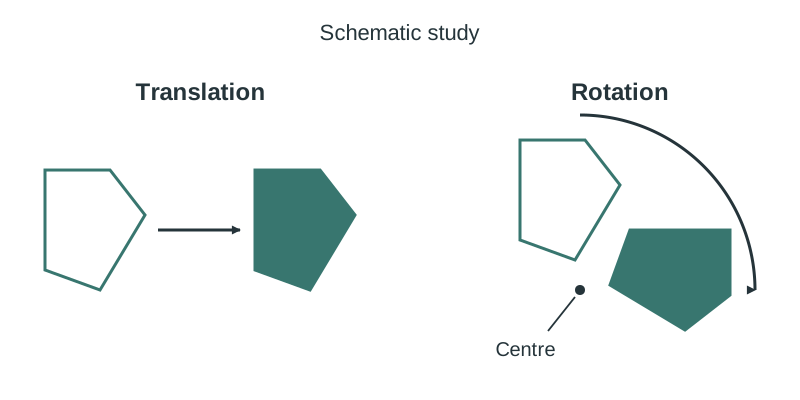
In 1921, Jellett and Hone travelled to Paris to study under André Lhote and then Albert Gleizes, a leading Cubist theorist. Gleizes taught them his formal system of translation and rotation:
- Translation: Moving flat geometric shapes along horizontal or vertical axes across the surface.
- Rotation: Turning these planes around a central point to create rhythm, movement, and visual balance without depicting an external object.
When Jellett exhibited two pure abstract paintings, including Decoration (1923), at the Society of Dublin Painters, Dublin critics reacted with outrage. The work is a small panel built on a central vertical axis, with flat geometric planes translated and rotated outwards as radiating arcs, in a restrained, non-naturalistic palette and a flat, matt, non-illusionistic surface. The influential writer and painter George (AE) Russell attacked her work in the press, calling it 'an artistic malaria'.
Jellett defended abstraction in lectures, radio talks, and articles. She built a brilliant cultural defence: she pointed out that Early Christian Insular art (such as the Book of Kells and stone high crosses) was completely non-naturalistic, symbolic, and built on intricate geometric rhythms. Abstraction, she argued, was not a foreign disease; it was a return to Ireland's oldest and greatest visual tradition.
Stained Glass, Graphic Illustration, and Modernist Architecture
The Leaving Certificate specification defines art across fine art, craft, and design. Groundbreaking modern work appeared in stained glass, book illustration, and public architecture.
Stained Glass and Book Illustration: Harry Clarke and Evie Hone
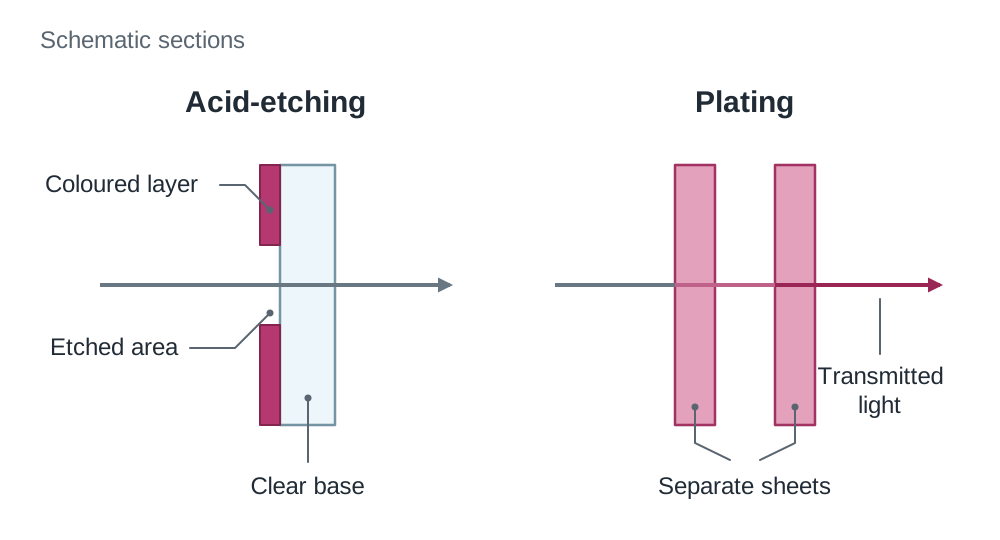
Stained glass relies on transmitted light (light travelling directly through coloured glass) rather than the reflected light of an opaque painting. The artist creates a full-size working cartoon, cuts hand-blown glass, paints fine detail with dark enamel trace lines, fires the pieces in a kiln, and joins them using grooved lead strips (cames).
- Harry Clarke (1889–1931): Clarke combined the rich colour of medieval glass with the elongated lines of Art Nouveau and Continental Symbolism. He mastered acid-etching (using hydrofluoric acid to eat away areas of coloured flash glass, leaving clear or pale glass beneath) and plating (layering glasses together) to create jewel-like gradations. In The Eve of St Agnes (1924, Hugh Lane Gallery), he clothed figures in glowing sapphire blues and magentas, filling every border with microscopic detail. His Geneva Window (commissioned 1926, completed 1930) was made as the Free State's gift for the International Labour Organisation building in Geneva. Illustrating scenes from 15 modern Irish writers, it was rejected by the Cosgrave government because scenes (including Liam O'Flaherty's Mr Gilhooley) were judged indecent, making it a key case study in state censorship.
- Clarke's Graphic Illustration: Clarke's pen-and-ink illustrations for Edgar Allan Poe's Tales of Mystery and Imagination (1919) share the visual language of his windows. Dense black ink areas contrast with fine white lines, elongated figures, and grotesque, dreamlike patterns. In the glass, the dark line is formed by the lead came and the painted trace line; on paper, it is formed by the pen.
- Evie Hone (1894–1955): Hone joined An Túr Gloine in the 1930s, translating her French Cubist training into stained glass. In My Four Green Fields (1938–39, now in Government Buildings, Dublin), she arranged the four provinces into broad, interlocking geometric planes. Her huge east window for Eton College Chapel (1949–52) depicted the Crucifixion using heavy lead lines and thick slabs of deep cobalt and ruby glass, uniting modern Cubist structure with intense religious feeling.
Modernist Architecture: Michael Scott's Busáras
Modernism reshaped the built environment through the International Style, which rejected applied historical ornament in favour of clean geometric form and modern materials. Designed by Michael Scott and completed in 1953, Busáras (Dublin's central bus station) introduced functionalist architecture to the capital. It features a reinforced concrete frame, Portland stone cladding, glass curtain walls, and a distinctive, cantilevered wave-like concrete canopy over the top pavilion, proving that modern design could serve the public needs of an independent state.
Alternative Institutions, Mid-Century Modernism, and Legacy
Because the RHA repeatedly rejected modernist submissions, progressive artists set up independent exhibiting groups to show their work.
Alternative Exhibiting Groups
- Society of Dublin Painters (1920): Founded by Jack B. Yeats, Paul Henry, Mary Swanzy, and others at 7 St Stephen's Green. By the late 1920s, it was run mainly by modernist women, becoming the chief Dublin venue for avant-garde painting.
- The White Stag Group (Dublin, 1940–1946): Formed by British artists Basil Rákóczi and Kenneth Hall who moved to Dublin during the Second World War. They promoted subjective, psychological, and Surrealist art, inspiring young Irish painters to work freely from the subconscious.
- Irish Exhibition of Living Art (IELA, 1943): Founded by Mainie Jellett (its first chair), Evie Hone, Louis le Brocquy, and Norah McGuinness after the RHA rejected several progressive works, including le Brocquy's The Spanish Shawl (1941). The IELA became the primary annual showcase for modernist painting and sculpture in Ireland for three decades.
- 1950 Venice Biennale: The Department of External Affairs selected two women modernists, Norah McGuinness and Nano Reid, to represent Ireland at its first national pavilion in Venice, demonstrating internationally that the young Republic was moving past academic isolation.
Key Mid-Century Modernists
- Norah McGuinness (1901–1980): Trained in Dublin and Paris under André Lhote. She painted in a decorative, semi-Cubist style with high viewpoints, tilted ground planes, and strong outlines. In Garden Green (1952), she broke the landscape down into crisp, interlocking geometric shapes while keeping the subject recognisable. She succeeded Jellett as chair of the IELA.
- Nano Reid (1900–1981): From Drogheda, Reid developed an earthy, expressive style using scrubbed, muted greens, ochres, and greys. In Tinkers at Slieve Breagh (late 1950s), human figures and livestock merge into the ancient Boyne Valley landscape, bridging traditional Irish rural subject matter with a loose, near-abstract handling of paint.
- Gerard Dillon (1916–1971): Belfast-born Dillon merged western folk themes with modernist space. In The Yellow Bungalow (1954), he tilted the perspective and flattened the picture plane, celebrating Connemara life with direct, naive charm rather than academic finish.
- Louis le Brocquy (1916–2012): Achieved international prominence with his Tinker series (1945–1948). In A Family (1951, oil on canvas), he portrayed an austere, post-war room with isolated, angular figures conveying human vulnerability and anxiety. The painting won a major international award at the 1956 Venice Biennale, where le Brocquy exhibited alongside sculptor Hilary Heron.
- Patrick Scott (1921–2014): Scott distilled painting to pure geometric reduction. In his Gold Paintings (from the 1960s), he contrasted pale, watery tempera washes on raw, unprimed linen canvas with precise geometric squares and circles of 23-carat gold leaf, aiming at a calm, meditative balance between the empty canvas and the glowing gold.
After Modernism: The European Link and Long-Term Legacy
Modernism permanently altered Irish visual culture. Because Jellett and Hone learned directly from Gleizes in Paris, Irish abstraction developed as a direct branch of European Cubism rather than a second-hand copy. Ireland's presence at the Venice Biennale from 1950, and the launch of the international ROSC exhibitions in Dublin from 1967, placed modern Irish art firmly inside the international contemporary art circuit.
Revision Reference Grid: Artists, Works, and Context
| Artist | Dates | Named Work & Date | Medium | Style & Visual Approach | Context & Significance |
|---|---|---|---|---|---|
| Walter Osborne | 1859–1903 | Apple Gathering, Quimperlé (1883) | Oil on canvas | Naturalist plein air, square-brush handling, dappled light | Trained in Antwerp; brought French outdoor realism to Dublin street life |
| Roderic O'Conor | 1860–1940 | Field of Corn, Pont-Aven (1892) | Oil on canvas | Post-Impressionist, thick stripes of complementary colour | Worked with Gauguin in Brittany; influenced by Van Gogh's expressive colour |
| Paul Henry | 1876–1958 | Launching the Currach (c. 1910–11) | Oil on canvas | Simplified forms, flat colour planes, low horizon | Distilled western peasant life into an iconic symbol of national identity |
| Seán Keating | 1889–1977 | Men of the South (1921–22) | Oil on canvas | Academic realism, strong chiaroscuro, frieze composition | Heroic image of the War of Independence; purchased by Crawford Art Gallery |
| Oliver Sheppard | 1865–1941 | The Death of Cúchulainn (1911) | Bronze sculpture | Smooth classical modelling, heroic Symbolist nude | Installed in the GPO in 1935 as the official 1916 Rising memorial |
| Jack B. Yeats | 1871–1957 | The Liffey Swim (1923) | Oil on canvas | Dynamic brushwork, steep diagonal quay wall, high viewpoint | Civic sporting event; won Olympic silver medal for art in Paris (1924) |
| Mary Swanzy | 1882–1978 | Pattern of Rooftops (c. 1920) | Oil on canvas | Cubist/Orphist, faceted translucent planes, rhythmic lines | Exhibited at Salon des Indépendants (1914); pioneer of Irish Cubism |
| Mainie Jellett | 1897–1944 | Decoration (1923) | Tempera on panel | Pure non-objective abstraction; translation and rotation | Attacked by AE as 'artistic malaria'; linked abstraction to Celtic Insular art |
| Harry Clarke | 1889–1931 | The Eve of St Agnes (1924) | Stained glass | Transmitted light, acid-etching, plating, rich jewel tones | Master of stained glass and book illustration; Geneva Window rejected by state |
| Albert Power | 1881–1945 | Connemara Trout (c. 1930s) | Connemara marble | Direct carving, simplified compact form, native material | Championed native stone; sculpted official portrait busts of Pearse and Yeats |
| Evie Hone | 1894–1955 | My Four Green Fields (1938–39) | Stained glass | Bold Cubist planes, thick black leading, rich primary glass | Member of An Túr Gloine; brought Parisian abstraction into ecclesiastical craft |
| Michael Scott | 1905–1989 | Busáras, Dublin (1953) | Architecture | International Style, reinforced concrete, glass curtain wall | Introduced functionalist modern architecture to post-war Dublin |
| Norah McGuinness | 1901–1980 | Garden Green (1952) | Oil on canvas | Structured, decorative semi-Cubism, tilted planes | Co-represented Ireland at 1950 Venice Biennale; long-standing chair of IELA |
| Nano Reid | 1900–1981 | Tinkers at Slieve Breagh (late 1950s) | Oil on canvas | Earthy palette, scrubbed paint, near-abstract landscape | Co-represented Ireland at 1950 Venice Biennale; linked modernism with Boyne valley |
| Louis le Brocquy | 1916–2012 | A Family (1951) | Oil on canvas | Pale palette, angular figures, post-war existential mood | Won major award at 1956 Venice Biennale; major figure in post-war European art |
| Hilary Heron | 1923–1977 | Crazy Jane (1950s) | Carved wood / stone | Direct carving, rough expressive texture, modern form | Pioneer modernist sculptor; represented Ireland at 1956 Venice Biennale |
| Oisín Kelly | 1915–1981 | The Children of Lir (1964) | Bronze sculpture | Stripped-back soaring stylized forms, mythic subject | Fused Celtic folklore with modern public sculpture in Garden of Remembrance |
| Patrick Scott | 1921–2014 | Gold Painting 21 (1960s) | Tempera & gold on linen | Minimalist geometric abstraction, unprimed linen, gold leaf | Represented Ireland at 1960 Venice Biennale; pioneer of geometric reduction |
Key terms
- Modernism
- A broad cultural movement that broke with traditional academic realism, emphasising formal experimentation, expressive colour, abstraction, and new materials.
- En Plein Air
- The practice of painting outdoors directly in front of the subject, allowing the artist to capture natural light, atmosphere, and fleeting colour variations.
- Post-Impressionism
- A movement following Impressionism that favoured simplified structure, directional brushwork, and expressive, non-naturalistic colour (exemplified by Roderic O'Conor).
- Celtic Revival
- A movement from the 1890s that revived ancient Irish literature, folklore, and Early Christian decorative designs to forge a distinctive national identity.
- Academic Realism
- A style rooted in traditional academy training, relying on preparatory drawings, anatomical precision, perspective, and illusionistic tonal modelling.
- Royal Hibernian Academy (RHA)
- Ireland's primary academic exhibiting institution, which for decades favoured conservative representational painting and resisted continental modernism.
- Society of Dublin Painters
- An independent exhibiting group founded in 1920 by artists including Jack B. Yeats and Mary Swanzy to bypass the RHA; later run largely by modernist women.
- Cubism
- An avant-garde movement that abandoned single-point perspective, breaking subjects down into faceted geometric planes viewed from multiple angles at once.
- Translation and Rotation
- The abstract compositional system taught by Albert Gleizes and used by Mainie Jellett, where geometric planes are shifted along axes and rotated around a centre to create balance and rhythm.
- Expressionism
- An approach to art that distorts line, shape, and colour to convey deep emotional and psychological states rather than copying external reality.
- Impasto
- The thick, raised application of oil paint using heavily loaded brushes, palette knives, or fingers, creating a sculptural, textured surface that catches light.
- An Túr Gloine
- The stained-glass cooperative founded in Dublin in 1903 by Sarah Purser and Edward Martyn to train Irish craftworkers and make high-quality ecclesiastical windows.
- Transmitted Light
- Light that passes directly through a transparent material such as stained glass, creating radiant colour, unlike the reflected light that bounces off an opaque painting.
- Flash Glass
- Hand-blown glass made of a clear base layered with a thin veneer of coloured glass, designed for acid-etching to create pale and white highlights.
- Acid-Etching
- A technique using hydrofluoric acid to eat away areas of flash glass, leaving delicate tonal variations and intricate patterns on the pane.
- Lead Cames
- H-shaped strips of grooved lead used by stained-glass artists to join individual cut pieces of coloured glass into a unified panel.
- White Stag Group
- An informal circle of artists active in Dublin during the Second World War (1940–1946), led by Basil Rákóczi and Kenneth Hall, that promoted Surrealist and psychological art.
- Irish Exhibition of Living Art (IELA)
- The landmark exhibition body founded in 1943 by Mainie Jellett, Evie Hone, and Louis le Brocquy to provide an open annual forum for progressive Irish art.
- International Style
- A functionalist architectural style using reinforced concrete, steel framing, flat roofs, and glass curtain walls with no applied historic decoration (e.g. Busáras).
- Chiaroscuro
- The bold contrast between light and dark in a painting, used by realist painters to give solid three-dimensional volume to figures and heighten drama.
Check yourself
What is the difference between transmitted light and reflected light in visual art?
Transmitted light passes directly through a material (such as coloured stained glass), creating radiant, luminous colour, whereas reflected light bounces off the opaque surface of a painting or sculpture.
Why did George (AE) Russell attack Mainie Jellett's 'Decoration' when it was exhibited in 1923?
He considered its non-representational, Cubist geometric abstraction cold, mechanical, and un-Irish, dismissing it in the press as 'an artistic malaria'.
How did Mainie Jellett use early Irish art to defend modern abstraction?
She pointed out that Early Christian Insular art (such as the Book of Kells and carved high crosses) was non-naturalistic, decorative, and built on complex geometric rhythms, meaning abstract art was a continuation of ancient native tradition rather than a foreign corruption.
Explain Albert Gleizes's principles of 'translation and rotation' as used by Mainie Jellett.
Translation means shifting flat geometric planes horizontally or vertically across the surface; rotation means pivoting those planes around a central point to create rhythm and balance without depicting realistic objects.
In two sentences, analyse the composition of Jack B. Yeats's 'The Liffey Swim' (1923) and explain its visual effect.
Yeats cuts a sharp diagonal quay wall across the picture plane and crowds the foreground with dark, overlapping silhouettes of spectators. This elevated, compressed viewpoint blocks a direct view and forces the spectator to crane over the crowd's shoulders, creating the sensation of being right inside the excited urban crowd.
Name one art element and one design principle Keating uses in 'Men of the South' and state the effect of each.
Keating uses tone (element) through strong chiaroscuro to make the men's bodies and tweed coats feel solid and sculptural; he uses composition (principle) by arranging the figures in a horizontal frieze seen from a low viewpoint, making ordinary guerrilla fighters look monumental and heroic.
Why did the Free State government reject Harry Clarke's 'Geneva Window' (1926–1930)?
The window illustrated scenes from 15 modern Irish writers; the government judged several scenes (especially the portrayal of Liam O'Flaherty's 'Mr Gilhooley') morally offensive and feared it would present an unwholesome image of Catholic Ireland abroad.
Which two modernist women artists represented Ireland at its first Venice Biennale pavilion in 1950?
Norah McGuinness and Nano Reid.