
This topic explores how people express their beliefs and values through rituals, sacred spaces, non-religious celebrations, and prayer. The exam asks you to name and describe rituals, sacred spaces and non-religious celebrations, explain the meaning of their symbols, and describe the role of prayer in a believer's life.
Religious Rituals and Rites of Passage
A religious ritual is a ceremony consisting of a series of actions performed according to a prescribed order which have a religious and a symbolic value attached to them. Many rituals mark key life transitions, known as a rite of passage:
- Christian Infant Baptism: Welcomes a child into the Christian community. Water poured three times over the head washes away original sin, and the baptismal candle lit from the Paschal candle represents the light of Christ.
- Jewish Bar and Bat Mitzvah: Marks religious adulthood at age 13 for boys and 12 for girls. The young person reads aloud from the Torah on the bimah, taking personal responsibility for following the commandments (mitzvot).
- Islamic Aqiqah: On the seventh day after birth, the baby is named, the head is shaved, and charity is given to the poor, welcoming the child into the ummah.
Places of Worship, Sacred Spaces, and Pilgrimage
A formal place of worship is a specially-designed building where people gather to worship together, such as a church, synagogue, temple, or mosque. Internal features directly reflect core beliefs:
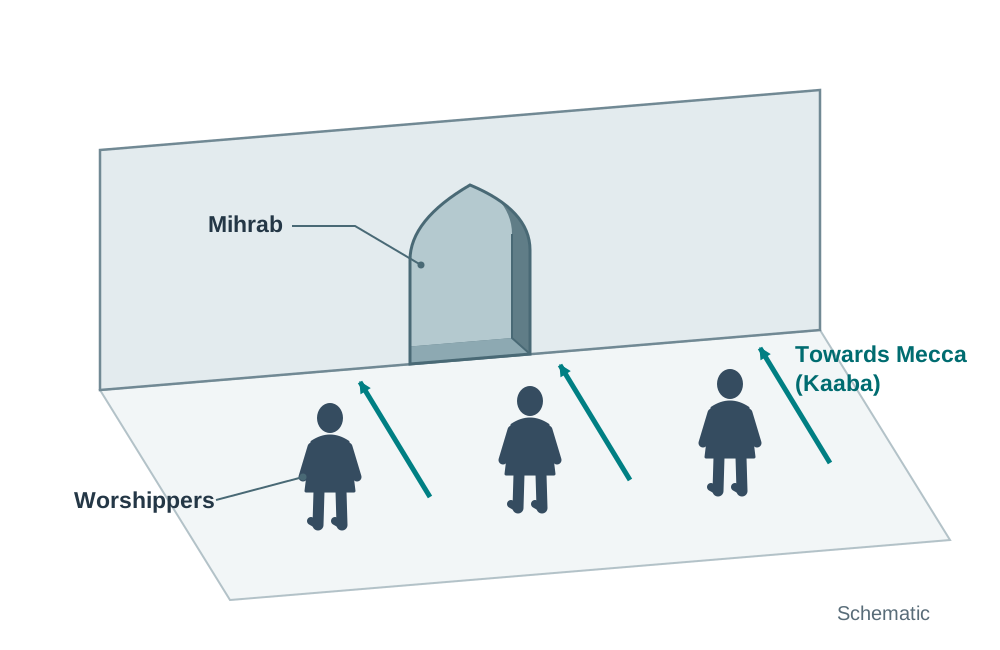
- In a mosque, the mihrab is an alcove in the wall indicating the direction of Mecca, ensuring worshippers face the Kaaba during prayer.
- In a synagogue, the Ark holds the sacred Torah scrolls, showing that God's word is central to Jewish life.
A sacred space refers to places that are considered sacred or holy and fulfil a religious purpose, including natural sites like rivers, wells, and mountains. Believers often travel to these spaces on a pilgrimage:
- Croagh Patrick (Mayo): Pilgrims climb the mountain on Reek Sunday to honour Saint Patrick's 40-day fast, often walking barefoot as an act of penance.
- Lough Derg (Donegal): A three-day penitential retreat on Station Island involving fasting, walking barefoot around prayer stations, and an all-night vigil.
Non-Religious Rituals and Celebrations
A non-religious ritual is a practice that is not religious or spiritual in nature but can still have symbolic meaning. Secular families and Humanists mark life stages based on shared human values rather than divine law:
- Humanist Naming Ceremonies: Welcome a baby into the family and wider community. Instead of godparents, parents appoint mentors or guideparents. Grandparents often light candles to symbolise the connection across generations.
- Humanist Weddings: Celebrate love, equality, and mutual commitment without referencing religious law or the Divine. Many couples practise hand-fasting, binding their hands with cords to symbolise their union.
Significance: these ceremonies mark important milestones, express a family's own values, and create belonging and support without reference to the Divine. A humanist funeral, for example, comforts mourners by celebrating the life the person actually lived.
The Purpose, Forms, and Role of Prayer
Prayer is a mental or vocal expression to a deity or power beyond the person. Believers pray for reasons such as praise (honouring God), thanksgiving (giving gratitude), petition (asking for help), and sorrow (seeking forgiveness).
| Form | Paired form |
|---|---|
| Silent (meditation, reflection) | Vocal (spoken aloud, sung) |
| Individual (praying alone) | Communal (gathered with others) |
| Formal (set words like the Our Father) | Informal (spontaneous personal words) |
The role of prayer for a believer:
- Gives comfort and strength during illness or bereavement.
- Helps the believer feel closer to the Divine and build a personal relationship with God.
- Provides guidance when facing difficult moral decisions.
- Shapes daily life, such as when a Muslim performs Salat five times a day.
- Creates unity and belonging when a congregation prays together.
Key terms
- Rituals
- The traditions, habits and actions that are repeated in a family, community or society.
- Religious ritual
- A ceremony consisting of a series of actions performed according to a prescribed order which have a religious and a symbolic value attached to them.
- Non-religious ritual
- A practice that is not religious or spiritual in nature but can still have symbolic meaning (e.g. in sports or in cultural spheres).
- Formal place of worship
- A specially-designed building where people gather to worship together, such as a church, synagogue, temple or mosque.
- Sacred spaces
- Places that are considered sacred or holy and fulfil a religious purpose, encompassing rivers, mountains, wells, burial sites, buildings, and shrines.
- Prayer
- A mental or vocal expression to a deity or power beyond the person.
- The Divine
- Used to indicate and include the various ways in which the world's major religions refer to God, gods, or the Transcendent.
- Pilgrimage
- A journey to a sacred place undertaken for spiritual, devotional, or penitential reasons.
Check yourself
What is the difference between an ordinary ritual and a religious ritual?
A ritual is any action repeated in a family or community; a religious ritual follows a prescribed order and its actions carry religious and symbolic meaning.
Name two challenging penitential actions carried out by pilgrims at Lough Derg.
Walking barefoot around prayer stations and remaining awake during an all-night vigil.
What does hand-fasting at a Humanist wedding symbolise?
It symbolises the couple's partnership and commitment by binding their hands together with cords.
Name one feature of a mosque and state what belief it shows.
The mihrab shows the direction of Mecca, reflecting the belief that all Muslims face the Kaaba when praying.
Name three contrasting pairs of prayer forms.
Silent or vocal, individual or communal, and formal or informal.