
Graphic notation represents sound or music using shapes, lines, or images rather than standard notes on a five-line stave. Listening questions may ask you to match melodies to graphics or explain how symbols represent sounds.
Traditional Notation vs Graphic Notation
Staff notation uses a stave and note values to specify pitches and relative durations. Graphic notation uses shapes, lines or images; its instructions determine how precisely sounds are specified.
| Feature | Staff Notation | Graphic Score |
|---|---|---|
| Visual system | Five-line stave, clefs, note values | Shapes, lines, dots, colours, text |
| Precision | Exact pitches and relative durations | Instructions set by composer's key |
Graphic scores give composers the freedom to notate sounds that traditional staves cannot easily capture, such as found sounds, vocal effects, or electronic sounds.
Reading Musical Elements on a Graphic Score
Most graphic scores read from left to right along a timeline. Vertical position on the page typically indicates pitch, though you should always check the score's key.
| Visual Feature | Possible meaning—check the score’s instructions |
|---|---|
| Rising line | Pitch rising higher |
| Falling line | Pitch moving lower |
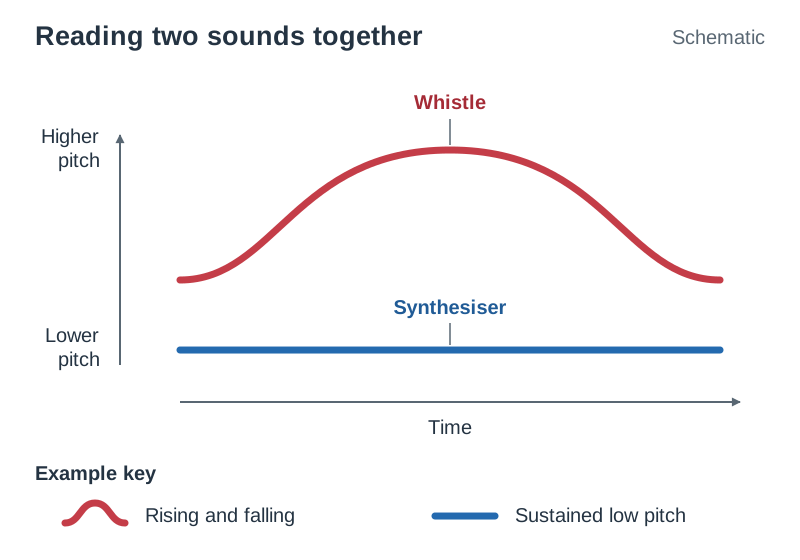
| Flat horizontal bar | Sustained note held at an unchanging pitch |
| Repeated dots or specks | Short, detached sounds (staccato) |
| Smooth wave | Rising and falling pitch |
| Multiple stacked shapes | Thick texture with several layers playing together |
| Thick or bold line | Louder dynamics (forte) |
| Thin or faint line | Softer dynamics (piano) |
These visual patterns are common conventions rather than rigid rules. Always check the score's key or legend before interpreting unfamiliar symbols.
Melodic Contour and Structure
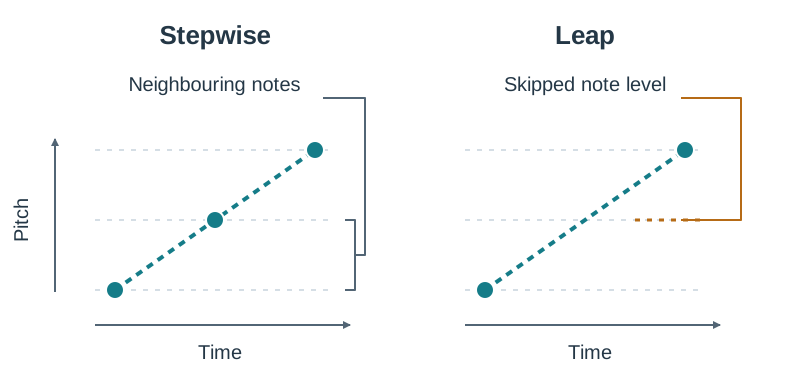
Melodic contour describes the overall visual and auditory shape of a melody as it moves through time.
- Stepwise motion: Movement between neighbouring scale notes, shown by a smooth line that climbs or dips gently.
- Leap: Movement to a non-neighbouring note, shown in contour diagrams by larger vertical changes.
- Ascending and descending: Lines that climb steadily upward or slope steadily downward.
Showing Structure
Visual shapes can also show large-scale musical structure. For example, a three-part ternary form (ABA) can be drawn using two identical coloured blocks for the outer A sections and a contrasting shape for the central B section.
Devising Graphic Scores for CBA 1
For Classroom-Based Assessment 1 (Composition Portfolio), you can create and submit pieces notated graphically, especially when writing soundscapes or responses to a stimulus.
- Choose a stimulus (such as an image, poem, or story) and select your sound sources (instruments, voices, or found sounds).
- Experiment and improvise to discover contrasting timbres, such as tapping, rubbing, or striking an object.
- Devise symbolic representations for each sound.
- Include a key where symbols need explaining, identifying the relevant sounds and playing techniques.
- Read and play from the symbols, then clarify any instructions that do not produce the intended sounds.
Key terms
- Graphic notation
- Notation in which sound or music is represented by shapes or lines or images.
- Symbolic representation of sound
- Written or visual symbols used to represent musical sounds.
- Sound source
- The means by which a sound is produced (e.g. on an instrument, by using the voice, an environmental object, an electronic device).
- Stimulus
- Something that inspires a musical idea, such as an image, sound, object or experience.
- Melodic contour
- The overall shape of a melody as its pitch moves up, down, or stays level over time.
- Texture
- The density of sound in a piece of music, ranging from thin (single line) to thick (several layers).
Check yourself
What is graphic notation?
Notation in which sound or music is represented by shapes or lines or images.
What does a key or legend explain?
It explains the sound source, symbol, and playing technique needed to perform the score.
A score's key says thicker lines mean louder sounds. What could a gradually thickening line represent?
A crescendo: gradually getting louder.
Which pattern shows an opening section returning after a contrasting section?
ABA.
How does stepwise melodic movement differ from a leap in a contour drawing?
Stepwise motion moves between neighbouring scale notes with gentle slopes, while a leap creates a larger pitch jump.