
Backing chords provide harmonic support to a melody line, making a tune sound complete. In the Junior Cycle written exam, you must choose suitable chords to fill boxes above the stave, using the notation requested: chord symbols, Roman numerals, or either when explicitly allowed.
Triads and Harmonic Support
A chord consists of two or more notes sounding simultaneously. The chords used most often in Junior Cycle harmony are triads.
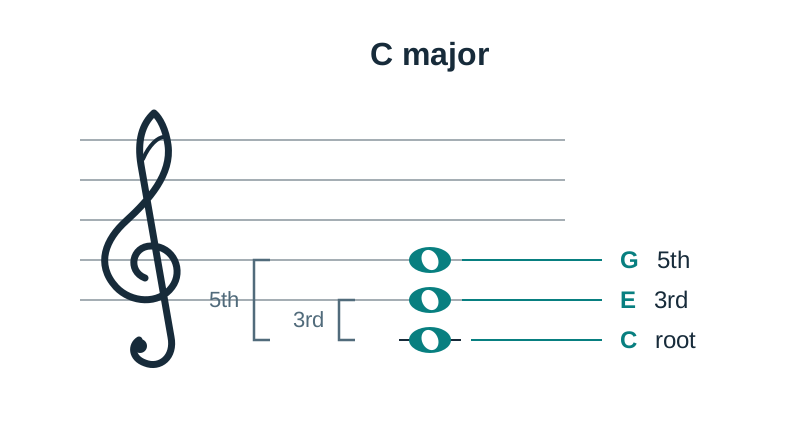
- A triad is a three-note chord built from a root, a 3rd above the root, and a 5th above the root.
- To build a triad, start on a scale note, miss the next note, add the following note, and repeat (for example, C–E–G forms C major).
- An accompaniment supports the melody by using chords that share notes with it.
- Major chords often sound bright, while minor chords often sound darker, though their musical effect depends on the context.
- You can adapt an accompaniment by trying alternative chords: for example, playing Em instead of G under a held B note, because both chords contain B.
Example Chord Banks and Notation
Build one triad on each major-scale note using only the notes of that key. Questions provide a chord bank or ask you to work within a specific key.
| Key | I | ii | iii | IV | V | vi | vii° |
|---|---|---|---|---|---|---|---|
| C major | C | Dm | Em | F | G | Am | B° |
| G major | G | Am | Bm | C | D | Em | F♯° |
| D major | D | Em | F♯m | G | A | Bm | C♯° |
| F major | F | Gm | Am | B♭ | C | Dm | E° |
- Chord symbols: use a capital letter for major (G), add 'm' for minor (Am), and include accidentals (B♭).
- Roman numerals: uppercase indicates major (I, IV, V), lowercase indicates minor (ii, iii, vi), and vii° indicates diminished.
- Any chord supplied in the bank may be considered; choose one that suits the melody and progression.
Step-by-Step Chord Selection
Work methodically through the melody, filling one box at a time.
- Check the key signature and note the chords in your bank.
- Look at all melody notes directly underneath the box up to the next chord change.
- Prioritise strong-beat and longer notes (such as beats 1 and 3 in 4/4 time).
- Choose a chord from your bank that matches the highest number of those notes.
- You can usually ignore passing notes (short notes on weak beats that step between harmony notes).
- If instructed, do not repeat a chord in adjacent boxes.
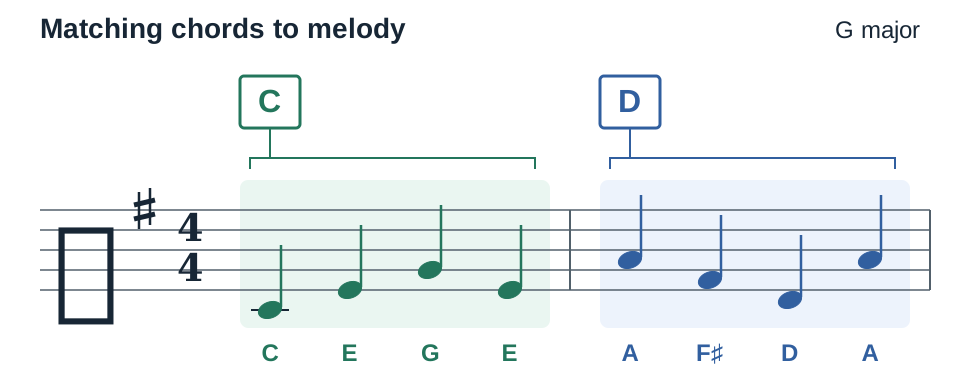
When listening to songs, identify chord changes by tracking harmonic shifts under the tune, remembering that melody notes often move while one chord continues.
Cadences and Progressions
A cadence is a pair of chords at the end of a musical phrase, functioning like musical punctuation.
| Cadence | Chord Pattern | G Major Example | Musical Effect |
|---|---|---|---|
| Perfect | V to I | D to G | Finished; acts like a full stop |
| Plagal | IV to I | C to G | Finished; softer resolution |
| Imperfect | Another chord to V, for example I–V or IV–V | C to D or G to D | Unfinished; acts like a comma |
| Interrupted | V to vi | D to Em | Unfinished; surprise move to minor |
A chord progression is a sequence of chords played in order. Songs often share chord patterns across different keys; for example, G–Em–C–D and C–Am–F–G both use the progression I–vi–IV–V.
Key terms
- Chord
- Two or more notes of different pitches sounding simultaneously.
- Triad
- A three-note chord constructed by stacking a root, a third, and a fifth.
- Tonic
- The first note, or doh, of a scale; the chord built on it is the tonic chord, Chord I.
- Cadence
- A pair of chords marking the end of a musical phrase.
- Chord Progression
- A series of chords played one after another to support a melody.
- Non-chord Note
- A melody note that does not belong to the supporting harmony, such as a passing note stepping between chord tones.
- Roman Numerals
- A numbering system indicating scale degrees and chord types, using uppercase for major (I, IV, V) and lowercase for minor (ii, iii, vi).
Check yourself
Which chord progression forms a perfect cadence?
Chord V followed by Chord I.
What does the lowercase 'm' mean in the chord symbol Am?
It indicates that the triad is minor.
How are major triads represented when using Roman numerals?
Using uppercase Roman numerals (such as I, IV, and V).
Which beats in a 4/4 bar are most important to match with chord tones?
The strong beats: beats 1 and 3.