
Aural skills mean recognising and describing what you hear in music. The Junior Cycle examination uses recorded audio tracks to test your knowledge of musical elements, instruments, vocal roles, textures, structures, and notation.
Expressive Elements, Metre, and Texture
Composers combine expressive elements to create mood, character, and tension.
- Dynamics control volume: pp (pianissimo, very soft), p (piano, soft), f (forte, loud), and ff (fortissimo, very loud).
- A crescendo means gradually getting louder, while a diminuendo means gradually getting softer.
- Tempo is the speed of the pulse: Largo (very slow), Andante (walking pace), and Allegro (fast).
- Metre groups beats: simple metres group beats in twos (2/4), threes (3/4), or fours (4/4).
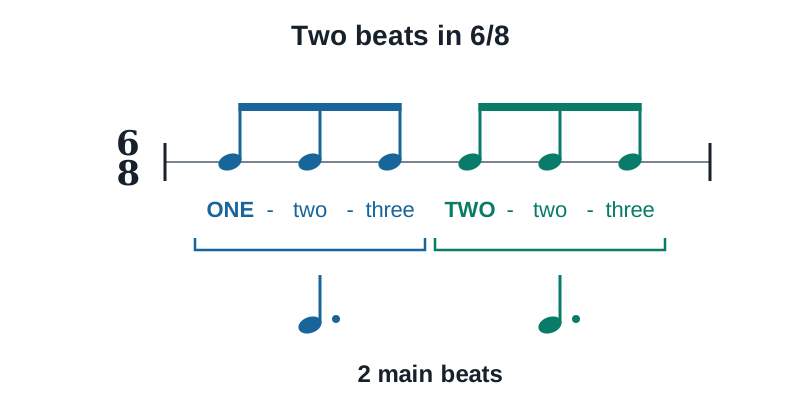
- Compound metre (6/8) groups six quavers into two dotted-crotchet beats, counted ONE-two-three, TWO-two-three.
- Tonality organises music around a home key; distinguish major from minor by ear rather than mood alone.
- Monophonic texture is a single unaccompanied melody line, such as solo sean-nós singing.
- Homophonic texture has a main melody supported by chordal accompaniment.
- Polyphonic texture features two or more independent melodies sounding at the same time.
Instruments, Voices, and Processing Effects
Instrument families use different ways to produce sound.
- Strings vibrate when bowed (arco) or plucked (pizzicato); bowing sustains sound, while plucked notes fade.
- Woodwind instruments make sound by blowing across an edge (flute) or vibrating a single or double reed.
- Brass instruments produce sound by buzzing the lips into a mouthpiece, using valves or slides to change pitch.
- Percussion instruments are struck, shaken, or scraped; they are either tuned (xylophone) or untuned (snare drum).
- Vocal ranges include soprano (high female), alto (low female), tenor (high male), and bass (low male).
- Describe the role actually heard: any voice type may sing melody, harmony, call-and-response or rhythmic sounds.
- Distortion alters sound waves to create a gritty tone on electric guitars.
- Reverb simulates room acoustics, making a sound linger in an acoustic space.
- Panning spreads audio across the left, centre, and right speakers to add stereo width.
Melodic, Rhythmic, and Structural Devices
Composers use recognisable musical patterns to build melodies, rhythms, and forms.
- A sequence repeats a melodic idea immediately at a higher or lower pitch.
- A drone sustains a note or chord continuously beneath changing melodies.
- In imitation, one voice or instrument repeats a phrase previously heard in another part.
- A scale moves through successive notes in order, while a broken triad sounds chord notes separately.
- Rhythmic features include syncopation (accenting off-beats), swing rhythm (uneven long-short quavers), and dotted rhythms.
- Unitary form has one main musical section, which may be repeated or varied.
- Binary form contains two contrasting sections (AB or AABB).
- Ternary has an A–B–A section plan; a repeated opening section can produce AABA. Check how phrases form sections.
- Graphic notation uses visual shapes, lines, or images; link each shape to its pitch or rhythm.
Aural Dictation and Chords
Dictation tasks test your ability to transcribe rhythms, pitch contour, and chord changes.
- Pulse is the steady beat; rhythm is the pattern of long and short sounds.
- In rhythmic dictation, listen for ties (same-pitch note lengths joined without replaying), rests (silence), and dotted notes alongside note values.
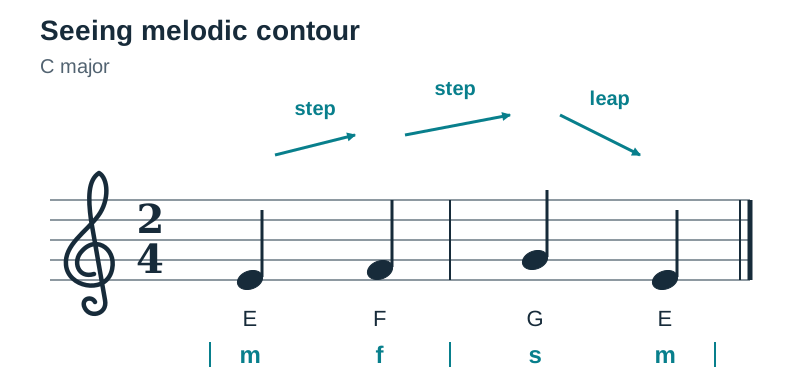
- In melodic dictation, listen for contour: whether notes step, leap, or repeat.
- Use the requested format: stave notation or, where offered, tonic solfa.
- A chord progression is a series of chords, such as I-IV-V or C-F-G.
- Listen to the whole accompaniment for a change of chord; the bass line often provides helpful clues.
- Choose criteria such as balance (parts heard clearly) and intonation (tuning); judge performances using evidence.
Key terms
- Timbre
- The distinctive tone colour or sound quality of an instrument or voice.
- Monophonic
- A musical texture consisting of a single unaccompanied melody line.
- Homophonic
- A musical texture where a main melody is supported by chordal accompaniment.
- Polyphonic
- A musical texture with two or more independent melodic lines sounding at the same time.
- Sequence
- A musical pattern repeated immediately at a higher or lower pitch.
- Ostinato
- A rhythmic, melodic, or harmonic pattern repeated continually throughout a piece.
- Syncopation
- A rhythmic device where accents are deliberately placed on unexpected weak beats or off-beats.
- Graphic notation
- A system where sound is represented by shapes, lines, or images rather than standard stave notes.
Check yourself
What texture consists of one single melody line without any accompaniment?
Monophonic texture.
What is the difference between arco and pizzicato on string instruments?
Arco means playing with a bow, while pizzicato means plucking the strings with the fingers.
Which letter pattern represents ternary form?
ABA: the opening section returns after a contrasting middle section.
What audio processing effect alters sound waves to produce a gritty, rough tone on an electric guitar?
Distortion.
How can you identify chord changes?
Listen to the whole accompaniment; bass movement can provide clues.