
Irish music encompasses traditional instrumental dance forms, expressive vocal styles, and orchestral or contemporary arrangements. The Junior Cycle examination assesses your ability to identify instruments, metres, and textures by ear, compare contrasting works, and investigate how Irish artists are represented across modern media.
Traditional Instruments and the Céilí Band
Identify traditional instruments by sound, then decide whether they provide melody, harmony, or rhythm.
Melody and Harmony Instruments
- Fiddle: standard violin played with traditional ornamentation such as cuts and rolls.
- Irish flute and tin whistle: wooden flutes and metal whistles that play swift melody lines.
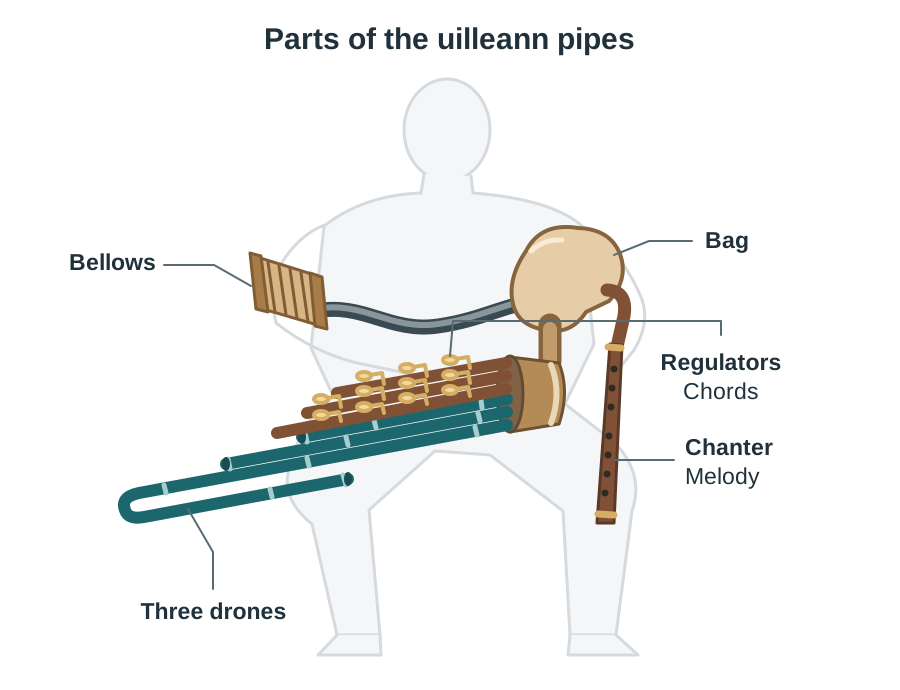
- Uilleann pipes: bellows-driven bagpipes with a melody chanter, three drones, and keyed regulators for chords.
- Concertina and button accordion: handheld bellows instruments that produce bright dance melodies.
- Harp and banjo: the harp provides melody and harmony; the banjo plays melody with a bright, percussive sound.
The Céilí Band
A céilí band accompanies group dancing. Fiddles, flutes, and accordions play the melody in unison. A piano provides vamping accompaniment, supported by rhythm from a snare drum or bodhrán.
Dance Forms and Metres
Dance types have characteristic metres and rhythms; tempo alone does not identify them. In performance, musicians frequently join two or three tunes of the same type together into a set.
| Dance Type | Time Signature | Pulse & Rhythm | Rhythm Cue |
|---|---|---|---|
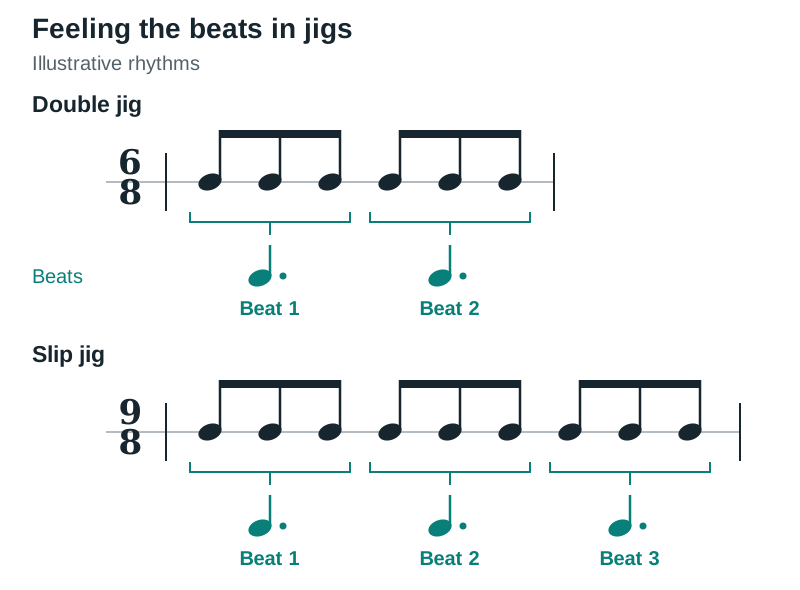
| Double Jig | 6/8 | Compound duple: two dotted-crotchet beats per bar, each dividing into three quavers | "Rashers and sausages" |
| Slip Jig | 9/8 | Compound triple: three dotted-crotchet beats per bar with a flowing triple feel | Counted in three groups of three (1-2-3, 4-5-6, 7-8-9) |
| Reel | 4/4 (or 2/2) | Simple duple or quadruple metre with a continuous flow of even quavers | Continuous even quavers with accents on beats 1 and 3 |
| Hornpipe | 4/4 | Moderate quadruple metre featuring bouncy dotted rhythms and triplets | "Will-ya wash the bloomin' dishes" |
Vocal Traditions, Interpretation, and Arrangement
Traditional performance centres on individual expression, acoustic textures, and melodic decoration.
- Sean-nós: unaccompanied Irish-language solo singing, often with decorative notes, flexible rhythm and melisma (several notes on one syllable).
- Lilting: vocalising dance tunes using rhythmic nonsense syllables instead of text.
- Monophonic: one unaccompanied melody, including instruments playing in unison.
- Homophonic: a melody with chordal accompaniment.
- Interpretation: a performer's expressive choices, such as tempo, dynamics, phrasing, and ornamentation.
- Arrangement: reworking a piece by changing instruments, harmony, structure or texture.
Irish Composers and Media Airtime
Composers often adapt traditional melodies for orchestra, while media tracking monitors how Irish artists gain broadcast airtime.
- Comparing composers: Seán Ó Riada's Mise Éire arranges the traditional air Róisín Dubh for orchestra using brass and homophonic chords.
- Shaun Davey: The Brendan Voyage pairs a solo uilleann pipes virtuoso with a full symphony orchestra.
- Investigating media airtime: students track minutes allocated to Irish artists across a variety of local or national Irish media.
- Airtime reports: log the station, monitoring period, and recorded minutes of airplay, and describe each artist's musical style.
- Promoting artists: awards, television appearances, and radio playlists raise artist profiles and influence public support.
Key terms
- Sean-nós
- An unaccompanied, highly ornamented style of traditional Irish solo singing, typically performed in the Irish language with flexible rhythm.
- Jig
- A lively traditional dance tune in compound time, characterised in a double jig by 6/8 metre with two dotted-crotchet beats per bar, each containing three quavers.
- Reel
- A fast, driving Irish dance tune in 4/4 or 2/2 time, characterised by a continuous flow of even quavers.
- Hornpipe
- A moderate-tempo Irish dance tune in 4/4 time characterised by dotted rhythms, triplets, and heavy accents.
- Uilleann Pipes
- Bellows-blown Irish bagpipes featuring a melody chanter, three continuous drones, and keyed regulators played with the wrist to produce chords.
- Vamping
- A piano accompaniment style in céilí bands that alternates a single bass note on the beat with an offbeat chord.
- Arrangement
- A reworking of an existing piece of music that alters elements such as instrumentation, harmony, voicing, or texture while keeping the original melody recognizable.
- IMRO
- The Irish Music Rights Organisation, which collects and distributes royalty payments to songwriters, composers, and music publishers when their music is broadcast or performed publicly.
Check yourself
What is the time signature and beat grouping of a slip jig?
9/8 time, organised into three dotted-crotchet beats per bar, each containing three quavers.
What is the musical difference between an interpretation and an arrangement?
An interpretation changes expressive choices like tempo and ornamentation during performance, while an arrangement alters instrumentation, harmony, or texture.
Which instrument provides the vamping accompaniment in a traditional céilí band?
The piano.
What essential information must be included in a media airtime investigation report?
Named artists, their musical styles, the media investigated, the monitoring period, and the recorded airtime allocated.