

This topic covers either World War One or World War Two, following your class choice. Exam questions ask you to explain causes, key wartime events, and immediate and long-term consequences for people and nations.
Working with Wartime Sources
Exam questions often present wartime posters, speeches, or photographs to test source skills.
- Propaganda: biased information spread by governments to shape civilian attitudes, enlist soldiers, or keep public morale high.
- Bias: an unbalanced view that favours one nation or political cause over another.
- Primary sources give direct eyewitness accounts from the period, while secondary sources offer later historical analysis.
- When studying a wartime poster, note the intended audience, the visual symbols used, and why the government issued it.
World War I: Causes and Course (1914–1918)
Four long-term tensions divided Europe before 1914:
- Militarism: rival nations competed in arms races, especially the naval race between Britain and Germany.
- Alliances: Europe split into the Triple Entente (Britain, France, Russia) and the Triple Alliance (Germany, Austria-Hungary, Italy).
- Imperialism: major powers clashed over trade routes and overseas colonies in Africa and Asia.
- Nationalism: strong national rivalries created political unrest across the Balkan region.
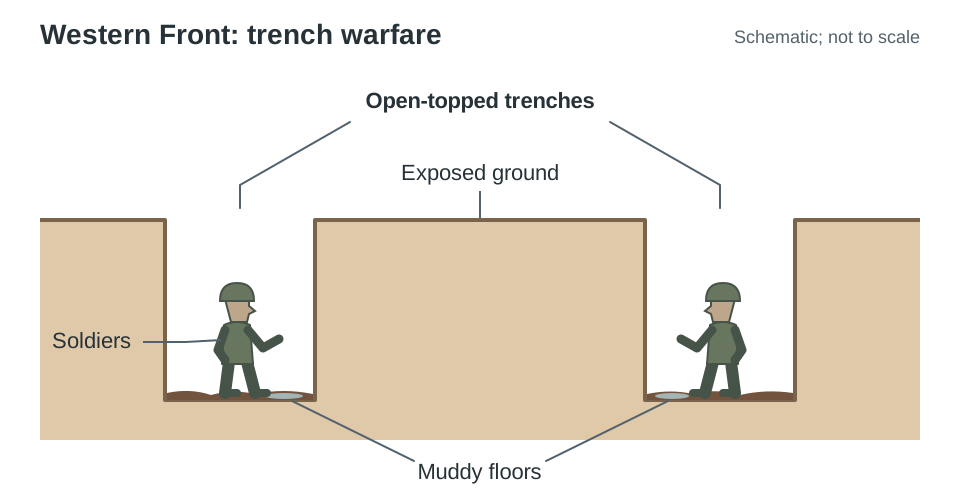
The assassination of Archduke Franz Ferdinand in Sarajevo on 28 June 1914 triggered war declarations across Europe. Trench warfare soon deadlocked the Western Front for four brutal years. Soldiers endured mud, artillery bombardments, poison gas, and shell shock. The 1916 Battle of the Somme caused 1.1 million casualties. In 1917, Russia withdrew after revolution and the United States entered. Germany signed an armistice on 11 November 1918.
World War I: Impact on People and Nations
The Great War permanently reshaped societies and redrew national borders across the globe.
- Over eight million soldiers died, while millions more returned home with severe injuries or permanent physical disabilities.
- Women entered factories, drove public transport, and worked on farms, accelerating campaigns for equal voting rights.
- Four historic empires collapsed: the German, Austro-Hungarian, Russian, and Ottoman empires.
- The 1919 Treaty of Versailles forced Germany to accept war guilt, lose territory, and pay £6.6 billion in reparations.
- The Treaty's reparations and loss of territory damaged the German economy, and anger at the Treaty helped Adolf Hitler rise to power.
- The League of Nations was established to preserve world peace, but it lacked an army and US membership.
World War II: Causes and Course (1939–1945)
Hitler's aggressive foreign policy and desire for Lebensraum (living space) in Eastern Europe drove Europe toward conflict.
- Germany remilitarised the Rhineland in 1936 and annexed Austria during the 1938 Anschluss.
- Britain and France used appeasement, conceding the Sudetenland at the 1938 Munich Conference to prevent another conflict.
- Hitler and Joseph Stalin signed the Nazi-Soviet Pact in August 1939, agreeing to carve up Poland.
- Germany invaded Poland on 1 September 1939, prompting Britain and France to declare war.
German forces deployed Blitzkrieg tactics, using coordinated tanks and aircraft to conquer Poland and France by June 1940. Radar helped the Royal Air Force win the Battle of Britain. Germany invaded the Soviet Union in June 1941, but Soviet troops halted the invasion at Stalingrad in February 1943. Following the 1944 D-Day landings in Normandy, Allied armies liberated Western Europe, leading to German surrender in May 1945.
World War II: Impact on People and Nations
World War II brought unprecedented civilian casualties and completely altered global politics.
- Over 60 million people died, and millions of city dwellers survived heavy aerial bombing raids during the Blitz.
- In the Holocaust, Nazi Germany systematically murdered six million Jewish people alongside millions of other victims.
- Strict food, clothing, and fuel rationing dominated daily life on domestic home fronts.
- Germany was partitioned into four military occupation zones administered by the Allied powers.
- The United States and Soviet Union became rival superpowers, triggering the ideological conflict of the Cold War.
- The United Nations formed in 1945 to resolve disputes, and the 1957 Treaty of Rome created the EEC.
Key terms
- Appeasement
- The British and French policy during the 1930s of giving in to Hitler's territorial demands to prevent another war.
- Blitzkrieg
- A German military tactic meaning 'lightning war' that combined tanks, motorised infantry, and close air support for rapid breakthroughs.
- Lebensraum
- A Nazi foreign policy concept meaning 'living space', aiming to conquer territory across Eastern Europe for German settlement.
- Armistice
- A formal agreement between warring sides to suspend combat operations, signed on 11 November 1918.
- Treaty of Versailles
- The 1919 peace treaty that forced Germany to accept war guilt, pay heavy reparations, lose land, and downsize its armed forces.
- Holocaust
- The state-sponsored, systematic murder of six million Jewish people and millions of others by the Nazi regime.
- Propaganda
- Information, imagery, or slogans published by a government or group to steer public opinion and control civilian behaviour.
- United Nations
- An international peacekeeping body established in 1945 to resolve diplomatic disputes, protect human rights, and promote global cooperation.
Check yourself
What 1914 event triggered the European alliance system and started World War One?
The assassination of Archduke Franz Ferdinand by Gavrilo Princip in Sarajevo on 28 June 1914.
Which battle fought between 1942 and 1943 marked the decisive turning point on the Eastern Front in World War Two?
The Battle of Stalingrad, where Soviet forces encircled and captured the German Sixth Army.
Name two ways World War Two affected civilian lives on the home front.
Civilians coped with mandatory food rationing and sent children away to rural areas during evacuation schemes.
What secret agreement did Hitler and Stalin make in the August 1939 Nazi-Soviet Pact?
They agreed not to attack each other and secretly planned to divide Poland between their two countries.