

This topic examines why Portuguese and Spanish voyages began and how they led to overseas conquest, colonial rule, and global trade. In the exam, you will explain the causes of exploration and evaluate how conquest affected indigenous peoples, enslaved Africans, and European societies.
Causes of Exploration and the Portuguese Route
Before the 1400s, sea voyages were slow and risky. Europeans relied on land routes across Asia, but Ottoman control pushed up prices. Spices were needed to preserve and flavour food, and were worth more than gold by weight. Kings wanted wealth, territory, and glory, while Catholic missionaries wanted to convert new souls. New tools made deep-sea travel possible: the magnetic compass, the astrolabe for measuring latitude, and the caravel, a fast ship with triangular lateen sails that could sail into the wind.
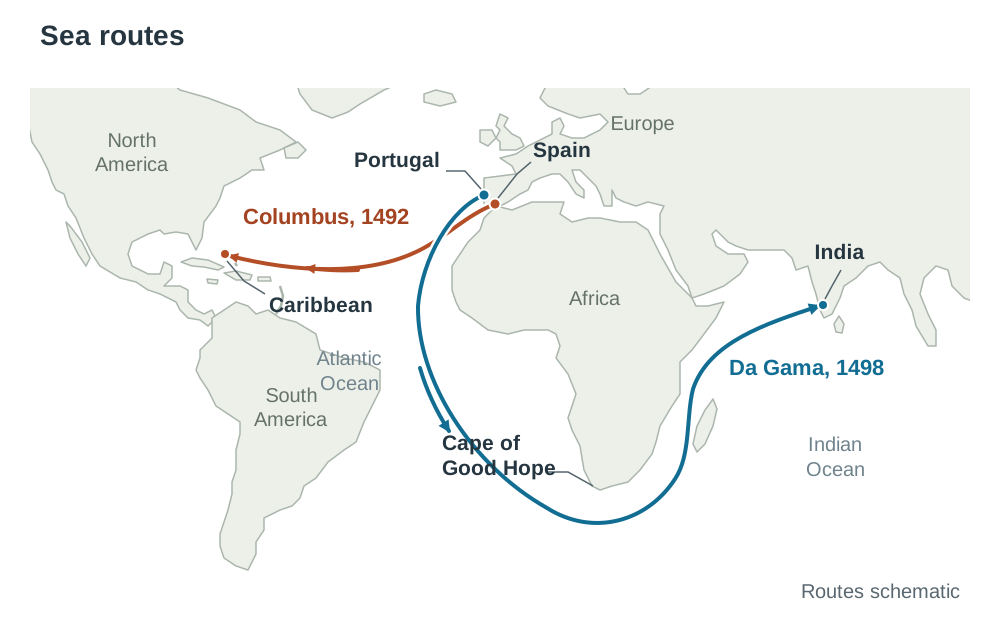
Portugal led the search for a sea route to Asia. Prince Henry the Navigator set up a centre of navigation at Sagres. Bartolomeu Dias rounded the Cape of Good Hope in 1488, and Vasco da Gama reached India in 1498, giving Portugal direct access to Asian spice markets. Portugal soon built fortified trading posts along African and Indian coasts, taking over trade previously run by Arab and Indian merchants. In 1500, Pedro Álvares Cabral reached Brazil, establishing a vast sugar colony.
Spanish Conquest of the Aztec and Inca Empires
Spain sponsored Christopher Columbus, who sailed west in 1492 and landed in the Caribbean. Spanish conquistadores soon followed to seize land and gold.
In 1519, Hernán Cortés landed in Mexico with roughly 500 men. He made alliances with tribes who resented Aztec rule, captured the capital Tenochtitlán in 1521, and renamed the territory New Spain. In 1532, Francisco Pizarro invaded Peru with fewer than 200 men. He captured the Inca ruler Atahualpa at Cajamarca, demanded a room filled with gold and silver as ransom, and executed him in 1533 before founding Lima.
Key Milestones
| Year | Event |
|---|---|
| 1488 | Dias rounds the Cape of Good Hope |
| 1492 | Columbus lands in the Caribbean |
| 1494 | Treaty of Tordesillas divides new lands |
| 1498 | Da Gama reaches India |
| 1500 | Cabral lands in Brazil |
| 1521 | Cortés takes Tenochtitlán |
| 1533 | Pizarro executes Atahualpa |
Impact on Indigenous Peoples and the Slave Trade
Conquest brought catastrophe to native populations. The conquistadores won because they had steel armour, guns, and horses, but European illnesses caused the worst damage. Historians estimate that diseases like smallpox, measles, and influenza wiped out up to 90% of native people, who carried no natural immunity.
Under the encomienda system, Spanish settlers received royal grants entitling them to forced native labour and tribute, promising protection and religious instruction in return. In practice, settlers worked native people to death in silver mines like Potosí and on large estates. Spanish friars tore down temples and burned native records to impose Christianity, though friar Bartolomé de las Casas condemned this cruelty and defended native rights.
To replace the dying workforce, Europeans turned to the transatlantic slave trade. Portugal had begun buying and shipping enslaved Africans from the 1440s. Millions were transported across the Atlantic under terrible conditions on the Middle Passage to work sugar plantations in Brazil and the Caribbean.
The Columbian Exchange and Effects on Europe
Overseas conquest transformed Europe alongside the Americas through the Columbian Exchange, the global transfer of plants, animals, goods, and people after 1492.
Effects in the Americas
- American societies received wheat, sugar cane, cattle, and horses, which altered transport and hunting.
- Ancient empires collapsed, and Spanish and Portuguese rule, language and the Catholic religion became dominant, though many native languages survived.
Effects in Europe
- New crops like potatoes and maize enriched European diets and supported population growth.
- Port cities such as Lisbon and Seville grew wealthy on colonial imports.
- Huge amounts of silver and gold flowed into Spain, enriching the Crown but triggering continent-wide inflation.
- European rivalries sharpened: Spain and Portugal agreed the Treaty of Tordesillas (1494), drawing an Atlantic meridian where lands to the west went to Spain and lands to the east went to Portugal, explaining why Brazil became Portuguese while the rest of South America became Spanish. Rivalry soon drew England, France, and the Netherlands into overseas wars.
Key terms
- Conquest
- Where a people or country takes control of another people or country by military force.
- Colonisation
- Process where a country takes over another country, establishes its authority and settles its people there.
- Conquistadores
- Spanish soldier-explorers who conquered native empires in the Americas during the sixteenth century.
- Encomienda system
- A Spanish colonial system giving settlers the right to demand forced labour and tribute from native people in return for promised protection and Christian conversion.
- Columbian Exchange
- The global transfer of plants, animals, food, human populations, and diseases between the Americas and Europe after 1492.
- Treaty of Tordesillas
- A 1494 agreement between Spain and Portugal dividing newly discovered non-European lands along an Atlantic line of longitude.
- Caravel
- A light, fast Portuguese-designed ship with lateen sails, capable of sailing into the wind on ocean voyages.
Check yourself
Give two reasons why Europeans sought an ocean route to Asia in the fifteenth century.
To bypass expensive Ottoman-controlled land routes and secure valuable spices directly to preserve and flavour food.
What was the encomienda system?
A Spanish system granting settlers the right to forced native labour and tribute in return for promised protection and conversion to Christianity.
Name two items that went to Europe and two items that went to the Americas in the Columbian Exchange.
Europe gained potatoes and maize; the Americas received horses and wheat.
Why did Brazil become a Portuguese colony while most of South America became Spanish?
The 1494 Treaty of Tordesillas drew an Atlantic dividing line giving newly discovered lands to the east to Portugal and to the west to Spain.