

This topic explores daily life, social organisation, and beliefs in an ancient society, using Ancient Rome as our example. You can answer exam questions on whichever civilisation you studied in class, such as Rome, Egypt, Greece, or the Celts.
Chronology and Archaeological Evidence
A civilisation is an organised society with its own government, culture, and way of life. Rome grew from a single city in Italy into an empire ruling lands across Europe, North Africa and the Middle East.
| Date | Historical Event |
|---|---|
| 753 BC | Rome founded, according to legend, by Romulus and Remus. |
| 509 BC | Rome became a republic ruled by elected officials and the Senate. |
| 27 BC | Augustus became the first emperor of Rome. |
| AD 313 | Emperor Constantine granted religious toleration to Christians. |
| AD 476 | The Western Roman Empire collapsed; the Eastern Empire survived. |
Historians learn about Rome through physical and written evidence:
- Archaeology uncovers physical remains, such as the towns of Pompeii and Herculaneum preserved under volcanic ash in AD 79.
- Artefacts including coins, tools, pottery, and mosaics show how ordinary people worked and lived.
- Standing ruins like aqueducts and the Colosseum prove Roman engineering skill.
- A primary source comes directly from the time, while a secondary source is written later by a historian.
Towns, Entertainment, and Beliefs
Roman towns followed a grid layout centred on the forum, a large open square used for markets, public meetings, and government business.
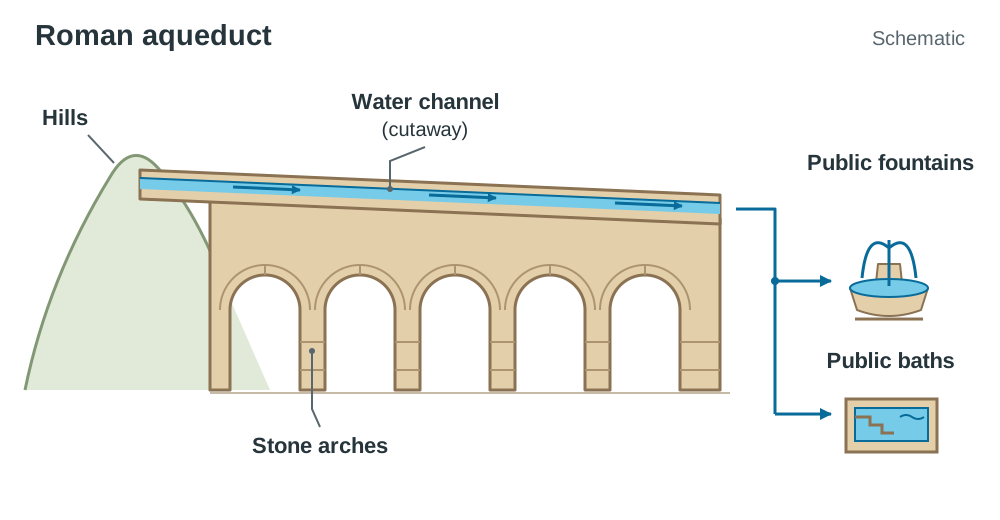
- Stone aqueducts used arches to carry fresh water from hills into public fountains and baths.
- Public baths were cheap places to wash, exercise, and meet friends.
- The Circus Maximus held over 100,000 spectators for dangerous chariot races.
- The Colosseum hosted gladiatorial contests between trained fighters, though matches did not always end in death.
- Roman religion was originally polytheistic, meaning people worshipped many gods, such as Jupiter and Mars.
- Early Christians were persecuted for refusing to worship the emperor, until Constantine granted them toleration in AD 313.
Rome's Lasting Legacy
Exam questions on this topic ask you to explain how your civilisation shaped later history, not just to list what it built.
- Roads: Straight, stone-paved roads linked Europe, and many modern routes still follow Roman foundations.
- Language: Latin evolved into modern Romance languages like French, Spanish, and Italian, and gave English many legal words.
- Architecture: The invention of durable concrete, rounded arches, and domes still shapes modern bridges and public buildings.
- Law and government: Written laws and public court trials form the basis of European legal systems, and modern parliaments copied the senate.
- The calendar: The Julian calendar introduced the 365-day year and twelve months used internationally today.
- Religion: Once the Roman Empire accepted Christianity, it spread widely and became the main religion of Europe.
Key terms
- Civilisation
- A people or nation in the past that was socially and politically organised.
- Artefact
- A human-made article of historical interest, including as a source of evidence.
- Patricians
- The wealthy ruling class and landowners of ancient Rome.
- Plebeians
- The ordinary citizens of ancient Rome, such as farmers, shopkeepers, and craftworkers.
- Domus
- A private, self-contained townhouse owned by a wealthy Roman family.
- Insulae
- Multi-storey Roman apartment buildings where most plebeians lived.
- Aqueducts
- Stone bridge channels engineered to bring clean water into Roman towns.
- Polytheistic
- Believing in and worshipping more than one god.
Check yourself
What was the name of the central public square in a Roman town?
The forum.
Name the volcanic disaster in AD 79 that preserved vital archaeological evidence about Roman daily life.
The eruption of Mount Vesuvius, which buried Pompeii and Herculaneum.
Identify one key difference between a domus and an insula.
A domus was a private house for a single wealthy family, whereas an insula was a multi-storey apartment block for ordinary families.
Which Roman emperor granted official toleration to Christians in AD 313?
Emperor Constantine.
Social Structure and Daily Living
Roman citizens were divided into two main social classes, alongside a large population of enslaved people.
The upper wooden floors of insulae had no water supply, so fires spread quickly. Enslaved people had no legal rights and worked in houses, on farms, and in mines, though some were granted freedom by their owners. Roman women could not vote or hold political office, and their daily life centred on running the household.