

This topic covers how people lived, worked, and died in Europe during the Middle Ages under the feudal system and in growing towns. The exam asks you to describe how people lived, to use evidence from pictures and documents, and to explain the causes and effects of the Black Death.
Feudalism, Castles, and Knights
Most of medieval Europe was organised under feudalism: the king gave out land in return for loyalty and military service. The monarch owned all the land and granted large estates called a fief to noble vassals, who swore an oath of fealty.
Castles and knights
- Early Norman fortifications were motte-and-bailey castles, built with a wooden keep on a raised earth mound beside a fenced courtyard.
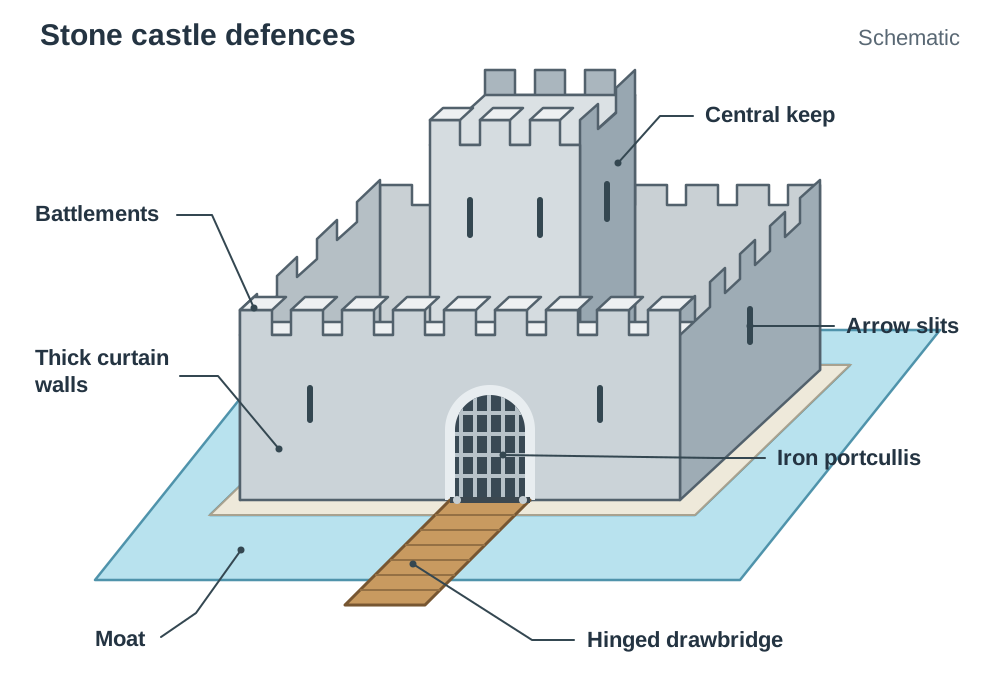
- Later stone castles featured a central keep, thick curtain walls, battlements, narrow arrow-slit windows, a moat, a drawbridge, and an iron portcullis gate.
- Castles stood on high ground or beside rivers so approaching enemies could be spotted quickly.
- Attackers breached defences using battering rams, catapults, siege towers, undermining tunnels, or by surrounding the castle to starve defenders out.
- Noble boys began military training as a page at age seven, advanced to squire at fourteen, and were dubbed a knight around twenty-one.
Peasant Life and Open-Field Farming
Most people lived in the countryside on manors managed for the lord by a bailiff. Freemen paid rent and could leave, but a serf was legally bound to the land. Peasants paid a tithe, equal to one-tenth of their yearly produce, to support the local church.
The open-field system
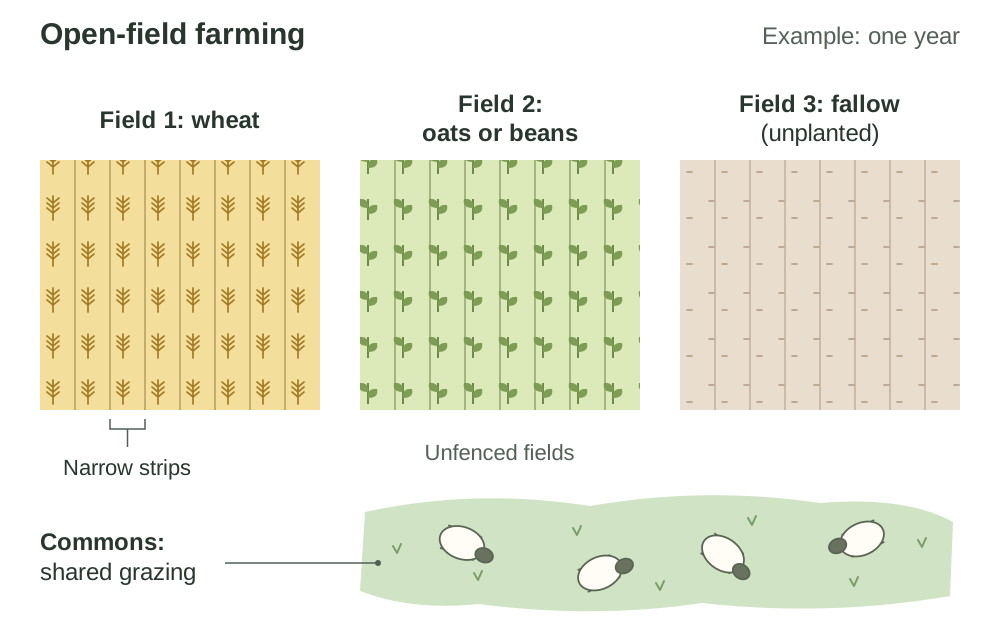
- Arable land was farmed using the open-field system, which divided large unfenced fields into narrow strips shared among families.
- Villagers used crop rotation, leaving one field fallow (unplanted) each year to let the soil recover nutrients naturally. For example, in one year field 1 grew wheat, field 2 grew oats or beans, and field 3 was left fallow; the next year they moved around.
- Animals grazed on shared grassland called the commons.
- Peasants lived in wattle-and-daub cottages with thatched roofs and ate dark bread, cheese, and vegetable pottage.
Life in a Chartered Medieval Town
Towns grew along waterways and near castles to promote trade. A town obtained self-government by buying a royal charter from the king, allowing citizens to elect a mayor, hold markets, and collect taxes. A runaway serf who lived in a town for a year and a day without being caught became legally free.
Guilds and town conditions
Craft guilds controlled trade in a town. They fixed prices, checked quality and trained workers in three stages:
- Apprentice: an unpaid youth living with a master craftsman to learn the trade.
- Journeyman: a trained worker paid by the day. To become a master, he made a 'masterpiece' for the guild to judge.
- Master craftsman: a fully qualified tradesman who owned a workshop and trained new apprentices.
Streets were narrow, unpaved and full of waste, so rats and disease spread easily.
Death and Religion in Medieval Times
Everyday survival was precarious. Life expectancy was short, roughly thirty to thirty-five years, and many infants died before their first birthday. Women frequently died in childbirth, while poor sanitation, untreated infections, and recurring bad harvests caused high mortality.
Religious beliefs and practices
- The Catholic Church was central to daily life and guided medieval attitudes toward death.
- People believed that after death the soul faced heaven, hell, or purgatory.
- Families paid priests to say Masses and prayers for dead relatives to shorten their suffering in purgatory.
- Christians went on pilgrimage to holy shrines and prayed before sacred relics to seek physical healing and the forgiveness of sins.
Disease and the Black Death
Medieval medicine lacked scientific understanding. Doctors blamed sickness on bad air (miasma) or God's punishment, and treated it with bloodletting, herbs and prayer to rebalance the four humours (body fluids).
Between 1347 and 1351 a deadly disease called the Black Death spread across Europe. It reached Ireland in 1348. The disease was bubonic plague, carried by fleas living on black rats. Victims suffered high fevers, spat blood, and developed painful swellings called buboes in the groin and armpits. Up to half the population died.
Consequences:
- A severe labour shortage left crops rotting in fields.
- Surviving peasants demanded to be paid wages in money and to pay lower rents.
- Serfs left manors to seek higher pay, permanently weakening the feudal system.
Key terms
- Feudalism
- A medieval political and social system where monarchs granted land in return for loyalty, taxes, and military service.
- Fief
- An estate of land granted by a monarch to a noble vassal under the feudal system.
- Serf
- An unfree peasant legally bound to live and work on a lord's manor.
- Tithe
- A compulsory tax of one-tenth of yearly agricultural produce or income paid to the church.
- Fallow
- Arable land left unseeded for a growing season to restore the soil's natural fertility.
- Charter
- A royal document granting a town rights of self-government, courts, and market privileges in return for taxes.
- Guild
- An organisation of craftworkers or merchants that regulated trade standards, prices, and apprentice training.
- Black Death
- A devastating pandemic of bubonic plague that swept across Europe between 1347 and 1351, killing up to half the population.
Check yourself
What were the walls of a medieval peasant's cottage made from?
Wattle and daub, which was woven wooden sticks plastered with mud, clay, and straw.
Name two defensive features that made a medieval stone castle difficult to capture.
Thick curtain walls, a deep moat, narrow arrow slits, and a drawbridge with an iron portcullis.
Under what condition could an escaped serf gain legal freedom in a chartered town?
By living in the town for a year and a day without being caught by the lord.
Name the three training stages required to become a master in a medieval craft guild.
Apprentice, journeyman, and master craftsman.
In what year did the Black Death first arrive in Ireland?
1348.