

The Cold War (1945–1991) was a long period of hostility between the capitalist USA and the communist USSR that never became a direct war between them. In the Junior Cycle exam, you must define key terms, explain major crises like Cuba, and recognise its importance in international relations.
Opposing Ideologies and the Outbreak of Tension
After Nazi Germany was defeated in 1945, the wartime alliance between the USA and the USSR broke down.
- The USA was capitalist and democratic: businesses were privately owned and people voted in free elections.
- The USSR was communist and a one-party dictatorship: the state controlled all property and censored the press.
- Mistrust grew as Stalin set up communist satellite states (countries controlled by the USSR) across Eastern Europe as a buffer against attack.
- In 1946, Winston Churchill announced that an Iron Curtain had come down across Europe, dividing East from West.
Containment and the Division of Europe
The United States introduced a policy of containment to stop Soviet communism spreading to any more countries.
- The Truman Doctrine (March 1947) promised US money, weapons and political support to any country resisting a communist takeover, beginning with Greece and Turkey.
- The Marshall Plan gave about $13 billion in US aid to rebuild western European economies between 1948 and 1952.
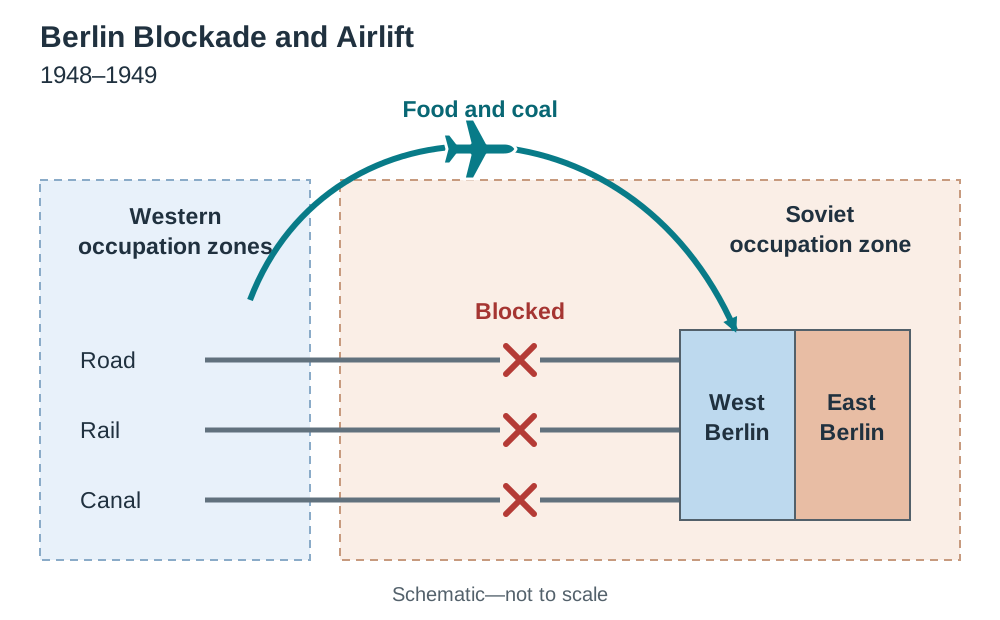
- In June 1948, Stalin launched the Berlin Blockade by cutting all road, rail and canal access to West Berlin.
- The Western Allies defeated the blockade with the Berlin Airlift, flying in food and coal until Stalin reopened routes in May 1949.
- The division hardened into rival military alliances: the Western Bloc formed NATO in 1949, and the Eastern Bloc formed the Warsaw Pact in 1955.
Flashpoints, the Arms Race and the Cuban Crisis
Both sides built huge arsenals of nuclear weapons, so fear of complete destruction stopped them fighting each other directly. Instead, they competed through proxy wars — conflicts in other countries where each superpower backed an opposing side — space exploration and diplomatic standoffs.
- The space race became a contest of prestige: the USSR launched Sputnik in 1957 and put the first man in space in 1961, while the USA landed men on the Moon in 1969.
- In 1961, East Germany built the Berlin Wall to stop its people escaping to West Berlin, turning it into the physical symbol of the Iron Curtain.
- The USA sent large numbers of troops to Vietnam from 1965 because of the domino theory, but communist forces won and united the country in 1975.
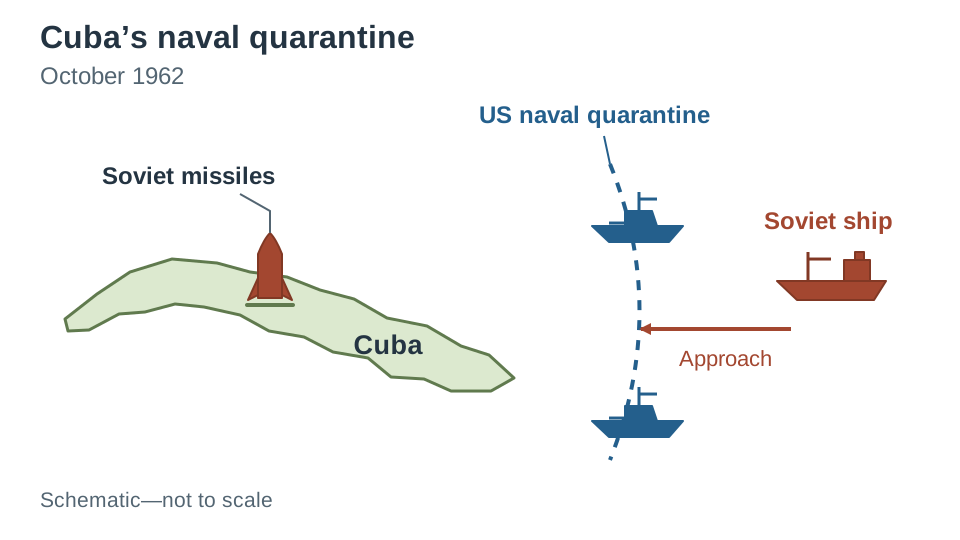
- The Cuban Missile Crisis (October 1962) brought both sides to the brink of nuclear war after US spy planes found Soviet missile sites on Cuba.
- President Kennedy set up a naval quarantine around Cuba, and Soviet leader Nikita Khrushchev agreed to remove the missiles in return for a US promise not to invade Cuba.
Importance in International Relations and the Fall of the USSR
The Cold War transformed world affairs for nearly fifty years and left lasting effects.
- Europe was split in two, with Germany and Berlin divided until 1989–1990.
- Countries were pushed into rival military alliances: NATO in the West and the Warsaw Pact in the East.
- The nuclear arms race meant the entire world lived under constant fear of total destruction.
- Local civil wars in Asia, Africa and the Americas were turned into superpower conflicts.
- Superpower tension eased during periods of détente, but the Soviet economy could not keep pace with military spending.
- Mikhail Gorbachev introduced two major reforms: Glasnost (openness) and Perestroika (economic restructuring).
- In November 1989 the Berlin Wall opened and communist governments across Eastern Europe fell, most of them without fighting.
- The Soviet Union dissolved in December 1991, ending the Cold War.
Key terms
- Western Bloc
- The group of capitalist, democratic countries led by the USA.
- Eastern Bloc
- The group of communist countries led by the USSR.
- Containment
- The American policy of stopping the spread of communism to other countries.
- Iron Curtain
- Winston Churchill's description of the political and physical division between communist Eastern Europe and democratic Western Europe.
- Blockade
- Stopping people, food or goods from moving into or out of an area.
- Domino theory
- The belief that if one country fell to communism, neighbouring countries would quickly follow.
- Arms race
- Competition between rival superpowers to build larger stocks of superior nuclear and conventional weapons.
- Détente
- A relaxation in relations between East and West, when tension between the superpowers eased.
Check yourself
What phrase did Winston Churchill use in 1946 to describe the division of Europe?
The Iron Curtain.
How did the Western Allies bypass the 1948 Soviet ground blockade of West Berlin?
They flew supplies into the city during the Berlin Airlift.
What secret concession did the US make to help resolve the Cuban Missile Crisis in 1962?
The US secretly agreed to remove its nuclear missiles from Turkey.
What were the names and meanings of Mikhail Gorbachev's two major reform policies?
Glasnost (political openness) and Perestroika (economic restructuring).
Give two ways the Cold War affected international relations.
It divided Europe into rival military alliances (NATO and Warsaw Pact) and created a global nuclear arms race.