

This topic explores the political crises, civil rights struggles, and cultural changes that swept Europe and the wider world during the 1960s. For your Junior Cycle exam, you must be able to debate whether the 1960s was an important decade by pointing to key people, events, and results.
Cold War Crises and the Space Race
The 1960s opened with intense Cold War rivalry between the United States and the Soviet Union. Tensions peaked in Europe and the Caribbean before competition shifted into space.
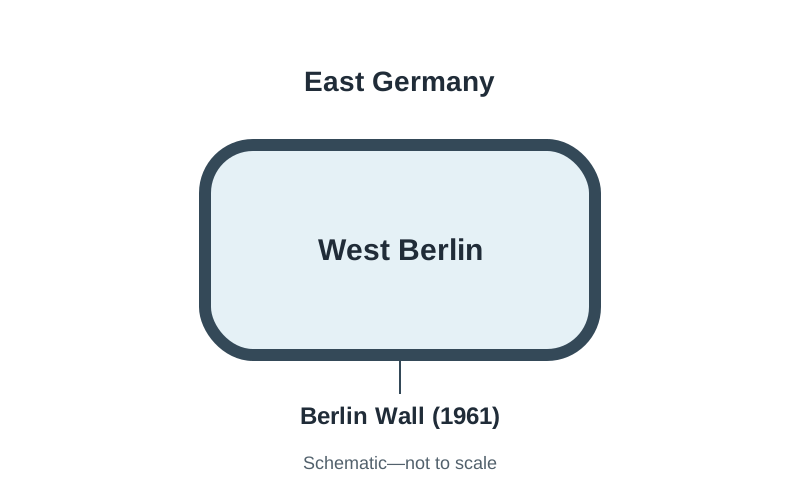
- Berlin Wall (1961): Communist East Germany built a concrete wall around West Berlin to stop citizens escaping to the West.
- Cuban Missile Crisis (1962): A dangerous 13-day nuclear standoff erupted when the Soviets placed nuclear missiles in Cuba. President John F. Kennedy blockaded the island, and the crisis ended when Khrushchev agreed to remove the missiles; a direct Moscow–Washington hotline was set up in 1963.
- Space Race: Soviet cosmonaut Yuri Gagarin became the first person in space in April 1961. Kennedy then pledged that America would land an astronaut on the Moon before 1970.
- Apollo 11 (1969): Neil Armstrong and Buzz Aldrin walked on the Moon on 20 July 1969, fulfilling that pledge.
The US Civil Rights Movement
In the American South, state laws called Jim Crow laws enforced racial segregation. African Americans could not use the same schools, buses, or restaurants as white citizens, and unfair tests stopped them from voting.
- Martin Luther King Jr.: A Baptist minister who organised non-violent marches, boycotts, and speeches.
- March on Washington (1963): Over 250,000 people gathered to hear King's famous 'I Have a Dream' speech calling for equality.
- Civil Rights Act (1964): Federal law that made racial segregation illegal in public places and workplaces.
- Selma March (1965): Police violently attacked peaceful marchers demanding voting rights on 'Bloody Sunday', outraging the public.
- Voting Rights Act (1965): Banned literacy tests and protected black voters at polling stations.
Youth Culture, Protest, and European Reform
A post-war baby boom produced millions of teenagers with more spending money, education, and free time than their parents ever had.
- Counterculture: Young people rejected traditional rules through rock music, fashion, and anti-war rallies against the Vietnam War.
- Women's Rights: Authors like Betty Friedan challenged traditional gender roles, sparking campaigns for equal pay and workplace rights.
- Prague Spring (1968): Alexander Dubček introduced democratic reforms in Czechoslovakia, but Soviet tanks invaded in August to crush them.
- Paris Protests (May 1968): French students and striking workers shut down factories and universities, demanding political reform.
- Vatican II (1962–1965): Pope John XXIII called Catholic bishops together to modernise the Church, allowing Mass in people's own language instead of only Latin.
Debating Historical Significance: The 5 Rs
When you debate whether the 1960s was an important decade, test the evidence against the 5 Rs framework:
| 5 Rs Criterion | 1960s Historical Evidence |
|---|---|
| Remarkable | The Apollo 11 Moon landing stunned millions watching live on television worldwide. |
| Remembered | Events like King's 1963 march feature prominently in history books, films, and school courses today. |
| Resonant | Modern protest groups still borrow the peaceful protest tactics and songs of the 1960s. |
| Resulting in change | US federal laws ended legal segregation, and Vatican II permanently changed Catholic worship. |
| Revealing | The decade exposed deep racial divisions, Cold War dangers, and a growing generation gap. |
Key terms
- Cold War
- The period of political tension and nuclear rivalry between the USA and the Soviet Union without direct fighting between them.
- Space Race
- The Cold War competition between the USA and the USSR to achieve major milestones in space exploration.
- Civil Rights Movement
- The campaign in 1950s and 1960s America that used peaceful methods to end racial discrimination and gain legal equality.
- Segregation
- The enforced separation of different racial groups in daily life, housing, transport, and schools.
- Counterculture
- A 1960s youth movement that rejected conservative lifestyles, traditional authority, and military conflict.
- Vatican II
- A council of Catholic bishops (1962–1965) that modernised church practices, including allowing Mass in local languages.
- Historical significance
- How important a person, issue, or event was in causing change and shaping the future.
Check yourself
Which Soviet cosmonaut became the first human in space in 1961?
Yuri Gagarin.
What was the main purpose of the Berlin Wall built in 1961?
To stop East Germans escaping into democratic West Berlin.
Name the US legislation passed in 1964 that banned racial segregation in public places.
The Civil Rights Act of 1964.
What major change did the Second Vatican Council introduce to the Catholic Mass?
It allowed Mass to be said in local languages instead of Latin.
Why is the 1960s Civil Rights Movement considered 'resonant' today?
Modern equality and justice campaigns still copy its peaceful protest methods, songs, and speeches.