

Chronology is the practice of arranging historical events in date order. In Junior Cycle History, you will use timelines to build a 'big picture' of the past, calculate centuries and date spans, and connect Irish history to wider world events.
The 'Big Picture' and Historical Eras
Prehistory is the time before people kept written records, which we learn about through archaeology rather than documents. Historians divide the past into broad eras to trace major patterns of change:
- Prehistory (before writing): Stone, Bronze and Iron Age Ireland, for example Newgrange (c. 3200 BC). Here c. (short for circa) means 'about', showing the date is an estimate.
- Medieval era: roughly 500 AD to 1500 AD, including the arrival of the Normans in 1169 AD.
- Early modern era: around 1500 to 1800, including the Irish Plantations.
- Modern era: 1800 to the present, including the Great Famine in 1845.
Measuring Time, Centuries, and Date Spans
Historical dates are traditionally counted from the estimated birth of Christ. There is no year zero, so 1 BC moves directly into 1 AD.
| Term | What it means |
|---|---|
| BC (Before Christ) | Dates before the birth of Christ, counting backwards towards 1 AD (500 BC is earlier than 100 BC) |
| AD (Anno Domini) | Dates after the birth of Christ, counting forwards from 1 AD to today |
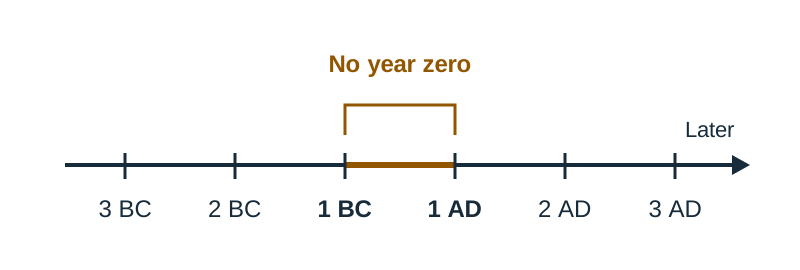
You may also see BCE (Before Common Era) and CE (Common Era); these mean the same as BC and AD.
A decade is 10 years, a century is 100 years, and a millennium is 1,000 years.
To find the century of an AD date, look at the hundreds. If a year ends in 00, it is the final year of that century (1800 is the 18th century). If digits follow the hundreds, add one: 1845 is the 19th century (18 + 1 = 19).
To calculate the span between dates:
- In the same era, subtract: from 1845 to 1916 is 1916 − 1845 = 71 years.
- Across BC and AD, add: from 500 BC to 1500 AD is 500 + 1500 = 2,000 years, because there is no year zero.
Creating and Maintaining Timelines
A timeline is a visual display that tracks historical events in order along a line. To maintain a timeline means to keep adding to it as you study new topics over the three years.
When constructing a timeline, follow three practical rules:
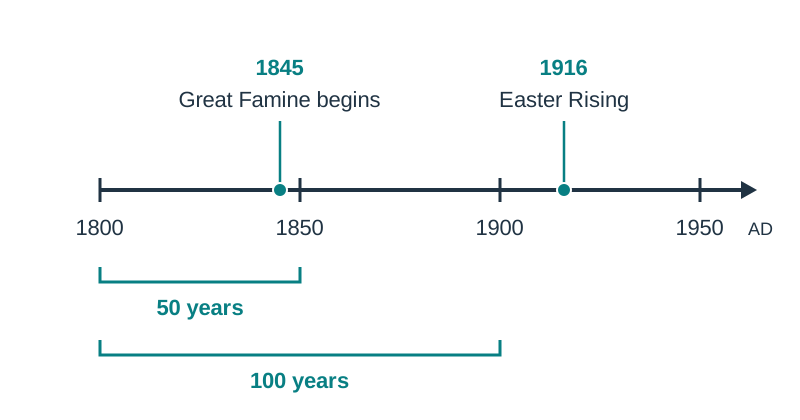
- Even scale: equal gaps on the line stand for equal numbers of years, so 100 years takes twice the space of 50 years.
- Chronological order: sequence events from left to right (or top to bottom), running from earliest to most recent.
- Precise labels: state the date alongside a brief explanation of what happened.
Making Connections Across Six Dimensions
A 'big picture' framework lets you connect events across Ireland and the wider world. For instance, the 1916 Easter Rising in Dublin occurred during the First World War in Europe.
Historians examine the past across six key dimensions:
- Political: governments, laws, power, and conflict.
- Social: daily life, families, and living conditions.
- Economic: work, trade, farming, and industry.
- Religious: beliefs, places of worship, and religious change.
- Cultural: language, art, literature, and customs.
- Scientific: technology, medicine, and inventions.
Chronological order shows the sequence of events, but an earlier event did not automatically cause a later one. You must use evidence to prove a connection.
Key terms
- Chronology
- Putting events in the order of the dates on which they happened.
- Timeline
- A visual display that marks dates and events in order along an even scale.
- Anno Domini (AD)
- Latin phrase meaning 'in the year of our Lord', used for dates counting forward from 1 AD.
- Before Christ (BC)
- Dating term used for years counting backwards before 1 AD.
- Century
- A period of 100 years, such as 1901 to 2000 (the 20th century).
- Prehistory
- The time before people kept written records, studied through archaeology.
- c. (circa)
- Latin word meaning 'about', used when an exact historical date is unknown.
- Historical Consciousness
- Understanding human actions in their historical context and seeing how the past shapes today's world.
Check yourself
Which date is more recent: 38 BC or 36 AD?
36 AD is more recent because all AD dates occur after BC dates.
Which century does the year 1609 (the Plantation of Ulster) fall into?
The 17th century (16 + 1 = 17).
Is there a year zero between 1 BC and 1 AD?
No, the calendar moves directly from 1 BC to 1 AD.
How many years passed from 300 BC to 1200 AD?
1,500 years (300 + 1200 = 1,500, because there is no year zero).