

This topic covers how historians and archaeologists find, date, and examine physical and written evidence from the past. Exam questions test your ability to classify primary and secondary sources, explain dating techniques, and spot bias in historical evidence.
Finding and Excavating Sites
Archaeology is the study of the past through physical remains. An artefact is any human-made object, such as a coin or an axe. Archaeologists look for sites before they dig.
- Aerial photography: Drone or plane photos show crop marks and shadows of buried walls.
- Documentary research: Old maps, placenames, and records point to forgotten ruins.
- Rescue archaeology: Excavations carried out before new roads or buildings destroy a site.
- Chance finds: Discoveries made by accident during farming, construction, or turf-cutting.
Bogs and dry conditions preserve wood, leather, and textiles that normally rot away.
Scientific Dating and New Technology
Archaeologists test discoveries to find out when people made them.
| Method | What it dates | How it works |
|---|---|---|
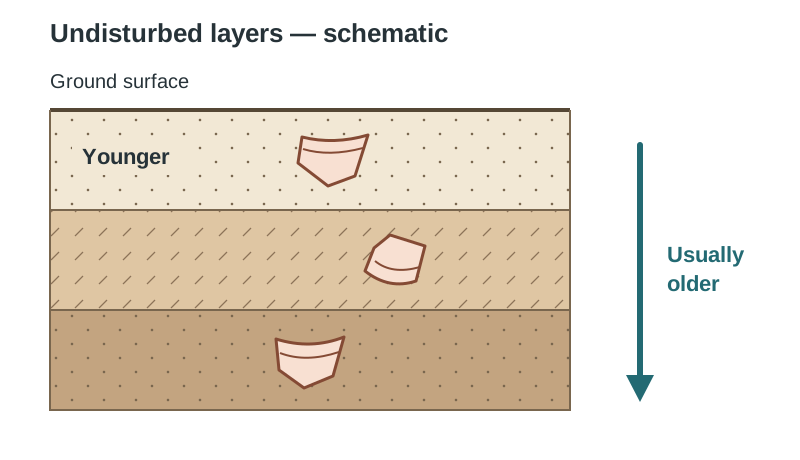
| Stratigraphy | Relative sequence | Finds in deeper soil layers are usually older than those above. |
| Radiocarbon dating | Once-living material | Measures how much carbon-14 remains in dead bone, wood, or charcoal. |
| Dendrochronology | Ancient timber | Matches tree-ring growth patterns in wood to dated calendar sequences. |
| Pollen analysis | Surrounding plants | Preserved pollen grains show which crops and trees grew nearby. |
- Geophysical survey: Radar and magnet scanners detect buried walls without digging.
- DNA analysis: Ancient bones reveal genetic ancestry, illnesses, and family relationships.
Sources and Types of Evidence
A source is anything that gives us information about the past. When you use information from a source to support an answer, it becomes evidence.
- Primary source: First-hand evidence created during the period under study, such as a 1916 diary or an iron spearhead.
- Secondary source: A second-hand account made after an event by someone who was not there, like a school textbook.
| Type | Example | Usefulness and Limitation |
|---|---|---|
| Written | Diary, census record | Gives detailed thoughts, but can be one-sided. |
| Visual | Painting, photograph | Shows appearances and dress, but can be staged. |
| Oral | Spoken interview | Gives personal memories, but human memory fades. |
| Aural | Speech recording | Preserves tone of voice, but needs background context. |
| Tactile | Pottery shard, tool | Shows craftsmanship, but cannot tell you the maker's thoughts. |
Evaluating Evidence and Repositories
Historians test evidence to build an accurate picture of what happened. Because new evidence appears over time, historical judgements are provisional and can change.
- Fact: A statement proven true by evidence.
- Opinion: A personal belief that cannot be proven conclusively.
- Viewpoint: The position a person takes, shaped by their background, politics, or religion.
- Bias: An unfairly one-sided view that shows prejudice.
- Objectivity: Looking at evidence fairly and neutrally without taking sides.
- Corroboration: Cross-checking a claim against independent sources to see if they agree.
- Repositories: A museum displays physical artefacts, while an archive stores official records, maps, and manuscripts.
Key terms
- Archaeology
- The study of the past by digging up and examining physical remains.
- Artefact
- A human-made object of historical interest.
- Stratigraphy
- Dating artefacts based on the layer of soil in which they are buried.
- Radiocarbon dating
- Dating once-living material by measuring its remaining carbon-14.
- Dendrochronology
- Dating ancient timber by matching its tree rings to calendar years.
- Primary source
- First-hand evidence from the time of the event.
- Secondary source
- A second-hand account produced after an event took place.
- Bias
- An attitude or account that is unfairly one-sided.
Check yourself
What is the difference between a historical source and historical evidence?
A source is the item itself, such as an object, document or recording, while evidence is the information you take from it to support an answer.
Which dating method matches ring patterns in ancient timber to calendar dates?
Dendrochronology.
What is rescue archaeology?
An emergency excavation carried out to record a site before road building or construction destroys it.
How does a museum differ from an archive?
A museum collects and displays physical artefacts, while an archive stores written records, letters, and documents.
Why are historical judgements described as provisional?
Because fresh evidence from new digs or newly opened archives can change what historians know.