

Historical concepts are the core ideas historians use to investigate evidence, understand why people acted as they did, and trace patterns of change. In the exam, you need to define these concepts, spot bias in sources, and explain historical significance.
Working with Evidence: Sources, Facts, and Bias
A source is any surviving material from the past, while evidence is information taken from a source to answer a question.
| Concept | Meaning | Example |
|---|---|---|
| Primary source | First-hand material created during the time being studied. | A 1798 diary, a 1911 census record, or a photograph. |
| Secondary source | An account written after an event by someone who was not there. | A school textbook, modern biography, or website article. |
| Fact | A statement that can be proven true using evidence. | 'The Easter Rising began in Dublin in 1916.' |
| Opinion | A personal view or interpretation that cannot be proven true. | 'The rising was a mistake.' |
| Viewpoint | The perspective a source expresses, shaped by the writer's background or beliefs. | A unionist and a nationalist describing the same event differently. |
| Bias | An unfairly one-sided view that ignores alternative perspectives. | Using insults or exaggerated language to attack opponents. |
| Objectivity | Looking at evidence neutrally without personal prejudice. | Reporting the actions of both sides in a conflict fairly. |
| Propaganda | Biased or exaggerated information spread to persuade people to support a cause. | Wartime recruiting posters. |
Historians always cross-check their sources. Comparing different accounts helps them confirm that facts are accurate.
Cause, Consequence, Change, and Continuity
Every major historical event has causes that led up to it and consequences that followed.
- A cause is the reason something happened, which can be a long-term condition or an immediate trigger.
- Potato blight was the trigger of the Great Famine, while widespread poverty was an underlying cause.
- A consequence is the outcome or result that follows an event.
- Mass emigration and sharp population decline were major consequences of the Famine.
- Change and continuity describes how some features transform over time while others stay the same.
- Change refers to what altered in politics, work, or daily life.
- Continuity refers to practices, laws, or traditions that carried on without altering.
During the Famine, land ownership stayed in landlord hands even though rural society changed completely.
Time, Space, and Historical Empathy
To make sense of past actions, you must place people in their correct geographic setting and era.
- Chronology means putting events in time order from earliest to latest.
- To find the century, add one to the hundreds figure: 1798 is in the eighteenth century.
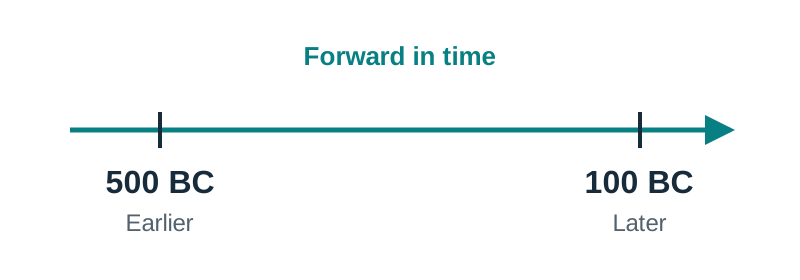
- BC dates count backwards toward zero, so 500 BC happened before 100 BC.
- Space matters because events depend on where they happened, such as Ireland's position within the British Empire in 1916.
- Historical empathy means understanding the motivations and beliefs of people within the context of their own time.
- Having empathy does not mean you agree with someone's actions; it means you understand their reasons.
- A contentious issue is a topic that people still disagree about, such as the Northern Ireland Troubles.
- Nationalists and unionists viewed the same events from opposing perspectives.
Historical Significance and Commemoration
Historians describe a person or event as historically significant when they caused major change or revealed something important about an era.
Historians often judge significance using the 5 Rs framework:
- Remarkable: People remarked on it at the time or later.
- Remembered: It remained important in the collective memory of a group.
- Resonant: People make comparisons with it across time and space.
- Resulting in change: It led to clear consequences for the future.
- Revealing: It uncovers wider truths about society or beliefs.
A topic does not need all five Rs to be significant.
- A commemoration is a public act of remembrance, like a statue, ceremony, or anniversary.
- Commemorations can be contentious because different groups remember the same past event in very different ways.
Key terms
- Primary Source
- First-hand material or an object created during the historical period under study.
- Secondary Source
- An account or interpretation produced after an event by someone who was not there.
- Bias
- An inclination to take an unfairly one-sided view while ignoring other perspectives.
- Propaganda
- Information, often biased or exaggerated, spread deliberately to persuade people to support a cause.
- Objectivity
- Examining historical evidence fairly and neutrally without allowing personal prejudice to sway judgements.
- Historical Empathy
- Understanding the motivations, actions, and beliefs of people in the context of their own era.
- Historical Significance
- The importance of a person, event, or issue in bringing about change or revealing the past.
- Commemoration
- A public act of remembrance honouring a historically significant person or event.
Check yourself
What is the difference between a source and historical evidence?
A source is surviving material from the past; evidence is information extracted from that source to answer a historical question.
Can change and continuity happen at the same time?
Yes, because political systems or living standards can change while cultural habits, religions, or land ownership remain the same.
Which century does the year 1798 fall into?
The eighteenth century.
Does a person or event need to meet all 5 Rs to be historically significant?
No, a subject can be historically significant without satisfying all five criteria.