

A historian investigates the past by gathering surviving evidence, testing how reliable it is and drawing fair, balanced conclusions about human experience. In the Junior Cycle examination, you must distinguish between different types of sources, evaluate their usefulness and limitations, and explain how historians test evidence.
The Historian, Evidence and Time
Historians investigate surviving evidence to reconstruct past events and understand why people acted as they did.
- The historian's method: asks a clear question about the past; finds sources in archives, libraries and museums; cross-checks them for accuracy and bias; forms a judgement based on evidence; writes up findings and lists sources in a bibliography.
- Source and evidence: a source is any material that gives us information about the past. Evidence is the specific information taken from that source to answer an enquiry.
- Chronology means putting events in date order. BC means before Christ and AD after. Dates in the 1900s belong to the twentieth century, and dates in the 1800s to the nineteenth. Timelines place events in the right era.
A historian's judgement can change when fresh evidence appears. In 2016, new radiocarbon dating of a cut-marked bear bone from a Co. Clare cave pushed the earliest known human activity in Ireland back by about 2,500 years.
Primary and Secondary Sources
Historians classify all historical material into two main categories:
- A primary source is first-hand material from the time being studied, made by someone who was there or close to the event (such as a 1916 diary, a 1911 census form or a Viking sword).
- A secondary source is a later account produced by someone looking back, interpreting primary evidence (such as a school textbook, a modern biography or a historical documentary).
Sources come in five forms:
| Form | Example |
|---|---|
| Written | Letters, treaties, census returns |
| Visual | Photographs, posters, paintings |
| Aural | Radio broadcasts, recorded speeches |
| Oral | Eyewitness interviews, folk memories |
| Tactile | Coins, tools, clothing |
Judging a Source: Bias, Fact and Fairness
Historians do not take a source at face value. They question it closely to judge how reliable it is and why it was made.
- Fact and opinion: a fact can be proven with evidence, whereas an opinion is a personal belief or interpretation.
- Objectivity means forming a fair, balanced judgement without personal feelings. A bias unfairly favours one side.
- Propaganda is information created deliberately to influence public attitudes, often using exaggeration to overstate what happened.
- Cross-checking means comparing multiple independent sources to confirm facts, spot mistakes and notice bias or propaganda.
- Biased sources are still useful because they reveal the motives, prejudices and tactics of the people who created them.
- Cause and consequence: a cause is why an event happened; a consequence is a result that followed it.
- Change and continuity: change is what became different over time; continuity is what stayed the same.
Archaeology and Repositories of Evidence
Archaeologists uncover physical remains to study the past, especially prehistory, the long period before written records began.
- Tools on a dig: a trowel scrapes back thin layers of soil; a brush cleans soil off fragile finds; a sieve sifts soil to catch tiny objects such as beads or bone fragments.
- Recording finds: every artefact is photographed, labelled and marked on a site plan before it is lifted, so its exact position is recorded.
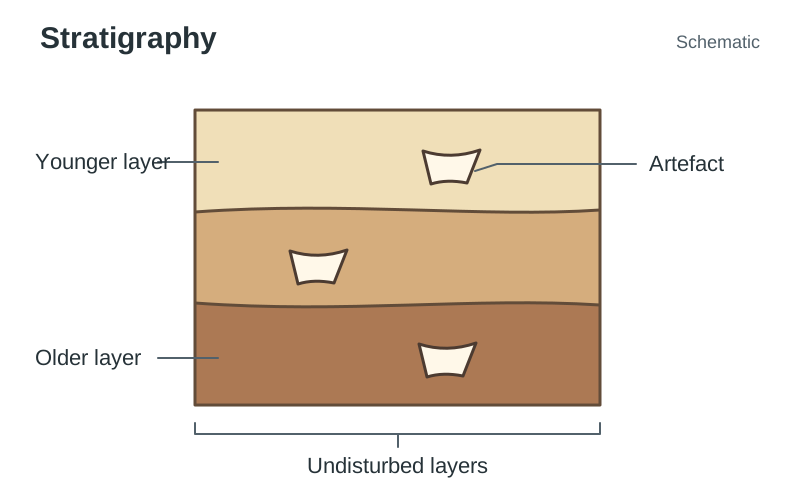
- Scientific dating: radiocarbon dating measures carbon decay in organic remains such as bone or wood; stratigraphy dates finds by the soil layer in which they lie; dendrochronology dates preserved timber using tree rings.
- A repository is a place that stores and looks after evidence — an archive, library, museum, heritage centre or online archive.
Key terms
- Primary source
- First-hand material from the time being studied, made by someone who was there or close to the event.
- Secondary source
- A later account produced by someone looking back, interpreting primary evidence.
- Cross-checking
- Comparing different sources to confirm facts, spot mistakes and verify accuracy.
- Bias
- An unfair preference for or prejudice against a particular viewpoint or side.
- Propaganda
- Information created deliberately to influence public attitudes and opinions.
- Objectivity
- Forming fair, balanced judgements based on evidence without personal feelings.
- Historical empathy
- Judging people of the past by the beliefs and conditions of their own time, not by modern standards.
- Significance
- The historical importance of a person, issue or event that caused major change or is remembered today.
Check yourself
What is the key difference between a primary source and a secondary source?
A primary source comes directly from the time being studied, whereas a secondary source is created later by someone looking back.
Which archaeological dating method determines age by counting rings in preserved timber?
Dendrochronology.
Give one reason why information in a historical document might be incorrect.
Bias, propaganda, exaggeration, or an accidental factual error by the writer.
What is the purpose of using a sieve on an archaeological dig?
It sifts excavated soil to catch tiny artefacts such as beads or small bone fragments.