

Superposition, Interference, and Polarisation
The Principle of Superposition
The principle of superposition states that when two or more waves meet, the resultant displacement at that point is equal to the algebraic sum of the individual displacements produced by each wave acting alone.
Interference and Path Difference
Interference occurs when waves combine according to the principle of superposition:
- Constructive interference: Waves arrive in phase (crest meets crest or trough meets trough). Displacements reinforce to produce a wave of larger amplitude.
- Destructive interference: Waves arrive completely out of phase (crest meets trough). Displacements oppose each other; identical amplitudes cancel out entirely, producing zero resultant displacement.
To produce a stable, observable interference pattern, sources must be coherent: they must have the same frequency and maintain a constant phase difference.
For two coherent sources vibrating in phase, the path difference is the difference in distance from each source to a given point:
- Constructive interference occurs when the path difference (where ).
- Destructive interference occurs when the path difference (where ).
The Diffraction Grating
A diffraction grating consists of many fine, closely spaced, parallel slits. Light diffracts through each slit and interferes, forming bright lines at specific angles:
Here is the order number (), is the wavelength (m), is the angle from the central maximum, and is the grating constant (slit separation in metres), where and is lines per metre. Generating an interference pattern like this confirms that light behaves as a wave.
Polarisation
Polarisation is the restriction of the vibrations of a transverse wave to a single plane perpendicular to the direction of wave travel.
To demonstrate that light is transverse:
- Look at a light source through two polarising filters (polaroids).
- Rotate one filter while keeping the other fixed.
- The transmitted light dims and drops to near zero when the filters are at to each other ('crossed polaroids').
- As rotation continues towards , maximum brightness returns.
This shows light is a transverse wave, because only vibrations perpendicular to travel can be blocked in one plane. Sound cannot be polarised because it is longitudinal; its vibrations are already along the line of travel.
Stationary Waves and the Stretched String
A stationary (standing) wave is formed when two periodic waves of identical frequency, wavelength, and amplitude travel in opposite directions along the same medium and interfere.
Unlike travelling waves, stationary waves do not transmit net energy through the medium. Instead, energy remains confined in standing loops:
- Nodes (): Points of permanent destructive interference where displacement is always zero.
- Antinodes (): Points of constructive interference where displacement reaches maximum amplitude.
Distances on a Stationary Wave
- Distance between two consecutive nodes
- Distance between two consecutive antinodes
- Distance between an adjacent node and antinode
Frequency of a Stretched String
For a string of length fixed at both ends, nodes occur at the ends. In the fundamental mode (first harmonic), the string vibrates with one loop: , giving . The fundamental frequency is:
- = vibrating length (m)
- = tension in the string (N)
- = mass per unit length (kg m⁻¹), where
This yields three relationships:
- at constant and (shorter strings produce higher notes).
- at constant and (tightening a string raises its pitch).
- at constant and (thicker strings produce lower notes).
Harmonics are whole-number multiples of the fundamental frequency (). For the harmonic, there are loops: .
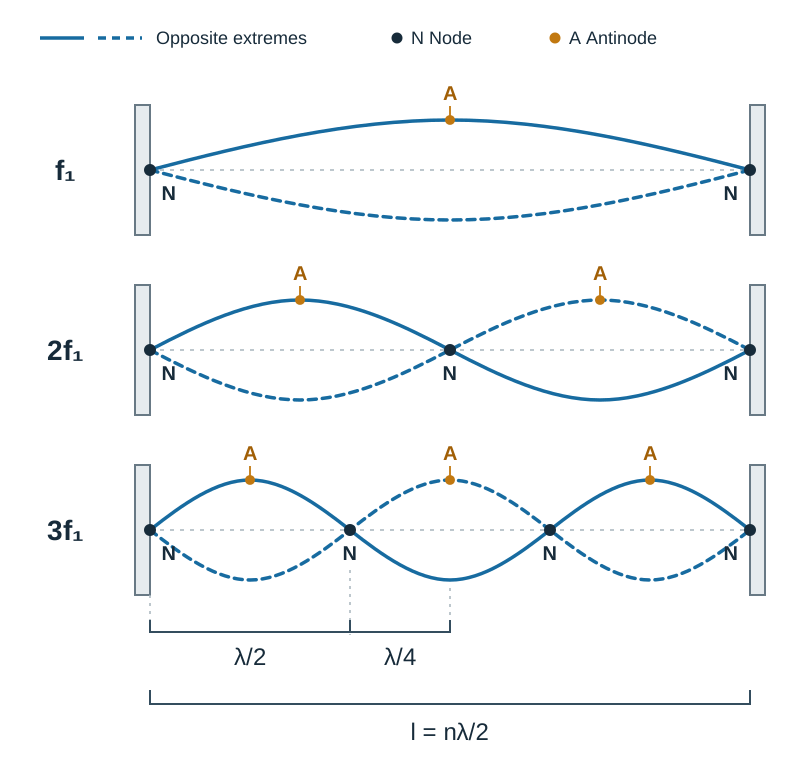
Worked Example: String Harmonics Problem: A string stretched between two fixed points apart vibrates at its third harmonic. The wave speed along the string is . Calculate the wavelength and frequency, and state the number of nodes and antinodes. Solution:
- At the third harmonic there are 3 loops, so :
- Using :
- Fixed at both ends with 3 loops, the wave pattern has 4 nodes (two at the fixed ends, two inside) and 3 antinodes.
| Property | Travelling Waves | Stationary (Standing) Waves |
|---|---|---|
| Energy transmission | Energy transfers continuously through space | No net energy transfer; energy is confined in loops |
| Amplitude distribution | Every particle has the same amplitude | Amplitude varies from zero at nodes to maximum at antinodes |
| Phase relationships | Phase changes continuously from point to point | All particles between two adjacent nodes vibrate in phase |
Investigating How Frequency Depends on Length
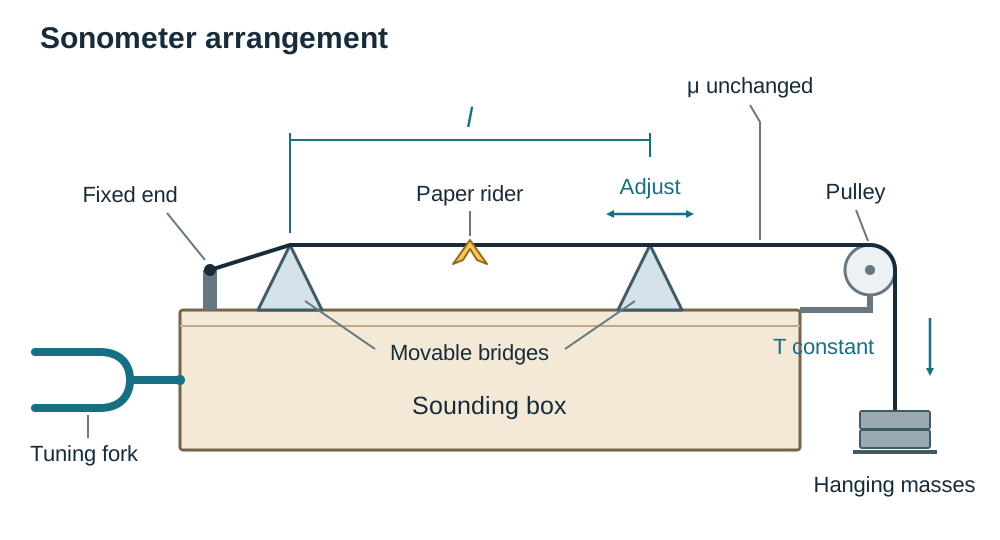
To verify for a stretched string at constant tension:
- Set up a sonometer wire over two movable bridges with a fixed tension provided by hanging masses.
- Place a light paper rider at the midpoint of the wire between the bridges.
- Sound a tuning fork of known frequency and hold its stem firmly against the sonometer sounding box.
- Move one bridge until the wire resonates and throws the paper rider off. Measure the vibrating length between the bridges.
- Repeat for several tuning forks of different frequencies.
- Plot against . A straight line through the origin verifies that .