The Electromagnetic Spectrum and Solar Irradiance
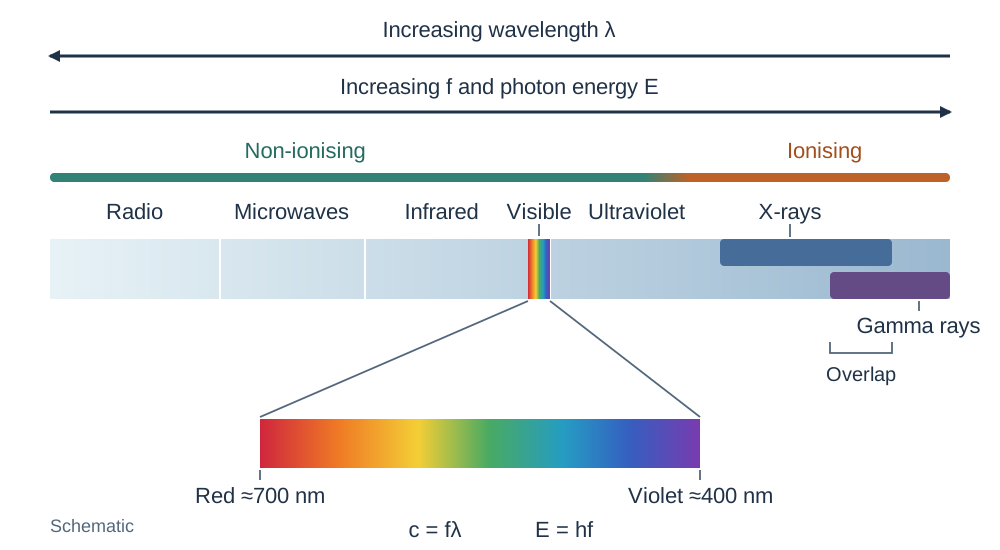
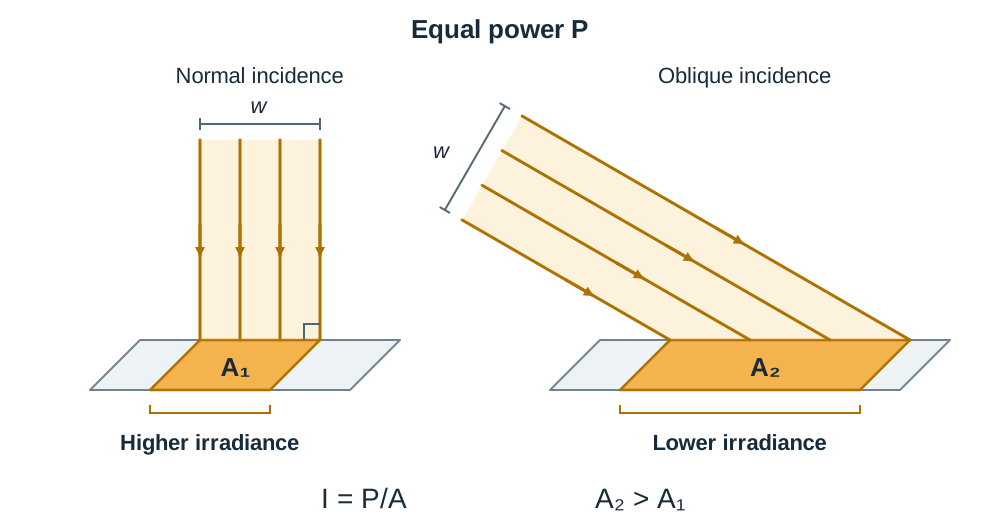
The electromagnetic spectrum is the continuous family of transverse electromagnetic waves that all travel through a vacuum at the speed of light, c = 3.00 × 10⁸ m s⁻¹. All members obey the wave equation c = fλ. Electromagnetic energy is carried in discrete packets called photons. The energy of a single photon is given by E = hf, where h is Planck's constant (6.6 × 10⁻³⁴ J s) and f is the frequency. Higher-frequency waves carry photons with greater energy. When photon energy is high enough, the radiation becomes ionising radiation, capable of removing electrons from atoms and damaging biological molecules and DNA. Spectrum Overview: 1. Radio waves: λ > 1 m; f < 3 × 10⁸ Hz; Source: accelerating electrons in transmitting aerials; Use: telecommunications, broadcasting; Non-ionising. 2. Microwaves: λ ≈ 1 mm to 1 m; f ≈ 3 × 10⁸ to 3 × 10¹¹ Hz; Source: magnetrons, mobile transmitters; Use: radar, satellite communication, heating food via water absorption; Non-ionising. 3. Infrared: λ ≈ 700 nm to 1 mm; f ≈ 3 × 10¹¹ to 4 × 10¹⁴ Hz; Source: warm and hot objects, radiant heaters; Use: optical fibre communication, thermal imaging, remote controls; Non-ionising. 4. Visible light: λ ≈ 400 nm (violet) to 700 nm (red); f ≈ 4 × 10¹⁴ to 7.5 × 10¹⁴ Hz; Source: very hot bodies, LEDs, lasers; Use: human vision, photography, photosynthesis; Non-ionising. 5. Ultraviolet: λ ≈ 10 nm to 400 nm; f ≈ 7.5 × 10¹⁴ to 3 × 10¹⁶ Hz; Source: the Sun, mercury discharge lamps; Use: counterfeit detection, medical sterilisation, vitamin D synthesis; Upper frequencies are ionising. 6. X-rays: λ ≈ 10⁻¹¹ to 10⁻⁸ m; f ≈ 3 × 10¹⁶ to 3 × 10¹⁹ Hz; Source: high-speed electrons striking a heavy metal target in an X-ray tube; Use: medical bone imaging, airport luggage scanners; Ionising. 7. Gamma rays: λ < 10⁻¹¹ m; f > 10¹⁹ Hz; Source: radioactive nuclear decay, cosmic events; Use: cancer radiotherapy, sterilising surgical equipment; Highly ionising. Note: X-ray and gamma ranges overlap; they are distinguished by their origin. ### Solar Irradiance. Solar irradiance is the solar power falling on a surface per unit area: I = P / A, measured in watts per square metre (W m⁻²). At the top of Earth's atmosphere, solar irradiance is approximately 1360 W m⁻². At ground level, it reaches up to 1000 W m⁻² at solar noon on a clear day. Factors reducing surface irradiance: 1. Solar elevation: when the Sun is lower in the sky (early morning, evening, winter, or high latitudes such as Ireland), solar power spreads over a larger surface area and travels through a thicker atmospheric path. 2. Atmospheric attenuation: clouds, dust, aerosols, and pollution scatter and absorb radiation. 3. Surface tilt: irradiance is maximised when the surface is perpendicular to incoming rays. Environmental impacts: solar irradiance powers photosynthesis at the base of food chains and drives planetary weather systems. Earth's atmosphere absorbs energetic bands: UVC is completely absorbed by oxygen and ozone high in the atmosphere; UVB is largely filtered by the stratospheric ozone layer, but remaining levels trigger vitamin D synthesis or cause sunburn and skin cancer; UVA penetrates to the surface, causing skin ageing and eye cataract risk.