

The Nature of Waves and Energy Transfer
A travelling wave is a regular disturbance that moves through a medium or through space, transferring energy from one location to another without transferring matter. While energy travels forward, the particles of the medium oscillate about fixed rest positions without travelling along with the wave.
Mechanical and Electromagnetic Waves
- Mechanical waves require a physical material medium (solid, liquid, or gas) to travel. Energy passes from particle to particle by mechanical forces. Examples include sound in air, waves on a string, water ripples, and seismic vibrations. Mechanical waves cannot travel through a vacuum. A classic demonstration is an electric bell ringing inside an evacuated glass bell jar: as air is pumped out, the sound fades to silence even though the clapper is visibly striking the gong.
- Electromagnetic waves require no physical medium. They consist of coupled electric and magnetic fields oscillating at right angles to each other and both at right angles to the direction of travel. In a vacuum, all electromagnetic waves travel at the speed of light:
Wave Speed, Frequency, and Medium
For sound in air and waves on a stretched wire, the wave speed is set by the properties of the medium (such as elasticity, tension, or density) and does not depend on amplitude. In most everyday media, wave speed is practically the same across all frequencies. The main exception is light travelling through transparent materials like glass or water: different frequencies (colours) travel at slightly different speeds, causing white light to separate into a spectrum (dispersion).
Amplitude and Energy
The energy transported by a wave depends directly on its amplitude:
Doubling the amplitude quadruples the energy carried (). Tripling the amplitude increases the energy ninefold (). In sound waves, greater amplitude corresponds to greater loudness, while higher frequency corresponds to higher pitch.
Transverse and Longitudinal Waves
Waves are sorted into two groups based on how particles vibrate relative to the direction of wave travel:
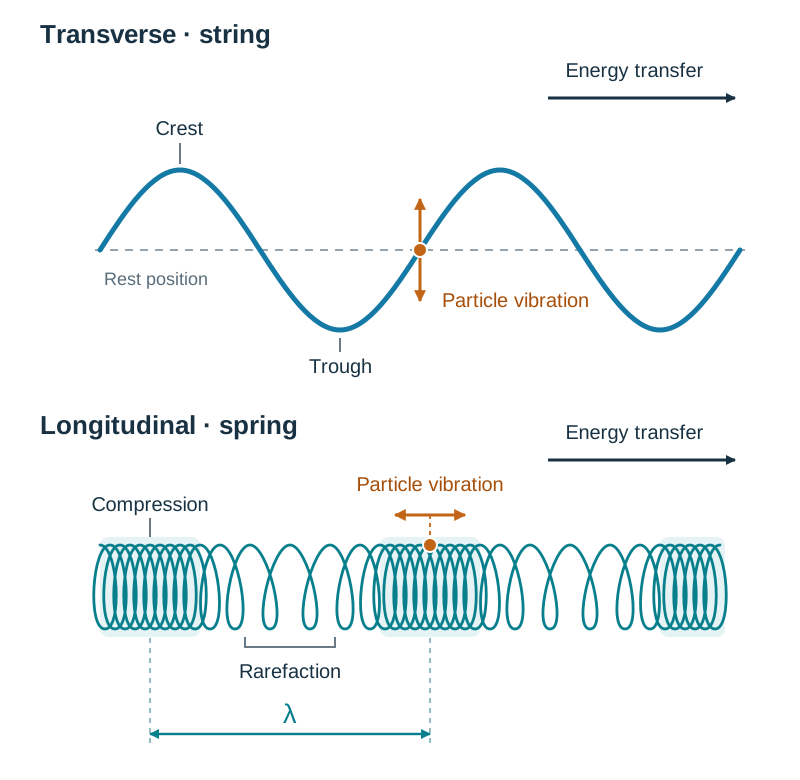
- Transverse waves: The vibrations are perpendicular (at right angles) to the direction the wave travels. In water waves and string waves the particles vibrate up and down. In electromagnetic waves there are no particles: the electric and magnetic fields vibrate. The highest point above the equilibrium rest position is the crest, and the lowest point below is the trough.
- Longitudinal waves: The vibrations of the medium are parallel to the direction the wave travels. Examples include sound waves in air and compression pulses on a slinky spring. Regions where particles are crowded together at higher pressure are compressions, and regions where particles are spread further apart at lower pressure are rarefactions.
Core Wave Measurements
- Displacement (): Distance of an oscillating particle from its undisturbed equilibrium position in a specified direction (m).
- Amplitude (): Maximum displacement of a particle from its undisturbed rest position (m).
- Wavelength (): Distance between two successive points that are in phase, such as crest to crest or compression to compression (m).
- Period (): Time taken for one complete wave cycle to pass a fixed point (s).
- Frequency (): Number of complete wave cycles passing a fixed reference point per second (Hz, where ).
Frequency and period are reciprocals:
Because a wave travels a distance of one wavelength in one period , wave speed is :
For electromagnetic waves in a vacuum:
Reading Wave Graphs
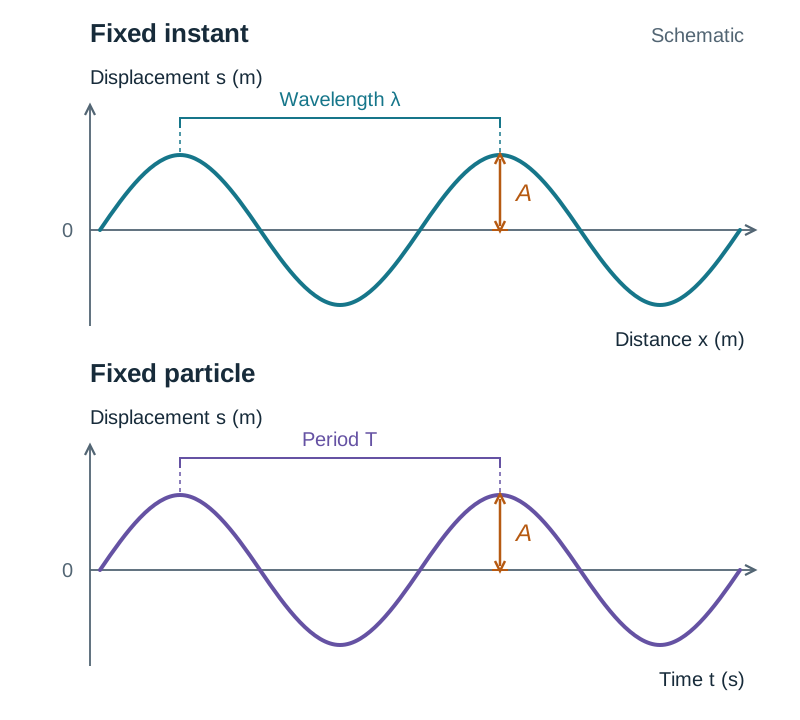
- Displacement–distance graph: A snapshot of the entire wave at one fixed instant in time. The horizontal distance between two consecutive identical points is the wavelength .
- Displacement–time graph: Shows how a single particle moves as time passes. The horizontal time for one complete repeat is the period .
- On both graphs, the vertical height from the central rest line to a crest is the amplitude . It is never measured from crest to trough.