

Traditional Irish music is an oral tradition that developed from solo instrumental playing, sean-nós singing, and Gaelic harping into a globally recognised music culture. In the Leaving Certificate Higher Level Music examination, Irish music is examined in Question 5 of the Listening paper. Part A tests your aural skills through short recorded excerpts, asking you to identify dance metres, instruments, ornamentation, textures, and song forms, or to distinguish traditional from non-traditional features. Part B requires a 10-mark essay chosen from several options, covering topics such as 20th-century developments, regional fiddle styles, the harping tradition, collectors, or modern fusion.
How Question 5 Works: Structure and Aural Strategy
Question 5 appears on the Listening paper, which accounts for 25% of the total Higher Level marks. The question is split into two distinct parts that demand different examination skills.
Part A: Aural Analysis of Excerpts
You will hear three short recorded excerpts of Irish music. The questions test your ear and your technical vocabulary. Typical prompts require you to:
- Identify the dance tune type (such as reel, double jig, slip jig, or hornpipe) and state its time signature.
- Name solo or accompanying instruments (such as uilleann pipes, fiddle, concertina, or bouzouki).
- Identify specific ornaments (such as rolls, crans, cuts, or triplets) and describe how they are produced.
- Describe the musical texture, distinguishing between unison, homophony, and heterophony.
- Determine the structural form of an air or ballad (such as AABA or ABBA) by tracking four-bar phrases.
- Contrast traditional features with non-traditional features in modern arrangements or fusion excerpts.
Always use precise musical terms. An examiner cannot reward vague descriptions such as "lively rhythm" or "modern backing". Instead, write "compound duple time (6/8) with quaver movement" or "chromatic walking bass on double bass with syncopated piano chords".
Part B: The 10-Mark Essay
Part B offers a choice of essay titles. High-scoring essays (8 to 10 marks) require detailed musical knowledge supported by named individuals, ensembles, tune titles, historical dates, and specific stylistic traits. A general narrative without musical terms will lose marks. Structure your answer into three or four well-developed paragraphs, each focusing on a distinct musical point.
Dance Tune Types, Metres, and Structures
Most traditional Irish dance tunes use a 32-bar binary structure consisting of two 8-bar sections, labelled the tune (A part) and the turn (B part). Each section is repeated, creating an AABB form. The B part usually moves into a higher register to contrast with the lower-pitched A part. In performance, musicians rarely play a single tune on its own; they link two or three contrasting tunes together into a continuous set.
Metric Guide to Dance Forms
| Tune Type | Time Signature | Metre | Beat Division & Rhythmic Character | Example Tune |
|---|---|---|---|---|
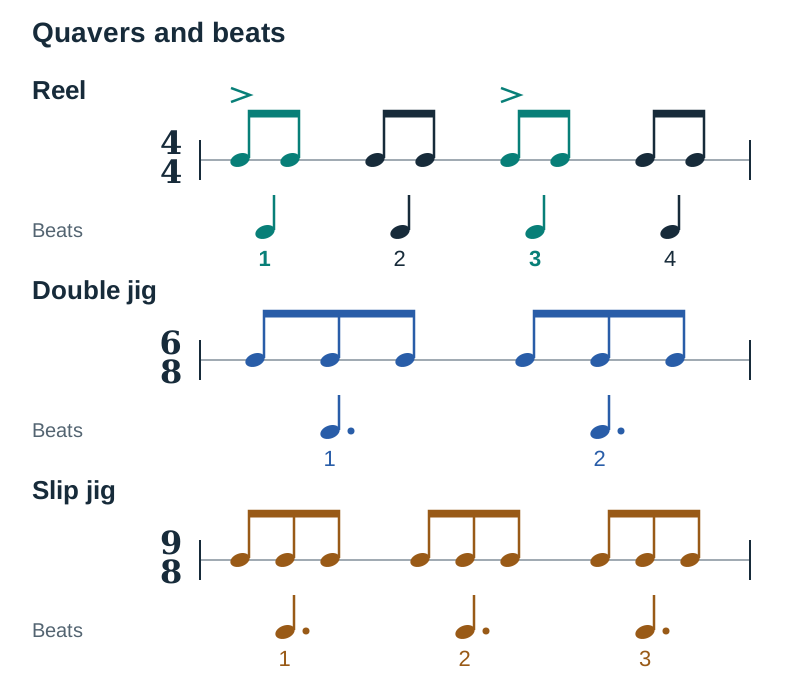
| Reel | 4/4 or 2/2 | Simple quadruple or simple duple | Brisk, driving continuous quavers with accents on the first and third crotchets of the bar (the two main beats in 2/2) | The Maid Behind the Bar |
| Double Jig | 6/8 | Compound duple | Two dotted-crotchet beats per bar, each dividing into three quavers | The Kesh Jig |
| Single Jig | 6/8 | Compound duple | Dominated by a crotchet–quaver (long–short) pattern rather than continuous running quavers | Off She Goes |
| Slide | 12/8 | Compound quadruple | Four dotted-crotchet beats per bar, played fast with a driving, bouncy pulse for set dancing | Denis Murphy's Slide |
| Slip Jig | 9/8 | Compound triple | Three dotted-crotchet beats per bar, each dividing into three quavers, giving an 8-bar lilting, flowing hop | The Butterfly |
| Hornpipe | 4/4 | Simple quadruple | Slower than a reel, featuring swung dotted quaver–semiquaver pairs and a three-crotchet cadence ending each part | The Boys of Bluehill |
| Polka | 2/4 | Simple duple | Fast, energetic two-beat march tempo with crisp, accented off-beats, central to Sliabh Luachra set dancing | The Britches Full of Stitches |
To tell a reel from a double jig at the same tempo, count the subdivision. A reel divides each main pulse into pairs of even quavers. A double jig divides each main pulse into three quavers. Say "rashers and sausages" to feel one bar of a double jig: "ra-shers-and" fills the first beat and "sau-sa-ges" fills the second, three quavers per beat.
Instruments, Ornaments, and Musical Idioms
Traditional instrumental music is driven by variation and personal expression rather than strict repetition.
Core Traditional Instruments
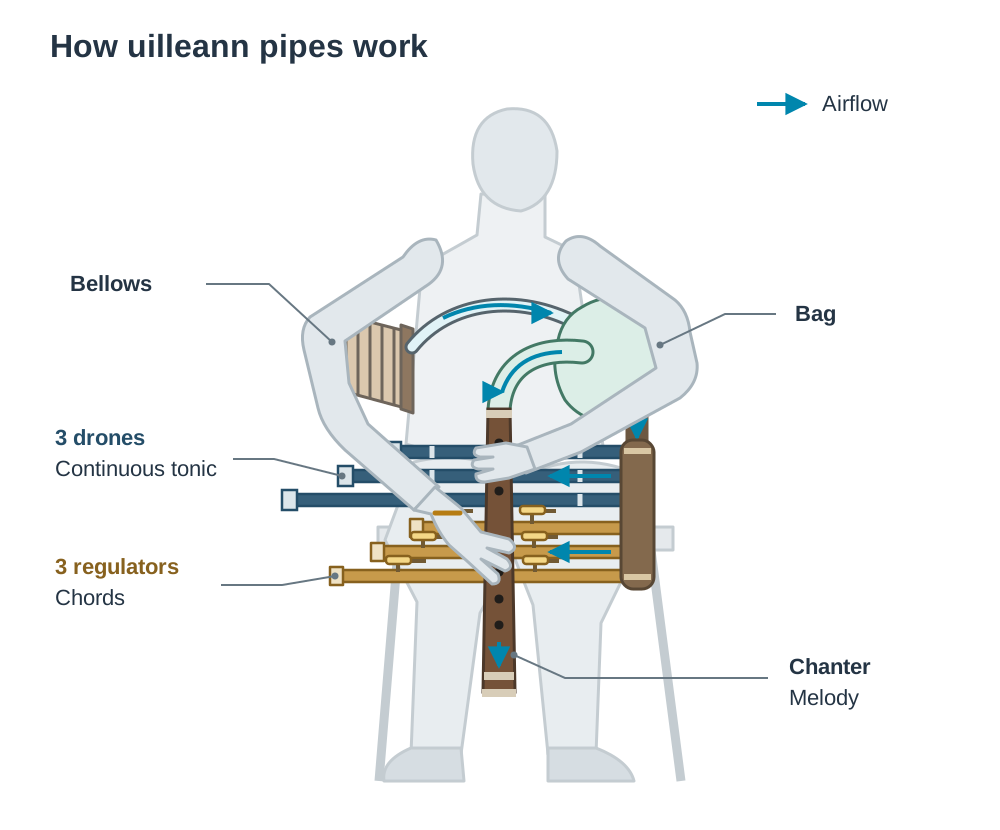
- Uilleann Pipes: Developed in the 18th century, these bagpipes use air pumped by an under-arm bellows rather than lung power. They produce a sweet, mellow tone spanning two octaves. They consist of a chanter (the melody pipe with a double reed), three continuous drones (sounding the tonic pitch in octaves), and three regulators (keyed pipes resting across the thigh, pressed with the piper's wrist to play chordal accompaniment).
- Fiddle: Physically identical to the classical violin, but played with distinctive regional bowing styles, little or no vibrato, and extensive finger ornamentation.
- Timber Flute and Tin Whistle: Simple-system conical wooden flutes produce a dark, breathy tone. The six-hole tin whistle uses identical fingering across two octaves.
- Bodhrán: A shallow wooden frame drum covered with a goatskin head. It is struck using a double-ended wooden stick called a tipper or cipín. The player's free hand presses against the inside of the skin to alter pitch and dampen resonance.
- Free-Reed Instruments: The button accordion (tuned in B/C or C#/D) and the smaller hexagonal concertina (especially prominent in Co. Clare) provide rhythmic, punchy melodic lines.
- Fretted String Accompaniment: The bouzouki entered Irish traditional music in the 1960s; guitars were already used in the ballad scene. Guitarists may use DADGAD tuning; the flat-backed bouzouki commonly uses four-course tunings such as GDAD. These tunings support drones and modal accompaniment.
Core Ornaments
- Cut: A very quick grace note pitched higher than the melody note, inserted to articulate the pitch or separate two notes of the same pitch.
- Tap (Pat): A single rapid grace note struck below the melody note.
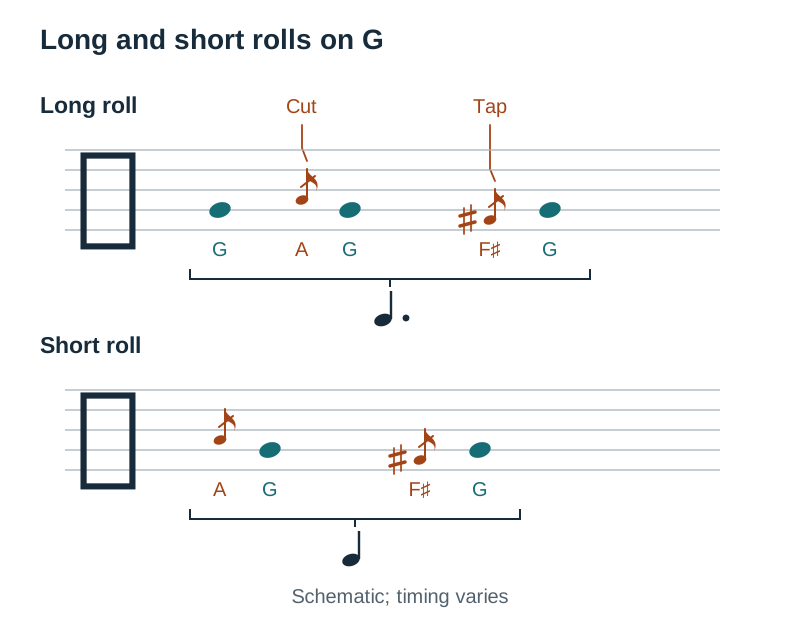
- Long Roll: Replaces a dotted-crotchet note with a five-movement sequence: main note – cut above – main note – tap below – main note. For example, on the note G, the sequence is G–A–G–F#–G.
- Short Roll: Condenses the roll into the duration of a single crotchet beat by omitting the opening main note: cut above – main note – tap below – main note (e.g. A–G–F#–G, with the cut and tap acting as quick grace notes).
- Cran: An ornament associated with the uilleann pipes and also used on flute. Bottom D is the lowest note, so there is no lower note to tap with in a normal roll. Instead, the piper sustains the low D while cutting it rapidly with several higher fingers in quick succession.
- Bowed Triplet: A fiddle technique where three rapid notes are played in the time of a single beat using separate, crisp bow strokes.
- Slide: A smooth, expressive glissando sliding into a note from a pitch just below it.
Irish Musical Idioms and Textures
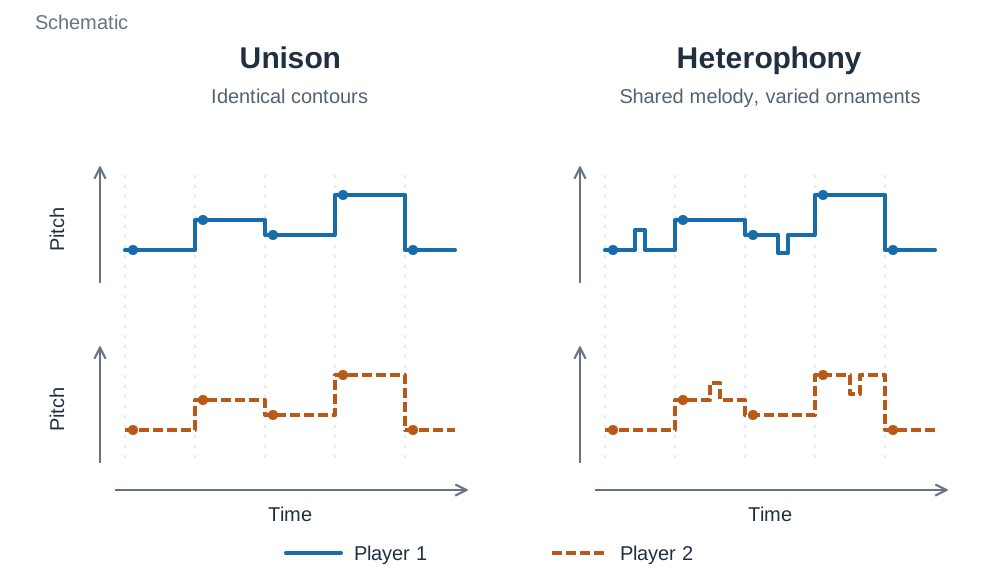
- Heterophony: The standard texture of an informal traditional session. Several musicians play the same melody simultaneously, but each player adds their own individual ornaments, bowing choices, and minor variations. It is neither strict unison nor multi-part harmony.
- Unison: Everyone plays the exact same melodic notes and rhythms together, as heard across the melody line of a traditional céilí band.
- Modes: Traditional melodies are often built on four main diatonic modes: Ionian (the ordinary major scale), Mixolydian (major with a flattened 7th), Dorian (natural minor with a raised 6th), and Aeolian (natural minor). D Mixolydian (D-E-F#-G-A-B-C-D) is exceptionally common on the whistle, flute, and pipes.
- Gapped Scales: Many older airs use pentatonic (5-note) or hexatonic (6-note) scales, omitting specific scale steps (frequently the 4th or 7th).
Regional Styles and Performers
Before national radio and commercial recordings spread across Ireland, geography shaped distinct regional dialects on the fiddle.
Regional Fiddle Styles
- Donegal: Fast, aggressive, and rhythmically driving. Characterised by rapid single-bowing, sparse finger ornamentation, and Scottish musical influence (such as playing strathspeys and highlands). Notable players: John Doherty, Tommy Peoples.
- Sligo: Swift, flamboyant, and heavily ornamented. Features fluid finger rolls, bouncy bowing, and frequent bowed triplets. Notable players: Michael Coleman, James Morrison, Paddy Killoran.
- Clare: Slower, relaxed tempos, long flowing bow strokes, and expressive rolls, which give a lyrical, "lonesome" sound with subtle variation. Notable players: Martin Hayes, Bobby Casey, Junior Crehan.
- Sliabh Luachra (Cork/Kerry border): Energetic, dance-centred style dominated by polkas and slides. The rhythm is driven by crisp bowing accents rather than heavy finger ornamentation, which suits set dancing. Notable players: Pádraig O'Keeffe, Denis Murphy, Julia Clifford.
Regional Sean-Nós Singing Styles
- Connemara: Highly florid, intricate, and melismatic, with great rhythmic freedom and extensive ornamentation on held syllables. Notable singer: Joe Heaney (Seosamh Ó hÉanaí).
- Munster: Highly ornamented but with a clearer, more regular underlying pulse than Connemara singing, and rich vocal tone. Notable singers: Nioclás Tóibín, Iarla Ó Lionáird.
- Donegal: More direct and melodic with a steady pulse, clear diction, and far less ornamentation, showing close kinship to Scots-Gaelic singing. Notable singers: Róise Mhic Grianna (Róise na nAmhrán), Lillis Ó Laoire.
The Harping Heritage and Turlough O'Carolan
The harp is Ireland's national emblem, with a history in Ireland of more than a thousand years.
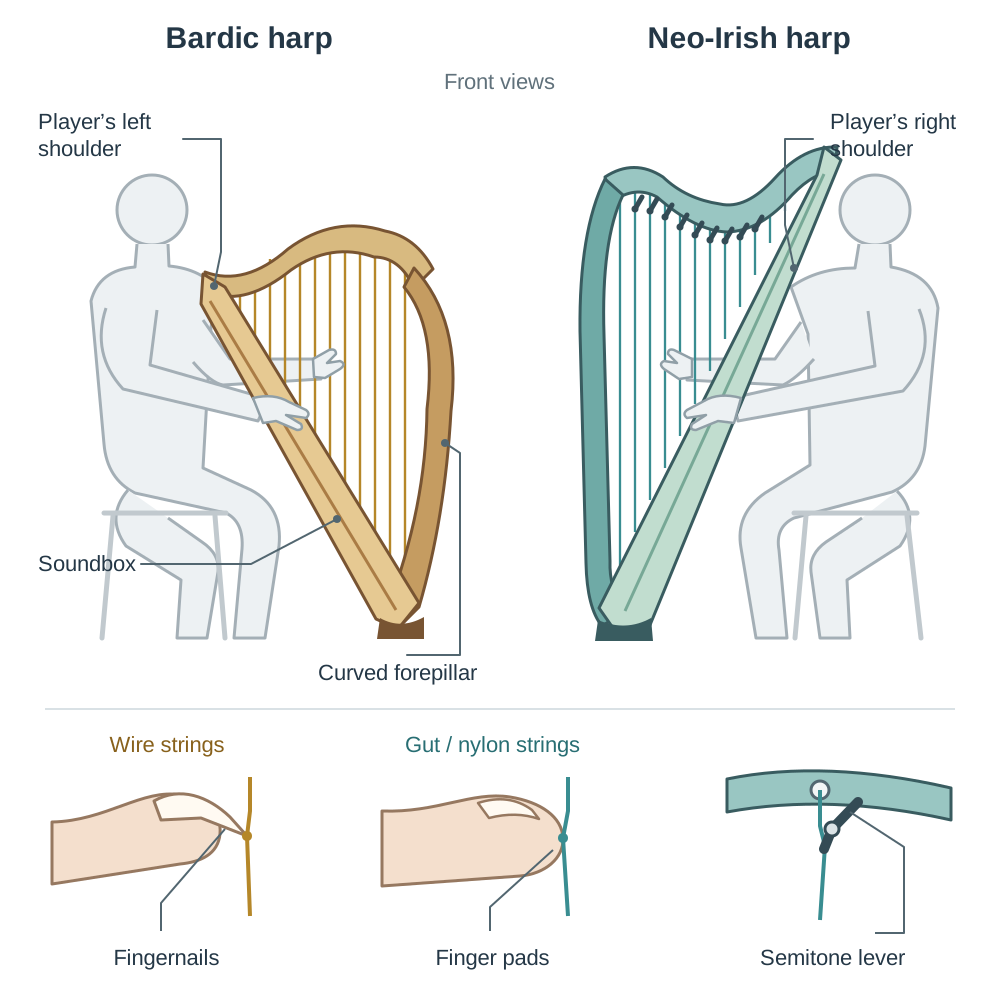
Bardic Harp vs Modern Neo-Irish Harp
- Bardic Harp (Cláirseach): Flourished in the medieval Gaelic aristocratic order. Its soundbox was hollowed out of a single block of willow, fitted with a hardwood neck and curved forepillar. It carried 29 to 31 heavy brass wire strings, rested on the left shoulder, and was plucked with long, curved fingernails. The wire strings created a resonant, bell-like ring that required complex finger damping to stop clashing overtones.
- Neo-Irish Harp: Developed in the 19th and 20th centuries as the wire-strung tradition died out. Taller than the bardic harp, it uses gut or nylon strings, with the number varying by model, and rests on the right shoulder. It is plucked with the fleshy pads of the fingertips, giving a warmer tone. Semitone levers or blades fitted along the neck near the top of each string allow key changes.
Turlough O'Carolan (1670–1738)
Turlough O'Carolan was the most famous itinerant blind harper and composer. Because he lived through the collapse of the old Gaelic aristocracy following the Williamite wars, he relied on patronage from both surviving Gaelic families and Anglo-Irish gentry estates. O'Carolan blended native Irish modal melodies with the continental Italian Baroque style of Corelli, Geminiani, and Vivaldi. He composed instrumental tribute pieces for his patrons called planxties (such as Planxty Irwin and Planxty Hewlett), as well as his famous Baroque-style piece Carolan's Concerto.
The 1792 Belfast Harp Festival and Modern Revival
By the late 18th century, the old wire-strung tradition was nearly extinct. Organisers staged the 1792 Belfast Harp Festival to preserve the repertoire of the old harpers. Eleven harpers, aged 15 to 97, took part, including 97-year-old Denis Hempson, the only player who still used fingernails on wire strings. Organist Edward Bunting was employed to transcribe their tunes into staff notation, saving ancient harp pieces from disappearing.
In the late 20th century, harpers such as Máire Ní Chathasaigh, Derek Bell (The Chieftains), and Laoise Kelly revived the harp as a solo and ensemble dance instrument, adapting traditional ornamentation, reels, and jigs to the modern lever harp.
The Song Tradition: Sean-Nós, Airs, and Ballads
Irish vocal music encompasses the ancient Irish-language sean-nós tradition, instrumental slow airs, and narrative English-language ballads.
Sean-Nós Singing
Sean-nós ('in the old style') is an unaccompanied, highly expressive solo vocal tradition sung in Irish (Gaeilge). Its musical hallmarks are:
- Rhythm shaped by the words: Words and emotional emphasis shape note lengths. Connemara singing is often rhythmically free, while other regional styles may keep a steadier pulse.
- Ornamentation: The melody is decorated with subtle melismas (several notes sung to one syllable), grace notes, and vocal slides.
- Tone and delivery: Delivered with a direct, nasal chest voice, avoiding classical vibrato.
- Modal scales: Melodies often use modes such as Mixolydian or Dorian, as well as ordinary major and natural minor scales.
Vocal Forms and Song Categories
- Aisling: 17th- and 18th-century vision poetry where Ireland is personified as a beautiful woman suffering under oppression, awaiting deliverance.
- Caoineadh (Keening): An ancient improvised ritual vocal lament for the dead, sung by women at wakes and funerals.
- Amhráin Chumha: General laments expressing sorrow over forced eviction, famine, or emigration (e.g. Bánchnoic Éireann Ó).
- Amhráin Ghrá: Lyrical love songs, often tragic, rich with natural imagery (e.g. Úna Bhán).
- Macaronic Songs: Bilingual songs alternating between Irish and English lines or verses (e.g. Siúil a Rúin).
Song Structures and Slow Airs
Most traditional airs consist of four 4-bar phrases. In an exam, track phrase structures by assigning letters to each phrase:
- AABA: The opening phrase repeats, followed by a contrasting phrase, returning to the opening melody.
- ABBA: The opening phrase frames two repeating inner phrases (e.g. the song Galway Bay).
- ABCD: Through-composed, where every four-bar phrase is melodically new.
In many traditional airs, the third phrase climbs to the highest vocal register, providing an emotional peak.
A slow air is an instrumental performance of a sean-nós song melody, played on an instrument such as the uilleann pipes, tin whistle, or fiddle. It retains the free rhythm, pauses, and melismatic ornamentation of the unaccompanied singer.
The Ballad Tradition
Ballads are narrative folk songs in English. They are usually strophic (the same melody serves every verse) and frequently feature a chorus. Typical themes include historical rebellions, emigration, working life, and romance. Many were printed on single sheets and sold on street corners as broadsides during the 18th and 19th centuries.
The 1960s ballad boom popularised group ballad singing with accompaniment from acoustic guitars, banjos, and mandolins, spearheaded by The Clancy Brothers and Tommy Makem and The Dubliners.
When evaluating a song performance in an exam, use this checklist:
- Traditional features: Solo singing, unaccompanied delivery, free rhythm, modal melody, nasal vocal tone, lack of vibrato, melismatic ornamentation.
- Non-traditional features: Instrumental accompaniment (guitar, piano, orchestra), multi-part backing harmony or barbershop chords, group unison singing, strict regular metronome beat, classical vibrato, instrumental introductions and interludes.
Collectors of Irish Music
Because traditional Irish music was learned and passed down entirely by ear, historical crises such as the Great Famine (1845–1849), mass emigration, and language decline threatened to destroy it. Dedicated collectors transcribed tunes into notation or made audio recordings, preserving thousands of airs and dances.
| Collector | Era | Major Publications & Fieldwork | Significance |
|---|---|---|---|
| Edward Bunting | 1773–1843 | A General Collection of the Ancient Irish Music (1796); A General Collection of the Ancient Music of Ireland (1809); The Ancient Music of Ireland (1840) | Classical organist employed at the 1792 Belfast Harp Festival. He transcribed the melodies and documented the fingering and damping techniques of the old wire-strung Gaelic harpers. Although his piano settings added classical Romantic chords, his work saved the ancient repertoire from disappearing. |
| George Petrie | 1790–1866 | The Ancient Music of Ireland (1855) | Dublin antiquarian who collected well over a thousand airs, many noted directly from singers in the west of Ireland. His 1855 collection printed texts and melodies, including the first publication of the Londonderry Air. |
| Francis O'Neill | 1848–1936 | The Music of Ireland (1903), The Dance Music of Ireland (1907) | Cork-born Chief of Police in Chicago. He gathered 1,001 dance tunes from Irish immigrants in Chicago and published The Dance Music of Ireland (known simply as "The Book"). It became the universal printed reference standard for 20th-century traditional players. |
| Séamus Ennis | 1919–1982 | Fieldwork for the Irish Folklore Commission (1940s) and later the BBC (1950s) | Master uilleann piper who travelled through Gaeltacht regions collecting more than 2,000 songs and airs, recording authentic sean-nós singers and regional pipers in their own homes. |
| Breandán Breathnach | 1912–1985 | Ceol Rince na hÉireann (5 volumes) | Piper and civil servant who compiled the definitive modern scholarly archive of instrumental dance tunes, meticulously transcribing intricate regional variants and ornaments. |
20th-Century Revival, Organisations, and Ensemble Innovation
During the 20th century, traditional Irish music moved from informal firesides and crossroads dances into public dance halls, radio broadcasts, and international concert stages.
Céilí Bands and the Dance Halls Act (1935)
In 1897, the Gaelic League organised the first céilí in London to promote Irish cultural dance. Bands were soon formed to play for dancers. The Public Dance Halls Act (1935) required all public dancing to be licensed by the state. In practice, this ended informal crossroads and kitchen dances, moving dancing into parish and commercial halls. Céilí bands met the need for loud, driving dance music in large venues. Early pioneers included the Kilfenora Céilí Band (founded 1909), the Ballinakill Céilí Band (late 1920s), and later the Tulla Céilí Band (1946).
- Melodic style: Lead instruments (fiddles, wooden flutes, accordions, banjos) play the tune together in strict unison.
- Rhythm and accompaniment: Driven by piano vamping (crisp, chordal, off-beat accompaniment), a snare-drum kit, and double bass to keep dancers in strict time.
- Ornamentation: Solo ornaments are toned down so the ensemble can maintain rhythmic precision in unison.
Organisations and the Media
- Comhaltas Ceoltóirí Éireann (CCÉ): Founded in Mullingar in 1951 to promote, teach, and preserve traditional music. CCÉ established local branches, structured music classes, and the annual Fleadh Cheoil festival and competition. Competitions raised technical playing standards across Ireland, though critics argued they encouraged a standardised, uniform playing style.
- Radio and Broadcasting: Radio Éireann (2RN from 1926) broadcast céilí bands and traditional soloists nationwide. Broadcaster Ciarán Mac Mathúna travelled the countryside making field recordings for popular programmes like A Job of Journeywork, introducing regional master players to national audiences.
- Gael-Linn: Established in 1953, this organisation produced commercial recordings of traditional music and sean-nós, and funded landmark documentary scores.
- Na Píobairí Uilleann: Founded in 1968 by pipers including Breandán Breathnach to preserve and teach the uilleann pipes at a time when very few makers and players remained.
- Academic and Archive Support: The Irish Traditional Music Archive (ITMA, founded 1987) catalogued source material, and the Irish World Academy at the University of Limerick introduced third-level performance degrees.
The Seán Ó Riada Revolution and Modern Fusion
Composer Seán Ó Riada believed that céilí-band unison playing flattened the true beauty of traditional music. In 1960, he formed Ceoltóirí Chualann:
- He arranged each tune so it passed between solo instruments, small groups, and the full ensemble, creating varied textures instead of unbroken unison.
- He brought the bodhrán into the concert ensemble as a primary rhythm instrument.
- He played the harpsichord to evoke the bell-like timbre of the historical wire-strung harp.
- He scored the music for the 1959 Gael-Linn documentary film *Mise Éire, arranging traditional airs like Róisín Dubh* for a full symphony orchestra with rich Romantic harmony.
- In 1962, while still performing with Ceoltóirí Chualann, piper Paddy Moloney formed The Chieftains, who carried this arranged ensemble approach to world concert stages.
Later ensemble innovations include:
- 1970s Folk Revival: Planxty and The Bothy Band combined traditional melodies with intricate counterpoint, using the bouzouki and DADGAD-tuned guitar as accompanying instruments.
- Trad–Rock Fusion: Horslips combined Irish myths and dance tunes with electric rock riffs. Moving Hearts (featuring Donal Lunny and Christy Moore) fused uilleann pipes with electric bass, saxophone, and a rock drum kit. The Pogues blended traditional rebel songs and jigs with punk energy.
- Hiberno-Jazz and Orchestral: Mícheál Ó Súilleabháin combined traditional piano ornaments with jazz improvisation, syncopation, and classical strings (e.g. Oíche Nollag). Shaun Davey pitted Liam O'Flynn's uilleann pipes against a classical symphony orchestra in The Brendan Voyage (1980).
- Global Dance and World Fusion: Bill Whelan's Riverdance (1994) took traditional step dancing and tunes to international arena stages. Afro Celt Sound System blended uilleann pipes, bodhrán, and fiddle with the West African kora and electronic dance beats.
Transatlantic Influence: Irish Music in North America
Centuries of emigration carried Irish music across the Atlantic, leaving a permanent mark on American folk and country traditions.
Recordings Made in America
In the 1920s, American recording companies based in New York produced 78-rpm shellac discs of immigrant Irish musicians. Sligo fiddle virtuosos Michael Coleman, James Morrison, and Paddy Killoran recorded reels and jigs with piano accompaniment. When these records were shipped home to Ireland, young players across the country copied their tune settings and playing techniques. This widely popularised the Sligo fiddle style and helped standardise tune repertoire, but it gradually smoothed out other local regional accents.
Francis O'Neill in Chicago
Francis O'Neill collected and transcribed tunes from immigrant musicians who had settled in Chicago from all parts of Ireland. By publishing The Music of Ireland (1903) and The Dance Music of Ireland (1907), O'Neill gathered regional tunes from across Ireland into print, sending a unified repertoire standard back home across the Atlantic.
American Folk, Old-Time, and Bluegrass Traditions
- Appalachian Old-Time Music: 18th-century Ulster-Scots and Irish settlers carried fiddle tunes, modal songs, and ballads into the Appalachian Mountains. Intermingling with the African-American banjo, these became old-time string-band music.
- Bluegrass: Developed by Bill Monroe in the 1940s, bluegrass retained the rapid fiddle breakdowns, modal melodic turns, and high, ornamented solo vocal lines derived from Irish and Scottish traditions.
- The 1960s American Folk Revival: In the early 1960s, The Clancy Brothers and Tommy Makem achieved national fame in America through appearances in Greenwich Village clubs and on nationwide television. Their performances influenced American folk revivalists, including Bob Dylan.
- Modern Irish-American Performers: Virtuoso musicians born in the United States, such as Chicago fiddler Liz Carroll, New York fiddler Eileen Ivers, and whistle player Joanie Madden (leading the all-female ensemble Cherish the Ladies), won All-Ireland titles and composed tunes that are now part of the living repertoire in Ireland.
Key terms
- Sean-nós
- An unaccompanied solo singing tradition in the Irish language. Typical features include ornamentation, rhythm shaped by the words and a direct vocal tone. The amount of ornamentation and freedom of rhythm vary by region; melodies may be modal, major or minor.
- Heterophony
- A musical texture where two or more instruments simultaneously perform the same fundamental melody, but each player introduces individual variations and ornaments; the standard texture of an Irish session.
- Long Roll
- A five-movement traditional ornament replacing a dotted crotchet: main note – cut above – main note – tap below – main note.
- Short Roll
- A four-movement ornament played within the duration of a single crotchet beat that omits the opening main note: cut above – main note – tap below – main note.
- Cran
- An uilleann pipe ornament used to articulate repeated low D notes by rapidly cutting the sustained pitch with several higher fingers in quick succession.
- Regulators
- Three keyed pipes resting across an uilleann piper's thigh, operated with the wrist to play harmonic chord accompaniments alongside the melody.
- Reel
- A fast Irish dance tune written in 4/4 (simple quadruple) or 2/2 (cut common, simple duple) time, built on continuous running quavers with accents on the first and third crotchets of the bar (the two main beats in 2/2).
- Double Jig
- A lively dance tune in compound duple time (6/8), consisting of two dotted-crotchet beats per bar, each subdivided into three quavers.
- Slip Jig
- A graceful, lilting dance tune in compound triple time (9/8) containing three dotted-crotchet beats per bar, each divided into three quavers.
- Hornpipe
- A moderate dance tune in simple quadruple time (4/4) characterised by swung dotted rhythms and an emphatic three-crotchet cadence ending each eight-bar phrase.
- Planxty
- A harp composition composed by itinerant harpers, particularly Turlough O'Carolan, in honour of a welcoming patron; it is also the name adopted by the influential 1970s folk band.
- Ceoltóirí Chualann
- The ensemble formed by Seán Ó Riada in 1960 that transformed traditional performance by replacing céilí-band unison with arranged folk counterpoint, solo contrasts, harpsichord, and bodhrán.
- Comhaltas Ceoltóirí Éireann
- An organisation founded in Mullingar in 1951 to promote, teach, and preserve traditional Irish music, notably through local branch classes and the annual Fleadh Cheoil.
- Aisling
- A poetic vision song genre from the 17th and 18th centuries in which Ireland is personified as a beautiful woman lamenting her suffering and awaiting rescue.
- Macaronic Song
- A bilingual folk song whose lyrics alternate between verses or lines of Irish and English.
- Vamping
- A rhythmic piano accompaniment style used in céilí bands, characterised by alternating bass notes on the beat with crisp chords on the off-beat.
Check yourself
A reel and a double jig are performed at the same tempo. How do you distinguish between them by counting the pulse?
Count the subdivision of the beat: a reel has four crotchet beats per bar, each dividing into pairs of even quavers; a double jig has two dotted-crotchet beats per bar, each dividing into groups of three quavers.
Two fiddlers play the exact same reel together, but one adds rolls and cuts where the other plays plain notes. What is this musical texture called?
Heterophony (or a heterophonic texture).
Why did uilleann pipers develop the cran instead of using a standard tap or roll on low D?
Bottom D is the lowest note on the chanter, so there is no lower note to tap with in a normal roll. Pipers instead articulate repeated low D notes by rapidly cutting the pitch with several higher fingers in quick succession.
What was the significance of the 1792 Belfast Harp Festival for the preservation of Irish music?
It brought together eleven of the remaining Gaelic harpers, aged 15 to 97, so that organist Edward Bunting could transcribe their tunes and playing techniques into staff notation before the old wire-strung tradition died out.
How did 78-rpm gramophone recordings made in 1920s New York affect regional fiddle styles back in Ireland?
Recordings by Sligo fiddlers like Michael Coleman were shipped back to Ireland and widely copied by young musicians, spreading the Sligo style nationally and gradually eroding distinct local regional styles.