

This note covers the core musical theory and exam techniques required across performing, composing, and listening for Leaving Certificate Music at Higher Level. It sets out key signatures up to four sharps and four flats, scale structures including traditional modes, chord vocabularies, cadence recognition, and functional harmony rules. It also provides practical routines for unseen tests, 16-bar melody construction, harmony writing, and the microtechnology performing option.
The Core Ingredients and Textures
Every question on the listening paper and every exercise you write in composing relies on the core building blocks of music.
Melodic and Rhythmic Features
- Melody: Moves either by step (conjunct) or by leap (disjunct). Recurring devices include a sequence (repeating a melodic idea at a higher or lower pitch) and imitation (one voice or instrument copying an idea played by another).
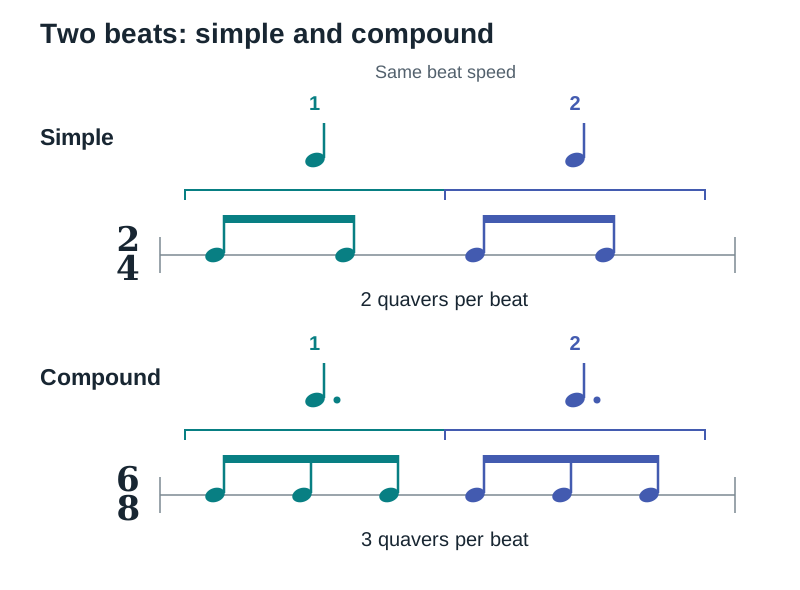
- Rhythm: The pattern of long and short sounds and silences, organised against a steady beat (the pulse). Simple metres () divide the beat into two equal parts. Compound metres, such as compound duple (), group pulses into dotted-crotchet beats that divide into three quavers. Common rhythmic devices include syncopation (stressing weak beats or off-beats so the accent falls unexpectedly) and ostinato (a persistently repeated pattern).
Compositional Devices to Listen For
- Augmentation: Repeating a theme or motif with longer note values, which makes it sound broader and slower.
- Diminution: Repeating a theme or motif with shorter note values, making it sound faster.
- Inversion: Turning a melodic line upside down, so every upward interval becomes an equivalent downward interval.
- Retrograde: Playing a musical idea backwards from end to start.
- Pedal (pedal point): A sustained or repeated note, usually in the bass, held while harmonies change above it.
- Polyrhythm: Two contrasting rhythms played at the same time (for example, three notes against two).
- Polymetre: Different metres occurring simultaneously in different parts.
Musical Textures
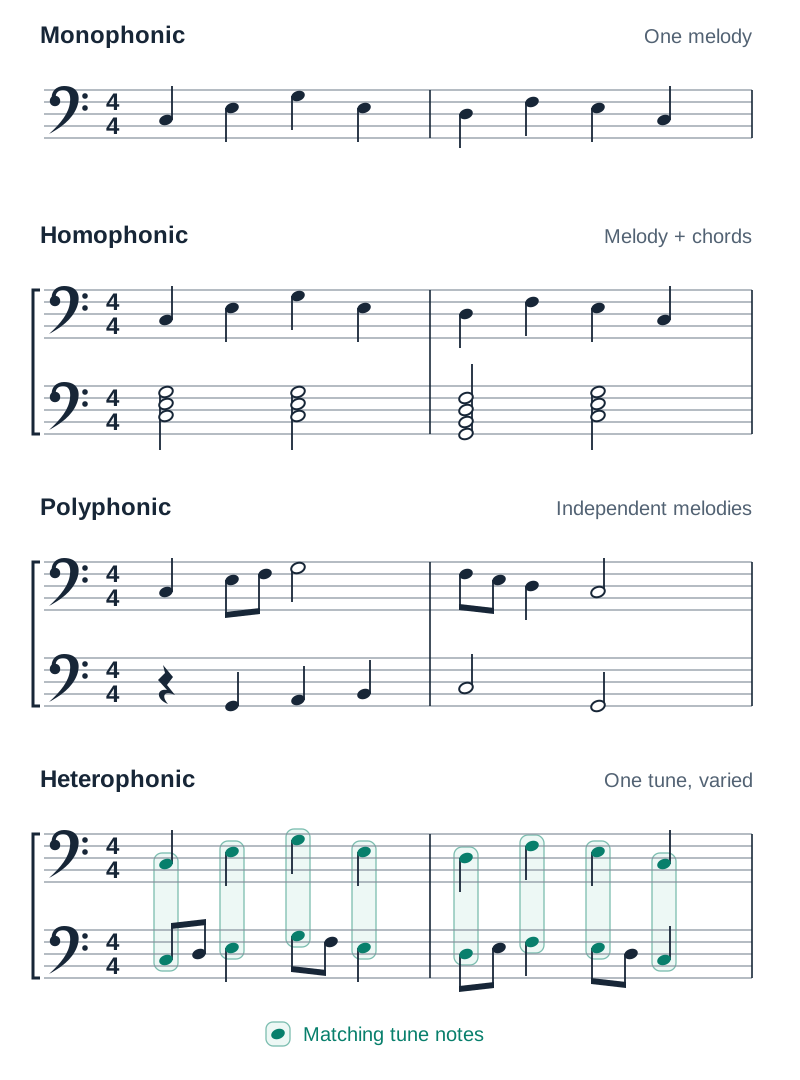
- Monophonic: A single, unaccompanied melodic line.
- Homophonic: A melody supported by chordal accompaniment, or multiple parts moving in the same rhythm.
- Polyphonic (contrapuntal): Two or more independent melodic lines weaving together.
- Heterophonic: Common in traditional Irish ensemble playing, where two or more musicians play the same basic tune simultaneously while adding individual ornaments and slight melodic variations.
Timbre and Dynamics
- Timbre: The tone colour of a voice or instrument. Name the instrument or voice type and any playing technique, such as pizzicato, muted brass or falsetto.
- Dynamics and articulation: How loud (p, f, crescendo, diminuendo) and how the notes are attacked or joined (legato, staccato, accents).
Exam Tip for Section Answers
When identifying musical features in listening questions or elective topics, avoid writing generic labels such as 'melody' or 'tempo'. Always pair a specific musical device with a named musical detail, such as: 'Augmentation: the cello plays the opening theme with note values doubled in length.'
Keys, Scales, and Modes
At Higher Level, you are examined on major and minor keys up to four sharps and four flats.
Reading Key Signatures
- Sharp Keys: Sharps appear in the fixed order F♯ – C♯ – G♯ – D♯ – A♯ – E♯ – B♯ (Father Charles Goes Down And Ends Battle). The major tonic note is always one semitone above the final sharp. For example, three sharps end on G♯, making A major the tonic.
- Flat Keys: Flats appear in the reverse order B♭ – E♭ – A♭ – D♭ – G♭ – C♭ – F♭ (Battle Ends And Down Goes Charles's Father). The major tonic is the second-to-last flat in the signature. For example, three flats end on A♭, so E♭ major is the tonic. F major (one flat: B♭) is the single exception you must memorise.
- Relative Minor: Every major key shares its signature with a relative minor whose tonic lies three semitones (a minor third) below the major tonic (for example, G major pairs with E minor, and E♭ major pairs with C minor).
Scale Construction
- Major Scale: Follows the pattern Tone – Tone – Semitone – Tone – Tone – Tone – Semitone ().
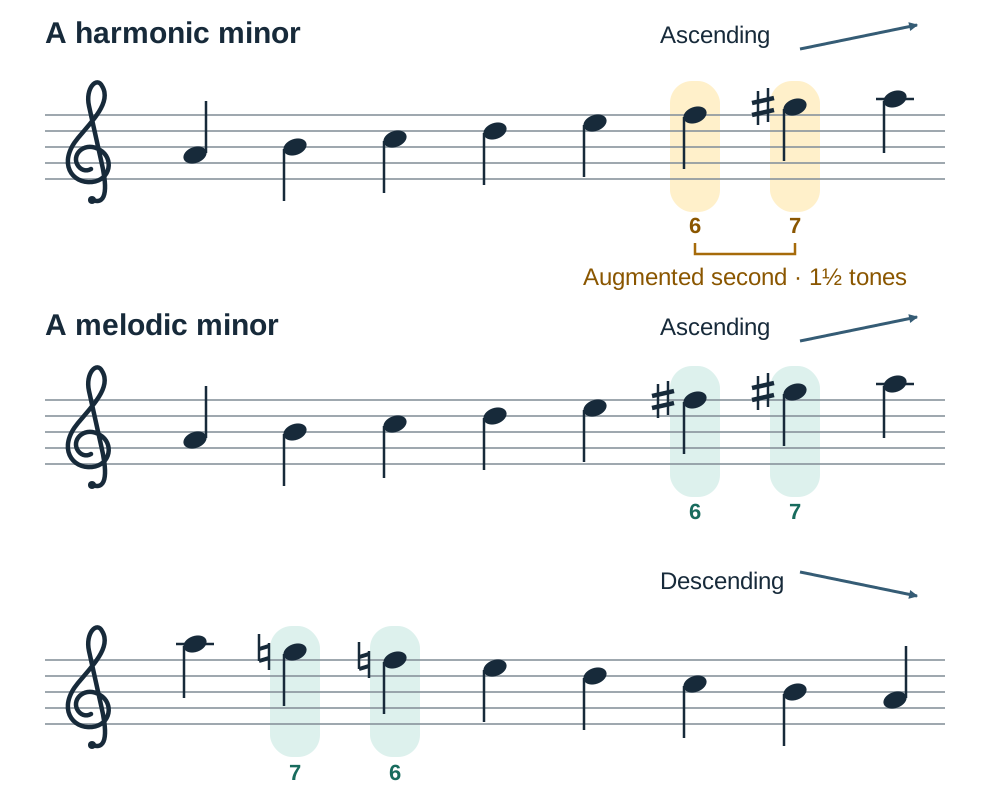
- Harmonic Minor: Follows the pattern Tone – Semitone – Tone – Tone – Semitone – Tone-and-a-half – Semitone. This produces an augmented second interval between the 6th and 7th degrees. The raised 7th degree functions as a leading note pulling upward into the tonic.
- Melodic Minor: Ascends with raised 6th and 7th degrees (), but descends using the natural minor scale ().
- Pentatonic Scale: A five-note scale containing no semitones (such as C–D–E–G–A), heard in folk traditions worldwide and in some traditional Irish airs.
Modes in Irish Traditional Music
A mode is a seven-note scale with its own pattern of tones and semitones. Many Irish dance tunes and airs are modal rather than major or minor. You can find their patterns on the white notes of a piano:
- Ionian: C to C (identical to the major scale).
- Dorian: D to D (a minor sound featuring a raised 6th degree).
- Mixolydian: G to G (a major sound featuring a flattened 7th degree).
- Aeolian: A to A (identical to the natural minor scale).
Reels and jigs frequently employ the Dorian and Mixolydian modes.
Harmonic Vocabulary, Cadences, and Bass Lines
Composing exercises require you to choose chords, write supporting bass notes, and punctuate phrases with standard cadences.
Cadence Formulas
- Perfect Cadence ( or ): Sounds finished, like a full stop. The bass normally moves soh to doh.
- Imperfect Cadence (any chord , most often or in major; or in minor): Sounds unfinished and pauses on chord V, like a comma.
- Plagal Cadence ( or ): Sounds finished but softer, often described as the 'Amen' cadence. The bass moves fah to doh.
- Interrupted Cadence ( or ): Deceptive. You expect resolution to chord I, but the music moves unexpectedly to chord vi, requiring the phrase to continue.
Chord Vocabulary at Higher Level
- Root Position: In major keys: I, ii, IV, V, vi. In minor keys: i, iv, V, VI. The diminished triad on the second degree () is not used in root position. Remember to write the necessary accidental to raise the leading note in chord V in minor keys.
- First Inversion Chords (): The third of the chord is in the bass. Higher Level requires Ib, iib, IVb, and Vb in major keys, and ib, , ivb, and Vb in minor keys. First inversions create smooth, stepwise bass lines.
- Dominant Seventh (): A major triad with an added minor seventh above the root (for example, G–B–D–F in C major). The chordal seventh resolves downward by step to the third of chord I.
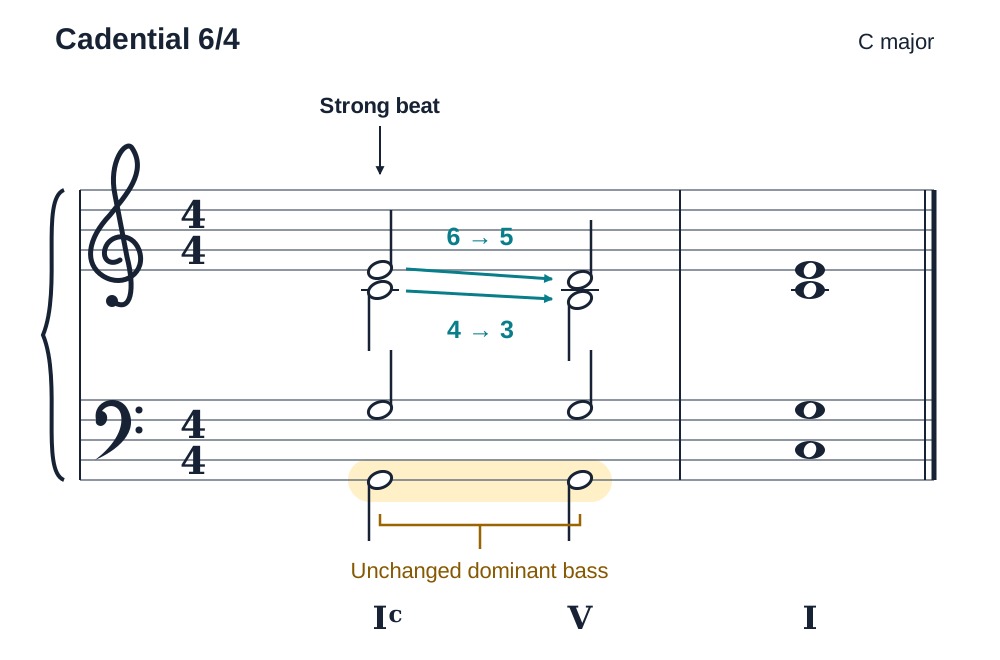
- Cadential Progression (): Tonic chord in second inversion (, fifth in the bass) falls on a strong beat, resolving directly to chord V before closing on chord I.
Non-Chord Notes
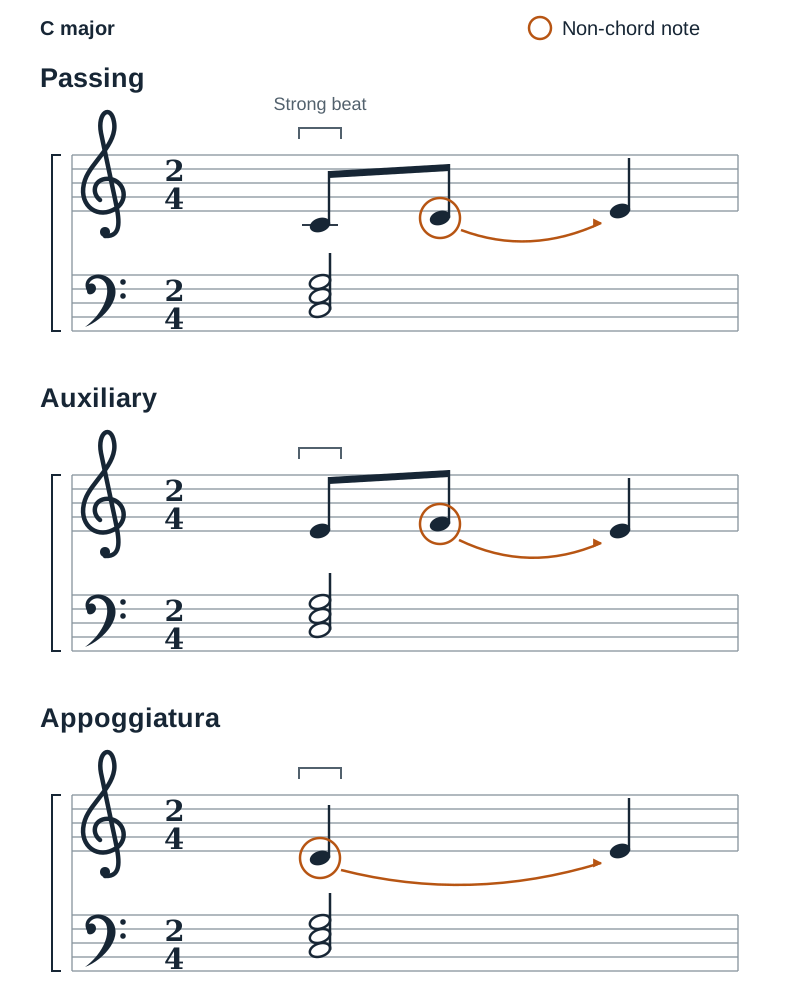
A non-chord note is a melody note that does not belong to the harmony underneath. It generally occurs on a weak beat and moves by step:
- Passing note: Steps between two different chord notes a third apart in the same direction.
- Auxiliary note: Steps away from a chord note (up or down) and returns immediately to the same chord note.
- Appoggiatura: An expressive dissonance on a strong beat that resolves by step to a chord note.
Adding a Bass and Chords to a Given Tune
When harmonising a melody at Higher Level:
- Write out the chord bank for the key (roots and chord notes).
- Plan the cadences at phrase ends first (for example, an imperfect cadence at the halfway point and a perfect cadence at the end).
- Match strong-beat melody notes to suitable chords.
- Write a bass line using roots or first inversions (), aiming for contrary motion against the melody.
- Check your part-writing to eliminate consecutive (parallel) fifths and octaves between the outer parts.
Recognising Musical Form and Structure
Form is the structural plan of a piece: which sections repeat, which contrast, and how tonal centres shift.
| Form | Outline | Aural and Structural Features | ||
|---|---|---|---|---|
| Binary | $A :\ | B :\ | $ | Two sections. Section A establishes the tonic and modulates (usually to the dominant or relative major). Section B develops ideas and modulates back to the tonic. |
| Ternary | Three-part structure. Section B provides contrast in key, melody, or mood. Section A returns in full, sometimes with decoration (). | |||
| Rondo | A main theme () in the tonic returns repeatedly between contrasting episodes (). Listen for the return of the recognisable opening tune. | |||
| Theme and Variations | A main theme is played and then repeated in altered forms, varying metre, rhythm, texture, or key. | |||
| Sonata Form | Exposition Development Recapitulation | 1. Exposition: First subject (tonic), bridge (modulating), second subject (dominant/relative major), codetta.<br>2. Development: Themes fragmented and explored through unstable keys.<br>3. Recapitulation: Both first and second subjects return in the tonic key, ending with a coda. |
Unseen Practical Tests and Melody Writing
At Higher Level, candidates present three pieces plus one unseen test, or two Ordinary Level performing activities plus the Higher Level unseen test. You can choose sight reading, an aural memory test, or an unprepared improvisation.
Practical Unseen Test Strategies
- Sight Reading: You will be given a short time to look over the test before playing. Check the clef, key signature, time signature, and accidentals. Tap the pulse silently. When playing, prioritise continuity and rhythmic shape over minor pitch slips. Never stop or double back.
- Aural Memory: The examiner plays an unseen phrase more than once. Use each hearing systematically: first determine tonality and the starting pitch, next trace the contour and rhythmic groupings, and finally verify intervals and the cadence ending before playing or singing it back.
- Unprepared Improvisation: Choose one option from melodic, rhythmic, or harmonic improvisation; free improvisation to a given stimulus; or any combination of these. Keep a steady tempo and shape clear, balanced phrases that resolve to a logical cadence.
16-Bar Melody Writing Options
Melodies can be composed as a continuation of a given opening, a setting of text, or using a dance metre and form.
- Choosing an Instrument: When offered an instrument choice (such as violin, flute, clarinet, or horn), select one whose playable range matches your melody and write its name at the start. Include expressive dynamics and phrasing marks throughout.
- Text Setting: Speak the verse aloud to find the natural word accents. Place stressed syllables on strong beats. Use mainly syllabic word-setting (one note per syllable) with occasional melisma for emphasis, and place cadences at line endings.
- 16-Bar Continuation Plan: A standard approach uses four 4-bar phrases: Phrase 1 gives the opening (cadencing on chord V); Phrase 2 modulates cleanly to the dominant with a perfect cadence at Bar 8; Phrase 3 cancels the accidental and creates melodic contrast; Phrase 4 builds to a climax near Bar 14 and closes on the tonic note with a perfect cadence at Bar 16.
Worked Example: 16-Bar Melody Continuation in G Major
- Phrase 1 (bars 1–4): Establish G major, ending on a note of chord V at bar 4.
- Phrase 2 (bars 5–8): Introduce C♯ as the new leading note and resolve C♯ up to D on the strong beat of bar 8, implying A–D (V–I in D major).
- Phrase 3 (bars 9–12): Use C♮ to return towards G and vary the opening idea.
- Phrase 4 (bars 13–16): Reach the climax around bar 14 and close with F♯→G (or D–G in the implied bass), a perfect cadence in G at bar 16.
- Exam Presentation: Always specify the chosen instrument name (e.g. flute or violin) at the start, and write phrasing slurs and dynamics throughout.
Technology Option: Microtechnology Music-Making
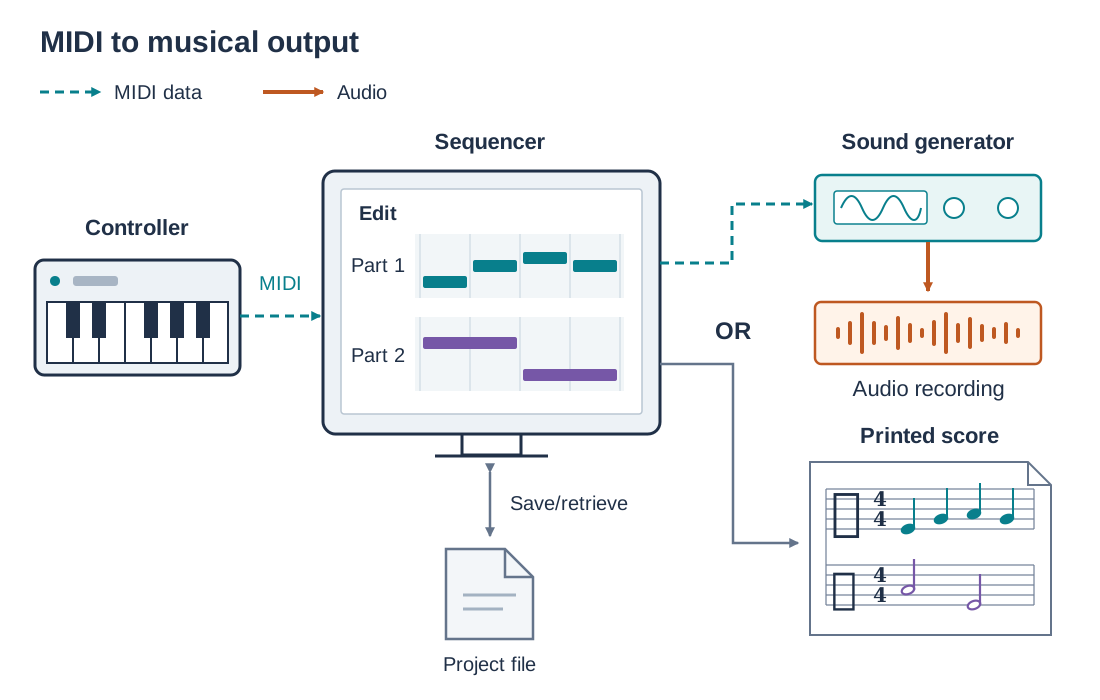
You can present your practical performance using music technology (Appendix A, Option 3) instead of, or alongside, a conventional instrument. MIDI (Musical Instrument Digital Interface) allows electronic instruments and controllers to communicate with sequencing software and sound modules.
Core Examination Requirements
To present this option, you must demonstrate the ability to:
- Input a score of at least two real parts using an electronic instrument or an instrument with a MIDI controller.
- Save, retrieve, and edit that score (for example, altering rhythms, pitches, dynamics, and instrument timbres).
- Produce a final version, either as an audio recording or as a printed musical score.
Higher Level Requirement
Higher Level students must meet one additional requirement: either compile and perform to their own prepared backing track, or play at least two pieces from the standard repertory for electronic instruments.
Preparation Tips
- Choose two genuinely independent musical lines (such as a melody and an active bass line) rather than simple octaves.
- Practise editing operations (quantising, copying, changing patch timbres) until you can complete them smoothly during the practical exam.
- Maintain verified backup copies of all project files on multiple storage devices before exam day.
Key terms
- Cadence
- A two-chord progression that ends a musical phrase or section, functioning like punctuation in language.
- Heterophonic
- A texture in which two or more musicians perform variations of the same melodic line simultaneously, common in traditional Irish sessions.
- Compound Time
- A metre in which the main beat is a dotted note that divides naturally into three equal pulses, such as 6/8 time having two dotted-crotchet beats per bar.
- Relative Minor
- The minor key that shares the key signature of a given major key, found three semitones below the major tonic.
- First Inversion
- A triad voiced with its third in the bass, designated by the letter 'b' (such as Ib or Vb).
- Cadential 6/4
- A classical progression where the tonic chord in second inversion (Ic) falls on an accented beat and resolves directly to chord V before moving to chord I.
- Sequence
- The immediate repetition of a melodic or harmonic idea at a higher or lower pitch.
- Ostinato
- A persistently repeated rhythmic or melodic phrase that underpins a section of music.
- Passing Note
- A non-chord note that moves by step to bridge the gap between two different chord notes a third apart.
- Augmentation
- A compositional device where the note values of a theme or motif are lengthened, making it sound broader and slower.
- MIDI
- Musical Instrument Digital Interface; the technical standard enabling electronic instruments, controllers, and computers to communicate.
- Mixolydian Mode
- A modal scale built with a major third and a flattened seventh degree, commonly found in traditional Irish dance tunes.
Check yourself
What is the key signature of E major, and what is its relative minor?
E major has four sharps: F♯, C♯, G♯, and D♯. Its relative minor is C♯ minor (three semitones below E).
How many main beats are in a bar of 6/8 metre, and what rhythmic note value represents one full beat?
There are two main beats per bar in 6/8 (compound duple time), and each main beat is represented by a dotted crotchet.
How do you distinguish a Dorian mode from an Aeolian mode starting on the same root note?
Both have a minor third, but the Dorian mode has a raised 6th degree, whereas the Aeolian mode has a minor (flattened) 6th degree.
A fiddle and a flute play the same traditional reel together, each adding their own spontaneous rolls and cuts. Name the musical texture.
Heterophonic texture.
What are the three core practical tasks required when presenting the microtechnology music-making option?
Input a score of at least two real parts; save, retrieve, and edit that score; and produce a final version as a recording or printed score.