

Leaving Certificate Music at Higher Level requires composing a balanced 16-bar melody and completing harmony exercises in four-bar phrases. Melodies should show coherent phrase structure, development through techniques such as sequence and variation, modulation where the question asks for it (usually to the dominant), and clear performing directions. Harmony questions test chord vocabulary in major and minor keys up to four sharps and four flats, voice-leading rules, smooth bass-line contour, cadence formulas, and fitting melodies to chord symbols using chord notes and non-chord notes.
16-Bar Melody Structure and Development
A Higher Level melody is 16 bars long, usually structured into four balanced 4-bar phrases ( or ). The music must sound cohesive rather than like four disconnected fragments.
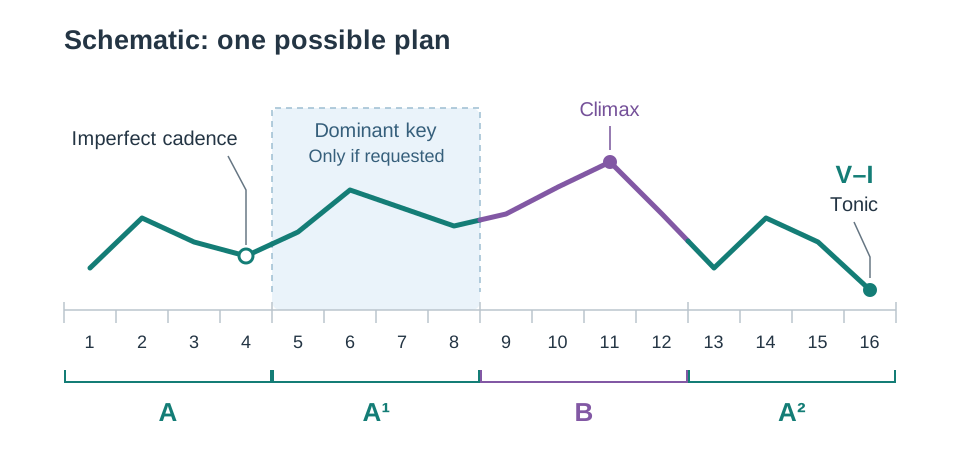
One Possible Four-Phrase Plan
This is a planning aid for a 16-bar continuation, not a compulsory pattern. Include the modulation below only when the question asks for it.
- Phrase 1 (bars 1–4): Establishes the home key using the given opening. It introduces the rhythmic motif and style, ending on an imperfect cadence (usually resting on scale degree or , implying chord ).
- Phrase 2 (bars 5–8): Develops the opening motif. If a modulation to the dominant is requested, this phrase is one suitable place to make it and cadence in the new key.
- Phrase 3 (bars 9–12): Introduces melodic and rhythmic contrast. It climbs toward the melodic climax—the highest, most expressive note of the piece, ideally around bar 10 or 11—before steering back toward the tonic key.
- Phrase 4 (bars 13–16): Returns definitively to the home tonic, echoing motifs from Phrase 1 to restore unity. It finishes on a strong beat in bar 16 with a conclusive perfect cadence () resolving onto the tonic note (scale degree ).
A quick way to remember the phrase plan:
- Bar 4: imperfect cadence
- Bar 8: cadence in the dominant if the requested modulation is placed here; otherwise use a cadence suited to the question
- Bar 12: imperfect cadence or climax area
- Bar 16: perfect cadence on the tonic
Melodic Contour and Voice Leading
Keep the line singable (cantabile). Move predominantly by step and keep leaps small (mostly 3rds and 4ths, with the occasional 5th or octave). Balance any leap of a 4th or wider by immediately stepping back in the opposite direction.
Starting with an Upbeat (Anacrusis)
If the given opening begins with an anacrusis, you must deduct that exact rhythmic duration from bar 16. In 4/4 time, an opening pickup of one crotchet means bar 16 must contain exactly three crotchet beats, so the upbeat and the last bar add up to one complete bar.
Motivic Development
Examiners look for organic development of the opening ideas:
- Tonal sequence: repeating a motif immediately at a higher or lower pitch while staying within the diatonic scale.
- Real sequence: repeating the motif with exact interval qualities preserved; accidentals may be needed.
- Melodic inversion: turning the melodic contour upside down, so every upward step or leap becomes an equivalent downward step or leap.
- Rhythmic variation: using augmentation (lengthening note values), diminution (shortening values), or subtle syncopation.
Avoiding the Augmented Second in Minor Keys
In a minor key, the raised 7th creates an awkward interval of an augmented 2nd between degrees and (such as to in A minor). To keep the line smooth, use the melodic minor scale: raise both the 6th and 7th degrees when the melody ascends (), and use the natural notes when it descends ().
Melody Writing Alternatives
The syllabus also provides options to set a text or use a dance metre:
- Setting a given text: write one note per syllable, except where you deliberately slur a syllable across two notes. Place stressed syllables on strong beats. Follow the punctuation of the text by ending musical phrases at line breaks and placing cadences at full stops. Reflect the meaning of the words using word-painting, and write words clearly beneath the stave with hyphens separating syllables.
- Dance rhythms: maintain the rhythmic metre and characteristic tempo of the requested dance throughout while following the specified formal structure.
Examiner Checklist for Melodies
Before finishing Question 1, check your work against the marking points: style and imagination, shape and balance, development of opening ideas, clear climax, accurate modulation where requested, suitable instrument choice, and complete performing directions.
Modulation and Instrumental Compass
If the question asks for a modulation to the dominant, Phrase 2 (bars 5–8) is one possible place, with a cadence in the new key at bar 8. Do not add a modulation merely because it appears in a memorised plan: follow the question’s exact instructions.
Modulating to the Dominant Key
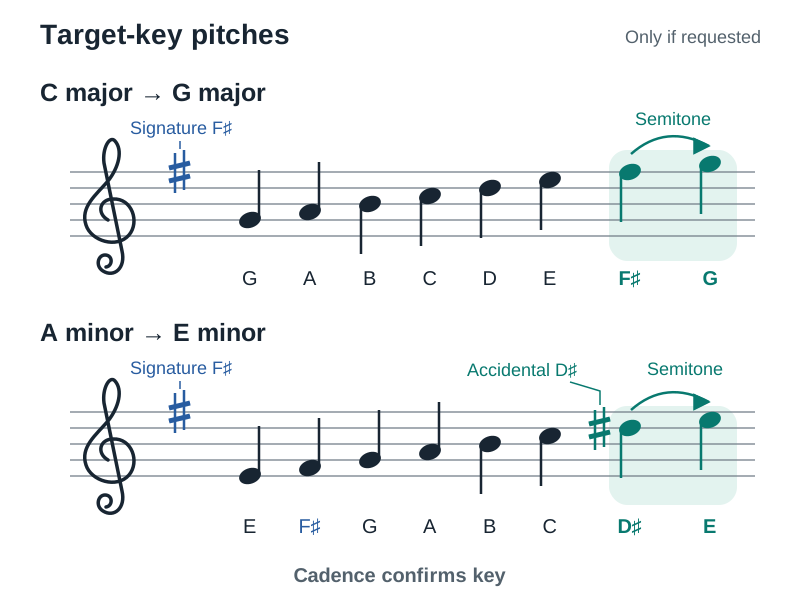
- Major keys: the dominant key is major. Raise the 4th degree of the home scale to create the new leading note. For example, in C major modulating to G major, introduce . In major modulating to major, introduce .
- Minor keys: the dominant key is the dominant minor. For example, A minor modulates to E minor. This requires as the new leading note, and to match the key signature of E minor. Check the key signature of the new key and insert every accidental it requires.
- Return to the tonic: in Phrase 3, cancel the new accidentals (restoring or ) to bring the tonality securely back home.
Instrumental Compass
Follow the question’s instructions about the instrument, range and notation. The ranges below are approximate practical ranges for these exercises, not each instrument’s complete compass; they are shown at concert pitch (for a B-flat clarinet and B-flat trumpet). Pitch notation here uses scientific pitch, where represents middle C:
- Flute: to
- Oboe: to
- Clarinet: to
- Violin: to
- Horn: approximately to (most comfortable in its middle register)
- Trumpet: to
If you are ever unsure of extreme ranges, keep the melody between and , as this octave falls comfortably within the compass of every instrument listed.
Performance Directions
Always include complete performance directions to earn full marks:
- Tempo: confirm or add an appropriate tempo marking (Allegro, Andante, Moderato).
- Phrasing and articulation: add phrase slurs over 2-bar or 4-bar units, along with staccato dots, tenuto dashes, or accents.
- Dynamics: place dynamic markings (, , , ) underneath the stave, using crescendo and diminuendo hairpins to shape the contour toward the climax.
Question 4: Composing over Chord Symbols
Question 4 requires composing an original melody and bass line to complete a piece from given chord symbols. This question carries substantial marks for showing awareness of key and harmonic structure.
Fitting a Melody to Chord Symbols
Each chord symbol specifies which pitches are consonant in that bar or half-bar:
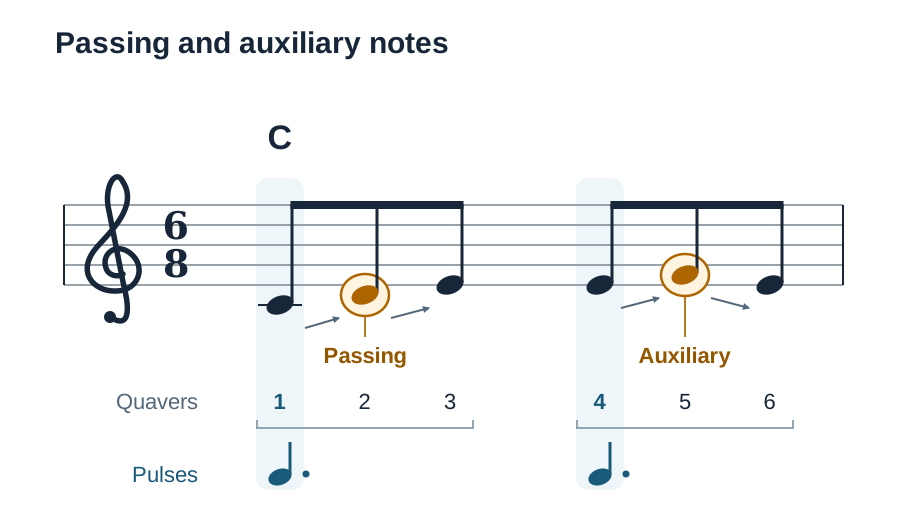
- Strong beats: use a chord note. In 4/4 time, beats 1 and 3 are strong. In 3/4 time, beat 1 is strong. In 6/8 time, quavers 1 and 4 are the strong dotted-crotchet beats.
- Weak beats: you may introduce a non-chord note to keep the line lyrical and moving:
- Passing note: moves by step between two different chord notes (for example, over C major, , where is the passing note).
- Auxiliary note: steps away from a chord note and returns to the same note (for example, over C major, , where is the auxiliary note).
- Never leap to or from a non-chord note; always approach and leave it by step.
Reading Chord Symbols and Slash Chords
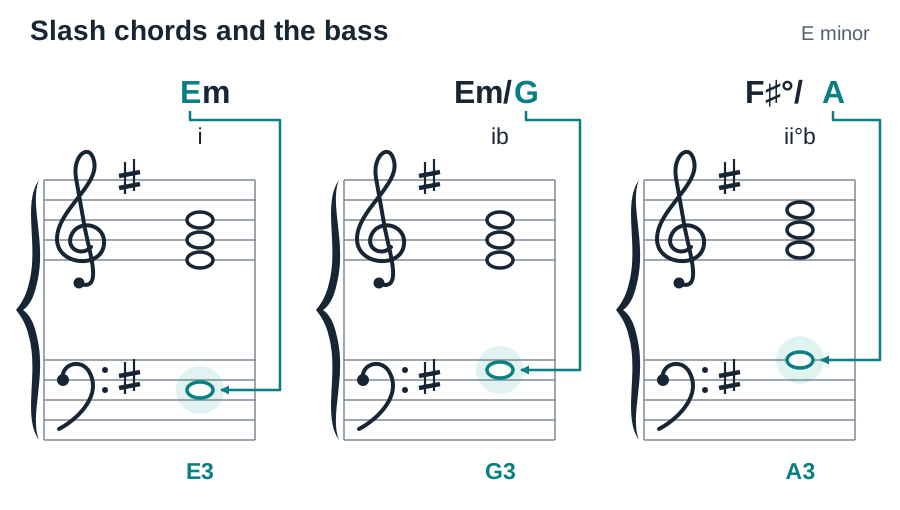
- A capital letter alone indicates a major triad: D = .
- An m indicates a minor triad: Em = .
- A degree circle (°) indicates a diminished triad: F#° = .
- A 7 indicates a dominant seventh: B7 = .
- Slash chords: the letter after the slash dictates the bass note. For example, Em/G is an E minor chord with in the bass, forming a first inversion (). F#°/A in E minor is , requiring in the bass.
Rule: with no slash, write the chord root in the bass. With a slash, write the pitch following the slash in the bass. Shape the bass line so it steps smoothly into and out of each inverted chord.
Working in 6/8 Compound Duple Time
Compound duple time has two dotted-crotchet beats per bar, each dividing into three quavers. Always beam quavers in groups of three (1-2-3, 4-5-6), never across the middle of the bar. Common rhythmic figures include crotchet-quaver (♩ ♪) and three quavers (♪ ♪ ♪). The main pulses fall on quavers 1 and 4. Use chord notes and chord changes on these pulses; a cadential 6/4 (Ic) belongs on a strong pulse. Ordinary first inversions are not restricted to strong pulses.
Harmonic Vocabulary, Inversions, and Cadences
At Higher Level you need to know these chords in all major and minor keys up to four sharps and four flats:
| Context | Permitted Root-Position Chords | Permitted First Inversions | Stock Cadential Formats |
|---|---|---|---|
| Major Keys | , , , , | , , , | , Cadential () |
| Minor Keys | , , , | , , , | , Cadential () |
Essential Vocabulary Rules
- Minor Chord ii: In minor keys, chord is diminished (). The syllabus excludes root-position ; it is permitted exclusively in first inversion (, such as in C minor voiced with in the bass).
- Raised 7th in Minor Keys: Dominant chords in minor keys (, , ) must use the raised leading note from the harmonic minor scale (for example, in A minor, producing ).
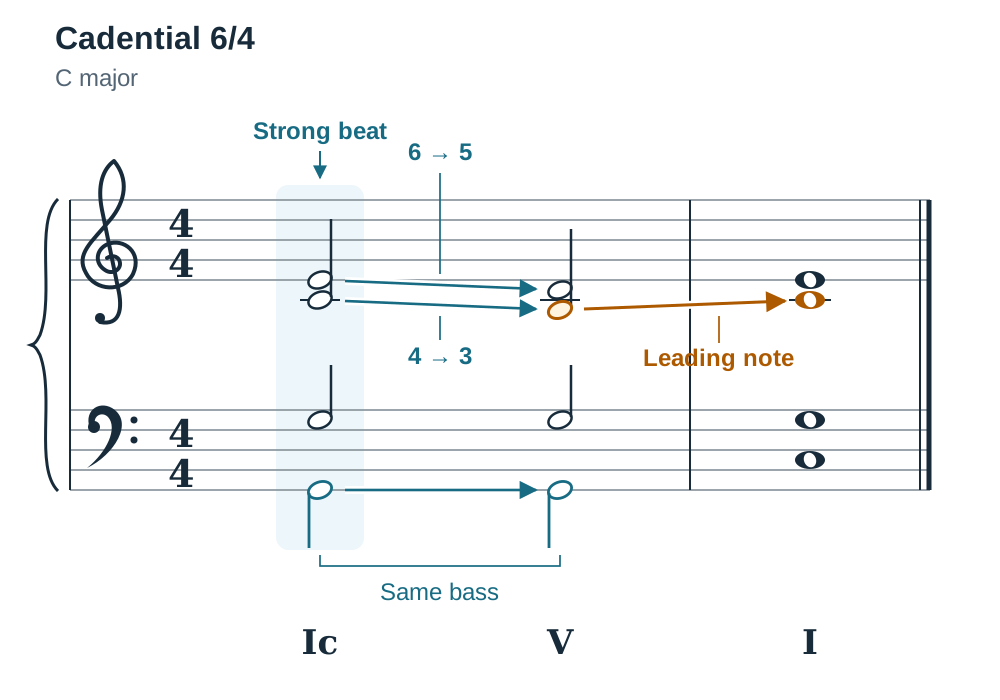
- Cadential 6/4 (): The tonic chord in second inversion ( or ) must be placed on a strong beat (beat 1 in 3/4 or 4/4, or beat 3 in 4/4) with the dominant note in the bass, resolving directly to chord over that same bass pitch.
- Dominant Seventh (): normally resolves to (or ) in a perfect cadence. It can also resolve to (or ) in an interrupted cadence. The 7th of the chord falls by step.
The Four Cadences
A cadence consists of the final two chords of a phrase:
| Cadence | Chords (Major Keys) | Chords (Minor Keys) | Musical Effect |
|---|---|---|---|
| Perfect | (or ) | Final, finished; use at bar 16 | |
| Imperfect | Ends on (, , , ) | Ends on (, , ) | Incomplete, like a comma; use at bars 4 or 12 |
| Plagal | Gentle, 'Amen' resolution | ||
| Interrupted | Deceptive surprise; moves to instead of |
Question 5: Bass Realisation and Voice Leading
In Question 5, you add backing chords and a bass line to a given melody. Treat the bass line as an elegant countermelody rather than an unshaped string of roots.
Step-by-Step Harmony Procedure
- Plot the chords: follow the question’s instructions, using the chord bank grid when provided. Write out the available chord notes: , , , , and their first inversions in major keys; , , , , , , and in minor keys.
- Fix the cadences: lock in the cadence chords at bars 4, 8, 12, and 16 before filling in intermediate bars.
- Select fitting chords: choose chords whose notes contain the melody pitch on each strong beat.
- Check adjacent boxes: avoid repeating identical chords in identical positions.
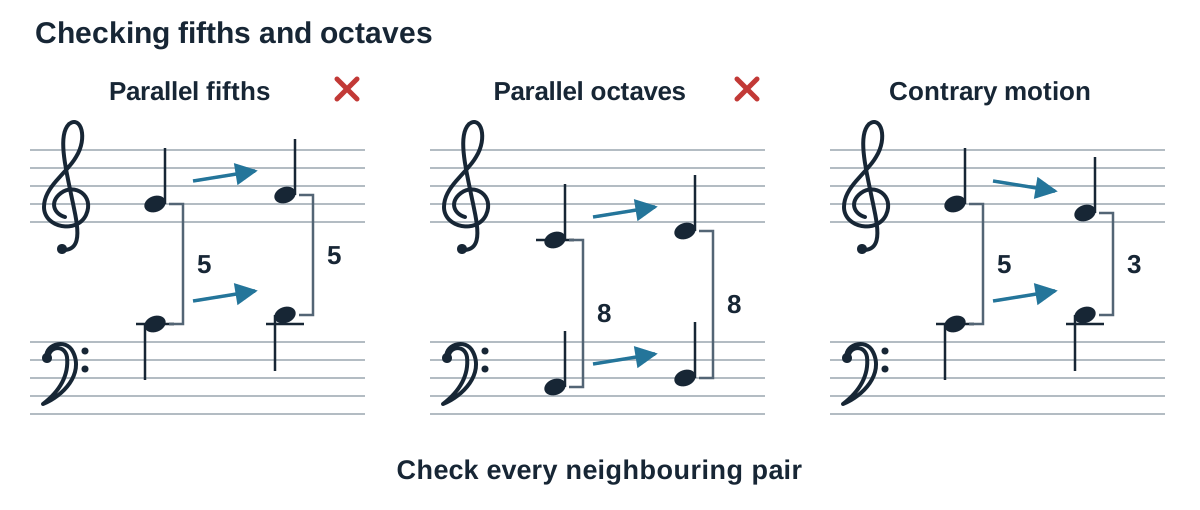
- Check for consecutive fifths and octaves: verify that the outer voices do not move in parallel 5ths or octaves.
- Shape the bass line: introduce first inversions to create stepwise movement.
Voice-Leading Principles
- Consecutive fifths and octaves: if the melody and bass are a 5th (or an octave) apart, they must not move to another 5th (or octave) in the same direction. Check each pair of neighbouring beats. Moving the bass in contrary motion can help, but it does not replace checking the intervals between successive notes.
- The adjacent-box repetition rule: State Examinations Commission marking schemes penalise using identical chords in identical inversions across adjacent boxes. If consecutive boxes share the same harmony, you have two options: change the bass note by using an inversion (such as to ), or add a seventh ( to ). Note that followed by is not accepted.
- Leading note resolution: in chord at cadence points, the leading note must resolve upward by semitone to the tonic in chord . Never double the leading note.
Key terms
- Anacrusis
- An upbeat or pickup note before the first complete bar of a piece, requiring an equivalent duration to be deducted from the final bar.
- Tonal Sequence
- The immediate repetition of a melodic motif at a higher or lower pitch while staying strictly within the notes of the home key signature.
- Real Sequence
- The immediate repetition of a melodic motif where all interval qualities are kept identical, sometimes requiring accidentals outside the home key.
- Leading Note
- The scale note a semitone below the tonic, with a strong tendency to resolve upward to it. In minor-key dominant harmony, raise the seventh degree to create it.
- Passing Note
- A non-chord note placed on a weak beat that connects two different chord notes by stepwise motion.
- First Inversion
- A triad voiced with its third in the bass, designated in the Leaving Certificate syllabus with the letter 'b' (such as Ib, iib, or Vb).
- Cadential 6/4
- A tonic chord in second inversion (Ic or ic) positioned on a strong metrical beat with the dominant note in the bass, resolving to chord V over that same bass pitch.
- Perfect Cadence
- A phrase ending moving from chord V (or V7) to chord I (or i), providing a complete and conclusive sense of rest.
- Imperfect Cadence
- A phrase ending that rests on chord V, creating an unfinished, expectant pause.
- Interrupted Cadence
- A cadence moving from chord V to chord vi (or VI in a minor key), surprising the ear by delaying the expected tonic resolution.
- Plagal Cadence
- A phrase ending moving from chord IV (or iv) to chord I (or i), producing a soft, gentle resolution.
- Contrary Motion
- Movement of two voices in opposite directions. Check the intervals between successive notes as well; contrary motion is not a guarantee that every voice-leading rule is satisfied.
Check yourself
If an opening phrase in 3/4 time starts with a one-crotchet upbeat, how many beats must be written in bar 16?
Exactly two crotchet beats, so the upbeat and the final bar combine to equal one complete three-beat bar.
What accidentals must be introduced to modulate from A minor to its dominant key in Phrase 2?
D sharp (the leading note of E minor) and F sharp (from the key signature of E minor).
Identify the cadence formed by the chord progression G major to A minor in the key of C major.
An interrupted cadence (chord V moving to chord vi).
What is the correct bass note for the chord symbol Bm/D?
D, because the letter following the slash indicates the bass note.
On which beats of the bar should a cadential 6/4 chord (Ic) be placed in 4/4 time?
On a strong beat: beat 1 or beat 3, resolving directly to chord V over the dominant bass note.
What is the only permitted inversion of chord ii in a minor key according to the Higher Level syllabus?
First inversion (ii°b), voiced with the third in the bass.