

In the Leaving Certificate Higher Level Italian examination, Reading Comprehension accounts for 30% of your total marks. In Section B of the reading paper, you are offered a choice: you can answer questions on an unseen literary passage or on an extract from a prescribed modern text, such as Paolo Cognetti's 2016 novel Le otto montagne. Choosing the studied text gives you a head start because you already know the characters, the setting, and the themes. However, there are no marks for a pre-learned plot summary: every answer has to come back to the extract printed on the paper. To achieve top marks, you need to understand the Italian rubric instructions, apply the Locate–Adapt–Answer technique to Italian questions without copying narrator forms blindly, interpret tone and unspoken meaning, and write structured, evidence-based points for the final English synthesis question.
Exam Structure, Paper Choice, and Rubric Instructions
In the literary section of the reading paper, you answer one option only: either the unseen passage or the extract from your studied text. Read both before committing. If the unseen text happens to be significantly more accessible, you are entitled to take it. Note also that the official prescribed list of texts is issued separately by circular and can change from cycle to cycle, so verify with your teacher that Le otto montagne is designated for your specific examination year.
The questions on the literary extract are set in two languages. The earlier questions are set in Italian and must be answered in Italian, typically in one or two accurate sentences. The final question is set in English and answered in English, carrying a larger weighting and requiring you to draw both on the extract and on your wider knowledge of the book.
Every year candidates lose marks simply by misreading the Italian instruction words. Underline these on your paper:
- Che cosa fa / dice...? – What does ... do / say?
- Perché...? – Why...?
- Come...? / In che modo...? – How? / In what way?
- Descrivete... – Describe...
- Spiegate... – Explain...
- Riassumete... – Summarise...
- Con parole vostre – In your own words (you must reword your answer, not copy directly).
- Citate la frase / le parole del testo che... – Quote the sentence / words from the text that... (copy exactly from the text).
- Trovate nel brano un'espressione che significa... – Find an expression in the passage meaning...
- Secondo il narratore... – According to the narrator...
- Giustificate la vostra risposta – Justify your answer (a bare statement without textual evidence will not score).
Comprehension Technique: Locate, Adapt, Answer
Unless the question explicitly says citate or trovate, examiners expect you to transfer meaning using your own grammatical sentence. You may use the vocabulary of the text, but you must adapt it. An answer that copies the narrator's first-person forms unchanged, or copies a whole chunk in the hope that the answer is somewhere inside it, does not show that you understood the question and will not score full marks.
Use the three-step Locate–Adapt–Answer method:
- Locate: Identify the precise sentence containing the target information using prompt keywords.
- Adapt: Shift the first-person narration into the third person:
- Change verbs: andavo becomes Pietro andava; ho deciso becomes ha deciso; salivamo becomes salivano.
- Change reflexive and object pronouns: mi sentivo becomes si sentiva; ci siamo visti becomes si sono visti; guardarmi becomes guardarlo.
- Change possessives: mio padre becomes suo padre.
- Answer: Write a focused sentence in Italian containing only the information requested.
When Copying Is Required
There is one clear exception to the adaptation rule. When a question asks you to quote (Citate la frase...) or to find a specific phrase (Trovate nel brano un'espressione che significa...), copy the exact words from the text, matching every accent and letter, and include nothing extra.
The Family Possessive Article Trap
In standard Italian grammar, singular unmodified family members do not take a definite article before a possessive adjective:
- suo padre (his father), not il suo padre
- sua madre (his mother), not la sua madre
However, possessives with loro and all plural family members always require the definite article:
- il loro padre (their father)
- i suoi genitori (his parents)
Italian Phrase Bank and Tone Analysis
Your Italian answers should be concise and grammatically sound. Rather than writing long essays in Italian, aim for one or two purposeful sentences using reliable connectors.
Analysis Connectors for Italian Responses
- Dal brano si capisce che... (From the passage we understand that...)
- Il narratore sottolinea che... (The narrator stresses that...)
- Questo dimostra / rivela che... (This shows / reveals that...)
- A differenza di Bruno, Pietro... (Unlike Bruno, Pietro...)
- Mentre Bruno resta nella valle, Pietro parte. (While Bruno stays in the valley, Pietro leaves.)
- Il rapporto tra i due amici cambia perché... (The relationship between the two friends changes because...)
- Si tratta di un momento decisivo / di svolta. (It is a decisive moment / a turning point.)
- Secondo me, il personaggio si sente... (In my opinion, the character feels...)
Evaluating Tone (Il tono)
Appreciating the tone of a literary text is a specific syllabus requirement at Higher Level. You identify tone through vocabulary, verb tenses, and punctuation. Common tone adjectives to learn include:
- nostalgico – nostalgic
- malinconico – melancholy, reflective
- teso – tense
- affettuoso – affectionate
- amaro – bitter
- distaccato – detached
- rassegnato – resigned
- asciutto / sobrio – spare, understated
When asked to justify a tone, state the adjective clearly, cite the specific language forms used (such as the imperfetto or negative adverbs), and explain their emotional effect.
Plot Timeline and Narrative Arc
Paolo Cognetti structures the novel as a romanzo di formazione (a coming-of-age story) told in the retrospective first person by Pietro. Grounding an exam extract within this timeline helps you identify unspoken character motives.
Stage 1: Childhood in Grana
Pietro's parents leave the industrial noise of Milan to rent a summer house in Grana, a semi-deserted hamlet near Monte Rosa. Pietro meets Bruno, the only child remaining in the valley, who spends his days looking after cattle. The boys form a close, unspoken friendship exploring streams, abandoned ruins, and Alpine pastures. Pietro's father, an intense factory chemist, introduces Pietro to demanding high-altitude climbs.
Stage 2: Adolescence, Rebellion, and the Years of Silence
As a teenager, Pietro resists his father's obsessive climbing regime and physical pressure. He drifts away from both the mountains and his friend. Pietro drifts through his twenties in the city, doing unsettled work, and later earns his living making documentaries, which takes him abroad and eventually to Nepal. During these eleven years, Pietro barely speaks to his father.
Meanwhile, Giovanni continues returning to Grana alone and climbs the highest peaks with Bruno, treating him as a surrogate son. Bruno remains in the valley working as a stone mason and builder (muratore). When Francesca (Pietro's mother) offers to bring Bruno to Milan so he can attend school and escape manual labour, Bruno's harsh, migrant father refuses, keeping him bound to hard physical work.
Stage 3: Adult Reunion, the Baita, and Divergence
Giovanni dies suddenly of a heart attack. Pietro returns to Grana and learns his father bought a plot of land at Barma Drola. Over one intense summer, Pietro and Bruno reunite to rebuild the ruined stone cottage (la baita). Later, Bruno marries Lara and they have a daughter, Anita, setting up an Alpine cheese dairy (l'alpeggio). However, the business accumulates unsustainable debts and collapses (il fallimento). Lara leaves for the valley with Anita. Bruno stubbornly refuses to take outside wage labour and stays alone at the high baita through the winter. An avalanche buries the cabin; Bruno disappears and his body is never found, leaving Pietro to confront the silence of the peaks.
Characters, Contrasting Worldviews, and the Central Parable
The novel's drama hinges on contrasting attitudes to work, family, and the Alpine environment. When writing character analyses in English or Italian, link each figure to specific textual habits:
- Pietro Guasti: Restless, urban, and observant. He approaches the mountains as a visitor seeking identity (la ricerca di sé). A key image is Pietro walking behind his father on trails, gasping for breath, or later reading his father's names in summit guestbooks (i libri di vetta).
- Bruno Guglielmina: Deeply rooted, practical, and uncompromising. He does not romanticise the landscape; to him it is pasture, rock, and work. Bruno's defining trait is his stubbornness (la testardaggine), seen in his rough stone-laying hands and his absolute refusal to leave the peaks even when facing bankruptcy. Bruno is a cowherd, builder, and cheesemaker; he is never an official mountain guide (guida alpina).
- Giovanni Guasti: Escapes his factory job through punishing Alpine ascents. He displays love through shared physical exhaustion and silent pacing rather than affectionate words, walking ahead without turning back.
- Francesca Guasti: Pietro's mother works in Milan as a social worker and brings empathy to Grana. She acts as a bridge between the city family and Bruno, attempting to educate him and maintaining ties when Giovanni and Pietro stop speaking.
The Parable of the Eight Mountains
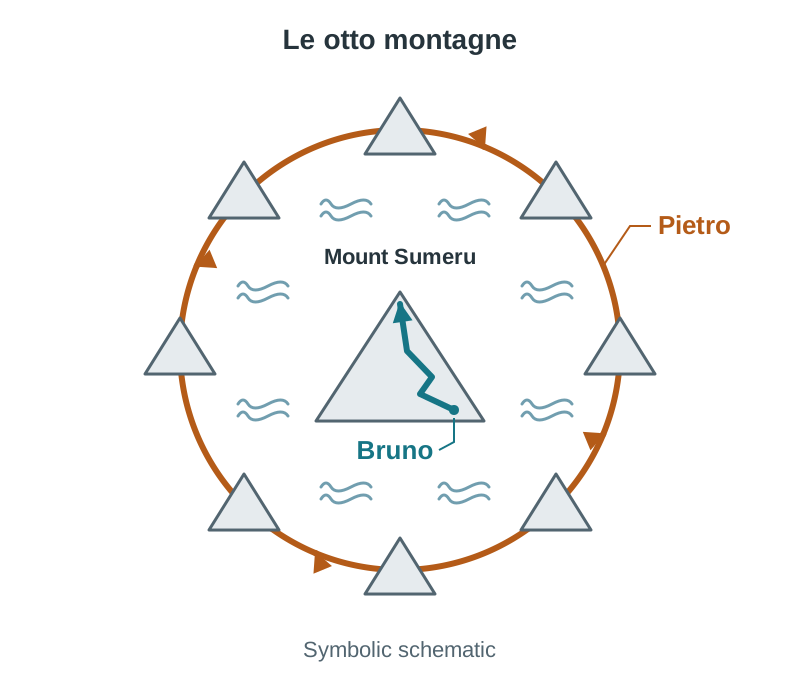
In Nepal, an elderly man sketches a wheel in the soil: a cosmic mountain called Mount Sumeru sits at the centre, surrounded by eight oceans and eight mountains. He asks who has learned more: the person who has visited the eight outer mountains, or the one who has reached the summit of Mount Sumeru?
| Character | Parable Counterpart | Chosen Path | Emotional and Practical Cost |
|---|---|---|---|
| Pietro | The Eight Mountains (Le otto montagne) | The wanderer who explores widely across different lands | Never feels at home anywhere; cannot put down roots; a constant sense of having lost something |
| Bruno | Mount Sumeru (Il monte Sumeru) | The rooted dweller who dedicates his entire life to one peak | Economic ruin; loss of family; fatal isolation in the winter mountains |
Cognetti does not declare either path superior. Both carry heavy costs. Recognise this parable as the book's central philosophical debate on whether wisdom comes from breadth of travel or depth of belonging.
Style, Narrative Tenses, Alpine Lexis, and Oral Exam Link
At Higher Level you are expected to notice how the author writes, not just what happens, and to recognise the mountain vocabulary he uses.
Narrative Register and Tenses
Cognetti writes with a spare, understated voice. He uses l'imperfetto (salivamo, era, credevamo) for ongoing background atmosphere, repetitive childhood routines, and unhurried descriptions. He switches to il passato remoto (andai, scoprì, disse) to mark decisive, irreversible turning points.
Essential Alpine and Emotional Lexis
Questions frequently ask you to explain or locate specific terms. Learn these in both directions (Italian to English and English to Italian):
| Italian Term | English Meaning |
|---|---|
| la baita | traditional stone mountain hut or cabin |
| l'alpeggio | high summer pasture for cattle; mountain dairy |
| il pascolo / pascolare | pasture / to graze cattle |
| il torrente | rushing mountain stream |
| la cresta / la parete | mountain ridge / rock face |
| il libro di vetta | summit guestbook kept in a metal box on high peaks |
| il distacco | emotional detachment or growing apart |
| il legame | bond or connection |
| la nostalgia | longing for the past |
| il rimpianto | regret |
| la solitudine | loneliness, solitude |
| tacere / il silenzio | to remain silent / silence |
| il lutto | grief, mourning |
| la testardaggine | stubbornness, obstinacy |
| lo spopolamento | depopulation of Alpine hamlets |
The Novel in the Oral Exam
The text you study for reading comprehension can also be discussed in your Leaving Certificate oral examination (which carries 25% of your total marks at Higher Level). During general conversation, you may choose to introduce a literary work. Prepare five clear sentences:
«Ho studiato il romanzo "Le otto montagne" di Paolo Cognetti. Racconta l'amicizia tra Pietro, un ragazzo di città, e Bruno, un ragazzo di montagna. Il tema principale è il contrasto tra chi resta e chi parte. Il personaggio che preferisco è Bruno, perché è testardo ma sincero. Mi è piaciuto lo stile semplice e poetico dell'autore.» (English gloss: I studied the novel "The Eight Mountains" by Paolo Cognetti. It tells the story of the friendship between Pietro, a city boy, and Bruno, a mountain boy. The main theme is the contrast between the one who stays and the one who leaves. My favourite character is Bruno, because he is stubborn but sincere. I liked the author's simple, poetic style.)
Key terms
- Il tono
- The mood or emotional attitude conveyed in a text (e.g. malinconico, nostalgico, teso), detected through word choices, punctuation, and grammatical tenses.
- Romanzo di formazione
- A coming-of-age novel depicting the moral, psychological, and social development of a protagonist from youth into adulthood.
- La baita
- A traditional Alpine stone hut; rebuilding the ruined cabin at Barma Drola represents the concrete repair of Pietro and Bruno's bond.
- Il monte Sumeru
- The central sacred peak in the Nepalese parable, symbolising Bruno's choice to commit entirely to a single valley.
- Le otto montagne
- The eight surrounding mountains of the Buddhist parable, symbolising Pietro's restless wandering around the world.
- Restare o partire
- The overarching thematic dilemma of the novel: the conflict between staying rooted in one's place of origin versus leaving to wander in search of identity.
- L'alpeggio
- High summer mountain grazing land and traditional cheese dairy; its financial failure precipitates Bruno's ultimate isolation.
- Il libro di vetta
- The register kept in a metal box on mountain summits where climbers record their ascent; through these books Pietro retraces his deceased father's secret climbs with Bruno.
- Muratore
- A stone mason and construction labourer; Bruno's trade after being denied the opportunity to attend school in Milan.
- L'imperfetto
- The past descriptive tense used by Cognetti to convey continuous emotional states, atmosphere, and repetitive childhood routines in the mountains.
- Il passato remoto
- The historic past tense used to denote definitive, completed actions and sharp turning points in the narrative timeline.
- Il legame
- The emotional bond between individuals, such as the tacit friendship between Pietro and Bruno or the complex connection between father and son.
Check yourself
Adapt the following first-person sentence into a correct Italian answer about Pietro: «Non gli avevo più parlato per undici anni.»
«Pietro non gli aveva più parlato per undici anni.» (Substitute the subject 'Pietro' and adapt the verb 'avevo' to the third-person 'aveva').
What is the grammatical error in this phrase: «Pietro lavorava con il suo padre sulla montagna»?
Singular family members do not take a definite article before a possessive adjective; it must be written as «suo padre».
In the Nepalese parable, what do Mount Sumeru and the eight mountains represent in relation to the two protagonists?
Mount Sumeru represents Bruno, who stays rooted deeply in one valley; the eight mountains represent Pietro, who wanders across the world seeking identity.
How did Giovanni (Pietro's father) spend his mountain holidays during the eleven years he and Pietro were estranged?
He returned alone to Grana and climbed high peaks with Bruno, who became an energetic climbing partner and surrogate son.
Why did Bruno not move to Milan with Pietro's family to attend secondary school during his childhood?
Bruno's father, an absent and demanding migrant worker, refused the offer and took Bruno away to work as a manual labourer.
Complete this sentence to justify a nostalgic tone in Italian: «Il tono del brano è nostalgico perché l'autore usa...»
«...l'imperfetto per descrivere i ricordi d'infanzia e parole come 'ormai' e 'non più', che esprimono il rimpianto per il tempo passato.»