

In the Leaving Certificate Italian Higher Level examination, the Listening Comprehension (Ascolto) accounts for 20% of your total marks. A large part of the listening paper is made up of conversations you overhear: friends making or changing plans, transactions in shops or offices, colleagues discussing work, and people debating contentious topics. Success requires listening beyond isolated words. You must identify register (informal 'tu' versus formal 'Lei'), follow conversational discourse markers, catch shifts in arrangements, and pinpoint speaker attitude, tone, and implicit meaning. Answers are written in English or Irish.
Register and Social Distance: 'Tu' versus 'Lei'
Italian conversation is shaped by social context. Deciding right away whether speakers are using the informal register (dare del tu) or the formal courtesy register (dare del Lei) helps answer the opening question of many dialogue items: what is the relationship between the speakers?
| Feature | Informal Register (il tu) | Formal Register (il Lei) |
|---|---|---|
| Social setting | Friends, classmates, family, teenagers | Strangers, officials, shopkeepers, employers |
| Greetings | Ciao!, A presto!, Ci vediamo! | Buongiorno, Buonasera, Arrivederla |
| Requests / apologies | Scusa, Scusami, Per favore | Scusi, Mi scusi, Si accomodi |
| Introductions | Ti presento Marco., Piacere! | Le presento il Dottor Rossi., Molto lieto/a. |
| Question forms | Come ti chiami?, Che ne pensi? | Come si chiama?, Che ne dice? |
| Direct object address | Ti ho chiamato ieri. | L'ho chiamato / chiamata ieri. |
Formal Lei uses the third-person feminine clitic pronoun La (contracted to L' before a vowel) for 'you', whether addressing a man or a woman. La ringrazio means 'I thank you', never 'I thank her'. In compound tenses, however, the past participle still agrees with the actual gender of the person addressed:
- «Signor Rossi, L'ho chiamato per confermare l'orario.» ('Mr Rossi, I rang you to confirm the time.')
- «Signora Rossi, L'ho chiamata per confermare l'orario.» ('Mrs Rossi, I rang you to confirm the time.')
When you hear La or L' in formal dialogue, it refers directly to the listener.
Exam Format and Structured Listening Routine
Each section of the listening test is played more than once. The exact number of playings, along with designated pauses, is printed at the start of each section on your examination paper. Typically, you hear the recording straight through, then split into shorter segments with pauses, then once more straight through. Use each pass deliberately.
The Three-Pass Routine
- Pre-listening reading: Read every question carefully before the recording starts. Underline the interrogative prompts (Why? Where? How long? Who?). This directs your attention toward the required facts.
- First playback (Gist and setting): Work out who is talking, how they know each other (tu versus Lei), where they are, and what the central issue is. Jot obvious facts and figures in pencil beside the question, and keep listening even if you miss a word.
- Segmented playback (Targeted extraction): Use the pauses between segments to write down specific details, times, numbers, and reasons, one piece at a time. Listen for qualifiers like circa or quasi, and note changes of mind.
- Final playback (Verification): Check your answers against the question prompts, fill any remaining gaps, and confirm that all required details are covered.
Answering and Layout Rules
- Check the number of details requested. If a question asks for 'two details', number them (i) and (ii). Giving only one detail means you lose the credit for the detail you left out.
- Answer the specific interrogative word: why demands a reason (look for perché, siccome, dato che); how long demands a duration.
- Do not offer alternative guesses (such as 'either 14 or 40'). Commit to one choice; adding an incorrect alternative can cancel out a correct point.
- Keep qualifiers: quasi due ore is 'almost two hours'; non ci va più is 'he no longer goes there'.
- Write in clear English or Irish. A short phrase is fine, provided the meaning is unambiguous.
Altering Arrangements, Clock Times, and Dates
Many dialogue questions ask what the speakers finally arrange. In natural conversation, the initial suggestion is often rejected, postponed, or amended.
Changing Plans and Making Decisions
Listen for these key phrases to identify the final outcome:
- Non ce la faccio — I can't make it.
- Mi è venuto un impegno — Something has come up.
- Devo annullare — I have to cancel; disdire la prenotazione — to cancel the booking.
- Spostare a / rimandare a — To move / postpone to: «Possiamo spostare a venerdì?» (Can we move it to Friday?).
- Anticipare — To bring forward: «Anticipiamo di un'ora» (Let's make it an hour earlier).
- Facciamo giovedì invece di mercoledì — Let's do Thursday instead of Wednesday.
- Ti va bene se...? / Le va bene se...? — Is it alright with you if...? (informal / formal).
- D'accordo, allora ci vediamo... — Agreed, so we'll meet...
- Confermo — I confirm; ti faccio sapere — I'll let you know (meaning the arrangement is not yet settled).
The final arrangement usually follows markers like però, allora, or facciamo così. If a speaker says ti faccio sapere, note that the matter is still undecided.
Clock Times, Days, and Dates
Questions about timetables, meetings, and opening hours require accurate conversion:
- alle otto e mezza — at half past eight (8.30)
- alle sette e un quarto — at a quarter past seven (7.15)
- alle nove meno un quarto — at a quarter to nine (8.45)
- alle dieci e dieci — at ten past ten (10.10)
- a mezzogiorno / a mezzanotte — at midday / at midnight
- alle quattordici e trenta — at 14:30 (half past two in the afternoon). Do not confuse this with 4.30.
- in punto — on the dot; verso le sei — around six; in anticipo / in ritardo — early / late.
For days and relative dates: lunedì, martedì, mercoledì, giovedì, venerdì, sabato, domenica.
- dopodomani — the day after tomorrow; l'altro ieri — the day before yesterday.
- fra/tra due settimane — in two weeks' time; due settimane fa — two weeks ago.
- il fine settimana — the weekend; ogni giovedì — every Thursday; una volta al mese — once a month.
Write times as both a figure and words (e.g. '8.45 / a quarter to nine') to show full comprehension.
Numbers, Names Spelled Aloud, and Everyday Content Vocabulary
Factual questions often test numerical precision, personal details, or everyday settings.
Numerical Discrimination: Teens versus Tens
Phonetic similarities between teens and multiples of ten are common traps:
- 14 quattordici / 40 quaranta
- 15 quindici / 50 cinquanta
- 16 sedici / 60 sessanta
- 17 diciassette / 70 settanta
- 7 sette / 70 settanta
- 8 otto / 80 ottanta
For the -dici teens the stress comes early (quattÓrdici, quÍndici, sÉdici) while the tens stress '-AN-' (quarÁnta, cinquÁnta, sessÁnta). For 17 versus 70, listen instead for the opening dicia- of diciassette; for 7 versus 70, listen for the extra -anta ending on settanta.
Names Spelled Aloud, Addresses, and Prices
Personal details are spelled out using Italian letter names: a, bi, ci, di, e, effe, gi, acca (h), i, elle, emme, enne, o, pi, cu, erre, esse, ti, u, vu, zeta. Foreign letters include i lunga (j), kappa (k), doppia vu (w), ics (x), and ipsilon / i greca (y).
- Come si scrive? — How do you spell it?
- con due elle / doppia zeta — with double l / double z; tutto attaccato — all one word.
- Addresses: via (street), viale (avenue), piazza (square), corso (main avenue); il numero civico (house number); al terzo piano, interno 5 (third floor, flat 5); il codice postale (postcode).
- Phone numbers are usually read digit by digit: zero due, quattro cinque sette...
- Costs: quindici euro e cinquanta (€15.50); gratis (free); lo sconto (discount); il biglietto ridotto / intero (reduced / full-price ticket).
Everyday Thematic Vocabulary
- Studies: la scuola superiore (secondary school), le materie (subjects), la maturità / l'esame di stato (final exams), la facoltà (university faculty), la laurea (degree), iscriversi a (to enrol in), un anno all'estero (a year abroad), bocciato/promosso (failed / passed).
- Work: un lavoretto (a part-time/odd job), un impiego / un posto (a job/post), la ditta / l'azienda (the company), il colloquio (interview), lo stage / il tirocinio (work placement/internship), lo stipendio (wages/salary), a tempo pieno / part-time (full-time / part-time), i turni (shifts), il capo (the boss).
- Family and Home: i miei (my parents), il fratello maggiore/minore (older/younger brother), un appartamento in affitto (a rented flat), l'inquilino (tenant), trasferirsi (to move house).
- Locality: il quartiere (neighbourhood), in periferia / in centro (on the outskirts / in the city centre), i mezzi pubblici (public transport), ben servito (well-serviced), tranquillo / rumoroso (quiet / noisy), scomodo (inconvenient).
Managing a Conversation and Taking Part in a Discussion
These are the set phrases Italians use to keep a conversation going: opening it, asking for repetition, confirming or denying, and closing.
Conversational Management and Turn-Taking
- Asking for repetition: Come? / Scusi? (Pardon?); Può ripetere, per favore? (Could you repeat that, please? — formal); Puoi ripetere? (informal).
- Clarification: In che senso? (In what sense? / What do you mean?); Che cosa vuol dire? (What does that mean?); Cioè? (That is to say? / Meaning?).
- Comprehension: Non ho capito bene (I didn't understand properly); Ho capito poco (I understood very little); Ho capito / D'accordo (Understood / Agreed).
- Challenging intent: Dove vuole arrivare? (Where are you going with this? / What are you driving at? — formal); Dove vuoi arrivare? (informal).
Discussion, Opinions, and Negotiation
- Expressing an opinion: Secondo me... / Per me... / A parere mio... (In my opinion); Mi sembra che... (It seems to me that); Non mi pare che... (It doesn't seem to me that).
- Asking opinions: Che ne pensi? / Che ne dici? (What do you think? — informal); Che ne pensa? / Che ne dice? (formal).
- Reactions and denial: È logico / È ovvio (It's logical / obvious); Non è vero! (That's not true!); No, nient'affatto! (No, not at all!); Impossibile! (Impossible!); La smetta! (Stop it! — formal command).
- Concession: E va bene! (Alright then!); Ammettiamo pure che... (Let's admit that... / Even assuming that...); Comunque... (Anyway / In any case).
- Contrasting and concluding: però / invece / anzi (but / instead / on the contrary, rather); pertanto / perciò / di conseguenza (therefore / consequently).
Note on 'insomma': It serves two distinct functions. Mid-sentence or mid-argument, it means 'in short' or 'to sum up'. Used alone as an answer to Come va?, it means 'so-so' or 'not great'. Determine its meaning from its sentence position and tone.
Time Structures, Plans, and Speaker Certainty
Leaving Certificate questions regularly test whether an event is happening now, occurred in the past, or represents a future wish.
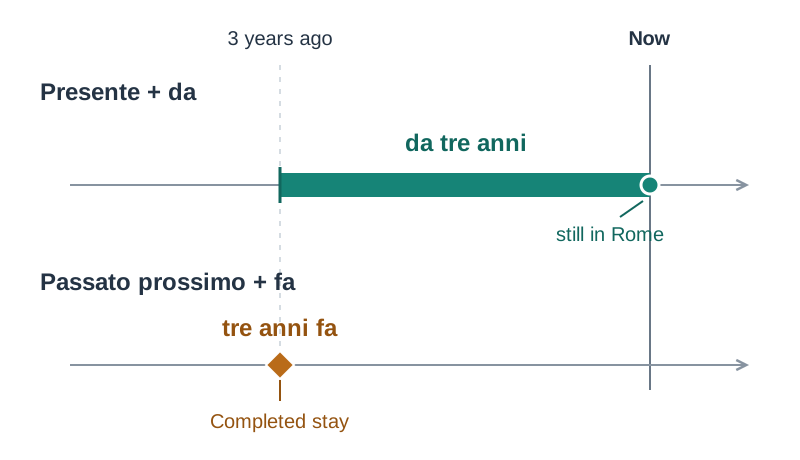
Ongoing Action versus Completed Past
- Presente + da (action ongoing now): «Vivo a Roma da tre anni.» means 'I have been living in Rome for three years' (the speaker moved three years ago and still lives there).
- Passato prossimo + fa (completed past action): «Ho vissuto a Roma tre anni fa.» means 'I lived in Rome three years ago' (the stay finished in the past).
Degrees of Certainty in Plans
- Fixed arrangement: Present indicative (Domani parto alle otto = I am leaving at eight tomorrow) or futuro semplice (L'anno prossimo andrò all'università = Next year I will go to university).
- Intention: Ho intenzione di... (I intend to...) or ho voglia di... (I feel like / want to...).
- Conditional wish: Verbs like vorrei... (I would like...), mi piacerebbe... (I would like to...), or preferirei... (I would prefer...).
For example, in the statement «Quest'estate lavoro in un albergo a Rimini — è già tutto sistemato. Poi, se metto da parte abbastanza, mi piacerebbe andare in Australia», the hotel job in Rimini is a definite arrangement (present tense with è già tutto sistemato), whereas traveling to Australia is an unconfirmed wish (mi piacerebbe) dependent on saving sufficient money.
Negation Patterns
Italian commonly pairs non with a secondary negative without producing an affirmative meaning: non faccio mai (I never do); non vedo nessuno (I see nobody); non ho ancora deciso (I haven't decided yet); non lavoro più lì (I no longer work there). If nessuno or niente begins the clause, non is omitted: Nessuno è venuto (Nobody came).
Tone, Attitude, and Implicit Meaning
Higher Level questions regularly evaluate tone and attitude. You must deduce whether a speaker is supportive, disappointed, relieved, or ironic by assessing their intonation alongside their words.
Common Interjections and Tone Markers
- Mah... / Beh... — Hesitation, doubt, or mild reluctance.
- Magari! — 'If only!' or 'I wish!' (expressing a strong, unfulfilled desire).
- Purtroppo / Che peccato! — Regret or disappointment.
- Per fortuna / Meno male! — Relief or gratitude.
- Uffa! / Che barba! / Che noia! — Irritation, exasperation, or boredom.
- Non vedo l'ora! — Eager anticipation ('I can't wait!').
Detecting Sarcasm and Irony
In sarcastic remarks, a speaker's vocal inflection and the surrounding facts contradict the literal wording. If a speaker sighs heavily and says «Sì, sì, magnifico... piove a dirotto e il treno è stato soppresso» ('Yes, yes, wonderful... it's pouring rain and the train has been cancelled'), the attitude is frustrated and sarcastic, not enthusiastic.
When an exam question asks for attitude, provide a two-part answer: an attitude adjective (e.g. disappointed, sarcastic, relieved) plus the specific supporting evidence from the dialogue.
Key terms
- Il Lei (forma di cortesia)
- The formal grammatical register used in Italian to address strangers, officials, or elders, employing third-person singular verbs and pronouns (including 'La' as the direct object for 'you').
- Presente + da
- The Italian grammatical structure indicating an action that began in the past and continues into the present ('vivo qui da un anno' = I have lived here for a year).
- Passato prossimo + fa
- The Italian structure used for completed past events viewed from the present ('ho finito l'esame due mesi fa' = I finished the exam two months ago).
- Spostare / rimandare
- Verbs meaning to move, reschedule, or postpone an appointment or arrangement to a different day or time.
- Disdire / annullare
- Verbs meaning to cancel an appointment, booking, or existing arrangement.
- Invece
- Discourse marker meaning 'instead' or 'on the other hand', signalling an alternative choice, contrasting situation, or opposing view.
- Anzi
- Discourse marker meaning 'in fact', 'rather', or 'on the contrary', used to introduce an immediate correction or refinement to an earlier statement.
- Magari!
- Conversational interjection meaning 'If only!' or 'I wish!', expressing strong longing for a desired but uncertain outcome.
- In che senso?
- Conversational phrase meaning 'In what sense?' or 'What do you mean?', used to request immediate clarification from the speaker.
- Circa / quasi
- Qualifying words meaning 'approximately/about' (circa) and 'almost' (quasi), which must be included in English exam answers to preserve numerical accuracy.
- Insomma
- Dual-purpose discourse word meaning 'in short / to sum up' when concluding an argument, or 'so-so / not great' when answering an enquiry about wellbeing.
- Deluso/a
- Italian adjective meaning 'disappointed' (a common false friend often incorrectly translated into English as 'deluded').
Check yourself
What percentage of the Leaving Certificate Italian Higher Level examination is allocated to Listening Comprehension?
20%.
«Senti, per sabato non ce la faccio, mi è venuto un impegno. Possiamo spostare a domenica pomeriggio?» — «D'accordo, allora domenica alle tre.» What is finally arranged?
They will meet on Sunday at 3.00 p.m. (Saturday is cancelled because something came up).
«Ho fatto il colloquio ieri: è uno stage di tre mesi, part-time, ma lo stipendio è basso.» Give two details about the job.
(i) It is a three-month work placement / internship, part-time; (ii) the salary/pay is low.
Translate accurately into English: «Studio l'italiano da quattro anni.»
I have been studying Italian for four years.
What is the difference in certainty between «Andrò a Roma» and «Mi piacerebbe andare a Roma»?
«Andrò a Roma» is a definite future plan ('I will go to Rome'), whereas «Mi piacerebbe andare a Roma» is a conditional wish ('I would like to go to Rome').
If a speaker on the recording says «Il biglietto costa circa quindici euro», what must you write down to get full marks?
You must include the approximation: 'About €15' or 'Roughly €15' (writing an exact €15 is incomplete).
What are the two different meanings of the word 'insomma' depending on where and how it is said?
Mid-sentence or in an argument it means 'in short / to sum up'; spoken alone in reply to 'Come va?' it means 'so-so / not great'.
What two elements must you include in your answer when an exam question asks you to identify a speaker's attitude?
An appropriate attitude adjective (e.g. disappointed, sarcastic, relieved) and the specific textual evidence or vocal tone from the recording supporting it.