

At Leaving Certificate Higher Level, the question on your prescribed novel sits inside the literary and reading comprehension section of the paper, rather than the general written composition section. Whether the examination asks you to analyse Paolo Cognetti's Le otto montagne through a set extract or as a broader thematic essay, success depends on moving beyond simple plot summary. Examiners look for focused analytical claims, accurate textual references, and clear thematic interpretation. This guide covers the essential narrative turning points, character dynamics, the governing metaphor of Mount Sumeru, and the structural and linguistic tools required for top-band responses in both written and oral assessments.
Before You Prepare: Exam Rubrics, Language, and Timing
The prescribed-novel question appears in the literary and reading part of the written paper, completely separate from the general writing options (such as opinion pieces, letters, and guided narratives). When approaching this question, two practical details determine your strategy:
- The language of your answer: Look carefully at how the question is phrased on your exam paper. In many recent examination papers, the questions on prescribed novels are printed in English. If the question is printed in English, write your answer in English. In that case, marks are awarded primarily for content: making distinct points, providing accurate references, and linking each reference to the prompt. If the prompt is printed in Italian, write your answer in Italian, where both content and grammatical accuracy are assessed.
- Length and timing: Allocate roughly 20 minutes to this section. Spend 3 minutes choosing your angle and planning three distinct points, 15 minutes writing, and 2 minutes checking your work. Aim for three developed paragraphs of 5 to 7 sentences each.
Recommended 20-Minute Exam Allocation
- Minutes 1–3 (Planning): Select your three points. Identify one concrete, named episode for each point before you start writing.
- Minutes 4–18 (Writing): Draft your three paragraphs using the Punto – Prova – Spiegazione structure.
- Minutes 19–20 (Review): If writing in Italian, verify four common pitfalls: the congiuntivo after opinion verbs, the omission of the definite article before singular family nouns (suo padre), past participle agreement, and correct accents (è, perché, più, così).
Always verify with your teacher and the latest State Examinations Commission (SEC) circular that Le otto montagne is on the prescribed list for your examination year.
The Novel at a Glance: Who is Who and the Governing Contrast
Paolo Cognetti's Le otto montagne, published in 2016 and winner of the Premio Strega in 2017, is a retrospective romanzo di formazione (coming-of-age novel) narrated in the first person by Pietro. Set between industrial Milan, the fictional Alpine village of Grana near Monte Rosa, and the Nepalese Himalayas, the book explores how landscapes shape human identity.
Chi è chi: Characters and Roles
| Character | Description and Role in the Narrative |
|---|---|
| Pietro Guasti | The narrator; an introverted, restless city boy from Milan who wanders the world making documentaries. |
| Bruno Guglielmina | The last child living in Grana; deeply rooted in the valley, he works with cattle, becomes a bricklayer, and later runs an alpeggio. |
| Giovanni Guasti | Pietro's father; an intense factory chemist who finds relief from city depression by climbing strenuous peaks at high speed. |
| Francesca Guasti | Pietro's mother; a sociable, empathetic woman who prefers village community life and lower valley paths to rugged summits. |
| Luigi | Bruno's uncle; the mountain farmer who keeps Bruno to herd cows during childhood. |
| Bruno's Father | A remote builder working away from the valley; he abruptly takes Bruno out of school to work on construction sites. |
| Lara | A woman who moves to the mountains to work with livestock; she partners with Bruno at the dairy farm and has his daughter. |
| Anita | Bruno and Lara's young daughter, who leaves Grana with her mother when the farm collapses into debt. |
The central tension of the novel can be summarised in one phrase: Pietro leaves, Bruno stays (Pietro parte, Bruno resta). Pietro seeks identity horizontally across the globe, while Bruno seeks identity vertically in one solitary valley.
The Three Movements and Key Narrative Episodes
The novel is structured into three clear movements. Knowing these divisions provides an immediate three-paragraph plan for questions asking how a relationship or character develops over time.
1. Childhood Summers in Grana
Pietro meets Bruno around age eleven. Bruno lives an ancestral, pastoral existence tending cows, in stark contrast to Pietro's urban life. Pietro's father, Giovanni, introduces both boys to strenuous climbing, but Pietro suffers from altitude sickness and resents his father's obsessive pace. Giovanni forms a silent climbing bond with Bruno, who can match his endurance.
The Pivotal Turning Point: The Blocked Education
Francesca, noticing Bruno's intelligence, proposes taking him down to Milan so he can live with the Guasti family and attend secondary school. Bruno is open to the idea, but his father refuses immediately. He pulls Bruno out of school and sends him to work on building sites as a muratore (bricklayer). This decision seals the boys' diverging destinies: Pietro returns to Milan to complete his education, while Bruno is locked into manual labour. During their teenage years, Pietro distances himself from Grana and stops speaking to his father.
2. Adulthood and Rebuilding the Baita
After Giovanni dies suddenly, Pietro learns his father bought a plot of land with a ruin at Barma Drola, high above Grana. Pietro returns to the valley and reunites with Bruno. Over a summer, the two men manually rebuild la baita (the stone hut). Physical labour replaces verbal communication: as they lay stone walls together, they restore their childhood friendship and Pietro begins to understand his deceased father's silent world.
3. The Final Years: Diverging Destinies and the Ending
Pietro begins travelling to the Himalayas, where he meets an old man who tells him the legend of Monte Sumeru. Meanwhile, Bruno enters a relationship with Lara, has a daughter named Anita, and sets up an alpeggio (a high mountain pasture dairy farm) making artisanal cheese.
Bruno's project ends in financial ruin. Unable to pay mounting debts, he refuses every compromise: he will not take an ordinary valley job, nor will he accept modern commercial shortcuts. Lara takes Anita and leaves. Facing eviction, Bruno retreats to la baita at Barma Drola to live in total isolation through the brutal winter. Pietro visits and tries to persuade him to descend, but Bruno refuses to abandon the peak. Bruno disappears during heavy snowstorms, his body taken by the mountain. Pietro is left to carry the memory of his friend, wandering the outer world alone.
The Central Metaphor: Mount Sumeru and the Eight Mountains
While in Nepal, an elderly local sketches a circle in the dirt to explain Buddhist cosmology to Pietro. At the centre stands Monte Sumeru, encircled by eight peripheral rings of oceans and mountains. The old man poses a question: who has acquired greater wisdom, the one who visits all eight mountains, or the one who reaches the peak of Mount Sumeru?
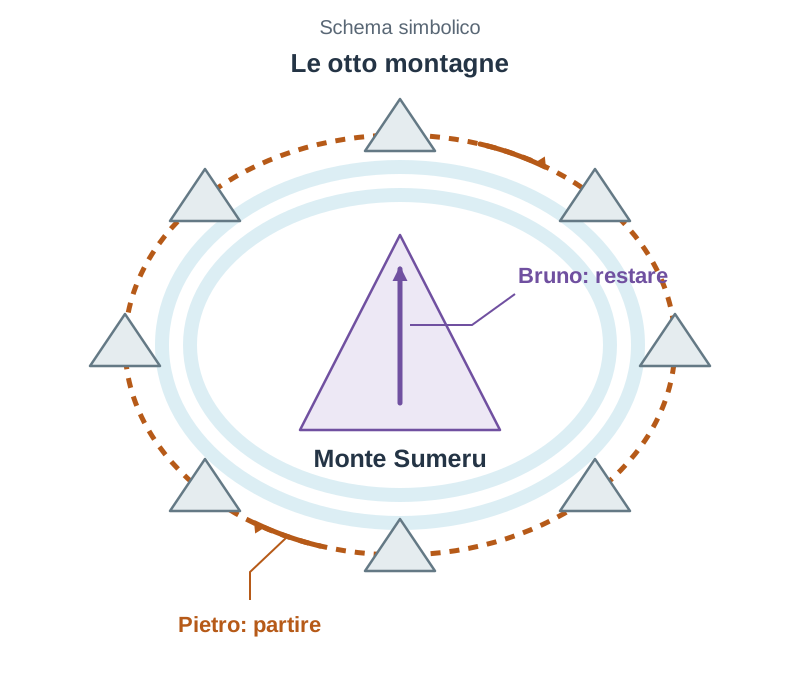
| Dimension | Pietro (The Eight Mountains) | Bruno (Mount Sumeru) |
|---|---|---|
| Symbolic Metaphor | Le otto montagne (the restless traveller) | Monte Sumeru (the central mountain) |
| Life Choice | Constant movement, global travel (partire) | Absolute rootedness, physical tradition (restare) |
| Form of Knowledge | Broad horizontal life experience | Deep vertical intimacy with one landscape |
| The Cost / Price | Chronic rootlessness, recurring nostalgia, grief | Economic ruin, refusal to adapt, fatal isolation |
In analytical essays, avoid claiming that the novel presents one choice as morally superior. Cognetti shows that both choices carry painful costs. Bruno's rootedness becomes stubborn inflexibility that costs him his family and his life. Pietro's mobility gives him perspective, but deprives him of a home to which he can return.
Essay Architecture: The Punto – Prova – Spiegazione Blueprint
To achieve top-bracket marks, structure each paragraph around the Punto – Prova – Spiegazione sequence. This structure ensures you analyse rather than retell the plot.
- Punto (Point): State a direct analytical argument addressing the examination question.
- Prova (Evidence): Provide a concrete textual reference, character action, or short quotation.
- Spiegazione (Explanation): Explain how this episode illustrates the deeper theme or character development.
Sample Structural Move: English-Language Format
When the exam question is set in English, follow this structure:
- Point: Bruno's connection to the mountain is marked by an unbending refusal to compromise with modern society.
- Evidence: After his dairy farm at the alpeggio goes bankrupt, he rejects Pietro's help, refuses to find wage labour in the valley, and isolates himself in the stone hut at Barma Drola as winter arrives.
- Explanation: This demonstrates that Bruno's loyalty to the mountain is not merely a rustic virtue, but a tragic obstinacy that alienates his family and ultimately costs him his life.
Analytical Starters for Italian Writing
If writing your response in Italian, use these transitional phrases:
| Essay Stage | Purpose | Useful Italian Phrasing |
|---|---|---|
| Introduzione | Situates the text and states your central thesis | Nel romanzo Le otto montagne di Paolo Cognetti..., Fin dal principio emerge il contrasto tra... |
| Punto 1 | First analytical argument with specific evidence | Innanzitutto, bisogna notare che..., Un episodio significativo si verifica quando... |
| Punto 2 | Second argument showing contrast or shift | In secondo luogo, la situazione cambia quando..., D'altra parte, invece... |
| Punto 3 | Third argument examining consequences or symbolism | Infine, la vicenda si conclude con..., Questo evento riflette chiaramente... |
| Conclusione | Synthesises findings without repeating the prompt | In conclusione, possiamo affermare che..., Tutto sommato, il destino dei personaggi dimostra che... |
Essential Vocabulary and Discursive Connectors
Examiners reward candidates who use formal connectors and precise literary vocabulary instead of colloquial speech.
Parole utili per parlare del romanzo
| Italian | English | Italian | English |
|---|---|---|---|
| la trama / la vicenda | the plot / the story | l'ambientazione | the setting |
| il protagonista | the main character | il punto di vista | the point of view |
| il legame / il rapporto | the bond / the relationship | le radici | roots |
| l'inquietudine | restlessness | l'isolamento | isolation |
| il lutto | grief, bereavement | l'eredità | the inheritance |
| il muratore | the bricklayer | l'alpeggio | the high summer pasture/dairy |
| la baita | the stone mountain hut | la valanga | the avalanche |
| la vetta / il sentiero | the summit / the mountain path | lo spopolamento | rural depopulation |
Useful analytical verbs include: rappresentare (to represent), incarnare (to embody), simboleggiare (to symbolise), mettere in evidenza (to highlight), allontanarsi da (to grow distant from), and riavvicinarsi a (to draw close to again).
Core Discursive Connectors
Use these nine dependable connectors to structure your thoughts:
- Innanzitutto (First of all)
- In secondo luogo (Secondly)
- Inoltre (Furthermore)
- Mentre (While / whereas)
- Tuttavia (However)
- Al contrario (On the contrary)
- Di conseguenza (Consequently)
- Da una parte... dall'altra... (On the one hand... on the other...)
- In conclusione (In conclusion)
Short Quotations and Key References
Check each of these phrases against the edition you are using and memorise only what you can reproduce with precision. If you are not certain of the exact wording under exam conditions, do not invent quotations. Simply report the idea in plain prose—for example: Bruno osserva che la parola «natura» è un'invenzione tipica di chi vive in città (Bruno observes that the word 'nature' is an invention of city dwellers). An accurate paraphrase earns full content credit, whereas an invented quotation loses language accuracy marks.
- On the central parable: «al centro del mondo c'è un monte altissimo, il Sumeru» (at the centre of the world there is a very high mountain, Sumeru). Use this when discussing the title, the contrasting paths of the protagonists, or the conflict between depth and breadth.
- On retrospective grief and the father: «in certe vite esistono montagne a cui non è possibile tornare» (in certain lives there are mountains to which it is not possible to return). Use this when exploring Pietro's late reconciliation with Giovanni and the finality of loss.
- On Bruno's childhood origin: «c'era un ragazzino che pascolava le mucche» (there was a young boy grazing the cows). Use this to illustrate Bruno's practical integration into Alpine life from the opening chapters.
- On the urban idealisation of the outdoors: «siete voi di città che la chiamate natura» (it is you city people who call it nature). Use this when discussing how the novel strips away romantic urban attitudes towards the wild.
- On the emotional cost of departure: «Stavo imparando che cosa succede a uno che va via» (I was learning what happens to someone who goes away). Use this to explain Pietro's dawning realisation of the price he pays for perpetual movement.
High-Scoring Grammar: Subjunctive, Indicative, and Family Nouns
To secure top marks when writing in Italian, ensure your grammar reflects formal written conventions.
1. Opinion Verbs with the Congiuntivo
Verbs of opinion, belief, or uncertainty (credere, pensare, ritenere) followed by che require the subjunctive mood:
- Credo che questo romanzo sia una riflessione profonda sul destino. (I believe that this novel is a profound reflection on destiny.) Note sia, the present subjunctive of essere.
- Ritengo che Bruno rappresenti la fedeltà alla montagna. (I believe that Bruno represents loyalty to the mountain.) Note rappresenti, the present subjunctive of rappresentare.
2. Impersonal Certainty Takes the Indicativo
Impersonal expressions that assert clear factual certainty govern the ordinary indicative mood, not the subjunctive:
- È evidente che la montagna ha un ruolo centrale nella storia. (It is evident that the mountain has a central role in the story.)
- È ovvio che Pietro e Bruno hanno due personalità opposte. (It is obvious that Pietro and Bruno have two opposing personalities.)
3. Prepositional Opinion Phrases Take the Indicativo
Expressions such as secondo me, a mio parere, and per me take the indicative mood:
- A mio parere, Bruno non vuole accettare il mondo moderno. (In my opinion, Bruno does not want to accept the modern world.)
4. Same-Subject Rule: di + Infinitive
When the subject of the main clause and the subordinate clause is the same person, use di followed by the infinitive instead of che and the subjunctive:
- Pietro crede di aver capito suo padre. (Pietro believes he has understood his father.) Never write: Pietro crede che lui abbia capito.
5. Family Nouns with Possessives
In standard Italian, singular unmodified family members do not take a definite article: write suo padre and sua madre, never il suo padre. The article is used only when the noun is plural (i suoi genitori) or modified by an adjective (il suo caro padre).
Likely Exam Questions and Oral Examination Advice
Higher Level prompts consistently assess character development, relationships over time, or the contrast between ways of living. Common prompt patterns include:
- The contrast in lifestyles: Pietro and Bruno choose two very different ways of living. Discuss. (Plan: childhood origins and schooling episode; divergence in adulthood and the baita; the Sumeru legend and Bruno's tragic ending).
- Enduring friendship: The friendship between Pietro and Bruno survives long periods of silence. Discuss with at least three references. (Plan: boyhood companionship in Grana; the summer rebuilding the hut; Pietro's final attempt to rescue Bruno before winter).
- Father-son relationship: Pietro only understands his father after his death. Discuss. (Plan: teenage conflict and climbing strain; retracing routes through the summit logbooks; discovering Giovanni's climbing bond with Bruno).
- The landscape as character: The mountain is more than a backdrop; it is an active presence. (Plan: summer escape for city dwellers; harsh economic reality for mountain labourers; the fatal Alpine winter that claims Bruno).
Preparing the Novel for the Oral Examination
The Leaving Certificate oral allows candidates to discuss a studied literary work during the general conversation. Prepare four or five natural, high-register sentences:
- Ho letto «Le otto montagne» di Paolo Cognetti, un romanzo di formazione ambientato sulle Alpi italiane. (I read Le otto montagne by Paolo Cognetti, a coming-of-age novel set in the Italian Alps.)
- Racconta l'amicizia tra Pietro, un ragazzo di città, e Bruno, un giovane montanaro. (It recounts the friendship between Pietro, a city boy, and Bruno, a young mountain dweller.)
- Il personaggio che mi ha colpito di più è Bruno, perché rifiuta ogni compromesso con la modernità. (The character who struck me most is Bruno, because he refuses any compromise with modernity.)
- Mi è piaciuto lo stile semplice e il modo in cui l'autore descrive il paesaggio. (I liked the simple style and the way the author describes the landscape.)
Key terms
- Romanzo di formazione
- A coming-of-age novel tracking the psychological, emotional, and moral development of a character from youth to maturity.
- Monte Sumeru
- The central mountain in Buddhist cosmology, representing vertical depth, steadfastness, and the choice to remain rooted in one place.
- Le otto montagne
- The eight peripheral mountains encircling Sumeru, symbolising horizontal travel, curiosity, restlessness, and the quest for identity.
- Restare o partire
- The governing thematic dilemma of the novel: the choice to remain rooted in one's ancestral valley versus leaving to explore the wider world.
- La baita
- A traditional Alpine stone hut; the ruin at Barma Drola, inherited by Pietro, which he and Bruno manually rebuild to restore their friendship.
- Alpeggio
- A high mountain pasture and dairy farm; Bruno's adult venture which collapses into debt, leading to his fatal winter retreat.
- Muratore
- A bricklayer or stone mason; the manual trade Bruno's father forces him into after refusing Francesca's offer to educate him in Milan.
- Punto – Prova – Spiegazione
- An analytical paragraph method: state a direct claim (Punto), provide concrete textual evidence (Prova), and explain its thematic significance (Spiegazione).
- Almeno tre punti
- The examination instruction requiring candidates to develop at least three distinct analytical arguments in their literary response.
- Congiuntivo
- The subjunctive mood, required in formal Italian after verbs of subjective opinion, belief, and doubt (e.g. 'ritengo che sia').
- Indicativo
- The indicative mood, required after impersonal expressions of certainty ('è evidente che') and prepositional opinion phrases ('secondo me').
Check yourself
How does Bruno's story end, and what does it reveal about the choice to stay ('restare')?
After his alpeggio dairy business goes bankrupt and Lara leaves with Anita, Bruno refuses to move to the valley for work. He stays alone in the stone hut at Barma Drola through the winter and disappears in the heavy snow. This reveals that staying is not presented as an easy or superior path; Bruno's refusal to adapt to modern life isolates him and ultimately costs him his life.
Name the three movements of the novel and give one key episode from each.
1. Childhood: Pietro and Bruno meet during summers in Grana, but Bruno's father prevents him from studying in Milan. 2. Adulthood: Pietro and Bruno reunite after Giovanni's death to rebuild the ruined hut at Barma Drola. 3. The Final Years: Pietro travels to Nepal and learns the Mount Sumeru legend, while Bruno's alpeggio fails and he dies in the winter snows.
Why is the episode where Francesca offers to bring Bruno to Milan a pivotal moment?
Francesca offers to host Bruno so he can continue his education, but Bruno's father refuses and puts him to work as a bricklayer (muratore). This cements the diverging futures of the two boys: Pietro has the freedom to study and travel, while Bruno remains tied to manual labour in the valley.
Which character represents Mount Sumeru and which represents the eight mountains?
Bruno represents Mount Sumeru (the central peak, staying rooted, vertical depth in one valley), while Pietro represents the eight mountains (the wanderer, horizontal breadth of experience, travel across the world).
Correct this sentence: 'Credo che Pietro ha un rapporto difficile con il suo padre.'
'Credo che Pietro abbia un rapporto difficile con suo padre.' ('Credo che' requires the subjunctive 'abbia', and singular unmodified family nouns omit the definite article, giving 'suo padre').
Correct this sentence: 'È evidente che la montagna sia un personaggio importante.'
'È evidente che la montagna è un personaggio importante.' ('È evidente che' expresses certainty and must be followed by the indicative mood 'è', not the subjunctive 'sia').