

This revision note covers the core mechanics of the Italian present tense, modal verbs, and reflexive verbs. These grammatical structures form the backbone of Leaving Certificate Higher Level Italian, underpinning the oral conversation and role-play, listening comprehension, and written tasks such as the diary entry, informal letter, and opinion piece.
Regular Present Tense and Crucial Spelling Adjustments
Italian regular verbs fall into three conjugations based on their infinitive endings: -are (first conjugation), -ere (second conjugation), and -ire (third conjugation). To form the present indicative, remove the infinitive ending to find the stem and attach the corresponding personal ending.
Regular Present Tense Endings
| Subject | -are (parlare) | -ere (scrivere) | -ire (dormire) |
|---|---|---|---|
| io | parlo | scrivo | dormo |
| tu | parli | scrivi | dormi |
| lui / lei / Lei | parla | scrive | dorme |
| noi | parliamo | scriviamo | dormiamo |
| voi | parlate | scrivete | dormite |
| loro | parlano | scrivono | dormono |
The io, tu, and noi endings (-o, -i, -iamo) are identical across all three families.
Spelling Changes in -care, -gare, and -iare Verbs
To maintain the correct consonant sound, verbs ending in -care and -gare add an h before endings starting with i (the tu and noi forms):
- giocare (to play): gioco, giochi, gioca, giochiamo, giocate, giocano
- pagare (to pay): pago, paghi, paga, paghiamo, pagate, pagano
Verbs ending in -iare do not double the letter i in the tu and noi forms:
- studiare (to study): studio, studi (never studii), studia, studiamo (never studiiamo), studiate, studiano
- mangiare (to eat): mangio, mangi, mangia, mangiamo, mangiate, mangiano
The -isc- Insertion in Third-Conjugation Verbs
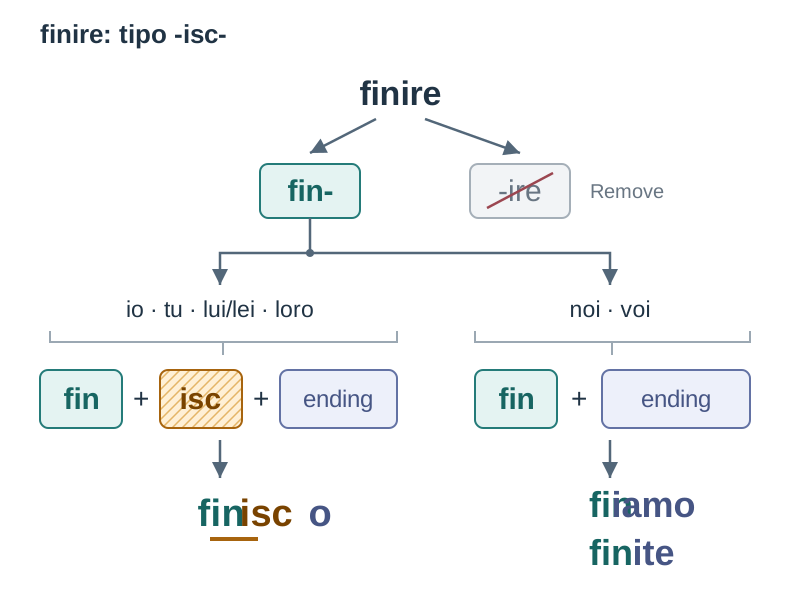
Many common -ire verbs insert -isc- between the stem and personal ending in the singular forms (io, tu, lui/lei) and the third-person plural (loro). It drops completely in the noi and voi forms.
- finire (to finish): finisco, finisci, finisce, finiamo, finite, finiscono
- capire (to understand): capisco, capisci, capisce, capiamo, capite, capiscono
- Other essential
-isc-verbs include preferire (to prefer) and pulire (to clean).
Present Tense Functions and Stare + Gerundio
The simple present covers both habitual actions and actions in progress (Mangio una pizza = I eat a pizza / I am eating a pizza). To emphasize that an action is underway at this exact moment, use stare in the present tense + the gerundio:
- -are verbs: stem + -ando (parlare → parlando)
- -ere and -ire verbs: stem + -endo (scrivere → scrivendo; dormire → dormendo)
- Irregulars: fare → facendo; dire → dicendo; bere → bevendo
Example: Nella foto, il ragazzo sta parlando al telefono. (In the picture, the boy is speaking on the phone.) Never say sono mangiando or sono mangiare.
Essential Irregular Verbs and Formal Address
Irregular verbs have non-standard stems that must be memorised. They appear continually in Leaving Certificate listening passages, oral questions, and reading comprehensions.
Auxiliary Verbs: Essere and Avere
- essere (to be): sono, sei, è, siamo, siete, sono
- avere (to have): ho, hai, ha, abbiamo, avete, hanno
The initial h in ho, hai, ha, and hanno is silent; it exists only in writing to separate verb forms from o (or), a (to/at), and anno (year). Remember that Italian expresses age with avere: Ho diciassette anni, never Sono diciassette anni.
High-Frequency Irregular Verbs
| Verb | io | tu | lui / lei / Lei | noi | voi | loro |
|---|---|---|---|---|---|---|
| andare (to go) | vado | vai | va | andiamo | andate | vanno |
| fare (to do/make) | faccio | fai | fa | facciamo | fate | fanno |
| dare (to give) | do | dai | dà | diamo | date | danno |
| stare (to stay/be) | sto | stai | sta | stiamo | state | stanno |
| uscire (to go out) | esco | esci | esce | usciamo | uscite | escono |
| venire (to come) | vengo | vieni | viene | veniamo | venite | vengono |
| dire (to say) | dico | dici | dice | diciamo | dite | dicono |
| bere (to drink) | bevo | bevi | beve | beviamo | bevete | bevono |
| tenere (to hold/keep) | tengo | tieni | tiene | teniamo | tenete | tengono |
| rimanere (to stay) | rimango | rimani | rimane | rimaniamo | rimanete | rimangono |
| scegliere (to choose) | scelgo | scegli | sceglie | scegliamo | scegliete | scelgono |
| sapere (to know) | so | sai | sa | sappiamo | sapete | sanno |
Watch the stem of uscire: it shifts from u- to e- in the stressed forms (esco, esci, esce, escono), but retains u- in usciamo and uscite. Notice also that the third-person singular of dare is written dà with an accent, distinguishing it from the preposition da (from).
Knowing: Sapere vs Conoscere
- sapere indicates facts, information, or learned skills: So dov'è la stazione (I know where the station is); So sciare (I know how to ski).
- conoscere indicates familiarity with people, places, or culture: Conosco Maria (I know Maria); Conosciamo bene Roma (We know Rome well).
The Formal Address (Lei)
In role-plays and interactions with adults or officials, use Lei (formal you). It takes the third-person singular verb form:
- Scusi, Lei parla inglese? (Excuse me, do you speak English?)
- Può ripetere, per favore? (Could you repeat that, please?)
- Keep the register consistent throughout an oral role-play; do not slip back into informal tu.
Modal Verbs, Intentions, and Polite Registers
Modal verbs combine directly with an infinitive to denote ability, obligation, or desire. Only the modal verb conjugates; the main verb remains an infinitive without linking prepositions.
Conjugation of Modal Verbs
| Subject | potere (can / to be able) | dovere (must / to have to) | volere (to want) |
|---|---|---|---|
| io | posso | devo | voglio |
| tu | puoi | devi | vuoi |
| lui / lei / Lei | può | deve | vuole |
| noi | possiamo | dobbiamo | vogliamo |
| voi | potete | dovete | volete |
| loro | possono | devono | vogliono |
Examples: Posso entrare? (May I enter?); Devo studiare (I must study — never devo di studiare); Vogliamo partire presto (We want to leave early).
Polite Requests vs Giving Advice
In service interactions and oral role-plays, replace direct modals with conditional forms to elevate your register:
- Polite requests: Vorrei (I would like) and Potrei (Could I / Might I). Vorrei prenotare un biglietto, per favore. (I would like to book a ticket, please.)
- Giving advice: Dovresti (You should). Dovresti riposare un po'. (You should rest a bit.)
Role-Play Booking Scenario
- Viaggiatore: Buongiorno, vorrei prenotare un posto sul treno per Firenze. (Good morning, I would like to book a seat on the train to Florence.)
- Bigliettaio: Certo. Preferisce finestrino o corridoio? (Certainly. Would you prefer a window or an aisle seat?)
- Viaggiatore: Potrei avere un posto vicino al finestrino? A che ora parte il treno? (Could I have a seat by the window? What time does the train leave?)
(Notice the polite conditionals vorrei and potrei, and the clerk's formal Lei form Preferisce — third-person singular used to mean 'you'.)
Structures for Declaring Intentions
To talk about plans and intentions with more variety than voglio, use these syllabus-listed structures:
- (non) ho intenzione di + infinitive: Ho intenzione di andare all'università. (I intend to go to university.)
- (non) ho voglia di + infinitive: Non ho voglia di uscire stasera. (I don't feel like going out tonight.)
- (non) mi va di + infinitive: Non mi va di cucinare. (I don't fancy cooking.)
- mi piacerebbe + infinitive: Mi piacerebbe lavorare all'estero. (I would like to work abroad.)
Reflexive Verbs and Daily Routine
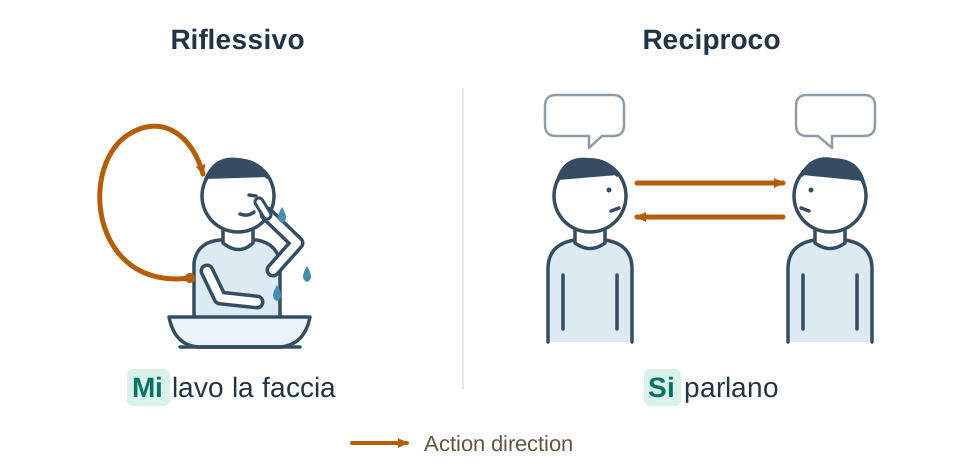
A verb is reflexive when the subject carries out an action upon itself. Reflexive infinitives end in -si (alzarsi, lavarsi). When conjugated, the reflexive pronoun matches the subject and precedes the verb.
Conjugating Alzarsi (to get up)
| Subject | Pronoun | Verb | Meaning |
|---|---|---|---|
| io | mi | alzo | I get up |
| tu | ti | alzi | you get up |
| lui / lei / Lei | si | alza | he / she gets up / you (formal) get up |
| noi | ci | alziamo | we get up |
| voi | vi | alzate | you get up (plural) |
| loro | si | alzano | they get up |
In negative sentences, non precedes the pronoun: Non mi alzo presto la domenica (I don't get up early on Sundays). In questions, the word order is unchanged: A che ora ti alzi? (What time do you get up?).
Daily Routine Vocabulary
Distinguish carefully between verbs that are inherently reflexive and regular verbs used in daily routines:
- Reflexive: svegliarsi (to wake up), alzarsi (to get up), vestirsi (to get dressed), prepararsi (to get ready), riposarsi (to rest), addormentarsi (to fall asleep), pettinarsi (to brush/comb one's hair), divertirsi (to enjoy oneself).
- Non-reflexive in everyday use: fare colazione (to have breakfast), fare la doccia (to take a shower), pranzare (to have lunch), cenare (to have dinner), prendere l'autobus (to take the bus), andare a letto (to go to bed — write vado a letto, never mi vado a letto).
With body parts and clothing, use the reflexive pronoun and the definite article, never a possessive adjective: write Mi lavo i denti (I brush my teeth), not Lavo i miei denti.
Reciprocal Actions
Plural reflexive pronouns (ci, vi, si) also express reciprocal actions ('each other'):
- Ci vediamo alle cinque. (We will see each other at five.)
- Si parlano ogni giorno. (They speak to each other every day.)
Connective Time Signals
Structure routine accounts with: di solito (usually), subito (immediately), prima di + infinitive (before doing...), dopo (afterwards), dopo + noun / dopo aver + past participle (after having done...), ogni tanto (from time to time), il fine settimana (at the weekend), domani (tomorrow).
Reflexive Syntax, Compound Past, and Reporting Messages
Reflexive Pronouns with Modal Verbs
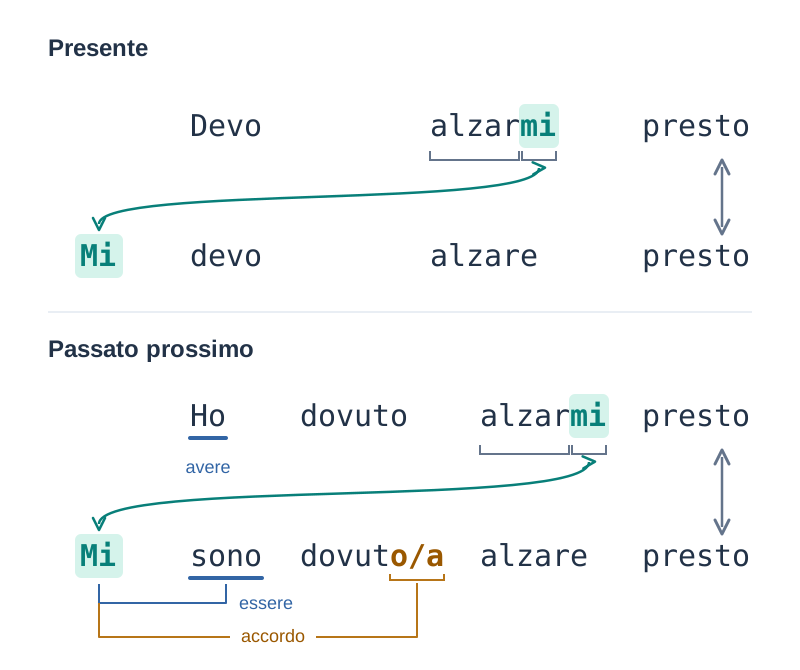
When a reflexive verb depends on a modal, the reflexive pronoun must always agree with the subject, but it can occupy two positions:
- Attached to the infinitive (dropping its final
-e): Devo alzarmi presto. - Before the conjugated modal: Mi devo alzare presto.
Trap: Never leave the pronoun as -si when the subject is first or second person (Voglio riposarmi, never Voglio riposarsi).
Reflexive Verbs in the Passato Prossimo
All reflexive verbs take essere in compound past tenses, and the past participle agrees in gender and number with the subject:
- Masculine singular (-o): Marco si è alzato. (Marco got up.)
- Feminine singular (-a): Giulia si è alzata. (Giulia got up.)
- Masculine / mixed plural (-i): Ci siamo divertiti. (We had fun.)
- Feminine plural (-e): Le ragazze si sono vestite. (The girls got dressed.)
Never use avere: Mi sono lavato/a, not Mi ho lavato.
When a modal verb governs a reflexive in the past, auxiliary selection depends on pronoun placement:
- Pronoun attached to infinitive → use avere: Ho dovuto alzarmi presto.
- Pronoun placed before modal → use essere with participle agreement: Mi sono dovuto/a alzare presto.
Reporting Messages and Forecasts in Indirect Speech
When reporting what someone says using a present reporting verb (dice che, si dice che, si prevede che), the original verb keeps its tense, but you must shift grammatical person, pronouns, and possessives:
- Direct: Luca dice: "Sono stanco e voglio restare a casa."
- Indirect: Luca dice che è stanco e vuole restare a casa.
- Direct: Anna dice: "Mi alzo alle sei e visito mia zia."
- Indirect: Anna dice che si alza alle sei e visita sua zia.
- Weather forecast: Si prevede che domani pioverà al nord. (Rain is forecast for the north tomorrow.)
Key terms
- Infinito
- The unconjugated base form of a verb ending in -are, -ere, -ire, or -si (such as parlare, scrivere, or alzarsi).
- Radice
- The verb stem obtained by removing the infinitive ending, to which person-specific endings are attached.
- Infix -isc-
- The syllable inserted between stem and ending in the io, tu, lui/lei, and loro forms of certain third-conjugation verbs.
- Verbi modali (servili)
- Helper verbs (potere, dovere, volere) combined directly with an infinitive to express ability, obligation, or desire.
- Pronome riflessivo
- A pronoun (mi, ti, si, ci, vi, si) indicating that the subject performs an action upon itself or mutually with another person.
- Accordo del participio
- Agreement of the past participle ending (-o, -a, -i, -e) in gender and number with the subject when conjugated with essere.
- Gerundio
- A verb form ending in -ando or -endo, used with stare to describe an action occurring right at that moment.
- Forma di cortesia (Lei)
- The formal mode of address using third-person singular verbs and pronouns to speak politely to adults, strangers, or officials.
Check yourself
Provide the 'tu' and 'noi' present-tense forms of 'giocare' and 'studiare'.
giocare: tu giochi, noi giochiamo; studiare: tu studi, noi studiamo.
Conjugate the irregular verb 'uscire' for 'io', 'noi', and 'loro'.
io esco, noi usciamo, loro escono (stem changes to e- in stressed forms; no written accents are used).
Give the two correct ways to say 'I must wake up at six' using the modal 'dovere' and the reflexive 'svegliarsi'.
'Devo svegliarmi alle sei' or 'Mi devo svegliare alle sei'.
How would you say 'I don't feel like studying today' using the syllabus expression 'mi va di'?
'Oggi non mi va di studiare' (or 'Non mi va di studiare oggi').
Report this direct statement in indirect speech using the present tense: Paolo: 'Mi alzo tardi e voglio dormire.'
Paolo dice che si alza tardi e vuole dormire (reflexive pronoun shifts from mi to si, and verbs change to the third-person singular).
Fill the blank with the correct past form of 'vestirsi': 'Ieri sera Chiara ed Elena _____ (vestirsi) in fretta'.
si sono vestite (reflexive verbs take essere in compound past tenses and agree with the feminine plural subject).