

The future tense (futuro semplice) and conditional tense (condizionale) form the foundation for talking about future plans, expressing intentions, making polite requests, and managing hypothetical scenarios in Leaving Certificate Higher Level Italian. Because both tenses share identical stems—including all irregular stems and spelling adjustments—learning the future stems unlocks the conditional as well. In the Leaving Certificate, mastering both tenses allows you to handle oral conversations about study and career options, write authentic letters and diary entries, and correctly interpret intentions and reported statements in reading and listening comprehensions.
Futuro Semplice: Regular Formation and Essential Spelling Changes
Forming the regular futuro semplice (simple future) is consistent across all three conjugations because they all take the exact same set of personal endings: -ò, -ai, -à, -emo, -ete, -anno.
To build the stem, take the infinitive and drop the final -e:
- -ere verbs: prendere drops the final -e to become prender- (prenderò)
- -ire verbs: dormire drops the final -e to become dormir- (dormirò)
- -are verbs: the characteristic stem vowel a must change to e (-are → -er-). For example, parlare drops its -e and shifts to parler- (parlerò); studiare becomes studier- (studierò).
| Subject Pronoun | Parlare (-are) | Prendere (-ere) | Dormire (-ire) |
|---|---|---|---|
| io | parlerò | prenderò | dormirò |
| tu | parlerai | prenderai | dormirai |
| lui / lei / Lei | parlerà | prenderà | dormirà |
| noi | parleremo | prenderemo | dormiremo |
| voi | parlerete | prenderete | dormirete |
| loro | parleranno | prenderanno | dormiranno |
Only the io and lui/lei/Lei forms carry a written grave accent (parlerò, parlerà). This accent indicates that the stress falls on the final syllable. Omitting it counts as a spelling mistake, so make sure to include it on those two forms.
Spelling Rules for Stems in -care, -gare, -ciare, -giare
Verbs ending in -care and -gare add an h in their stems to preserve the hard consonant sound before the 'e':
- cercare (to look for) → cercher- (cercherò, cercherai...)
- pagare (to pay) → pagher- (pagherò, pagherai...)
- nevicare (to snow) → nevicher- (nevicherà)
Verbs ending in -ciare and -giare drop the unstressed i, because the subsequent e already keeps the soft consonant sound:
- cominciare (to begin) → comincer- (comincerò)
- mangiare (to eat) → manger- (mangerò)
- viaggiare (to travel) → viagger- (viaggerò)
Irregular Stems: One Stem for Future and Conditional
A number of high-frequency verbs use shortened or modified stems. Crucially, the stem you use for the future tense is identical to the stem used for the conditional. Learn the stem once, and you can form both tenses immediately.
| Infinitive | Shared Stem | Future (io) | Present Conditional (io) | English Meaning |
|---|---|---|---|---|
| essere | sar- | sarò | sarei | I will be / I would be |
| avere | avr- | avrò | avrei | I will have / I would have |
| andare | andr- | andrò | andrei | I will go / I would go |
| fare | far- | farò | farei | I will do / I would do |
| dare | dar- | darò | darei | I will give / I would give |
| stare | star- | starò | starei | I will stay / I would stay |
| dovere | dovr- | dovrò | dovrei | I will have to / I should |
| potere | potr- | potrò | potrei | I will be able to / I could |
| sapere | sapr- | saprò | saprei | I will know / I would know |
| vedere | vedr- | vedrò | vedrei | I will see / I would see |
| vivere | vivr- | vivrò | vivrei | I will live / I would live |
| bere | berr- | berrò | berrei | I will drink / I would drink |
| rimanere | rimarr- | rimarrò | rimarrei | I will stay / I would stay |
| tenere | terr- | terrò | terrei | I will keep / I would keep |
| venire | verr- | verrò | verrei | I will come / I would come |
| volere | vorr- | vorrò | vorrei | I will want / I would like |
Notice that verbs like bere, rimanere, venire, and volere have a double r in their stem.
Present vs Future Tense, Time Clauses, and Weather Forecasts
For fixed arrangements in the near future, Italian often uses the present tense, just as English says 'I'm leaving tomorrow':
- Domani parto per Roma. (I'm leaving for Rome tomorrow.)
- Sabato vedo Marco. (I'm seeing Marco on Saturday.)
Use the future tense for plans further ahead, predictions, or promises:
- L'anno prossimo studierò all'estero. (Next year I will study abroad.)
Avoid translating 'I am going to study' word-for-word with andare a. In Italian, vado a studiare means 'I am physically going somewhere in order to study'. To express intention, use the future (studierò) or ho intenzione di studiare.
The Future after quando, appena, and se
When both actions refer to the future, careful written Italian uses the future tense in both clauses:
- Quando finirò gli esami, andrò in vacanza. (When I finish my exams, I will go on holiday.)
- Appena avrò tue notizie, ti chiamerò. (As soon as I have news from you, I will call you.)
- Se avrò tempo, ti scriverò. (If I have time, I will write to you.)
In everyday spoken Italian, native speakers frequently use the present tense for both clauses (Se ho tempo, ti chiamo). That is natural conversational Italian, not an error; however, using the future in both clauses in your written examination demonstrates firm grammatical control.
Weather Forecasts and Futuro di Probabilità
Listening and reading comprehensions regularly feature weather reports using future forms:
- Domani pioverà al nord e nevicherà sulle Alpi. (Tomorrow it will rain in the north and snow on the Alps.)
- Farà bel tempo, ma le temperature saranno in calo. (The weather will be fine, but temperatures will be dropping.)
- Si prevede che farà caldo. (Hot weather is forecast.)
Reflexive verbs in the future place the pronoun before the conjugated verb: Domani mi vestirò pesante (Tomorrow I will dress warmly).
The futuro di probabilità expresses an assumption or educated guess about something occurring right now: Che ore sono? — Saranno le quattro (What time is it? — It must be / is probably four o'clock). You mostly need to recognise this in reading and listening comprehensions; you do not have to generate it in your own essays.
Condizionale Presente: Formation and Usage
The condizionale presente (present conditional) usually translates to 'would' + verb (parlerei = I would speak). It translates to 'could' or 'should' only when using the modal verbs potere and dovere (potrei = I could; dovrei = I should / ought to).
It attaches to the shared future stem using the endings: -ei, -esti, -ebbe, -emmo, -este, -ebbero.
| Subject Pronoun | Parlare (parler-) | Prendere (prender-) | Dormire (dormir-) | Essere (sar-) |
|---|---|---|---|---|
| io | parlerei | prenderei | dormirei | sarei |
| tu | parleresti | prenderesti | dormiresti | saresti |
| lui / lei / Lei | parlerebbe | prenderebbe | dormirebbe | sarebbe |
| noi | parleremmo | prenderemmo | dormiremmo | saremmo |
| voi | parlereste | prendereste | dormireste | sareste |
| loro | parlerebbero | prenderebbero | dormirebbero | sarebbero |
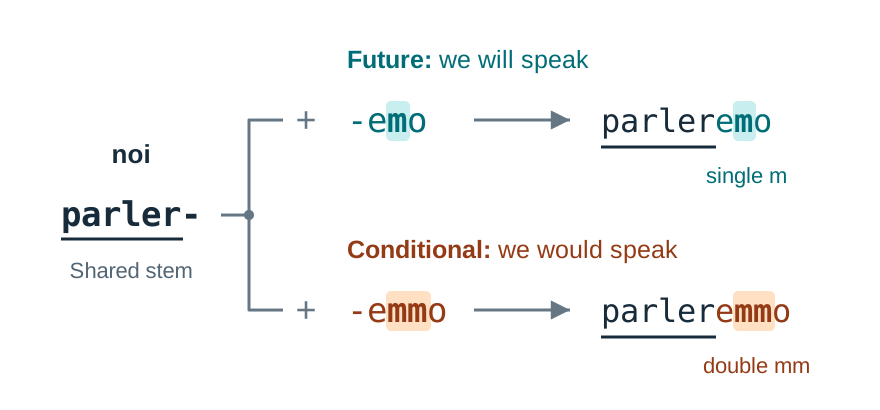
Take note of the crucial contrast between -emo and -emmo:
- parleremo (single m) = we will speak (future)
- parleremmo (double mm) = we would speak (conditional)
Main Communicative Roles
- Politeness: Vorrei un'informazione, per favore (I would like some information, please). Using voglio ('I want') sounds harsh and impolite in role-plays and transactions.
- Giving advice: Dovresti riposare di più (You should rest more).
- Journalistic conditional: In news articles, third-person forms indicate unconfirmed information: Secondo i giornali, il ministro darebbe le dimissioni (According to the newspapers, the minister is reportedly resigning). When translating this in comprehension tasks, do not state it as an established fact.
Hypothetical Sentences: se + Imperfect Subjunctive + Conditional
To discuss an imaginary, unreal, or unlikely situation, Italian pairs the imperfect subjunctive with the conditional:
se + imperfect subjunctive, then the conditional
- Se avessi più tempo, viaggerei per tutto il mondo. (If I had more time, I would travel around the whole world.)
- Se vincessi la lotteria, comprerei una casa sul mare. (If I won the lottery, I would buy a house by the sea.)
- Se fossi il sindaco della mia città, migliorerei i trasporti pubblici. (If I were the mayor of my city, I would improve public transport.)
Never place the conditional directly after se: ✗ Se avrei soldi → ✓ Se avessi soldi.
Compare the real condition with the imaginary one:
- Real / likely: Se avrò tempo, ti aiuterò. (If I have time, I will help you.)
- Imaginary / unlikely: Se avessi tempo, ti aiuterei. (If I had time, I would help you.)
Talking About Your Plans: Intentions, Reasons, and Everyday Interactions
When you talk about your future, do not keep repeating voglio. Italian provides several expressions to show how definite or keen you are, and varying them makes your spoken and written answers sound authentic.
Expressing Intentions
- Ho intenzione di + infinitive: A firm plan. Ho intenzione di iscrivermi all'università. (I intend to enrol in university.)
- Ho voglia di + infinitive: An inclination or desire. Ho voglia di fare una vacanza rilassante. (I feel like having a relaxing holiday.)
- Non mi va di + infinitive: Reluctance. Non mi va di lavorare in ufficio. (I do not feel like working in an office.)
- Vorrei + infinitive: A considered ambition. Vorrei trovare un lavoro estivo. (I would like to find a summer job.)
- Mi piacerebbe + infinitive: An aspirational wish. Mi piacerebbe fare un apprendistato. (I would like to do an apprenticeship.)
If the following verb is reflexive, you can attach the pronoun to the end of the infinitive: vorrei iscrivermi (or mi vorrei iscrivere).
Linking Plans with Reasons
Give reasons for your plans using these connectors:
- perché (because): introduces the cause. Vorrei studiare medicina perché mi piace aiutare gli altri. (I would like to study medicine because I like helping others.)
- perciò (so / therefore): introduces the result. Il mondo del lavoro è competitivo, perciò farò uno stage. (The world of work is competitive, so I will do an internship.)
Everyday Arrangements, Promises, and Cancellations
These everyday formulas are essential for dialogue in role-plays and notes:
- Offering: Posso aiutarti? (Can I help you?); Se vuoi, ti do una mano. (If you like, I'll give you a hand.)
- Promising: Ti prometto che studierò di più. (I promise you I will study more.); Te lo prometto! (I promise!)
- Making arrangements: Ci vediamo sabato alle otto? (Shall we meet on Saturday at eight?); Passerò a prenderti alle sette. (I'll call for you at seven.)
- Cancelling or altering plans: Purtroppo devo annullare il nostro appuntamento. (Unfortunately I have to cancel our arrangement.); Sabato non potrò venire; potremmo rimandare a domenica? (On Saturday I won't be able to come; could we postpone to Sunday?)
Condizionale Passato, Reported Speech, and Regrets
The condizionale passato (past conditional) is formed using the present conditional of avere or essere followed by the past participle:
- avrei parlato (I would have spoken)
- sarei andato/a (I would have gone)
Follow the same auxiliary rules as the passato prossimo: use essere with verbs of movement, state, and reflexive verbs, ensuring the past participle agrees with the subject in gender and number (loro sarebbero arrivati/e).
Reported Speech: Future in the Past
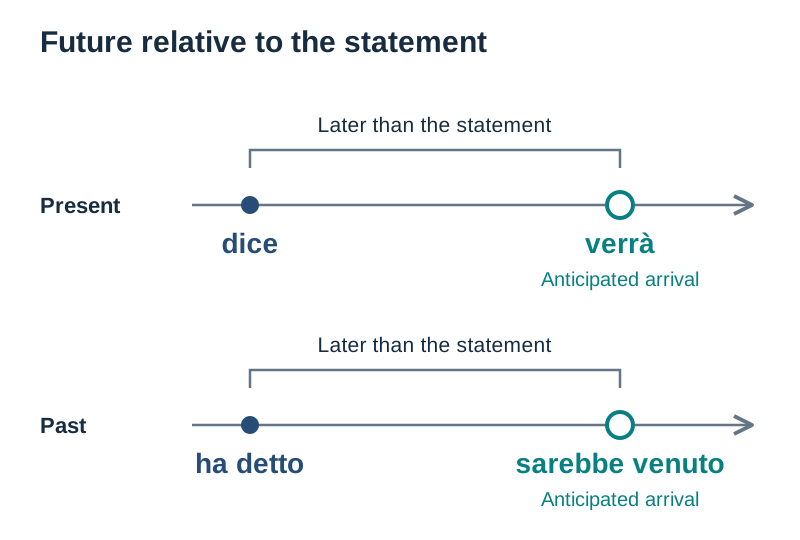
When reporting what someone said or thought in the past about an action that was still to take place, English says 'he said he would come'. In Italian, you must use the past conditional, never the present conditional:
- Present reporting verb → future: Marco dice che verrà. (Marco says he will come.)
- Past reporting verb → past conditional: Marco ha detto che sarebbe venuto. (Marco said he would come.)
- ✗ Marco ha detto che verrebbe. → ✓ Marco ha detto che sarebbe venuto.
- Dissi a mio padre che sarei andata al cinema. (I told my father that I would go to the cinema.)
Using this sequence in letters, diary entries, and stories demonstrates the grammatical range rewarded at Higher Level.
Expressing Regret: Past Conditional with Modal Verbs
To express what should or could have happened, use the past conditional of dovere or potere followed by an infinitive:
- avrei dovuto + infinitive (I should have...): Avrei dovuto ripassare di più. (I should have revised more.)
- avrei potuto + infinitive (I could have...): Avrei potuto aiutarti. (I could have helped you.)
- avrei voluto + infinitive (I would have liked to...): Avrei voluto partecipare alla gara. (I would have liked to take part in the race.)
- sarebbe stato meglio + infinitive (it would have been better to...): Sarebbe stato meglio partire prima. (It would have been better to leave earlier.)
Key terms
- Futuro semplice
- The simple future tense in Italian (-ò, -ai, -à, -emo, -ete, -anno), used for future plans, promises, predictions, and conjectures about the present.
- Condizionale presente
- The present conditional tense (-ei, -esti, -ebbe, -emmo, -este, -ebbero), used for polite requests, advice, hypothetical statements, and unconfirmed reports.
- Condizionale passato
- The compound past conditional (conditional auxiliary + past participle), used for unfulfilled actions in the past and the future in the past in indirect speech.
- Futuro nel passato
- The sequence-of-tenses structure requiring the past conditional in subordinate clauses when reporting an action that was future relative to a past main verb (e.g. 'Ha detto che sarebbe venuto').
- Futuro di probabilità
- The use of the future tense to express probability, conjecture, or an educated guess about the present (e.g. 'Saranno le due' = 'It is probably around two o'clock').
- Perciò
- A linking conjunction meaning 'so' or 'therefore', used to introduce the consequence or result of a decision.
- L'anno venturo
- A temporal phrase meaning 'next year' or 'the coming year', interchangeable with 'l'anno prossimo'.
- Vorrei
- The first-person conditional of 'volere' ('I would like'), replacing the abrupt 'voglio' to make requests politely.
- Il corso di laurea
- Degree course; the university programme of study leading to a degree ('la laurea').
- Iscriversi all'università
- To enrol or register at university (reflexive verb: 'mi iscriverò' / 'vorrei iscrivermi').
Check yourself
What are the first-person singular (io) future forms of 'cercare' and 'mangiare'?
'cercherò' (adds 'h' to maintain the hard sound) and 'mangerò' (drops the 'i').
How do you distinguish between 'we will go' and 'we would go' in Italian?
'noi andremo' has a single 'm' (future), while 'noi andremmo' has a double 'mm' (conditional).
Correct the following sentence: 'Se avrei più soldi, comprerei una nuova macchina.'
'Se avessi più soldi, comprerei una nuova macchina.' (Use the imperfect subjunctive 'avessi' after 'se', not the conditional).
Translate into Italian: 'Marco told me that he would arrive at nine.'
'Marco mi ha detto che sarebbe arrivato alle nove.' (Use the condizionale passato 'sarebbe arrivato' for the future in the past).
If an oral examiner asks: 'Che cosa farà l'anno prossimo?', which person of the verb should you answer in?
Answer in the first-person singular (io) ending in -ò (e.g. 'Farò domanda per l'università' or 'Andrò all'estero'). The examiner used the formal 'Lei' form ending in -à.
What is the difference between 'perché' and 'perciò' when explaining your study plans?
'perché' introduces the cause or reason ('because'), while 'perciò' introduces the result or consequence ('therefore' / 'so').