

In Leaving Certificate Higher Level Italian, written production accounts for 25% of the total examination marks. The formal letter appears regularly in Section C, typically asking you to submit an application (for a summer job, volunteer camp, or scholarship) or lodge an official complaint (about faulty goods or substandard services). Marking rewards three core areas: correct spatial format (addresses, date, subject line, greeting, and sign-off), thorough coverage of every task point, and grammatical accuracy in the formal register.
Letter Layout, Addresses, and Spatial Conventions
A formal Italian letter follows a defined spatial layout. Placing each element in its traditional position demonstrates communicative competence from the moment the examiner opens your script.
The Standard Layout Skeleton
[Il mittente - Your Name & Address: Top Left]
Conor O'Sullivan
12 Main Street
Ennis, Co. Clare
Irlanda

                                  [Il destinatario - Recipient Address: Top Right]
                                  Spettabile Ufficio Reclami
                                  Via Roma 45
                                  00186 Roma
                                  Italia

                                  [Luogo e data - Place and Date: Right]
                                  Dublino, 12 maggio 2027

Oggetto: [Brief Subject Line]

[Saluto formale - Formal Greeting:]
Gentile Direttore, / Egregio Signore, / Spettabile Ufficio Reclami,

[Corpo della lettera - Body paragraphs with indent or blank line between them...]

[Formula di chiusura - Pre-closing sentence & formal sign-off:]
In attesa di un Suo cortese riscontro, porgo distinti saluti.

[Firma - Full printed name]
Conor O'Sullivan
Sender and Recipient Address Blocks
- Your own address (il mittente): Write your name and Irish address at the top left of the page above everything else.
- The recipient's details (il destinatario): Position this block below your address. Italian business correspondence traditionally places the recipient block on the right-hand side, though a consistent left-aligned block is also acceptable.
- Place and date (luogo e data): Position this on the right-hand side. State the town or city followed by a comma, the day number, the month in lowercase letters, and the full year (for example:
Dublino, 12 maggio 2027orGalway, 5 ottobre 2027). Never capitalise the month and never use English ordinal suffixes such as th or st.
The Subject Line (Oggetto) and Email Adjustments
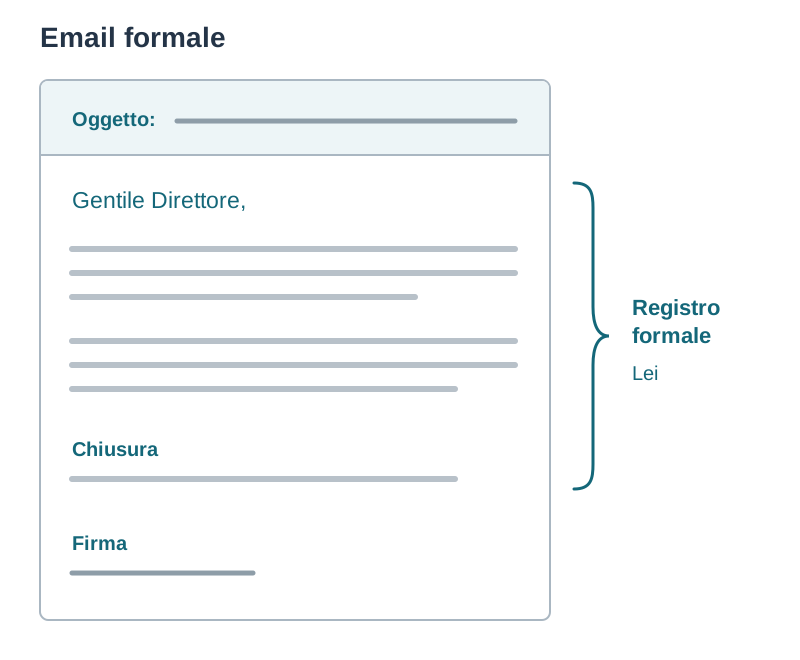
Place the Oggetto line after the addresses and before your opening salutation. It immediately defines the topic of your correspondence:
- Oggetto: Candidatura per la borsa di studio 2027-2028 (Subject: Application for the 2027-2028 scholarship)
- Oggetto: Reclamo per l'ordine n. 45821 (Subject: Complaint regarding order no. 45821)
When an exam prompt allows an email or provides an email address (such as ambasciata.dublino@esteri.it), leave out the street addresses and the place/date line. Retain the Oggetto line, the formal salutation, the Lei register, the pre-closing formula, and your printed signature at the bottom.
Formal Salutations
Select the greeting that fits your addressee and always follow it with a comma:
- Egregio Signore, (Dear Sir – name unknown)
- Gentile Signora, (Dear Madam – name unknown)
- Egregio / Gentile Direttore, (Dear Director / Manager)
- Egregio Signor Rossi, (Dear Mr Rossi; use Egregio for men)
- Gentile Signora Bianchi, (Dear Ms Bianchi; use Gentile for women)
- Spettabile Ditta, or Spettabile Ufficio Reclami, (Dear Company / Complaints Department)
The Lowercase Rule After the Greeting
Because your opening greeting ends with a comma, the sentence continues on the next line. Begin the first word of your opening paragraph with a lowercase letter:
✓ Gentile Direttore, le scrivo per presentare la mia candidatura...
Beginning with a lowercase le or la is standard. Using a capital courtesy pronoun (Le scrivo) is also acceptable in formal Italian correspondence because it signals respect, but opening with an ordinary capitalised verb or noun (Scrivo, Sono uno studente) is grammatically incorrect after a comma.
Mastering the Formal Register (Lei vs Voi)
Written production criteria assess accuracy and appropriateness of register. In formal correspondence, you must maintain an appropriate polite address from your opening sentence to your final sign-off.
Addressing an Individual: The 'Lei' Form
When writing to a named individual or specific role (Gentile Direttore, Egregio Signor Rossi), use the singular formal address (dare del Lei):
- Third-Person Verb Forms: Address the recipient using third-person singular verbs in every tense: Lei desidera (you wish), può confermare (you can confirm), vorrebbe (you would like).
- Object Pronouns (La and Le): Use feminine third-person pronouns for both male and female recipients. The direct object is La (La ringrazio sinceramente – I thank you), and the indirect object is Le (Le scrivo per informare – I am writing [to] you to inform).
- Formal Possessives: Use Suo, Sua, Suoi, Sue. Capitalising the initial letter indicates courtesy (il Suo annuncio, la Sua risposta). Never use tuo, tua, or informal second-person verb endings.
Addressing an Office or Company: The 'Voi' Option
When writing to an organisation or corporate department as an entity (Spettabile Ufficio Reclami, Spettabile Ditta), Italian business practice frequently employs the plural polite address (dare del Voi):
- In attesa di un Vostro cortese riscontro... (Awaiting your reply...)
- Vorrei sottoporre alla Vostra attenzione... (I would like to bring to your attention...)
Both Lei (addressing the manager) and Voi (addressing the collective team) are fully acceptable. What costs marks is shifting between registers within the same letter. Decide on your addressee in paragraph one and remain consistent throughout.
| Informal (tu) | Formal Singular (Lei) | Formal Plural (Voi) | English Meaning |
|---|---|---|---|
| Ti scrivo per... | Le scrivo per... | Vi scrivo per... | I am writing to you to... |
| Ti ringrazio molto | La ringrazio vivamente | Vi ringrazio vivamente | I thank you very much |
| Il tuo annuncio | Il Suo annuncio | Il Vostro annuncio | Your advertisement |
| Se puoi inviarmi... | Se potesse inviarmi... | Se poteste inviarmi... | If you could send me... |
| Fammi sapere | Resto in attesa di un Suo riscontro | Resto in attesa di un Vostro riscontro | I await your reply |
The 'Lei' Proofreading Audit
Before finishing your paper, audit your verbs and pronouns:
- Check every verb addressed to the reader. Formal Lei forms include può, vuole, ha, desidera, potrebbe, and potesse. Eradicate informal tu forms: puoi, vuoi, hai, desideri, potresti, and potessi. Remember that (mi) scusi and guardi are correct formal imperatives.
- Confirm that singular recipient pronouns are La (direct) or Le (indirect).
- Ensure possessives addressing the reader are Suo/Sua/Suoi/Sue, never tuo/tua.
Syntax, Subjunctives, and Gender Agreement
Higher Level scripts achieve top marks by demonstrating a varied grammatical range. Replacing basic indicative sentences with polite conditionals and subjunctive constructions raises the calibre of your writing.
Polite Requests: The Conditional and Subjunctive
Softening direct demands with conditional forms conveys natural courtesy:
- Vorrei sottoporre alla Sua attenzione la mia candidatura. (I would like to submit my application for your consideration.)
- Sarei molto grato/a se potesse confermare la mia richiesta. (I would be very grateful if you could confirm my request.)
- Potrebbe indicarmi i requisiti necessari? (Could you indicate the necessary requirements to me?)
After verbs of wishing, hoping, or requesting (spero che, desidero che) and conjunctions like benché, use the subjunctive mood:
- Spero che Lei possa prendere in considerazione la mia domanda. (I hope that you can consider my application.)
- Benché io non abbia ancora concluso gli studi, ho già maturato esperienza. (Although I have not yet finished my studies, I have already gained experience.)
- È inaccettabile che un'azienda seria offra un disservizio simile. (It is unacceptable that a reputable company should offer such poor service.)
Gender Agreement for the Writer
Accuracy is one of the written assessment criteria, and agreement between nouns, adjectives and verbs is part of the grammar you are expected to use correctly. If you are female, make sure first-person adjectives and past participles with essere take feminine endings:
| Male Writer | Female Writer | English Meaning |
|---|---|---|
| Sono uno studente irlandese | Sono una studentessa irlandese | I am an Irish student |
| Sono rimasto molto deluso | Sono rimasta molto delusa | I was very disappointed |
| Sarei molto grato | Sarei molto grata | I would be very grateful |
| Ho lavorato come volontario | Ho lavorato come volontaria | I worked as a volunteer |
| Sono sicuro di essere adatto | Sono sicura di essere adatta | I am sure I am suitable |
Cohesive Connectors
Use transitional phrases to structure your paragraphs logically:
- In primo luogo... (In the first place...)
- Inoltre / Oltre a ciò... (Furthermore / In addition to this...)
- Per quanto riguarda... (As far as ... is concerned...)
- Tuttavia / Ciononostante... (However / Nevertheless...)
- Di conseguenza / Pertanto... (Consequently / Therefore...)
The Application Letter (Lettera di Candidatura)
Application prompts test your ability to present qualifications, describe past experience, express future plans, and state preferred dates. Structure your application using this five-step sequence:
1. Statement of Purpose
Identify the vacancy or scholarship and specify where you saw the notice:
- In risposta al Suo annuncio pubblicato sul sito web, vorrei presentare la mia candidatura per il posto di animatore estivo. (In response to your advertisement on the website, I would like to submit my application for the summer camp leader role.)
- Le scrivo in merito alla borsa di studio promossa dall'Ambasciata per l'anno accademico 2027-2028. (I am writing regarding the scholarship offered by the Embassy for the 2027-2028 academic year.)
2. Personal Profile and Motivation
State your age, studies, and genuine motivation:
- Sono uno studente irlandese / una studentessa irlandese di diciotto anni e frequento l'ultimo anno di scuola secondaria. (I am an 18-year-old Irish student in my final year of secondary school.)
- Ritengo di meritare questa borsa di studio perché ho sempre dimostrato un forte impegno accademico e una grande passione per la cultura italiana. (I believe I deserve this scholarship because I have consistently shown strong academic dedication and passion for Italian culture.)
3. Relevant Skills and Qualities
Incorporate past tenses to describe previous work or volunteering duties:
- Ho già maturato esperienza nel settore turistico lavorando come cameriere. (I have already gained experience in tourism working as a waiter.)
- Ho collaborato con un'associazione locale, sviluppando spirito di iniziativa, autonomia e una spiccata predisposizione al lavoro di squadra. (I worked with a local charity, developing initiative, independence, and an aptitude for teamwork.)
4. Duration, Availability, and Future Intentions
Exam prompts often require specifying your preferred duration alongside future plans:
- Preferred Duration: Preferirei una borsa di studio di durata semestrale / annuale. (I would prefer a scholarship lasting one semester / one year.) Or: Sarei disponibile a prendere servizio dalla fine di giugno fino alla fine di agosto. (I would be available to take up duties from late June to late August.)
- Future Plans: Dopo questa esperienza ho intenzione di iscrivermi all'università per studiare lingue moderne. (After this experience I intend to enrol in university to study modern languages.) Or: Al mio ritorno in Irlanda continuerò a studiare l'italiano; questa opportunità mi sarà utilissima per il mio futuro professionale nel turismo. (Upon returning to Ireland I will continue studying Italian; this opportunity will be useful for my professional future in tourism.)
5. Enclosures and Interview Availability
- Allego alla presente il mio curriculum vitae dettagliato e resto a Sua disposizione per un eventuale colloquio conoscitivo. (I enclose my detailed CV and remain available for a potential interview.)
The Complaint Letter (Lettera di Reclamo)
A formal complaint must sound firm and assertive while remaining polite. Avoid aggressive personal attacks; instead, construct a clear factual argument across four stages.
1. Purchase or Booking Details
Identify the transaction date, invoice number, or booking reference:
- Le scrivo per presentare un formale reclamo riguardo all'ordine n. 58392 effettuato sul Suo sito in data 12 aprile. (I am writing to submit a formal complaint regarding order no. 58392 placed on your website on 12 April.)
2. The Specific Problem (Tense Precision)
Select your tenses carefully when reporting what went wrong:
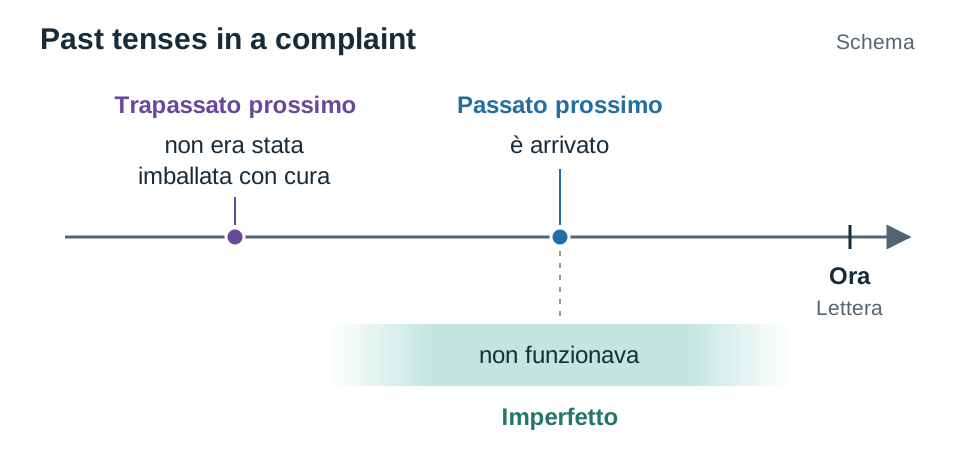
- Passato Prossimo: For completed occurrences (il pacco è arrivato con due settimane di ritardo; l'articolo è arrivato danneggiato).
- Imperfetto: For descriptions of ongoing conditions or defects (il prodotto non funzionava; lo schermo era completamente rotto).
- Trapassato Prossimo: For actions that occurred prior to your arrival or inspection (la merce non era stata imballata con cura – the goods had not been packed with care).
3. Dissatisfaction and Inconvenience Caused
Describe the negative impact on your routine or schedule:
- Sono rimasto/a profondamente deluso/a dalla scarsa qualità del servizio. (I was deeply disappointed by the poor quality of service.)
- Questo disservizio mi ha causato notevoli disagi, poiché l'articolo era un regalo di compleanno e non è stato possibile consegnarlo in tempo. (This issue caused me considerable inconvenience, as the item was a birthday gift and could not be delivered on time.)
4. Demanding a Remedy and Asking for Action
Never conclude without specifying your required resolution and questioning the company's planned actions:
- Full Refund: Chiedo pertanto il rimborso integrale della somma spesa (€120). (I therefore request a full refund of the amount spent.)
- Replacement: Gradirei la sostituzione immediata del prodotto difettoso con uno nuovo. (I would like an immediate replacement of the faulty item with a new one.)
- Price Reduction: Esigo una riduzione del prezzo e un parziale risarcimento per i danni subiti. (I require a price reduction and partial compensation for damages suffered.)
- Asking for Steps: Vorrei sapere quali provvedimenti intende prendere per risolvere la questione. (I would like to know what steps you intend to take to resolve the matter.)
Sign-Off Formulas and Valediction Layout
The conclusion of your letter must adhere to Italian punctuation conventions.
Complete Pre-Closing Formulas
Rather than leaving isolated phrases hanging, use a complete syntactic clause:
- In attesa di un Suo cortese riscontro, porgo distinti saluti. (Awaiting your kind reply, I offer my kind regards.)
- RingraziandoLa per la disponibilità e l'attenzione, porgo cordiali saluti. (Thanking you for your availability and attention, I offer warm regards.)
Valediction Punctuation
In English correspondence, sign-offs end with a comma (e.g., 'Yours faithfully,'). In Italian, a standalone valediction is written with no punctuation or with a full stop:
In attesa di un Suo cortese riscontro, porgo distinti saluti.
Conor O'Sullivan
Alternatively, if you separate the closing sentence from the valediction:
Resto a Sua completa disposizione per ogni chiarimento.
Distinti saluti
Conor O'Sullivan
Distinti saluti is the standard formal sign-off (equivalent to 'Yours faithfully'). Cordiali saluti is slightly warmer and also fully accepted. Never finish formal correspondence with informal spoken phrases such as Ciao, A presto, or Un abbraccio.
Key terms
- Forma di cortesia
- The formal grammatical register in Italian that addresses an individual using the third-person singular (Lei) and third-person pronouns and possessives.
- Il mittente
- The sender of the letter, whose name and postal address belong at the top left of the layout.
- Il destinatario
- The recipient of the letter, whose title, organisation, and address are positioned below the sender details.
- Oggetto
- The formal subject line placed before the greeting, stating the purpose of the letter or email concisely.
- Egregio
- A formal adjective ('Dear / Esteemed') used before a male recipient's title or surname (e.g. Egregio Direttore, Egregio Signor Rossi).
- Spettabile (Spett.le)
- A courtesy title used when formally addressing a company, institution, or department as an entity rather than an individual person.
- Riscontro
- A formal written reply, response, or acknowledgement from an organisation or professional addressee.
- Rimborso
- A financial refund issued to a customer following poor service, cancellation, or the return of faulty merchandise.
- Sostituzione
- A replacement of a defective or damaged product requested by a customer in a letter of complaint.
- Borsa di studio
- A scholarship or study grant, a frequent subject of Leaving Certificate application tasks.
- Colloquio
- A formal job, placement, or admissions interview.
- In allegato / Allego
- Enclosed / Attached (used when including documents such as a CV, receipts, or booking confirmations).
Check yourself
How must the place and date line appear at the top right of an Italian formal letter sent from Galway on the 3rd of October 2027?
Galway, 3 ottobre 2027 (cardinal number first, lowercase month name, no ordinal suffixes).
When writing to 'Spettabile Ufficio Reclami', how can you say 'your company', and what rule governs your choice?
You may say 'la Vostra azienda' (using the collective polite Voi) or 'la Sua azienda' (using the singular polite Lei addressed to the head). The crucial rule is register consistency: whichever you choose, maintain it throughout the entire letter.
How does a female candidate correctly write 'I was deeply disappointed' in Italian?
Sono rimasta profondamente delusa. (Because rimanere takes essere in compound tenses, the past participle and adjective must agree in gender with the female subject).
Which direct object pronoun must you use to say 'I thank you' when formally writing to a male hotel director?
La (written with a courtesy capital: 'La ringrazio'). In the formal Lei register, third-person feminine pronouns (La for direct, Le for indirect) are used for both men and women.
Translate into formal Italian: 'I would prefer a scholarship of one year's duration.'
Preferirei una borsa di studio di durata annuale.
What four elements are essential to construct an effective Leaving Certificate complaint letter?
1. Transaction details (dates, order or booking reference); 2. The specific fault described with precise tenses; 3. The inconvenience or disruption caused; 4. An explicit remedy (refund, replacement, or discount) and an enquiry about the company's intended action.