

Mastering the vocabulary and grammar of education, work, leisure, and future planning is central to Leaving Certificate Higher Level Italian. These themes appear across all four examination components: the general conversation and role-play in the oral (25%), factual retrieval and dialogues in the listening comprehension (20%), reading comprehension texts (30%), and the formal letter, informal note, or discursive essay in written production (25%). Scoring in the top grade bands requires moving past basic vocabulary lists by demonstrating precise verb governance, confident command of tenses and moods, and well-substantiated opinions.
School Systems and Daily Academic Life
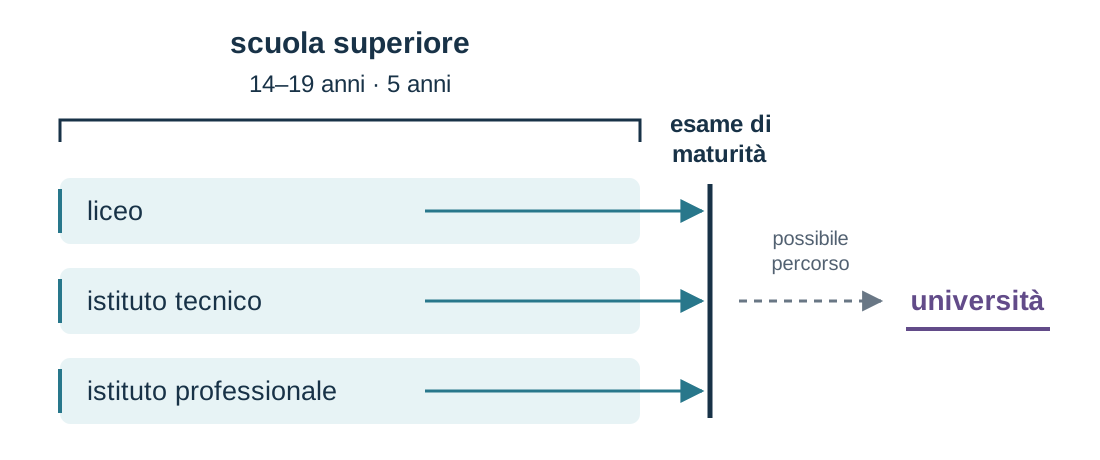
In Italy, upper secondary education takes place in la scuola superiore (often just le superiori). There are different types, such as the liceo, the istituto tecnico and the istituto professionale. It lasts five years from ages 14 to 19. It finishes with the state examination, known as l'esame di maturità or l'esame di Stato. For third-level education, use l'università. Do not confuse it with il collegio, which means a boarding school, or il liceo, which is secondary school.
Comparing Irish and Italian Schools
Under Cultural Awareness, the syllabus expects you to compare daily life and education in Ireland and Italy:
- In Ireland, students wear a uniform (la divisa), whereas Italian students wear their own clothes: In Irlanda portiamo la divisa, mentre in Italia gli studenti si vestono come vogliono.
- Many Italian schools finish around 13:00–14:00, and some also have lessons on Saturday.
- Grading in Italy is marked out of 10, with 6 representing a pass (la sufficienza).
- Oral tests (le interrogazioni) are a routine feature of Italian classwork, training students to present arguments publicly.
- If a student fails too many subjects, they may have to repeat the school year (ripetere l'anno or essere bocciato).
- Summer holidays in Italy usually run from mid-June to mid-September.
School Subjects and Definite Articles
Italian uses the definite article before school subjects when speaking about them generally or with verbs of liking and disliking like piacere:
- Mi piace la biologia perché trovo affascinante il corpo umano. (I like biology because I find the human body fascinating.)
- Studio sette materie: l'inglese, l'irlandese, la matematica, l'italiano, la chimica, la biologia e la storia. (I study seven subjects: English, Irish, maths, Italian, chemistry, biology, and history.)
When using the verb studiare on its own in everyday conversation, the article is often omitted: Studio chimica e fisica is perfectly acceptable.
Discussing Exams and Academic Competence
To pass an exam in standard written Italian, always use superare un esame. In colloquial conversation, Italians also say passare un esame, but superare is safer and preferred in formal writing. To sit or take an exam, use sostenere un esame or fare un esame. To fail is essere bocciato or non superare l'esame:
- A giugno sosterrò il Leaving Certificate e spero di superarlo con ottimi voti. (In June I will sit the Leaving Cert and I hope to pass it with great marks.)
To state competence in a subject, the adjective bravo/brava agrees with the speaker's gender and requires the preposition in:
- Sono brava in matematica, ma trovo la fisica piuttosto impegnativa. (I am good at maths [female speaker], but I find physics quite demanding.)
The Future Tense and Making Plans
The syllabus specifically names the future simple (il futuro semplice) under the theme of making plans and discussing future action. You need it to talk about your career ambitions, university plans, and upcoming holidays.
Forming the Futuro Semplice
For regular verbs, drop the final -e of the infinitive, change the stem vowel of -are verbs to -er-, and add the endings: -ò, -ai, -à, -emo, -ete, -anno.
| Person | studiare (-are) | prendere (-ere) | finire (-ire) |
|---|---|---|---|
| io | studierò | prenderò | finirò |
| tu | studierai | prenderai | finirai |
| lui/lei | studierà | prenderà | finirà |
| noi | studieremo | prenderemo | finiremo |
| voi | studierete | prenderete | finirete |
| loro | studieranno | prenderanno | finiranno |
Spelling Changes and Key Irregular Stems
- Verbs ending in -care and -gare add an h before all future endings to keep the hard sound: giocare → giocherò; pagare → pagherò.
- Verbs ending in -ciare and -giare drop the i: cominciare → comincerò; viaggiare → viaggerò.
- Common irregular stems share the same standard endings:
- essere → sarò
- avere → avrò
- fare → farò
- andare → andrò
- dovere → dovrò
- potere → potrò
- vedere → vedrò
- venire → verrò
- volere → vorrò
- rimanere → rimarrò
For near-future events and definite arrangements, Italian frequently uses the present indicative, just like English: Domani vado a Dublino con i miei compagni (Tomorrow I am going to Dublin with my classmates).
Expressing Future Intentions
Vary your expressions of intent beyond the future tense. While voglio (I want) is correct, conditional forms like vorrei (I would like) or mi piacerebbe (I would love to) sound more polished. Spero di, ho intenzione di and penso di take di + infinitive, while vorrei, voglio and mi piacerebbe are followed directly by the infinitive (Vorrei diventare medico; Spero di andare all'università).
Conditions, Opinions, and Subjunctive Structures
Higher Level marking criteria reward a range of structures. Showing control of conditions and opinion clauses will set your oral and written work apart.
Two Types of 'Se' Clauses
Be careful not to mix up likely conditions with hypothetical ones:
- Real, likely conditions: Use the present or future indicative after se, followed by the present or future indicative in the main clause. Either form is correct:
- Se prendo abbastanza punti, andrò all'università. (If I get enough points, I will go to university.)
- Se prenderò abbastanza punti, andrò all'università. (Slightly more formal, but equally correct.)
- Hypothetical or unlikely conditions: Use se + congiuntivo imperfetto, followed by the condizionale in the result clause:
- Se avessi più tempo libero, farei volontariato. (If I had more free time, I would do volunteer work.)
- Se vincessi la lotteria, viaggerei per tutto il mondo. (If I won the lottery, I would travel all over the world.)
- Se fossi il ministro dell'istruzione, abolirei il sistema dei punti. (If I were the Minister for Education, I would abolish the points system.)
Never put the conditional directly after se. Writing se avrei is an immediate red flag for examiners.
Expressing Opinions with the Congiuntivo Presente
When expressing opinions with che, verbs of opinion, belief, or necessity take the congiuntivo presente in the subordinate clause:
- Penso che il sistema dei punti sia troppo stressante. (I think the points system is too stressful.)
- Credo che un lavoro part-time abbia molti vantaggi. (I believe a part-time job has many advantages.)
- È importante che i giovani facciano sport per rilassarsi. (It is important that young people play sport to relax.)
Key irregular present subjunctive forms to memorise: essere → sia; avere → abbia; fare → faccia; andare → vada; potere → possa.
If you want to state a clear opinion without triggering the subjunctive, use Secondo me... or A mio parere... followed by the regular indicative: Secondo me, l'orario scolastico è troppo lungo.
To structure an opinion piece: Da un lato… dall'altro (on the one hand… on the other), Tuttavia (however), Per concludere (to conclude).
Work Experience, Part-Time Jobs, and Listening Vocabulary
Oral examiners routinely ask about part-time jobs and Transition Year work placements, while listening passages frequently feature employment duties and summer work.
Stating Professions and Occupations
In Italian, omit the indefinite article when stating a profession after essere or diventare:
- Mio padre è ingegnere e mia madre è avvocato. (My father is an engineer and my mother is a lawyer.)
- If you add an adjective, you must reinsert the article: È un ottimo insegnante. (He is an excellent teacher.)
- When using the verb fare, use the definite article: Mia madre fa l'avvocato. (My mother works as a lawyer.)
- For your own status, say Sono studente / studentessa, or Frequento l'ultimo anno delle superiori.
Work Experience, Summer Jobs, and Volunteering
| Italian | English |
|---|---|
| lo stage / il tirocinio | work placement / internship |
| l'esperienza lavorativa | work experience |
| il lavoro estivo | summer job |
| il lavoro part-time / a tempo pieno | part-time / full-time job |
| fare volontariato / il volontario, la volontaria | to volunteer / volunteer |
| il campo di volontariato | volunteer camp |
| l'azienda agricola / la fattoria | farm |
| dare informazioni ai turisti | to give information to tourists |
| prenotare visite guidate | to book guided tours |
| fare la babysitter / badare ai bambini | to babysit / mind children |
| accompagnare i bambini a scuola | to take children to school |
| andare a prendere i bambini | to collect children |
| aiutare con i compiti | to help with homework |
| fare le faccende (di casa) | to do housework / chores |
| le ripetizioni / le lezioni private | grinds / private lessons |
| alzarsi presto | to get up early |
| faticoso / duro | tiring / tough |
| all'aria aperta | in the open air |
| isolato / difficile da raggiungere | isolated / hard to reach |
| in pensione | retired |
Describing Past Work Duties
When discussing past work placements in the oral exam or reading about them in listening comprehensions, use the passato prossimo for completed events and the imperfetto for habitual duties:
- L'estate scorsa ho lavorato in un ufficio turistico: davo informazioni ai turisti e prenotavo visite guidate. (Last summer I worked in a tourist office: I gave information to tourists and booked guided tours.)
Listening Comprehension Clues
Exam papers regularly set questions requiring precise details about duties and routines. Be alert to these specific terms:
- I nipoti: In Italian this single word means either nephews and nieces or grandchildren. Always look at the age and family context in the dialogue before deciding which English word to write.
- Le ripetizioni: Refers specifically to grinds or private tutoring lessons.
- In pensione: Means retired, frequently used when explaining why an older relative has free time.
Leisure, Sports, and Social Arrangements
Talking about free time lets you demonstrate precise verb governance and practical conversational fluency for oral role-plays and written notes.
Three Verbs for 'Play' and 'Do': Giocare, Fare, and Suonare
- Giocare a + sport or game (generally without an article): gioco a calcio, giochiamo a basket, gioca a tennis, giocare a scacchi (chess), giocare a carte (cards). The main exception where the article is included is giocare ai videogiochi (video games).
- Fare + activity or workout: faccio nuoto (swimming), faccio atletica (athletics), faccio equitazione (horse riding), faccio palestra (working out at the gym).
- Suonare + musical instrument (always requires the definite article): suono il pianoforte, suona la chitarra, suonare la batteria (drums). Never use giocare for instruments.
Expressing Likes: Piacere
Piacere agrees with the thing liked: Mi piace il calcio / Mi piace leggere (one thing or an infinitive); Mi piacciono i film d'azione (plural).
- Quick check: Mi ___ gli sport (answer: piacciono).
Ongoing Actions: 'Da' + Present Tense
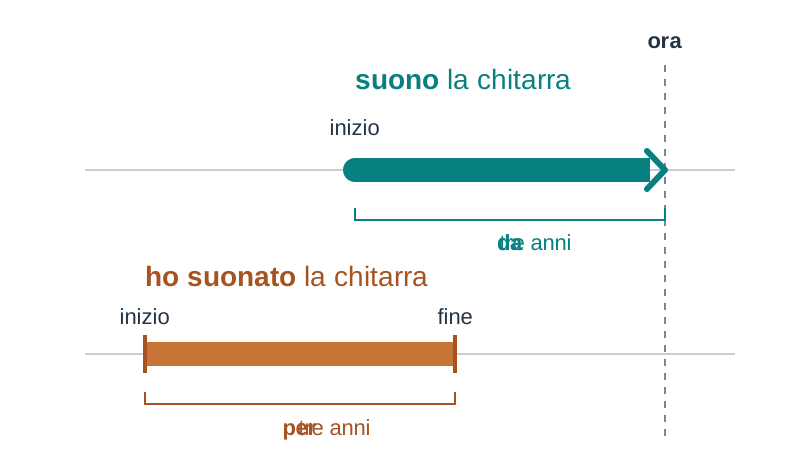
To describe an activity you started in the past and are still doing now, English uses 'have been doing', but Italian uses the present tense + da:
- Suono la chitarra da tre anni. (I have been playing the guitar for three years.)
- Studio l'italiano da cinque anni. (I have been studying Italian for five years.)
- Lavoro in questo negozio da sei mesi. (I have been working in this shop for six months.)
If you write Ho suonato la chitarra per tre anni, it means you played for three years in the past and have now stopped.
Two Meanings of 'Magari'
- As a standalone exclamation, Magari! means If only! or I wish!: — Vieni in vacanza in Sardegna con noi? — Magari! (— Are you coming on holiday to Sardinia with us? — I wish!).
- Inside a full sentence, magari means maybe or perhaps, functioning just like forse: Magari ci vediamo domani dopo scuola. (Maybe we will see each other tomorrow after school.)
Proposing, Changing, and Cancelling Plans
These expressions are tested directly in oral role-plays and listening dialogues:
- Proposing: Ti andrebbe di andare al cinema? (Would you feel like going to the cinema?); Che ne dici di vederci in centro? (What do you say to meeting in town?); Facciamo alle otto davanti al bar? (Shall we say eight o'clock in front of the café?).
- Declining politely: Always apologise and give a reason with perché: Mi dispiace davvero, ma non posso perché devo studiare. (I am really sorry, but I cannot because I have to study.)
- Managing hitches: Mi è capitato un imprevisto. (Something unexpected came up.); Non ce la faccio per le sette, possiamo rimandare a domani? (I cannot make it for seven, can we postpone until tomorrow? Note that ce la faccio comes from the pronominal verb farcela, meaning to manage or make it on time).
Written Formats: Formal Applications and Informal Messages
Writing tasks require you to adapt your layout and tone strictly to the required audience. A few standard building blocks will secure your communication and register marks.
Formal Letter or Application Email
When responding to job advertisements or volunteer camp notices:
- Place and Date: Top right corner: Cork, 10 maggio 2027.
- Salutation: To a company or office: Spett.le Ufficio Selezione del Personale, (Spett.le stands for Spettabile, 'Respected/Esteemed'). To a named person: Gentile Signora Rossi, or Egregio Direttore,.
- Reason for writing: Le scrivo in risposta al Vostro annuncio per... (I am writing in response to your advertisement for...) or Le scrivo per presentare la mia candidatura per il posto di... (I am writing to submit my application for the position of...).
- Period of availability: Sarei disponibile dal 1° al 31 luglio. (I would be available from 1 to 31 July).
- Preferred activity: Preferirei occuparmi delle attività sportive con i ragazzi. (I would prefer to look after sports activities with the children).
- Justifying qualities with examples: Ho molto spirito di iniziativa: l'anno scorso ho organizzato un torneo di beneficenza. (I have a lot of initiative: last year I organised a charity tournament).
- Closing formula and sign-off: Use one fixed formula: In attesa di una Sua cortese risposta, Le porgo distinti saluti. followed by your full signature on the line below.
Informal Note or Message
When texting or emailing a friend to make or alter arrangements:
- Salutation: Ciao Marco, or Caro Marco,
- Purpose: Ti scrivo due righe per dirti che... (I am writing a quick line to tell you that...)
- Changing plans: Purtroppo stasera non ce la faccio perché mi è capitato un imprevisto: devo aiutare mia sorella con i compiti. Ti andrebbe di rimandare a sabato? Fammi sapere! (Unfortunately I cannot make it tonight because something unexpected came up: I have to help my sister with homework. Would you fancy postponing until Saturday? Let me know!)
- Sign-off: A presto! or Un abbraccio,
- Name: Ciara
Key terms
- la scuola superiore
- Upper secondary school in Italy, lasting five years from ages 14 to 19 and concluding with the esame di maturità.
- superare un esame
- The standard verb phrase meaning to pass an examination successfully (as opposed to sostenere un esame, meaning to sit or take an exam).
- giocare a
- The verb construction used for games and sports (e.g. giocare a calcio, giocare a scacchi), contrasting with suonare for musical instruments.
- suonare
- The verb meaning to play a musical instrument, always followed by the definite article (e.g. suonare il pianoforte).
- il futuro semplice
- The simple future tense in Italian, formed with endings -ò, -ai, -à, -emo, -ete, -anno, used for future plans, predictions, and intentions.
- da + present tense
- The grammatical structure used to express an ongoing action that started in the past and continues into the present (e.g. studio l'italiano da tre anni).
- farcela
- An idiomatic pronominal verb meaning to manage, succeed, or make it on time (e.g. non ce la faccio).
- l'imprevisto
- An unexpected event or unforeseen emergency that disrupts scheduled plans.
- rimandare
- To postpone or defer an arrangement to a later date.
- i nipoti
- A dual-meaning noun translating either as nephews and nieces or as grandchildren, requiring attention to context in listening passages.
- le ripetizioni
- Private lessons or grinds taken outside school to reinforce a subject.
- in pensione
- Retired from work or employment.
Check yourself
What is the rule regarding articles when stating your profession or occupation with the verb 'essere'?
Omit the indefinite article (e.g. 'Sono studente' / 'Mio padre è medico'). Use an article when an adjective modifies the noun ('È un ottimo medico') or if you use 'fare' ('Fa il medico').
Put the bracketed verb into the correct form of the futuro semplice: 'L'anno prossimo io _____ (fare) un corso di informatica all'università.'
farò
Identify which sentence is correct and explain why: (a) 'Se avrò tempo, andrei in palestra' or (b) 'Se avessi tempo, andrei in palestra'.
Sentence (b) is correct. In a hypothetical sentence, 'se' must be followed by the congiuntivo imperfetto ('avessi'), which then pairs with the conditional ('andrei'). The conditional is never placed directly after 'se'.
What does 'magari' mean in: (a) '— Vieni a Roma con noi? — Magari!' and (b) 'Magari ci vediamo domani dopo scuola'?
In (a), as an exclamation, 'Magari!' means 'If only!' or 'I wish!'. In (b), within a full sentence, 'magari' means 'maybe' or 'perhaps'.
Translate into Italian: 'I have been studying Italian for five years.'
Studio l'italiano da cinque anni. (Italian uses the present tense + 'da' to describe an ongoing action that started in the past).