

Every Italian noun is masculine or feminine, singular or plural. The words around it – articles, adjectives, possessives, and even past participles – change their endings to match. Written tasks are marked for communication and for accuracy of language. Agreement errors are easy to spot and add up across a whole text, so getting the noun right first and checking its modifiers is one of the quickest ways to protect your accuracy marks.
Noun Gender and Forms for People
Every Italian noun belongs to a grammatical gender (maschile or femminile). This classification controls articles, adjectives, and dependent pronouns across the whole sentence.
The Standard Patterns (-o and -a)
- Nouns ending in -o are almost always masculine: il ragazzo (the boy), il libro (the book), il treno (the train).
- Nouns ending in -a are almost always feminine: la ragazza (the girl), la casa (the house), la scuola (the school).
Nouns Ending in -e
Nouns ending in -e in the singular can be masculine or feminine. The ending gives no clue to gender, so learn each word with its article:
- Masculine in -e: il fiore (the flower), il ponte (the bridge), il padre (the father), il sole (the sun).
- Feminine in -e: la notte (the night), la chiave (the key), la madre (the mother), la fame (hunger).
- Words ending in -zione or -sione are feminine: la stazione (the station), la decisione (the decision), la lezione (the lesson).
Notable Exceptions
- Greek-origin masculine nouns in -ma: il problema (the problem), il programma (the programme), il tema (the essay), il sistema (the system), il clima (the climate). These take masculine plurals in -i: i problemi, i programmi.
- Feminine nouns ending in -o: La mano (the hand) is feminine even though it ends in -o (plural: le mani). Shortened words keep their original feminine gender: la foto (from la fotografia), la moto (from la motocicletta), and l'auto (from l'automobile).
- Abbreviated loanwords: il cinema (from cinematografo) is masculine and invariable (i cinema).
Masculine and Feminine Forms for People
- -tore becomes -trice: il direttore → la direttrice, l'attore → l'attrice, lo scrittore → la scrittrice.
- -essa (a small group): lo studente → la studentessa, il professore → la professoressa, il dottore → la dottoressa.
- -ista (same singular form, article shows gender): il turista / la turista, il giornalista / la giornalista. Plurals differ: i turisti (m.), le turiste (f.).
- Same noun, article only: il cantante / la cantante, il nipote / la nipote, il collega / la collega (plurals: i colleghi, le colleghe).
Plural Formation, Spelling Rules, and Irregular Plurals
Italian forms plurals by changing the final vowel, never by adding an -s.
| Singular Ending | Gender | Plural Ending | Singular Example | Plural Example |
|---|---|---|---|---|
| -o | Masculine | -i | il libro | i libri |
| -a | Feminine | -e | la casa | le case |
| -e | Masc. or Fem. | -i | il fiore / la notte | i fiori / le notti |
| -a (Greek -ma) | Masculine | -i | il problema | i problemi |
Keeping the Hard Sound: -ca, -ga, -co, and -go
In Italian, c and g go soft before e and i (like ciao or gelato). To keep the hard "k" or "g" sound in the plural, you add an h:
- Feminine -ca and -ga: Always insert -h-: l'amica → le amiche, la barca → le barche, la collega → le colleghe, la riga → le righe.
- Masculine -co and -go: Most nouns keep the hard sound with -h-: il fuoco → i fuochi, il lago → i laghi, l'albergo → gli alberghi, il dialogo → i dialoghi. Learn these common exceptions that soften: l'amico → gli amici, il medico → i medici, il greco → i greci, and words in -logo referring to people (lo psicologo → gli psicologi).
Plurals in -cia and -gia
- A vowel before -cia or -gia keeps the i: la camicia → le camicie (shirts), la valigia → le valigie (suitcases).
- A consonant before -cia or -gia drops the i: la spiaggia → le spiagge (beaches), l'arancia → le arance (oranges), la pioggia → le piogge (rains).
- If the i is stressed, it stays: la farmacia → le farmacie (chemists).
Irregular Plurals to Learn by Heart
- l'uomo → gli uomini (men)
- l'uovo → le uova (eggs – feminine in the plural)
- il braccio → le braccia (arms), il dito → le dita (fingers), il paio → le paia (pairs)
- la mano → le mani (hands)
Invariable Nouns
Some nouns do not change in the plural; only the article shows the number:
- Accented endings: la città → le città, il caffè → i caffè.
- Loanwords ending in a consonant: il bar → i bar, il film → i film, lo sport → gli sport.
- Shortened words and nouns in -i: la foto → le foto, il cinema → i cinema, la crisi → le crisi.
Definite and Indefinite Articles
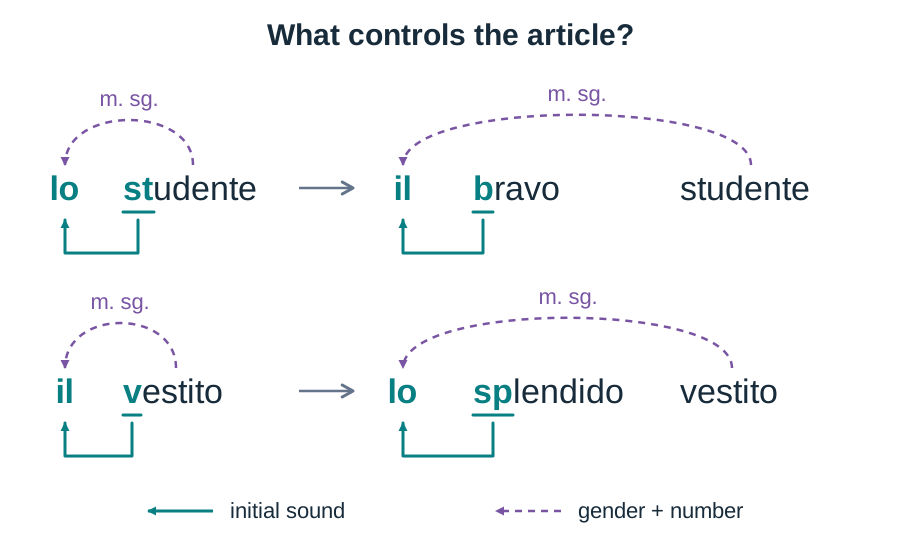
The article you choose depends on three things: whether the noun is masculine or feminine, singular or plural, and the first letter(s) of the word right after the article.
Definite Articles ("The")
| Gender & Number | Article | When to Use | Examples |
|---|---|---|---|
| Masculine Singular | il | Most consonants | il treno, il ragazzo |
| lo | s impura (s + consonant), z, ps, gn | lo studente, lo zaino, lo psicologo | |
| l' | Vowels (a, e, i, o, u) | l'albergo, l'amico | |
| Masculine Plural | i | Plural of il | i treni, i ragazzi |
| gli | Plural of lo and l' | gli studenti, gli zaini, gli alberghi | |
| Feminine Singular | la | Most consonants | la scuola, la casa |
| l' | Vowels | l'amica, l'ora | |
| Feminine Plural | le | All feminine plurals | le scuole, le amiche |
Indefinite Articles ("A" / "An")
- un: Masculine words before vowels and ordinary consonants: un libro, un treno, un amico.
- uno: Masculine words before s + consonant, z, ps, gn: uno studente, uno zaino.
- una: Feminine words before consonants: una casa, una scuola.
- un': Feminine words before a vowel: un'amica, un'idea.
The Apostrophe Rule with Indefinite Articles
Masculine un is already a full word, so it never needs an apostrophe: un amico, un esame, un albergo. Feminine una drops its vowel and takes an apostrophe (un') only when the next word starts with a vowel: un'amica, un'ottima idea. If an intervening word begins with a consonant, una stays whole: una bella amica.
The Intervening Word Rule
The article matches the start of the word right next to it, not the noun placed later:
- lo studente → il bravo studente (bravo begins with a simple consonant).
- il vestito → lo splendido vestito (splendido begins with s + consonant).
When Italian Says "The" but English Doesn't
- General statements and abstract concepts: I giovani di oggi usano troppo il telefonino. (Young people today use their phones too much.) La salute è importante. (Health is important.) Mi piace la musica. (I like music.)
- Countries and regions: L'Italia è bellissima. (Italy is beautiful.) After in with an unqualified country, drop the article: Vado in Italia. (I am going to Italy.)
- Languages: Studio l'italiano da cinque anni. (I have studied Italian for five years.) After the verb parlare, the article is usually omitted: Parlo italiano.
- Dates, days, and time: il 10 maggio (10 May), il lunedì (on Mondays, every Monday), Sono le tre. (It is three o'clock).
Demonstratives, Possessives, and Indefinites
Questo and Quello
- Questo (this) behaves like a Group 1 adjective: questo albergo, questa città, questi ragazzi, queste case. It can elide before a vowel in the singular: quest'anno.
- Quello (that) before a noun changes its endings exactly like the definite article:
- quel (like il): quel ragazzo, quel libro
- quello (like lo): quello studente, quello zaino
- quell' (like l'): quell'albergo, quell'amica
- quella (like la): quella casa, quella ragazza
- quei (like i): quei libri, quei ragazzi
- quegli (like gli): quegli amici, quegli studenti
- quelle (like le): quelle case, quelle amiche
Possessives: Article + Agreement with the Thing Owned
In Italian, the possessive usually keeps the definite article in front of it: la mia scuola, i miei amici, le nostre vacanze.
- The agreement rule: The possessive agrees in gender and number with the item possessed, not the owner: la sua casa (his or her house), il suo libro (his or her book).
- The family exception: A singular, unmodified family member takes no article: mia madre, mio padre, mio fratello. The article returns if the noun is plural (i miei fratelli), modified by an adjective or suffix (la mia sorellina, il mio fratello piccolo), or with loro (la loro madre). (With maggiore and minore the article is usually left out: mio fratello maggiore, mia sorella minore.)
Indefinite Adjectives: Ogni, Qualche, Alcuni
- ogni (every, each) is invariable and always takes a singular noun: ogni giorno, ogni settimana.
- qualche (some, a few) is invariable and always takes a singular noun, even though the meaning is plural: qualche giorno (a few days), qualche amica (some friends).
- alcuni / alcune (some, a few) agree and take a plural noun: alcuni giorni, alcune amiche.
- Example: Ogni estate passo qualche settimana in Italia con alcuni amici. (Every summer I spend a few weeks in Italy with some friends.)
Combined Prepositions (Preposizioni Articolate)
Words like di, a, and in join with "the" to make a single combined word (preposizione articolata): di + il = del. Because the article inside the preposition must match the next word phonetically, the same phonetic rules apply:
| Preposition | + il | + lo | + l' | + la | + i | + gli | + le |
|---|---|---|---|---|---|---|---|
| di (of) | del | dello | dell' | della | dei | degli | delle |
| a (to, at) | al | allo | all' | alla | ai | agli | alle |
| da (from, by) | dal | dallo | dall' | dalla | dai | dagli | dalle |
| in (in, into) | nel | nello | nell' | nella | nei | negli | nelle |
| su (on) | sul | sullo | sull' | sulla | sui | sugli | sulle |
Practical Application in Exam Tasks
- Before clusters (s + consonant, z): Use the forms ending in -lo or -gli: nello zaino (in the backpack), dello studente (of the student), negli Stati Uniti (in the United States). Writing nel zaino or del studente* is an agreement mistake.
- Before vowels: Use the contracted -l' form: all'aeroporto (at the airport), nell'albergo (in the hotel).
- Partitive articles: Compounds of di express "some" or "any": del pane (some bread), della pasta (some pasta), dei panini (some sandwiches), delle amiche (some friends).
Adjective Agreement, Truncations, and Verb Agreement
Adjectives must match their noun in gender and number. They fall into two main groups.
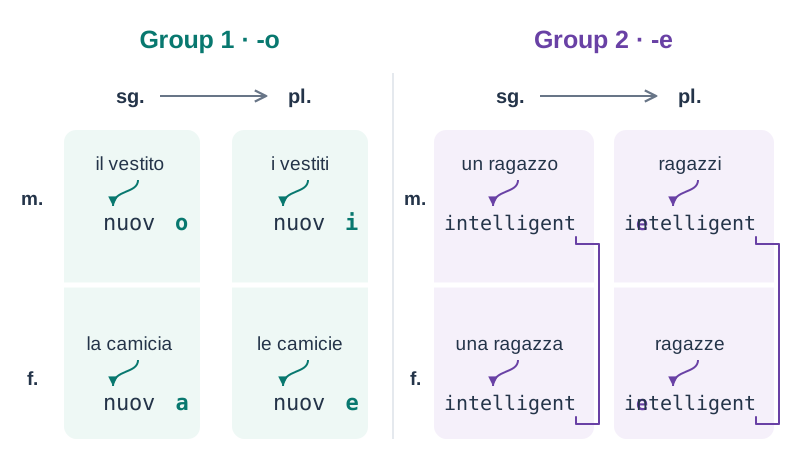
Group 1: Four-Ending Adjectives (-o)
- Masculine singular (-o): il vestito nuovo (the new suit)
- Feminine singular (-a): la camicia nuova (the new shirt)
- Masculine plural (-i): i vestiti nuovi (the new suits)
- Feminine plural (-e): le camicie nuove (the new shirts)
Group 2: Two-Ending Adjectives (-e)
These change only for number, not gender:
- Singular (-e): un ragazzo intelligente, una ragazza intelligente
- Plural (-i): ragazzi intelligenti, ragazze intelligenti
Mixed Groups and Position
- With mixed-gender groups, the adjective defaults to the masculine plural: Marco e Chiara sono bravi; Il tavolo e la sedia sono rotti.
- Most descriptive adjectives follow the noun: una macchina veloce, la lingua italiana. Common short adjectives often go before: bello, buono, bravo, grande, piccolo, nuovo, vecchio, giovane. Placement before the noun triggers the shortened forms of bello and buono.
Forms of Bello and Buono before a Noun
- Bello before a noun behaves like the definite article: un bel libro (like il), un bello specchio (like lo), un bell'uomo / una bell'idea (like l'), una bella ragazza (like la), bei quadri (like i), begli amici / begli studenti (like gli), belle case (like le).
- Buono before a noun behaves like the indefinite article: un buon amico / un buon viaggio (like un, no apostrophe), un buono studente (like uno), una buona scuola (like una), una buon'amica / una buon'idea (like un', with apostrophe).
Agreement Doesn't Stop at the Adjective
- With essere: The past participle agrees with the subject: Marco è arrivato; Chiara è arrivata; I ragazzi sono partiti; Le ragazze sono partite.
- Female students taking exams: In diary or narrative tasks, every sono + participle and every adjective describing yourself ends in -a: Sono andata a scuola, Sono rimasta a casa, Sono una studentessa irlandese.
- With avere: The participle stays in -o (Ho visto Chiara) unless preceded by direct object pronouns lo, la, li, or le: L'ho vista ieri (I saw her yesterday); Le ho comprate (I bought them).
Comparative and Superlative Degrees
Regular Comparisons
- Superiority / Inferiority (comparing two nouns): Use più ... di (more ... than) or meno ... di (less ... than): Il treno è più comodo dell'autobus. (The train is more comfortable than the bus.)
- Comparing adjectives, verbs, or quantities: Use che instead of di: Questo viaggio è più lungo che faticoso. (This journey is long rather than tiring.)
- Comparative of Equality (As ... as): Use (così) ... come or (tanto) ... quanto. The first word is often omitted: Il treno è comodo come l'aereo. (The train is as comfortable as the plane.) Dublino è cara quanto Milano. (Dublin is as expensive as Milan.)
- Relative Superlative: Definite article + più / meno: È l'albergo più moderno della città. (It is the most modern hotel in the city.)
- Absolute Superlative (-issimo): Drop the final vowel and add -issimo/-issima/-issimi/-issime to mean "very": un viaggio lunghissimo (note the -h- to keep the hard "g"); una ragazza simpaticissima.
Irregular Comparatives and Superlatives
| Adjective | Comparative | Relative Superlative | Absolute Superlative |
|---|---|---|---|
| buono (good) | migliore | il migliore | ottimo |
| cattivo (bad) | peggiore | il peggiore | pessimo |
| grande (big) | maggiore (bigger/older) | il maggiore | massimo |
| piccolo (small) | minore (smaller/younger) | il minore | minimo |
Regular forms like più buono, buonissimo, più grande, and piccolissimo are also fully correct. For siblings, use maggiore and minore: mio fratello maggiore (my older brother), mia sorella minore (my younger sister).
Migliore or Meglio?
- Migliore is an adjective. It modifies a noun and changes to -i in the plural: un risultato migliore, le condizioni migliori.
- Meglio is an adverb. It modifies a verb and never changes: Parlo italiano meglio di prima. (I speak Italian better than before.) Sto meglio. (I feel better.)
- The same contrast applies to peggiore (adjective) and peggio (adverb).
Thematic Vocabulary and Key Letter Conventions
Thematic Nouns with English Meanings
| Theme | Masculine Nouns | Feminine Nouns |
|---|---|---|
| People & Society | il rapporto (relationship), il compagno (classmate), il collega (colleague), lo studente (student) | la famiglia (family), la relazione (relationship), la collega (colleague), la studentessa (student) |
| Weather & Climate | il clima (climate), il maltempo (bad weather), il vento (wind), il temporale (thunderstorm) | la pioggia (rain), la neve (snow), le previsioni (forecasts), la temperatura (temperature) |
| Travel & Transport | il viaggio (journey), il mezzo (means of transport), lo scompartimento (compartment), l'orario (timetable) | la fermata (stop), la stazione (station), la prenotazione (booking), la coincidenza (connection) |
Agreement in Letter Conventions
- Addressing an office or organisation: Spettabile (or Spett.le): Spettabile Ufficio Selezione del Personale,
- Addressing a known individual: Egregio Direttore, (Dear Director, m.) or Gentile Direttrice, (Dear Director, f.); Gentile Signora,
- Informal greetings: Caro Marco, (m.) / Cara Giulia, (f.)
- Formal closing to an individual: In attesa di un Suo cortese riscontro, Le porgo distinti saluti. (I look forward to your reply. Yours faithfully,)
- Formal closing to a company or office: In attesa di un Vostro cortese riscontro, porgo distinti saluti.
- Past participle reflection: In informal letters or diaries, remember your ending: Sono stato contento (male student) / Sono stata contenta (female student).
Key terms
- Genere
- The grammatical classification of every Italian noun as either masculine (maschile) or feminine (femminile).
- Concordanza
- Grammatical agreement; the rule requiring articles, adjectives, possessives, and participles to match the gender and number of the noun they describe.
- S impura
- An initial letter 's' followed by another consonant (e.g. st-, sp-, sc-), requiring masculine articles lo, gli, and uno.
- Elisione
- The dropping of a final vowel before a word starting with a vowel, marked in writing with an apostrophe (e.g. un'amica, l'albergo).
- Preposizione articolata
- A compound preposition formed by merging a simple preposition (di, a, da, in, su) with a definite article (e.g. in + gli = negli).
- Nome invariabile
- A noun whose spelling does not change between singular and plural (e.g. accented words like la città, loanwords like il film).
- Superlativo relativo
- The structure expressing 'the most' or 'the least' within a group using the definite article + più/meno (e.g. l'albergo più moderno).
- Superlativo assoluto
- The intensive form expressing 'extremely' or 'very' by attaching -issimo/-issima/-issimi/-issime to an adjective stem.
Check yourself
Which definite article precedes 'zaino pesante', and how does it change if you say 'nuovo zaino'?
'Lo zaino pesante' (uses 'lo' because 'zaino' begins with 'z'). Preceded by 'nuovo', it becomes 'il nuovo zaino' because 'nuovo' begins with an ordinary consonant.
Give the correct plural forms of 'la spiaggia' and 'la valigia'.
'Le spiagge' (drops the 'i' because a consonant precedes -gia) and 'le valigie' (keeps the 'i' because a vowel precedes -gia).
Why is 'un'esperienza' written with an apostrophe, while 'un esame' is written without one?
'Esperienza' is feminine, so 'una' elides to 'un'' before a vowel. 'Esame' is masculine, and masculine 'un' never takes an apostrophe.
Complete with the correct compound preposition: 'Ho vissuto un anno ___ Stati Uniti.'
'negli' (the preposition 'in' joins with the plural article 'gli' to become 'negli').
Translate into Italian using an irregular comparative: 'This hotel is better than that one.'
'Questo albergo è migliore di quello.' ('Migliore' is the irregular comparative adjective modifying 'albergo').
How do you say 'that friend' (female) using the demonstrative 'quello'?
'quell'amica' ('quello' follows the definite article pattern, becoming 'quell'' before a vowel just like 'l'').
Translate: 'She sings better than me.'
'Canta meglio di me.' (Use the invariant adverb 'meglio' to describe the verb 'cantare').