

In Leaving Certificate Higher Level Italian, Written Production accounts for 25% of the total marks (100 out of 400 marks). Candidates are assessed on their ability to transfer meaning clearly and on the accuracy, appropriateness, and range of their language. While recent Higher Level past papers have frequently featured formal letters or emails (such as scholarship applications or letters of complaint), understanding the informal letter (lettera informale) is essential. The informal register (tu and voi), communicative exponents, and grammar covered here apply directly to journal entries, guided narratives, and the oral examination. If an exam task asks for an email rather than a postal letter, the place and date line may be omitted, but the greeting, register consistency, communicative range, and sign-offs remain identical.
Visual Layout, Date, and Register Choice
Set your letter out the way an Italian would. It shows you know the conventions, and it takes seconds to get right.
Place and Date (Luogo e data)
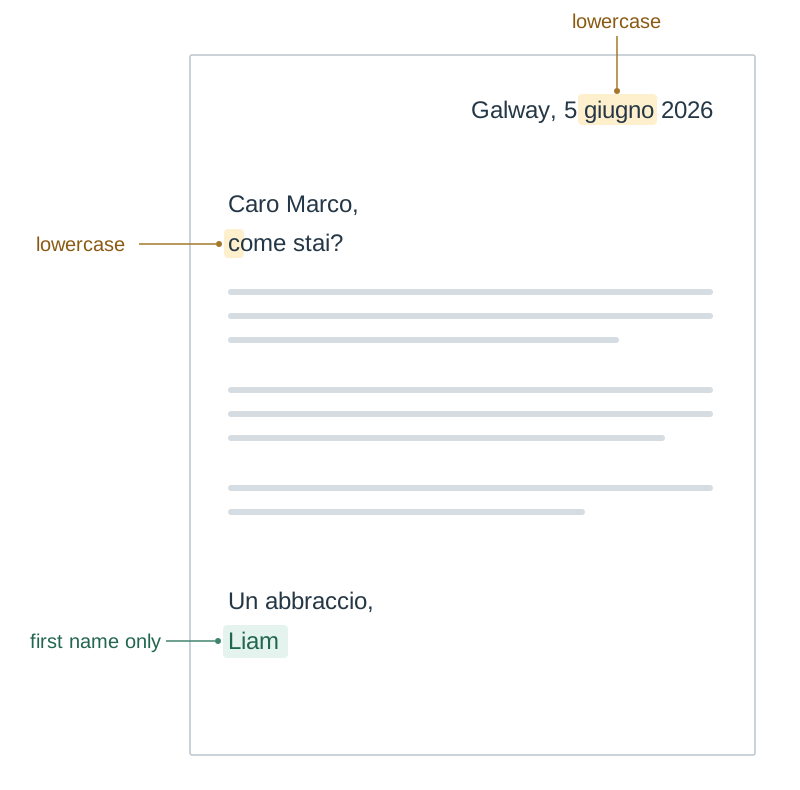
Place the date in the top right corner. State the town, followed immediately by a comma, the day as a digit, the month written out in full in lowercase, and the year:
- Galway, 5 giugno 2026
- Dublino, 12 maggio 2026
Unlike English, Italian calendar months never take a capital letter.
The Greeting (Formula di apertura)
Write the greeting on the left margin, followed by a comma. The opening adjective must agree in gender and number with the recipient:
- Caro Marco, (masculine singular)
- Cara Giulia, (feminine singular)
- Cari amici, (masculine or mixed plural)
- Care amiche, (feminine plural)
- Ciao Matteo, (casual greeting between peers)
Starting the First Line
Begin the line immediately below the greeting with a lowercase letter unless the first word is a proper noun:
- Caro Marco, / come stai?
Choosing Between Informal and Formal Letters
Make sure never to mix informal and formal styles:
| Feature | Informal Letter | Formal Letter |
|---|---|---|
| Greeting | Caro Marco, / Cara Giulia, | Gentile Signora Rossi, / Spettabile Ditta, |
| Register | tu (one friend) / voi (group / host family) | Lei (polite form for adults and officials) |
| Closing | Un abbraccio, / A presto, | Distinti saluti, / Cordiali saluti, |
| Signature | first name only | Full name (first name and surname) |
Opening Lines, Reactions, and Grammatical Agreement
Your opening paragraph establishes personal rapport before addressing specific news.
Opening Social Enquiries
- Come stai? Spero che tu stia bene. (How are you? I hope you are well. Notice that sperare che takes the present subjunctive stia).
- Spero che stiate tutti bene. (I hope you are all well — use this with a host family or a group of friends using voi).
- Grazie mille per la tua ultima lettera; mi ha fatto davvero piacere sentirti. (Thanks so much for your last letter; it was really great to hear from you.)
- Scusa se non ti ho scritto prima, ma sono stato occupatissimo con lo studio. (Sorry I haven't written sooner, but I've been very busy with studying.)
Past Participle Agreement with Essere
In compound tenses like the passato prossimo, verbs conjugated with essere must agree in gender and number with the subject:
- A male writer: Sono stato occupatissimo con gli esami di prova. (I have been really busy with mock exams.)
- A female writer: Sono stata occupatissima con gli esami di prova.
- A group: Siamo andati al mare. (We went to the seaside — masculine or mixed); Siamo andate al mare. (feminine plural).
Verbs conjugated with avere do not change to match the subject: Ho ricevuto la tua lettera is identical for male and female writers.
Reacting to News
Reacting naturally to your friend's news makes your writing sound authentic:
- Tanti auguri di buon compleanno! (Happy birthday!)
- Complimenti per la patente! (Congratulations on passing your driving test!)
- In bocca al lupo per gli esami! (Good luck in your exams! — Italian speakers reply: Crepi!)
- Mi dispiace tanto per tuo nonno. (I'm so sorry about your granddad.)
- Che peccato che tu non possa venire! (What a pity you can't come! — Che peccato che triggers the subjunctive possa).
- Non vedo l'ora di vederti! (I can't wait to see you!)
The Body: Answering Prompts, Possessives, and 'Se' Clauses
Cover Every Point in the Task
In Leaving Certificate tasks, marks are awarded for addressing every requirement. Before writing, underline each required point in the examination prompt and number it (1, 2, 3…). Give each point two or three sentences, then tick it off. A beautifully written letter that skips a bullet point loses marks that good grammar cannot recover.
A Genuine Two-Way Exchange
A letter that only talks about yourself reads unnaturally. Include questions to bring your friend into the conversation:
- E tu, cosa mi racconti di bello? (And you, what's your news?)
- Che progetti hai per le vacanze estive? (What plans do you have for the summer holidays?)
- Ti andrebbe di venire a trovarmi in Irlanda? (Would you like to come and visit me in Ireland?)
- Secondo me, sarebbe una splendida idea. (In my opinion, it would be a wonderful idea.)
Possessive Adjectives and the Family Exception
In Italian, possessive adjectives normally take a definite article (il mio cane, la tua scuola).
Exception: Drop the article with a single, unmodified family member in the singular:
- tuo fratello, mia madre, tua sorella
You still need the article if the family noun is plural, modified by an adjective or diminutive, or used with loro:
- i tuoi genitori (plural)
- la mia sorellina (diminutive)
- il mio fratello maggiore (modified by an adjective)
- la loro madre (used with loro)
Note that avere tue notizie or ricevere tue notizie (to hear from you) is a fixed idiom without the article.
Two Standard Patterns with 'Se' (If)
Never put a conditional tense immediately after se:
- Real or likely condition: se + present indicative, followed by future (or present):
- Se vieni a luglio, faremo una gita fantastica. (If you come in July, we'll go on a fantastic day trip.)
- Imaginary or hypothetical condition: se + imperfect subjunctive, followed by the present conditional:
- Se venissi a trovarmi, potremmo fare tantissime cose insieme. (If you were to come visit me, we could do so many things together.)
- Se avessi più tempo, verrei volentieri. (If I had more time, I would gladly come.)
The Concluding Paragraph: Imperatives and Sign-offs
Bring your letter to a natural conclusion with a brief pre-closing reason, an imperative request to reply, and an informal sign-off. The closing should take two to three lines.
Pre-Closing Reasons
- Ora devo proprio scappare perché devo rimettermi a studiare. (Now I really must run because I have to get back to studying.)
- È tardi e devo andare a dormire. (It is late and I must go to sleep.)
The Informal Imperative (Imperativo informale)
When giving friendly commands to one person using tu:
- Regular -are verbs end in -a: parla!, ascolta!, racconta!
- Regular -ere and -ire verbs end in -i: scrivi!, prendi!, senti!, dormi!
Direct, indirect, and reflexive pronouns join directly to the end of the imperative to form a single word:
- racconta + mi = raccontami (tell me)
- scrivi + mi = scrivimi (write to me)
- senti + mi = sentimi (listen to me)
Short Monosyllabic Imperatives
Short imperatives (fa', da', di', sta', va') double the initial consonant of attached pronouns:
- fa' + mi = fammi (fammi sapere = let me know)
- di' + mi = dimmi (tell me)
- da' + mi = dammi (give me)
Exception: The pronoun gli never doubles: fagli sapere (let him know).
The Negative Informal Imperative with Tu
To tell a friend not to do something, use non + infinitive:
- Non preoccuparti! or Non ti preoccupare! (Don't worry!)
- Non dimenticare di scrivermi! (Don't forget to write to me!)
- Non dirlo a nessuno! (Don't tell anyone!)
Never say non scrivi; the correct form is non scrivere.
Sign-offs (Formule di chiusura)
Place your sign-off at the bottom left, followed by a comma, and sign with your first name only on the line below:
- Un abbraccio, (A hug / Hugs — a warm, common informal closing)
- A presto, (Talk soon / See you soon)
- Con affetto, (With affection / Lots of love)
- Bacioni, (Big kisses — for close friends or family)
Never use formal business formulas such as Distinti saluti or Cordiali saluti in an informal letter.
Key terms
- Lettera informale
- A personal letter written to a peer, friend, or host family using conversational Italian, informal layout conventions, and the 'tu' or 'voi' register.
- Registro informale
- The informal grammatical address using second-person singular forms ('tu', 'ti', 'tuo') for an individual friend, or plural forms ('voi', 'vi', 'vostro') when writing to several people or a host family.
- Formula di apertura
- The opening greeting on the left margin, using 'Caro' or 'Cara' agreed with the recipient's gender and number, followed by a comma.
- Formula di chiusura
- The warm closing sign-off placed before the signature, such as 'Un abbraccio' or 'A presto'.
- Imperativo informale (tu)
- The command form used with 'tu', ending in '-a' for regular -are verbs and '-i' for regular -ere and -ire verbs.
- Imperativo negativo (tu)
- The negative command for 'tu', formed using 'non' followed by the verb's infinitive form (e.g. 'non preoccuparti', 'non dimenticare').
- Pronome enclitico (con l'imperativo)
- An object pronoun attached directly to the end of a positive imperative verb to make a single word (e.g. 'scrivimi', 'fammi sapere').
- Accordo del participio passato
- The grammatical agreement of the past participle with the subject's gender and number when conjugated with 'essere' in compound tenses.
Check yourself
Where should the place and date appear, and what is the rule for writing the month?
The place and date appear in the top right corner, formatted with the town name, a comma, the day as a digit, the month written out in full in lowercase letters, and the year (e.g. 'Galway, 5 giugno 2026').
How should you start the line immediately following the greeting 'Cara Francesca,'?
Start with a lowercase letter on the next line (e.g. 'come stai?'), unless the opening word is a proper noun.
What are the second-person singular ('tu') informal imperatives for 'parlare', 'sentire', and 'scrivere' when joined to the pronoun 'mi'?
'Parlami', 'sentimi', and 'scrivimi'. Regular -are verbs end in '-a' ('parla'), while regular -ere and -ire verbs end in '-i' ('senti', 'scrivi'). The pronoun attaches to the end of the imperative form.
How do you tell a friend 'Don't worry!' in Italian using the informal 'tu' imperative?
'Non preoccuparti!' or 'Non ti preoccupare!' (formed with 'non' + the infinitive verb).
You are writing to your Italian host family. How do you say 'I hope you are all well' using the correct register?
'Spero che stiate tutti bene.' (using the 'voi' present subjunctive form 'stiate' because you are addressing more than one person).
A female student writes: 'I have been very busy this week.' How should this be written in Italian with correct agreement?
'Questa settimana sono stata occupatissima.' (the past participle 'stata' agrees in gender with the female subject after 'essere').