

In the Leaving Certificate Higher Level German examination, Written Production (Schriftliche Produktion) accounts for 25% of the total marks. In the written production section (Schriftliche Produktion) of the written paper, you choose between option (a), a reply to a letter or email from a German-speaking friend (der persönliche Brief), and option (b), an essay on a set topic. Both options require approximately 160 words and carry 50 marks, divided equally into 25 marks for Content (covering every stimulus point with development) and 25 marks for Expression (grammatical accuracy, vocabulary range, tense variety, and appropriate register). The examination paper instruction is typically of the type Beantworten Sie den Brief (ungefähr 160 Wörter) — read the exact wording on your paper. The stimulus letter poses four distinct tasks or questions that must be addressed fully to secure top marks.
Layout and Set Phrases of a German Letter
A personal letter follows clear layout and punctuation rules. The marking scheme expects an authentic opening and closing. While these mechanical features do not replace strong German, getting them right immediately signals good register control.
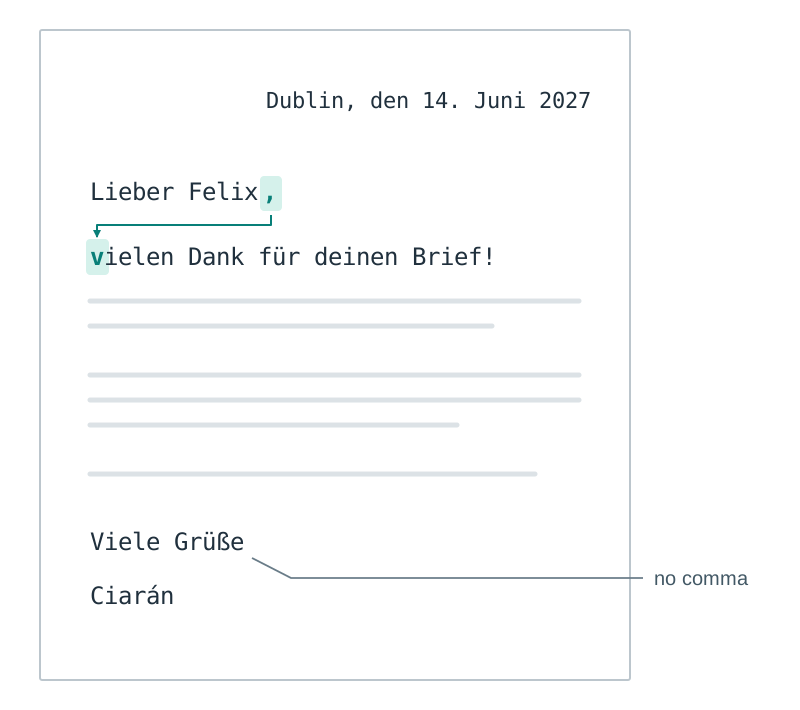
Place and date (Ort und Datum)
Position this in the top right-hand corner. German uses the accusative of time for dates, with a full stop after the day number to indicate the ordinal ending (-ten):
- Dublin, den 14. Juni 2027 (or Galway, den 3. Mai 2027)
Greeting (Die Anrede)
Align this on the left-hand margin. Adjust the ending to match the sex of your friend:
- Female friend: Liebe Julia,
- Male friend: Lieber Lukas,
- Group of friends: Liebe Freunde, or Hallo zusammen,
The lower-case continuation rule
Always place a comma after the greeting. Because of that comma, the sentence has not ended, so the next word on the following line must start with a lower-case letter, unless it is a noun, which always takes a capital letter in German:
- Liebe Sarah,
- vielen Dank für deinen Brief. (lower-case v)
- Lieber Felix,
- gestern habe ich deinen Brief bekommen.
- Liebe Anna,
- Grüße aus Dublin! — capital G here only because Grüße is a noun.
Sign-off (Die Grußformel)
Choose a natural closing phrase such as Viele Grüße (Best wishes) or Liebe Grüße (Kind regards). In a German letter the sign-off never takes a comma:
- Viele Grüße
- Ciarán
If you sign off with Dein or Deine, the possessive agrees with you, the writer, not the person receiving the letter. A girl always signs Deine Aoife, even when writing to a boy; a boy always signs Dein Ciarán.
The formal alternative (for contrast)
If you ever write to an adult you do not know, such as a hotel, school, or employer, the entire register switches to Sie:
- Opening: Sehr geehrte Frau Müller, / Sehr geehrter Herr Klein, / Sehr geehrte Damen und Herren, (if you do not know the name)
- Body: Könnten Sie mir bitte mitteilen, ob ... (Could you please let me know whether ...) — Sie, Ihnen, and Ihr take capital letters.
- Closing: Mit freundlichen Grüßen (Yours sincerely), with no comma.
In a personal letter to a friend, never use these formal phrases. Slipping into Sie or Ihnen is an obvious register mistake.
Digital format insurance: email
If the exam paper frames the task as an email rather than a post letter, simply leave out the place and date in the top corner. Keep the greeting (Liebe Julia, or Hallo Felix,), write the same body paragraphs, and finish with Viele Grüße.
Four-Paragraph Planning Strategy, Timing, and Task Choice
In the exam, the written production section (Schriftliche Produktion) offers you either option (a), the letter reply, or option (b), a piece on a set topic. Both are roughly 160 words and both carry 25 marks for Content and 25 marks for Expression. You also complete the shorter picture-based piece (Äußerung zum Thema), which is about 100 words (13 content, 12 expression). Before you commit to option (a), read all four prompts in the friend's letter to ensure you have the vocabulary to answer each one.
Allocating content across paragraphs
The four prompts share the 25 content marks between them, so if you skip one you throw away roughly a quarter of the content available. Your German is marked separately out of 25, but no amount of good German replaces a missing answer. Organise your letter into four clear paragraphs:
- Paragraph 1 (Opening, reaction and prompt 1, ≈ 28 words): Thank your friend, react warmly to their news, and answer prompt 1 directly.
- Paragraph 2 (Prompt 2, ≈ 55 words): Answer prompt 2 thoroughly, adding at least one specific reason, example, or feeling.
- Paragraph 3 (Prompt 3, ≈ 43 words): Address prompt 3, giving your opinion or advice with clear justifications.
- Paragraph 4 (Prompt 4, ≈ 39 words): Address prompt 4, discussing future plans or reflections with reasons.
- Closing line and sign-off (≈ 10 words): Ask your friend a question back so the letter sounds like a genuine exchange, invite a reply, and sign your name.
This distribution brings you to around 175 words, which fits the 160-word target without creating unnecessary opportunities for grammatical mistakes. You can group prompts into fewer paragraphs or give each prompt its own paragraph, provided every prompt is fully addressed.
Timing and proofreading routine
Spend around 30 minutes on the letter:
- Minutes 1–4: Read the printed letter, underline the four questions, and jot down two German keywords or verbs for each prompt.
- Minutes 5–25: Write your letter following your paragraph plan.
- Minutes 26–30: Proofread your work by checking five specific items:
- Is the verb in position 2 in every independent main clause?
- Did the verb move to the very end of every clause starting with weil, dass, obwohl, or wenn?
- Does every single noun start with a capital letter?
- Have you used the du family consistently (du, dich, dir, dein), without any accidental Sie or ihr?
- Are all umlauts (ä, ö, ü) and the ß in Grüße written correctly?
Register Control: The Informal 'du' Family
A letter to a pen pal requires strict adherence to the informal singular address. Mixing du with the formal Sie or the plural ihr damages your expression mark.
| Case / Function | Informal Singular (One Friend) | Example Sentence | Informal Plural (Multiple Friends / Host Family) | Example Sentence |
|---|---|---|---|---|
| Nominative (Subject) | du | Kommst du mich im Sommer besuchen? (Are you coming to visit me in summer?) | ihr | Habt ihr schon Ferien? (Do you already have holidays?) |
| Accusative (Direct Object) | dich | Ich lade dich herzlich nach Irland ein. (I warmly invite you to Ireland.) | euch | Ich möchte euch alle wiedersehen. (I would like to see you all again.) |
| Dative (Indirect Object) | dir | Wie geht es dir und deiner Familie? (How are you and your family?) | euch | Ich danke euch für die Gastfreundschaft. (I thank you for the hospitality.) |
| Possessive Determiner | dein- | dein Bruder, deine Schwester, mit deinem Bruder, für deinen Brief | euer / eure | euer Haus, eure Schule, mit euren Eltern |
The most important possessive phrase for opening your letter is Danke für deinen Brief (accusative masculine noun: der Brief becomes deinen Brief). Informal pronouns such as du and dir are written with lower-case letters in modern correspondence, though initial capitals are also accepted. Be consistent.
Grammar Engine: Past, Future, and Hypotheticals
Examiners look for a range of tenses to award marks in the top band for Expression. Prompts regularly require you to recount a past event, project into the future, or give hypothetical suggestions.
Talking about the past: das Perfekt
In letters and spoken conversation, German uses the Perfekt for completed past events. Place the auxiliary verb (haben or sein) in second position, and put the past participle at the very end of the clause.
- Regular verbs: ge- + stem + -t. machen → gemacht: Letztes Wochenende habe ich viel für Deutsch gelernt. (Last weekend I studied a lot for German.)
- Irregular verbs: ge- + irregular stem + -en. schreiben → geschrieben, sehen → gesehen: Ich habe deinen langen Brief gestern gelesen. (I read your long letter yesterday.)
- Verbs of movement or change of state take sein: fahren, gehen, fliegen, kommen, bleiben: Im Juli bin ich mit meiner Klasse nach Berlin geflogen. (In July I flew to Berlin with my class.)
- No ge- prefix with verbs ending in -ieren or verbs with inseparable prefixes (be-, ent-, er-, ver-, zer-): besuchen → besucht, studieren → studiert: Gestern habe ich meine Oma im Krankenhaus besucht. (Yesterday I visited my granny in hospital.)
- In a subordinate clause, the helper verb moves to the absolute end, directly after the participle: Ich war müde, weil ich bis spät in die Nacht gelernt habe. (I was tired because I had studied until late into the night.)
- Two high-frequency verbs use their simple past form (Präteritum) instead of the Perfekt: war (was) and hatte (had): Die Woche war sehr stressig und ich hatte überhaupt keine Zeit. (The week was very stressful and I had no time at all.)
Expressing the future: werden + Infinitiv
To explain future plans or career goals, use the conjugated form of werden in position 2 and the infinitive at the end of the sentence:
- Ich werde nach den Prüfungen zwei Wochen in Spanien verbringen. (I will spend two weeks in Spain after the exams.)
- You can also use the present tense with a future time adverb: Nächsten Monat fliege ich nach München. (Next month I am flying to Munich.)
Saying what you would do: würde, wäre, hätte, könnte
When prompts ask for alternative ideas, solutions, or what you would find difficult, deploy the conditional (Konjunktiv II):
- würde + Infinitiv (would do): Ich würde sofort an diesem Projekt teilnehmen. (I would take part in this project immediately.)
- wäre (would be): Eine Woche ohne Smartphone wäre extrem schwierig für mich. (A week without a smartphone would be extremely difficult for me.)
- hätte (would have): Ich hätte große Lust auf eine Reise nach Wien. (I would really fancy a trip to Vienna.)
- könnte (could): Man könnte mehr Geld für öffentliche Verkehrsmittel ausgeben. (One could spend more money on public transport.)
- With wenn (if), the verb goes to the end of the if-clause, and the following main clause begins with its verb: Wenn ich mehr Zeit hätte, würde ich öfter Sport treiben. (If I had more time, I would do sport more often.)
Sentence Variety: Connectors, Advice, and Cultural Comparison
Moving beyond simple main clauses demonstrates high linguistic ability. The Leaving Certificate syllabus highlights giving advice, expressing attitudes, and comparing life in Ireland with German-speaking countries.
Subordinate clauses and word order
- The Verb-Second (V2) rule: In a standard main clause, the verb must sit in position 2. Starting with an adverb or time phrase triggers inversion (Verb-Subject): Morgen schreibe ich eine Klassenarbeit. (Tomorrow I am writing a test.)
- Verb-kickers: Conjunctions such as weil (because), dass (that), and obwohl (although) send the conjugated verb to the end of the clause: Ich freue mich, weil die Sommerferien bald beginnen. (I am glad because the summer holidays are starting soon.)
- denn vs weil: Both mean 'because'. denn has zero position and standard subject-verb order (..., denn ich brauche Geld). weil kicks the verb to the end (..., weil ich Geld brauche).
- Purpose clauses: Use um ... zu + Infinitiv when the subject of both clauses is the same: Ich lerne Deutsch, um in Deutschland zu studieren. (I am learning German in order to study in Germany.) Use damit (verb-kicker) when the subjects differ: Ich gebe dir meine Notizen, damit du die Prüfung schaffst. (I am giving you my notes so that you pass the exam.)
Giving advice and suggestions
- Du solltest / Man sollte + Infinitiv: Du solltest jeden Tag deutsche Musik hören. (You should listen to German music every day.)
- An deiner Stelle würde ich ...: An deiner Stelle würde ich einen Sprachkurs an der Westküste machen. (If I were you, I would do a language course on the west coast.)
- Ich würde dir raten / empfehlen, ... zu + Infinitiv: Ich würde dir empfehlen, eine Vokabel-App herunterzuladen. (I would recommend that you download a vocabulary app.)
- Friendly imperative: Mach dir keine Sorgen! (Do not worry!); Schreib mir bald! (Write to me soon!)
Reacting to news and apologising
- Entschuldige, dass ich erst jetzt antworte, aber ich hatte viel Schulstress. (Sorry for only answering now, but I had a lot of school stress.)
- Es freut mich sehr zu hören, dass alles geklappt hat. (I am very pleased to hear that everything worked out.)
- Es tut mir leid zu hören, dass du krank warst. (I am sorry to hear that you were sick.)
- Herzlichen Glückwunsch zum Geburtstag! (Happy birthday!)
- Wie schade! (What a pity!); Das wundert mich überhaupt nicht. (That does not surprise me at all.)
- Avoid copying whole sentences directly from the stimulus text on the paper. Lifting chunks does not demonstrate your own command of German and gains no expression credit.
Comparing Ireland and Germany
Prompts frequently ask how an issue presents itself in Ireland compared to Germany:
- Bei uns in Irland ist das ganz anders. (With us in Ireland that is completely different.)
- Im Vergleich zu Deutschland haben wir in Irland keine U-Bahn. (Compared to Germany, we in Ireland have no underground train.)
- In Deutschland gibt es ein Pfandsystem, während wir in Irland erst jetzt damit anfangen. (In Germany there is a bottle deposit system, whereas we in Ireland are only starting with it now.)
- Useful nouns: die Schuluniform (school uniform), das Schulsystem (school system), der Irischunterricht (Irish lessons), die Gaeltacht (Irish-speaking region), die Lebensmittelverschwendung (food waste), der Umweltschutz (environmental protection), der Nebenjob (part-time job).
Key terms
- der persönliche Brief
- The informal letter written to a friend or pen pal in the written production section (Schriftliche Produktion) of the Leaving Certificate German examination.
- die Anrede
- The opening salutation of a letter, such as 'Liebe Anna,' or 'Lieber Felix,' followed by a comma.
- die Grußformel
- The sign-off phrase of a letter, such as 'Viele Grüße' or 'Liebe Grüße', written with no trailing comma.
- das Perfekt
- The compound past tense used in spoken German and letters, formed with 'haben' or 'sein' in position 2 and the past participle at the end.
- die Inversion
- The switching of subject and conjugated verb into Verb-Subject order when an element other than the subject occupies the first position in a main clause.
- der Nebensatz
- A subordinate clause introduced by conjunctions such as 'weil', 'dass', or 'obwohl', requiring the conjugated verb to sit at the absolute end of the clause.
- würde + Infinitiv
- The conditional construction used to express what one would do, with the conjugated form of 'werden' in position 2 and the infinitive at the end.
- um ... zu + Infinitiv
- An infinitive clause expressing purpose ('in order to'), used exclusively when the subject of both clauses is identical.
- damit
- A subordinating conjunction meaning 'so that', used to express purpose when the subject in the purpose clause is different from that of the main clause.
- sich freuen auf / über
- Prepositional verbs taking the accusative: 'auf' indicates looking forward to an upcoming event, while 'über' indicates being pleased about a past or present event.
Check yourself
How do you write the date line at the top right of a German letter written in Galway on 12 October 2027?
Galway, den 12. Oktober 2027 (using the accusative time phrase 'den' and an ordinal full stop after the day number).
Rewrite this sentence into the Perfekt: 'Ich gehe ins Kino und sehe einen tollen Film.'
Ich bin ins Kino gegangen und habe einen tollen Film gesehen. (gehen is a verb of movement and takes sein; sehen takes haben, with both past participles placed at the end of their clauses).
How would you answer this prompt in two sentences using conditional forms (würde / wäre): 'Was wäre für dich am schwierigsten an einer Woche ohne Handy?'
Eine Woche ohne Handy wäre für mich extrem schwierig, weil ich den Kontakt zu meinen Freunden verlieren würde. Anstatt Nachrichten zu schreiben, müsste ich meine Freunde direkt anrufen oder persönlich treffen.
Correct the word order in this sentence: 'Ich kann heute nicht mitkommen, weil ich muss für meine Matheprüfung lernen.'
Ich kann heute nicht mitkommen, weil ich für meine Matheprüfung lernen muss. (The subordinating conjunction 'weil' moves the conjugated verb 'muss' to the absolute end of the clause).
When must you use 'damit' instead of 'um ... zu + Infinitiv' to express purpose?
You must use 'damit' when the two clauses have different subjects (e.g. 'Ich leihe dir mein Fahrrad, damit du pünktlich zur Schule kommst'). Use 'um ... zu' only when the subject of both clauses is identical.
A female student named Sarah is signing off a letter to her friend Lukas using 'Dein / Deine'. Which form should she use?
She must write 'Deine Sarah', because the possessive agrees with the sex of the writer, not the recipient.