

Expressing Opinions and the Verb-Second (V2) Rule
Sharing your viewpoint effectively requires varied openers and accurate word order. In a German main clause (Hauptsatz), the conjugated verb must be the second element.
The most frequent introductory phrase in Leaving Certificate essays is Meiner Meinung nach (in my opinion) or Meiner Ansicht nach (in my view). Because this introductory phrase occupies the entire first position, the conjugated verb must come immediately next in position two, followed by the subject:
- Meiner Meinung nach ist dieses Thema besonders wichtig. (In my opinion, this topic is particularly important.)
- Meiner Ansicht nach sollten die Politiker sofort handeln. (In my view, politicians should act immediately.)
Avoid writing Meiner Meinung nach ich denke... or placing the subject before the verb. This English word order is one of the most common errors examiners see, and it costs Expression marks. If you prefer not to invert, start with the subject and put the phrase after the verb (Viele Schüler schlafen meiner Meinung nach zu wenig.), or use Ich bin der Meinung, dass… (I am of the opinion that…).
(Note on spelling: The syllabus and older exam papers print the spelling daß, but you should always write the modern spelling dass.)
Subordinate Clauses, Justifying Views, and Da-Compounds
When you introduce an opinion using a subordinating conjunction like dass (that) or weil (because), you create a subordinate clause (Nebensatz). In a subordinate clause, the conjugated verb is sent to the very end of the clause.
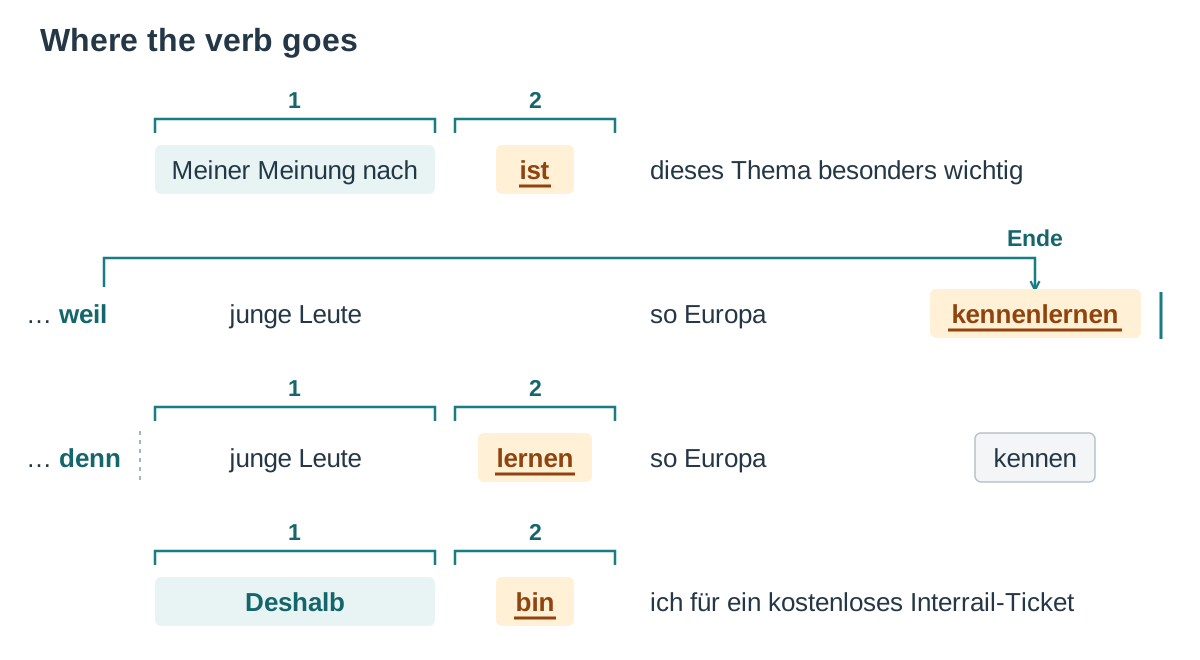
Giving reasons: weil vs denn vs deshalb
Justifying your opinion earns substantial Content marks in written tasks:
- weil (because) sends the verb to the end: Ich finde die Idee gut, weil junge Leute so Europa kennenlernen.* (I think the idea is good because young people get to know Europe that way.)
- denn (because / for) keeps normal word order, with the verb in position two: Ich finde die Idee gut, denn junge Leute lernen so Europa kennen.*
- deshalb / deswegen (that is why / therefore) takes position one, so the verb comes straight after it: Deshalb bin ich für ein kostenloses Interrail-Ticket.* (That is why I am in favour of a free Interrail ticket.)
Da-compounds before a dass-clause
Some adjectives and verbs take specific prepositions, such as überzeugt von (convinced of) or erstaunt über (amazed at). When followed by a whole clause, put da- + the preposition before the comma (or dar- if the preposition begins with a vowel):
- Ich bin davon überzeugt, dass Sport gesund ist. (I am convinced that sport is healthy.)
- Ich bin darüber erstaunt, dass so viele Lebensmittel weggeworfen werden. (I am amazed that so much food is thrown away.)
- Ich bin dafür / dagegen, dass Handys in der Schule verboten werden. (I am in favour of / against phones being banned in school.)
Reporting verbs and recognising Konjunktiv I
In reading texts, you will often meet reporting verbs (Verben des Mitteilens) such as behaupten (to claim), zugeben (to admit), and betonen (to emphasise). It is dass that sends the verb to the end:
- Der Autor behauptet, dass viele Jugendliche im Internet gemobbt werden. (The author claims that many teenagers are bullied online.)
In quality newspapers, journalists report utterances using the indirect speech subjunctive (Konjunktiv I), especially in the third person: sei (is), habe (has), werde (will), könne (can), müsse (must):
- Er behauptet, dass das eine Lüge sei. (He claims that it is a lie.)
- Die Ministerin sagte, die Regierung werde mehr investieren. (The minister said the government would invest more.)
In reading comprehension answers written in English, treat these forms as reported claims and attribute them to the speaker rather than stating them as confirmed facts. In your own writing, dass with standard indicative verbs is completely acceptable: Sie sagt, dass der Zug spät ankommt.
Giving Advice, Suggestions, and Role-Play Dialogue
Offering advice requires adapting your register to the task: an informal letter to a friend (du), a role-play with an adult host or official (Sie), or an opinion piece (man).
Subjunctive advice (Konjunktiv II)
- To a friend (du): An deiner Stelle würde ich sofort mit der Lehrerin sprechen.* (If I were you, I would speak to the teacher immediately.)
- Gentle advice: Du solltest dich besser vorbereiten. (You should prepare better.)
- Collaborative ideas: Wir könnten am Wochenende eine Radtour machen. (We could go on a bike tour at the weekend.)
- Verbs of advice: raten and empfehlen take a dative person and a zu-infinitive: Ich rate dir, mehr zu schlafen. (I advise you to sleep more.) / Ich empfehle dir, eine Sprach-App zu benutzen. (I recommend that you use a language app.)
Polite requests and suggestions
- Wäre es möglich, das Zimmer zu wechseln? (Would it be possible to change rooms?)
- Hätten Sie etwas dagegen, wenn ich das Fenster öffne? (Would you mind if I opened the window?)
- Könntest du nicht früher kommen? (Could you not come earlier?)
- Wie wäre es mit einem Ausflug nach Galway? (How about an excursion to Galway? Note: mit + dative)
- Lass uns ins Kino gehen! (Let us go to the cinema!)
- Warum machen wir nicht eine Radtour? (Why don't we do a bike tour?)
- Suggesting in the past: Er schlug eine Reise vor. (He suggested a trip.)
Forming commands: the imperative (Befehlsform)
- du form:* Take the du present tense, drop du and the -st. Retain vowel changes (), drop umlauts (): Komm!, Nimm!, Fahr!, Arbeite!, Sei vorsichtig!, Ruf mich an!*
- ihr form:* Verb matches regular ihr without the pronoun: Kommt!, Seid leise!*
- Sie form:* Invert verb and pronoun: Kommen Sie herein!, Seien Sie bitte vorsichtig!*
Sample role-play dialogue (Host parent & student)
- Gastmutter: Möchtest du heute Abend mit uns in die Stadt fahren? (Would you like to drive into town with us this evening?)
- Schüler(in): Das geht heute leider nicht, weil ich für die Deutschprüfung lernen muss. Aber wie wäre es mit morgen Abend? (Unfortunately that is not possible today because I have to study for the German exam. But how about tomorrow evening?)
- Gastmutter: Gute Idee! Wir könnten morgen ins Theater gehen. (Good idea! We could go to the theatre tomorrow.)
- Schüler(in): Wunderbar! Dürfte ich vielleicht einen Freund mitbringen? (Wonderful! Might I perhaps bring a friend along?)
- Gastmutter: Natürlich, kein Problem! (Of course, no problem!)
Obligation, Bans, and Past Modals: Müssen, Dürfen, and Trotz
Rules, permissions, and prohibitions are central to role-plays, opinion topics, and letters.
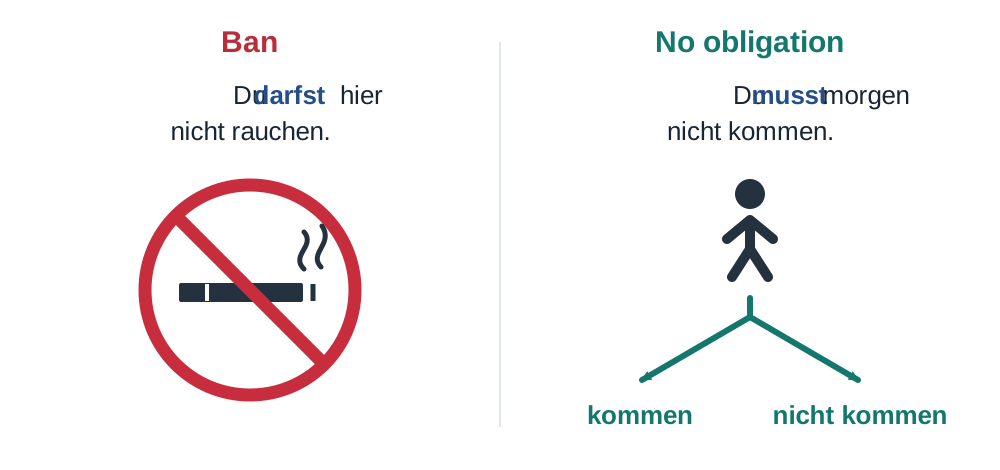
Don't have to vs must not
In English, 'must not' signifies a ban. In German, nicht müssen means there is no obligation. For a prohibition, you must use nicht dürfen:
- Du darfst hier nicht rauchen. = You must not / are not allowed to smoke here. (a ban)
- Du musst morgen nicht kommen. = You do not have to come tomorrow. (no obligation)
- Du brauchst morgen nicht zu kommen. = You do not need to come tomorrow. (alternative to nicht müssen)
Forbidding and permitting: verbieten and erlauben
Both verbs govern the dative of the person, followed by a zu-infinitive:
- Meine Eltern haben mir verboten, Musik illegal herunterzuladen. (My parents forbade me to download music illegally.)
- Die Schule erlaubt den Schülern, Handys in den Pausen zu benutzen. (The school allows students to use phones during breaks.)
- Nouns: das Verbot (the ban), die Erlaubnis (the permission).
Modal verbs in the past (Präteritum) vs Konjunktiv II
In the simple past tense, modal verbs lose their umlauts. Adding an umlaut changes the meaning to hypothetical or polite subjunctive (Konjunktiv II):
| Verb | Past / Präteritum | Konjunktiv II |
|---|---|---|
| dürfen | durfte (was allowed to) | dürfte (might / would be allowed) |
| können | konnte (was able to / could) | könnte (could / would be able to) |
| müssen | musste (had to) | müsste (would have to) |
| sollen | sollte (was supposed to) | sollte (should) |
| wollen | wollte (wanted to) | wollte (would want to) – same form as the past |
| mögen | mochte (liked) | möchte (would like) |
- Als ich fünfzehn war, durfte ich nicht allein in die Stadt fahren. (When I was fifteen, I was not allowed to go into town alone.)
- Letztes Jahr musste mein Bruder eine Geldstrafe zahlen. (Last year my brother had to pay a fine.)
The preposition trotz
Theme 1.7 highlights trotz (despite). In standard written German, trotz governs the genitive case (Genitiv):
- Trotz meines Verbotes hat er die Party besucht. (Despite my ban, he went to the party.)
- Trotz des schlechten Wetters machten wir eine Wanderung. (Despite the bad weather, we went for a hike.)
Essential Comprehension and Discussion Vocabulary
Leaving Certificate reading and listening passages frequently use specific vocabulary to express advice, demands, and arguments:
Advice and suggestions
- der Rat / die Ratschläge = advice / pieces of advice
- raten (+ Dativ) = to advise
- die Empfehlung (-en) = recommendation; empfehlen = to recommend
- der Vorschlag (die Vorschläge) = suggestion; vorschlagen = to suggest
Permission and bans
- die Erlaubnis = permission; erlauben (+ Dativ) = to permit
- das Verbot (-e) = ban / prohibition; verbieten (+ Dativ) = to forbid
Demands and conflict
- die Forderung (-en) = demand; fordern / verlangen = to demand
- nachgeben = to give in / yield (e.g. to trade union demands)
- auffordern zu = to call on / urge someone to do something
Pros, cons, and public announcements
- der Vorteil (-e) = advantage; der Nachteil (-e) = disadvantage
- dafür sein = to be in favour; dagegen sein = to be against
- ablehnen = to reject; kritisieren = to criticise
- Man sollte... = One should...
- Es wird empfohlen, ... zu... = It is recommended to...
- Sie sollten auf keinen Fall... = You should on no account...
Understanding the Two Exam Tasks and Mark Schemes
Before writing a single word, check which task you are doing and notice its length and weighting:
- Äußerung zum Thema (ÄZT): A short reaction piece of about 100 words, worth 25 marks. The marking allocates approximately 13 marks to content (Inhalt), which includes discretionary marks for elaboration, and 12 marks to expression (Ausdruck). Because word count is tight, you must answer every bullet point in a sentence or two without wasting time on a lengthy introduction.
- Schriftliche Produktion: An extended piece of about 160 words, worth 50 marks. This is divided equally into Inhalt (25 marks) and Ausdruck (25 marks). It usually takes the form of an opinion essay, a photo response, or a reply to an informal letter from a German-speaking friend.
In both tasks, content marks are tied directly to each individual prompt bullet point. Examiners also award discretionary marks for elaboration, so always support each point with a reason or a concrete example rather than giving a bare one-sentence answer. Leaving out a bullet point forfeits its marks entirely, no matter how good your German is.
Take thirty seconds to plan before you write: number each prompt bullet point on your exam paper and jot down one German keyword or verb structure beside each before starting.
Structure and Informal Letter Layout
Most tasks require either a standard short article or an informal letter reply.
The Standard Essay Framework
- Einleitung (Introduction): Refer briefly to the topic in your own words. Im Text geht es um das Thema... (The text deals with the topic of...) or Dieses Thema wird heutzutage viel diskutiert. (This topic is widely discussed nowadays).
- Hauptteil (Main Body): Work through each prompt bullet in turn. Answer only what is asked. If the question asks for advantages and disadvantages or a comparison between Ireland and Germany, provide both sides using connectors like einerseits ... andererseits (on the one hand ... on the other hand) and Im Vergleich zu Irland... (In comparison to Ireland...). If the prompt does not ask for a comparison, spend your words developing each point with examples instead.
- Schluss (Conclusion): Finish with one or two sentences that sum up your personal stance: Abschließend bin ich der Ansicht, dass... (In conclusion, I am of the view that...).
Informal Letter Frame
When the prompt is a letter from a friend (such as Julia or Alex), use correct letter conventions. In past papers, a suitable opening and closing has been rewarded (for example, 4 marks in 2016), so always include them:
- Opening: Liebe Julia, (to a female friend) or Lieber Julian, (to a male friend).
- First sentence: The line immediately after the comma starts with a small letter: vielen Dank für deinen Brief. (Many thanks for your letter.)
- Closing: Schreib bald wieder! (Write back soon!), followed on the next line by Liebe Grüße or Viele Grüße (Best wishes), and your name: Deine Aoife or Dein Conor.
- Pronouns: Address your friend consistently using informal pronouns: du, dich, dir, and dein.
Describing Photos, Reacting, and Suggesting
Exam prompts regularly require three specific functional skills:
1. Describing a Photo (Bildbeschreibung)
When a prompt asks you to describe an image, describe what you see and add a brief interpretation using verb second (V2) word order:
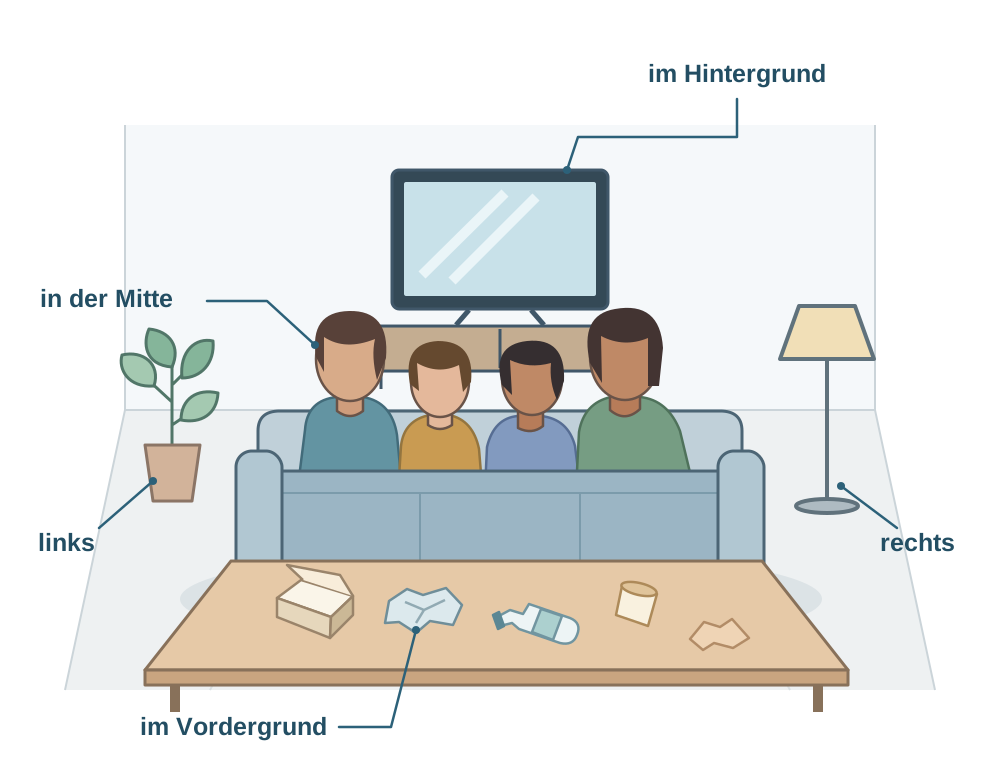
- Auf dem Foto sieht man eine Familie, die zusammen auf dem Sofa sitzt. (In the photo you can see a family sitting together on the sofa.)
- Im Vordergrund hält der Vater einen Laptop. (In the foreground the father is holding a laptop.)
- Es scheint, dass sie einen Film anschauen. (It seems that they are watching a film.)
- Useful location markers that trigger inversion: Im Hintergrund (in the background), Links / Rechts (on the left / on the right), In der Mitte (in the middle).
2. Reacting to Statements and Facts
When responding to a scenario (such as food waste or smartphone rules), state your emotional reaction clearly. Most of these phrases introduce a Nebensatz (subordinate clause) with dass, which sends the conjugated verb to the very end:
- Ich finde es erschreckend / schade, dass so viele Lebensmittel im Müll landen. (I find it shocking / a pity that so much food ends up in the bin.)
- Es freut mich, dass junge Leute sich für die Umwelt engagieren. (I am pleased that young people are getting involved in protecting the environment.)
- Ich bin darüber erstaunt, dass viele Jugendliche so wenig lesen. (I am astonished that many young people read so little.)
- Das wundert mich nicht. (That does not surprise me.)
3. Making Suggestions and Expressing Wishes
Use modal verbs and Konjunktiv II to offer solutions:
- Man sollte einen Essensplan machen. (One should make a meal plan.)
- Ich schlage vor, dass die Schule mehr Laptops kauft. (I suggest that the school buys more laptops.)
- Es wäre sinnvoll, mehr Geld in den Nahverkehr zu investieren. (It would make sense to invest more money in local transport.)
- Ich würde gern nach Österreich reisen, weil mich die Berge interessieren. (I would like to travel to Austria because the mountains interest me.)
- Für mich wäre es schwierig, eine Woche ohne Handy zu leben. (For me it would be difficult to live for a week without a mobile phone.)
Talking About Personal Experience in the Past
Prompts frequently ask you to recount a past event, primary school experience, or how you learned a language.
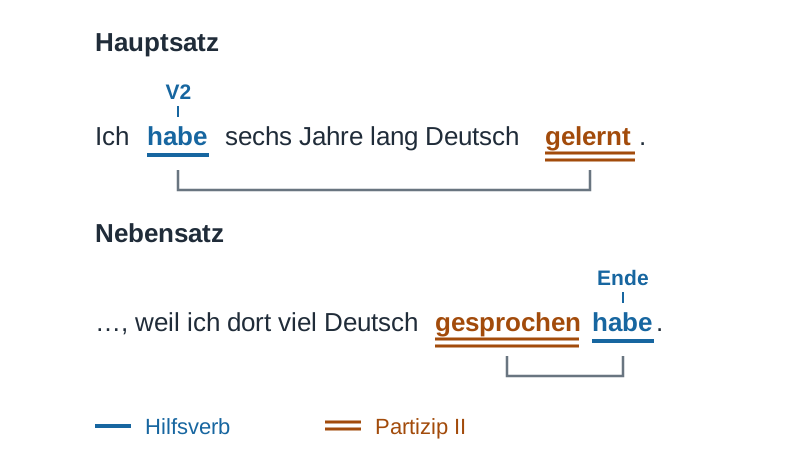
The Perfekt Tense
Use the Perfekt for talking about your past experiences. Place the auxiliary verb (haben or sein) in Position 2 and the past participle at the end of the main clause:
- Most verbs take haben: Ich habe sechs Jahre lang Deutsch gelernt. (I learned German for six years.)
- Verbs of movement or change of state take sein: Ich bin letztes Jahr nach Berlin gefahren. (I went to Berlin last year.)
- In a subordinate clause, the auxiliary goes to the very end: ..., weil ich dort viel Deutsch gesprochen habe. (...because I spoke a lot of German there.)
The Präteritum of Common Verbs
For sein, haben, and modal verbs, the simple past (Präteritum) is standard:
- In der Grundschule waren fast alle Lehrkräfte Frauen. (In primary school almost all the teachers were women.)
- Ich musste jeden Tag Hausaufgaben machen. (I had to do homework every day.)
- Wir hatten immer viel Spaß. (We always had lots of fun.)
Essential Word Order Rules and Connectors
Accurate sentence mechanics earn high marks in Ausdruck.
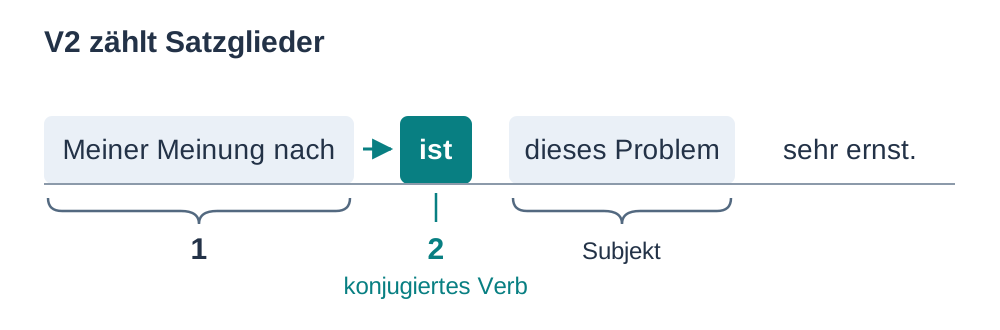
Verb-Second (V2) in Main Clauses
If you begin a sentence with a time phrase, an adverb, or an opinion starter like Meiner Meinung nach, that phrase takes Position 1. The conjugated verb must take Position 2, followed immediately by the subject:
- Correct: Meiner Meinung nach ist dieses Problem sehr ernst. (In my opinion this problem is very serious.)
- Incorrect: Meiner Meinung nach dieses Problem ist...
Verb-End in Subordinate Clauses (Nebensätze)
Subordinating conjunctions such as weil (because), dass (that), obwohl (although), and wenn (if/when) send the conjugated verb to the end of the clause:
- Viele Teenager stehen unter Druck, weil sie gute Noten erzielen wollen. (Many teenagers are under pressure because they want to achieve good grades.)
Note: Older exam papers and syllabus extracts print daß. Current standard German spelling is dass, which you should write consistently.
Expressing Purpose: 'um ... zu' vs 'damit'
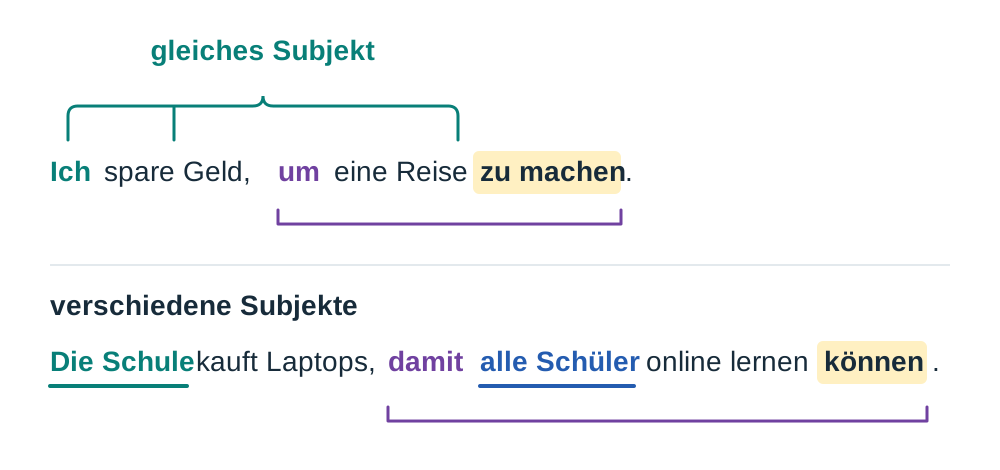
- Use um ... zu + Infinitiv when the subject of both actions is identical: Ich spare Geld, um eine Reise zu machen. (I am saving money in order to take a trip.)
- Use damit (with verb at the end) when the subjects are different: Die Schule kauft Laptops, damit alle Schüler online lernen können. (The school buys laptops so that all pupils can learn online.)
Da-Compounds
A compound of da(r)- + preposition (davon, darüber, dazu) represents a thing, an action, or a broader idea. It can point forward to an upcoming clause or back to an earlier statement:
- Ich bin davon überzeugt, dass wir handeln müssen. (I am convinced that we must act.)
- Ich habe mit Interesse darüber gelesen. (I read about that with interest.)
Thematic Vocabulary for Written Tasks
Senior cycle written prompts draw from recurring themes. Memorise the article, noun, and plural together:
| Theme | German Term (with Gender & Plural) | English Meaning |
|---|---|---|
| Umwelt & Konsum | die Lebensmittelverschwendung (no pl.)<br>wegwerfen (wirft weg, warf weg, hat weggeworfen)<br>der Klimawandel (no pl.)<br>die Umwelt schonen (verb) | food waste<br>to throw away<br>climate change<br>to protect the environment |
| Schule & Arbeit | der Leistungsdruck (no pl.)<br>das Punktesystem, -e<br>einen Studienplatz bekommen (verb)<br>Berufserfahrung sammeln (verb) | pressure to perform / do well<br>the points system<br>to get a university place<br>to gain work experience |
| Sprachen & Kultur | die Fremdsprache, -n<br>zweisprachig (adj.)<br>eine Kultur kennenlernen (verb)<br>das Ausland (no pl.) | foreign language<br>bilingual<br>to get to know a culture<br>abroad |
| Technologie | das Smartphone, -s<br>die sozialen Medien (pl.)<br>der Bildschirm, -e<br>im Netz surfen (verb) | smartphone<br>social media<br>screen<br>to surf the internet |
Telefonieren und Simsen (Calling and Texting)
Everyday communication begins with placing a call or sending a text message. German requires specific verbs, cases, and set phrases that differ from English.
Core Calling and Texting Vocabulary
| German | English |
|---|---|
| der Anruf, die Anrufe | phone call |
| anrufen (ruft an, rief an, hat angerufen) | to ring / phone |
| zurückrufen | to ring back |
| die Handynummer, die Handynummern | mobile number |
| die Vorwahl, die Vorwahlen | area code / dialling code |
| besetzt | engaged (line busy) |
| der Empfang / kein Netz | mobile reception / no signal |
| das WLAN | Wi-Fi |
| die Nachricht, die Nachrichten | message |
| die SMS, die SMS | text message |
| eine Nachricht schicken / schreiben | to send / write a message |
| der Klingelton, die Klingeltöne | ringtone |
| erreichbar | reachable / contactable |
| ständig erreichbar sein | to be constantly reachable |
Essential Grammar Rule: anrufen takes the Accusative
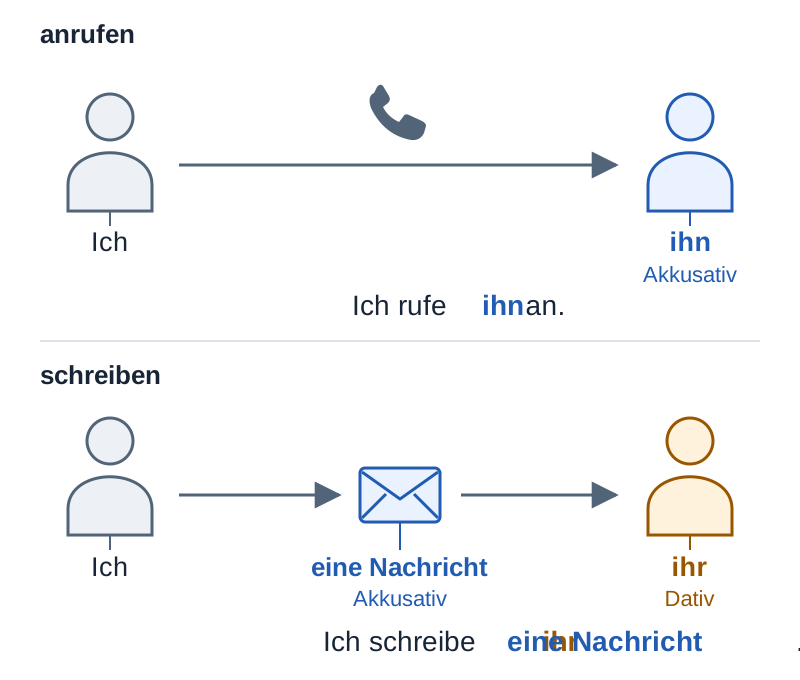
The verb anrufen governs a direct object in the accusative case, not the dative:
- Ich rufe ihn morgen an. (I will ring him tomorrow. NOT: ihm)
- Hast du deine Mutter angerufen? (Did you call your mother?)
In contrast, verbs for sending messages take a dative person and an accusative thing:
- Ich schreibe ihr eine Nachricht. (I am writing her a message.)
- Er hat mir ein Bildschirmfoto geschickt. (He sent me a screenshot.)
Gesprächsführung am Telefon (Managing a Phone Conversation)
Section 1.9 of the syllabus tests your ability to start a conversation, confirm details, deal with line breakdowns, and end the call politely.
Identifying Yourself and Picking Register
On the phone, state who you are using Hier spricht ... or Hier ist .... In professional or domestic settings, native speakers often state their surname directly (Kelly, guten Tag). Using Mein Name ist ... is also grammatically correct. Among friends, Hallo, ich bin's, Conor! is completely natural.
Maintain one register throughout the call:
- Formal (Sie): For an adult stranger, hotel, doctor's surgery, or school office.
- Könnten Sie das bitte wiederholen? (Could you please repeat that?)
- Wie ist Ihre Handynummer? (What is your mobile number?)
- Rufen Sie mich bitte zurück. (Please ring me back.)
- Informal (du): For a pen pal, friend, or host sibling.
- Könntest du das bitte wiederholen? (Could you please repeat that?)
- Wie ist deine Handynummer? (What is your mobile number?)
- Ruf mich bitte zurück. (Please ring me back.)
- Tschüss! / Bis später! (Bye! / See you later!)
Stating Purpose with Infinitive Clauses (um ... zu)
- Ich rufe an, um einen Termin zu vereinbaren. (I am ringing to arrange an appointment.)
- Ich rufe an, um mich nach dem Kurs zu erkundigen. (I am ringing to enquire about the course.)
Confirming and Checking Comprehension
- Alles klar, ich habe verstanden. (All clear, I have understood.)
- Habe ich Sie richtig verstanden, dass der Termin um zehn Uhr ist? (Have I understood you correctly that the appointment is at 10 o'clock?)
- Also, ich soll Sie morgen zurückrufen, oder? (So I am to ring you back tomorrow, right?)
Dealing with Breakdown and Line Problems
- Wie bitte? (Pardon? / Sorry?)
- Ich habe Sie nicht ganz verstanden. (I didn't quite understand you.)
- Das habe ich leider gar nicht verstanden. (Unfortunately I didn't catch that at all.)
- Könnten Sie bitte langsamer sprechen? (Could you please speak more slowly?)
- Könnten Sie das bitte buchstabieren? (Could you please spell that, please?)
- Die Verbindung ist sehr schlecht; ich kann Sie kaum hören. (The connection is very bad; I can barely hear you.)
- Die Verbindung ist abgebrochen. / Wir wurden getrennt. (The call dropped. / We got cut off.)
- Es tut mir leid, Sie haben sich verwählt. (I am sorry, you have dialled the wrong number.)
Closing the Call
On a formal call, end with Auf Wiederhören! rather than Auf Wiedersehen (which implies seeing someone face to face). With friends, Tschüss!, Bis später!, or Bis zum nächsten Mal! is normal.
Nachrichten aufnehmen und weiterleiten (Taking, Leaving, and Relaying Messages)
Syllabus Section 1.11 covers handling recorded messages, taking notes for others, and expressing urgency.
Taking a Message
- Er ist gerade nicht da / nicht erreichbar. (He is not here / not available at the moment.)
- Kann ich etwas ausrichten? (Can I take a message?)
- Möchten Sie eine Nachricht hinterlassen? (Would you like to leave a message?)
- Soll sie Sie zurückrufen? (Should she ring you back?)
- Unter welcher Nummer sind Sie erreichbar? (On what number can you be reached?)
- Ich richte es ihm aus. (I will pass it on to him.)
Leaving a Message on an Answering Machine (der Anrufbeantworter / die Mailbox)
- Bitte hinterlassen Sie eine Nachricht nach dem Signalton. (Please leave a message after the tone.)
- Hallo Frau Braun, hier ist Aoife Murphy. Ich rufe wegen des Praktikums an. Könnten Sie mich bitte so bald wie möglich zurückrufen? Sie erreichen mich unter 087 1234567. Vielen Dank und auf Wiederhören! (Hello Ms Braun, this is Aoife Murphy. I'm ringing about the work experience. Could you please ring me back as soon as possible? You can reach me on 087 1234567. Many thanks and goodbye!)
Urgency Adverbs and Short Notes
- dringend: urgently (Du sollst sie dringend zurückrufen.)
- umgehend: immediately / without delay (Bitte melden Sie sich umgehend.)
- wichtig: important (Es ist sehr wichtig.)
- Es eilt. (It is urgent.)
Model Written Note (Notiz)
Hallo Mama, Herr Braun hat um 15 Uhr angerufen. Er sagt, das Treffen sei auf Freitag verschoben. Bitte ruf ihn umgehend zurück! Bis später, Ciara (Hi Mam, Mr Braun rang at 3 o'clock. He says the meeting has been moved to Friday. Please ring him back straight away! See you later, Ciara)
This short note shows the key elements examiners look for: who called and when, what was said using reported speech (sei), an urgency adverb (umgehend), and an informal imperative (ruf ... zurück).
Indirekte Rede: Konjunktiv I und Konjunktiv II (Reported Speech)
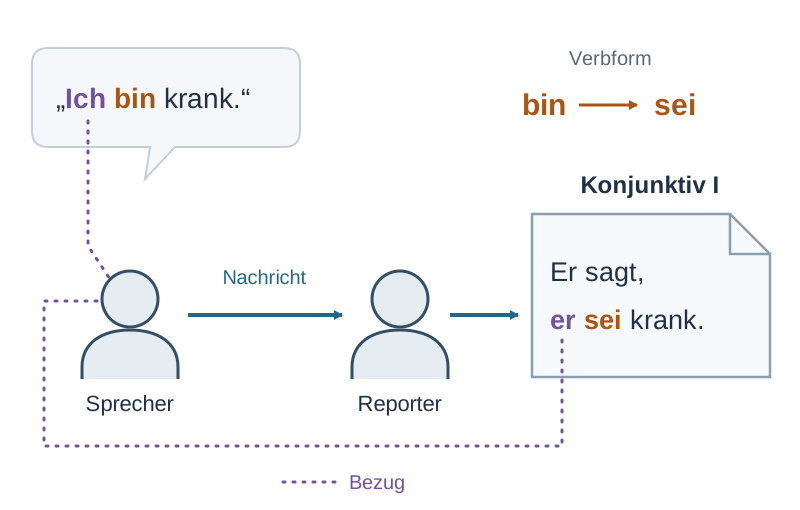
When reporting what someone else said or wrote, German uses reported speech (indirekte Rede). In news reports and formal written German, this requires Konjunktiv I.
In everyday speech, and when passing on a message, Germans usually keep the normal present tense: Sie sagt, dass der Zug spät ankommt. / Sie sagt, der Zug kommt spät an. (She says the train is arriving late.) Konjunktiv I (…, der Zug komme spät an) is the formal written version.
Forming Konjunktiv I
Take the infinitive stem (the infinitive minus -en) and add the endings: -e, -est, -e, -en, -et, -en.
- aufladen er lade auf (NOT läde)
- kommen er komme
- haben er habe
- sein is irregular: ich sei, du seist, er sei, wir seien, ihr seiet, sie seien.
The Ambiguity Rule: Replacing with Konjunktiv II
If the Konjunktiv I form looks identical to the normal present tense indicative (which is almost always true for ich, wir, and sie/Sie), replace it with Konjunktiv II (hätten, wären, or würden + infinitive):
- Indicative: Wir haben keine Zeit. Reported: Sie sagen, sie hätten keine Zeit. (not haben, which would sound like direct speech).
| Direct Speech | Reported Speech (with or without dass) | Meaning |
|---|---|---|
| „Ich bin krank.“ | Er sagt, er sei krank. | He says he is sick. |
| „Ich habe kein Netz.“ | Sie behauptet, dass sie kein Netz habe. | She claims she has no signal. |
| „Das ist eine Lüge.“ | Er behauptet, das sei eine Lüge. | He claims that is a lie. |
| „Wir wollen helfen.“ | Sie sagen, sie wollten helfen. | They say they want to help. |
Past, Future, Questions, and Requests in Reported Speech
- Past (Perfekt / Präteritum): Use habe / sei + past participle.
- „Ich habe das Foto hochgeladen.“ Er sagt, er habe das Foto hochgeladen. (He says he uploaded the photo.)
- „Sie ist nach Berlin geflogen.“ Er berichtet, sie sei nach Berlin geflogen. (He reports she flew to Berlin.)
- Infinitive structure: Er behauptet, den Brief schon geschickt zu haben. (He claims to have sent the letter already.)
- Future: Use werde + infinitive.
- Er sagt, er werde morgen anrufen. (He says he will ring tomorrow.)
- Reported Questions: Use ob for yes/no questions; retain the question word for open questions.
- Sie fragt, ob du Zeit habest. (She asks whether you have time.)
- Er fragt, wann der Zug ankomme. (He asks when the train arrives.)
- Reported Requests: Use the modal verb sollen.
- „Ruf mich an!“ Sie sagt, du sollst / sollest sie anrufen. (She says you are to ring her.)
Geräte, Software und trennbare Verben (Hardware, Software, and Verbs)
Discussing digital equipment requires control of noun genders and separable verbs.
Hardware and Digital Concepts
| German Noun | Plural | English Meaning |
|---|---|---|
| das Handy | die Handys | mobile phone |
| das Smartphone | die Smartphones | smartphone |
| der Computer | die Computer | computer |
| der Laptop | die Laptops | laptop |
| das Tablet | die Tablets | tablet |
| der Bildschirm | die Bildschirme | screen / monitor |
| der Akku | die Akkus | rechargeable battery |
| das Passwort | die Passwörter | password |
| die Datei | die Dateien | electronic file |
| die App | die Apps | app |
Note on das Handy: Remember that das Handy is exclusively a German noun for a mobile phone. Never use it as an adjective to mean convenient; use praktisch or nützlich instead.
Key Verbs and Their Principal Parts
Pay attention to the principal parts (Stammformen):
- aufladen (lädt auf, lud auf, hat aufgeladen) – to charge (separable)
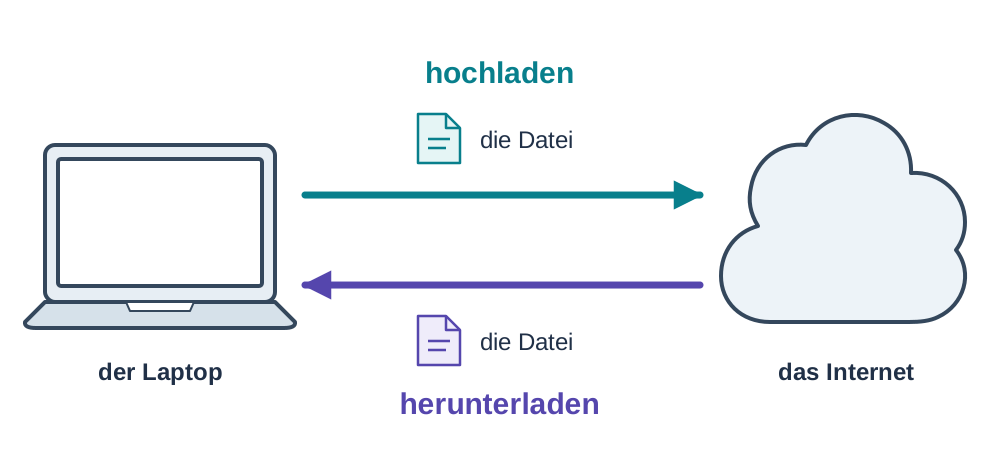
- herunterladen (lädt herunter, lud herunter, hat heruntergeladen) – to download (separable)
- hochladen (lädt hoch, lud hoch, hat hochgeladen) – to upload (separable)
- speichern (speichert, speicherte, hat gespeichert) – to save (not separable): Vergiss nicht, deine Hausaufgaben auf dem Laptop zu speichern! (Don't forget to save your homework on the laptop!)
- löschen (löscht, löschte, hat gelöscht) – to delete (not separable): Sie hat die Nachricht versehentlich gelöscht. (She deleted the message by mistake.)
Prefix movement rules:
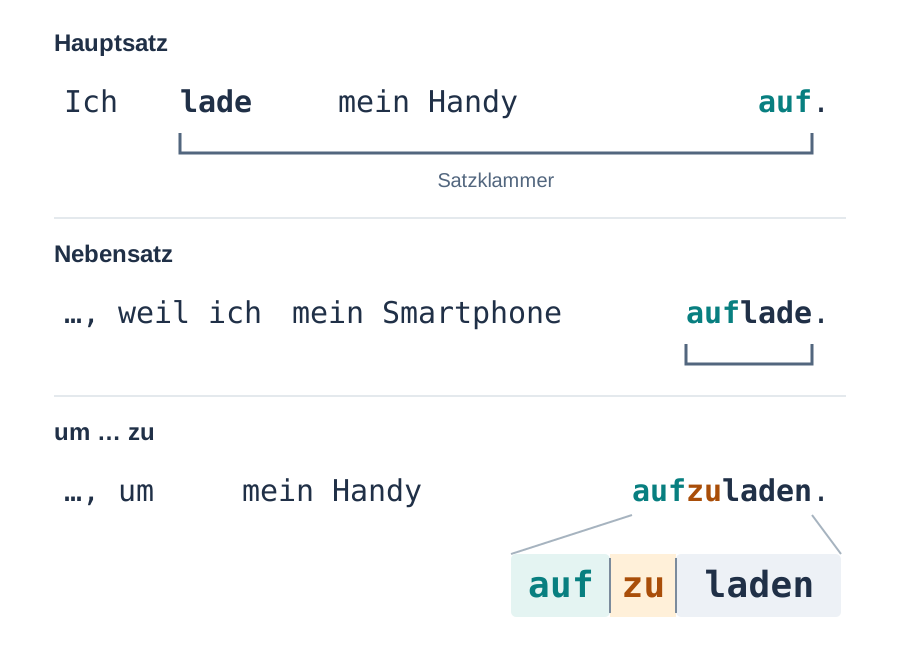
- In a main clause, the separable prefix separates and goes to the very end in the present tense, simple past, and imperative:
- Ich lade mein Handy auf. (I am charging my phone.)
- Er lud die App herunter. (He downloaded the app.)
- Lad dein Handy auf!* (Charge your phone!)
- In a subordinate clause (weil, dass, obwohl), the prefix remains attached to the verb at the very end:
- ..., weil ich mein Smartphone auflade.
- In an infinitive clause with zu, the zu slots between the prefix and the stem:
- Ich brauche ein Ladekabel, um mein Handy aufzuladen. (I need a charging cable to charge my phone.)
Soziale Medien, Hörverstehen und Online-Hilfe (Social Media and Helplines)
Social media topics appear frequently in listening comprehensions and reading texts, particularly around online youth services such as Nummer gegen Kummer.
Listening Vocabulary: Helpline Features and Youth Problems
| German | English |
|---|---|
| kostenlos | free of charge |
| bundesweit | nationwide |
| anonym | anonymous |
| vertraulich | confidential |
| die Nummer wird nicht angezeigt | the phone number is not displayed |
| die Daten werden nicht weitergegeben | data is not passed on to third parties |
| ein Benutzerkonto anlegen | to create a user account |
| der Live-Chat | live chat |
| per E-Mail | by email |
| der Kummer / die Sorgen | worries / grief |
| der Liebeskummer | lovesickness |
| der Streit mit Freunden | arguments with friends |
| der Leistungsdruck | pressure to perform / academic stress |
| die Zukunftsangst | fear of the future |
| das Mobbing / das Cybermobbing | bullying / cyberbullying |
Social Media Actions and Collocations
- in Kontakt bleiben: Soziale Netzwerke helfen mir, mit Freunden weltweit in Kontakt zu bleiben. (Social networks help me stay in contact with friends worldwide.)
- jemandem folgen (+ dative): Ich folge vielen deutschsprachigen Kanälen. (I follow many German channels.)
- die Privatsphäre schützen: Man muss seine Privatsphäre vor Missbrauch schützen. (You must protect your privacy from misuse.)
- süchtig machen: Kurze Videoclips können schnell süchtig machen. (Short video clips can quickly become addictive.)
- Zeit verschwenden: Viele Teenager verschwenden täglich Stunden am Bildschirm. (Many teenagers waste hours daily in front of the screen.)
- blockieren / melden: Wenn man beleidigt wird, sollte man den Absender sofort blockieren oder melden. (If someone insults you online, you should block or report them straight away.)
Gaming und Jugendkultur (Gaming and Leisure)
Syllabus Section III focuses on cultural awareness and everyday leisure (Freizeitgestaltung). When discussing gaming hobbies in the oral exam or an opinion piece, move beyond basic nouns into balanced viewpoints.
Gaming Terms
| German | English |
|---|---|
| das Videospiel, die Videospiele | video game |
| das Computerspiel, die Computerspiele | computer game |
| das Rollenspiel, die Rollenspiele | role-playing game (RPG) |
| der Mehrspielermodus, die Mehrspielermodi | multiplayer mode |
| der Einzelspielermodus | single-player mode |
| die Konsole, die Konsolen | console |
| die Steuerung, die Steuerungen | controls |
| das Level, die Levels / Level | level (game stage) |
Expressing Opinions on Gaming
- Am Wochenende spiele ich gern mit Freunden online Videospiele, um mich nach der Schule zu entspannen. (At the weekend I like playing video games online with friends to relax after school. Note: Keep the slang verb zocken for speaking only).
- Online-Spiele fördern den Teamgeist. (Online games promote team spirit.)
- Manche Spiele können leider süchtig machen. (Unfortunately, some games can be addictive.)
- Man verliert leicht das Zeitgefühl vor dem Bildschirm. (You easily lose track of time in front of the screen.)
- Brutale Spiele sind für jüngere Kinder absolut nicht geeignet. (Violent games are completely unsuitable for younger children.)
Diskussion und Konjunktiv II (Discussion Language and Hypotheses)
Higher Level writing tasks (the 25-mark Äußerung zum Thema and the 50-mark letter/opinion task) require structured argumentation. You need clear transitions, conditional forms, and comparisons between Ireland and German-speaking countries.
Reacting and Giving Conviction with dass-Clauses
- Ich finde es bedenklich, dass viele Jugendliche nachts am Handy sind. (I find it worrying that many teenagers are on their phones at night.)
- Es freut mich, dass Apps das Sprachenlernen erleichtern. (I am pleased that apps make language learning easier.)
- Ich bin davon überzeugt, dass Handyverbote Leben retten. (I am convinced that mobile phone bans save lives.)
Conceding and Contrasting (V2 Inversion)
- Es stimmt zwar, dass das Internet praktisch ist, aber ... (It is indeed true that the internet is handy, but ...)
- Das ist wohl möglich, aber ... (That may well be, but ...)
- Ich will nicht damit sagen, dass soziale Medien schlecht sind. (I don't mean to say that social media are bad.)
- Einerseits ... andererseits ... (triggers verb second (V2) word order immediately after each word):
- Einerseits bieten Smartphones viele Vorteile, andererseits führen sie oft zu Ablenkung. (On the one hand smartphones offer many advantages; on the other hand they often lead to distraction.)
- Meiner Meinung nach (occupies position 1; verb must come second):
- Meiner Meinung nach ist ein Smartphoneverbot sinnvoll. (In my opinion a smartphone ban makes sense. NOT: Meiner Meinung nach, ein Smartphoneverbot ist ...)
Comparing Ireland and Germany
- In Irland ist die Situation ähnlich wie in Deutschland. (In Ireland the situation is similar to Germany.)
- Wie in Deutschland gilt auch an vielen irischen Schulen ein Handyverbot. (As in Germany, a mobile phone ban also applies in many Irish schools.)
- Auch bei uns in Irland nutzen fast alle Jugendlichen Instagram und TikTok. (Here in Ireland too, almost all young people use Instagram and TikTok.)
Concluding
- Alles in allem ist Technologie ein nützliches Werkzeug. (All in all, technology is a useful tool. Note V2: ist follows Alles in allem.)
- Zusammenfassend lässt sich sagen, dass ein Gleichgewicht nötig ist. (In summary, it can be said that balance is necessary.)
Konjunktiv II: Hypotheses and Suggestions
When an exam task asks what you would do or what would be difficult, use Konjunktiv II.
- For most verbs: use würde + infinitive at the end: Ich würde eine Woche ohne Handy vorschlagen. (I would suggest a week without a phone.)
- For core auxiliary and modal verbs, memorise the one-word forms:
- sein wäre (would be): Ohne Handy wäre es für mich sehr schwierig. (Without a phone it would be very difficult for me.)
- haben hätte (would have): Wenn ich kein Handy hätte, würde ich mehr lesen. (If I didn't have a phone, I would read more.)
- können könnte (could): Man könnte ein Projekt starten. (You could start a project.)
- sollen sollte (should): Schulen sollten mehr Online-Projekte anbieten. (Schools should offer more online projects.)
- müssen müsste (would have to): Ich müsste früher aufstehen. (I would have to get up earlier.)
Written Exam Formats and Task Architecture
The formats below are drawn from the 2016–2018 papers and show how to practise social and environmental themes. Check the latest SEC paper for the current layout, and follow the instructions and word counts printed on your question.
Äußerung zum Thema (ÄZT)
The Äußerung zum Thema is a short exercise of roughly 100 words attached to one of the reading comprehension texts. You receive two or three compulsory bullet points, such as giving two reasons for a social trend and describing the situation in Ireland.
- Answer every single bullet point in the exact order given. If a prompt demands zwei Gründe, supply two distinct reasons. If it asks for in zwei Sätzen, write exactly two well-formed sentences.
- In the 2016 and 2017 examples, marks were split roughly evenly between content (covering all prompt requirements) and expression (grammatical accuracy and vocabulary range). Leaving out one prompt point immediately caps your content mark, no matter how flawless your German is.
Schriftliche Produktion
The longer Schriftliche Produktion task requires approximately 160 words (marked 25 for content and 25 for expression in the 2018 example). You generally choose between:
- An informal letter or email to a German-speaking friend, replying to four topic prompts.
- A discursive piece based on a photo or stimulus text covering four or five specified aspects.
Give every prompt bullet its own dedicated paragraph containing a clear opinion, an explanation, and a concrete example.
Describing a Photo (Bildbeschreibung)
Practise using a photo as a starting point for social commentary. Keep these core phrases ready:
- Auf dem Foto sieht man... (In the photo you see... finite verb in second position)
- Im Vordergrund / Im Hintergrund (In the foreground / In the background)
- In der Mitte / Links / Rechts (In the middle / On the left / On the right)
- Es scheint, dass... / Es sieht so aus, als ob... (It seems that... / It looks as if...)
- Die Leute sehen glücklich / besorgt / gestresst aus. (The people look happy / worried / stressed.)
Auf dem Foto sieht man eine Familie, die zusammen vor dem Fernseher sitzt. Im Vordergrund liegt viel Verpackungsmüll auf dem Tisch. Es scheint, dass die Jugendlichen sich langweilen.
Nature, Climate, and Waste Management
Higher Level answers require specific environmental vocabulary and accurate prepositions rather than vague statements.
Essential Climate and Landscape Lexis
- der Klimawandel (no pl.): climate change
- die globale Erwärmung: global warming
- der Umweltschutz (no pl.): environmental protection
- die erneuerbaren Energien (pl.): renewable energies
- die Abgase (pl.): exhaust fumes
- die Luftverschmutzung / die Wasserverschmutzung: air / water pollution
- die Dürre (-n): drought
- die Überschwemmung (-en): flood
- der Meeresspiegel (no pl.): sea level (steigt = rises)
- das Aussterben (no pl.): extinction (vom Aussterben bedroht = endangered)
Sea vs. Lake: Three Distinct Words
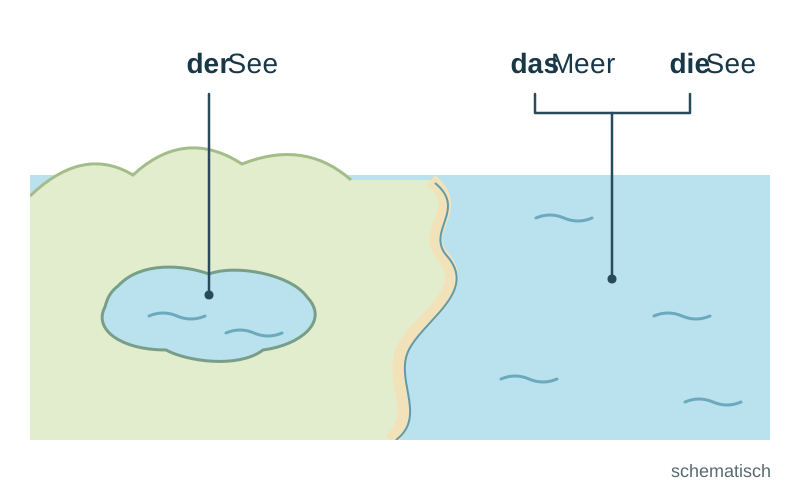
- das Meer (-e): open sea or ocean (im Meer schwimmen)
- die See (-n): sea (used in compound coastal names: die Nordsee, die Ostsee; an die See fahren = to go to the coast)
- der See (-n): inland freshwater lake (am Bodensee urlauben)
High-Yield Verb Distinction: schützen vs. schaden
- schützen takes the accusative case: Wir müssen die Umwelt schützen. (We must protect the environment.)
- schaden takes the dative case: Abgase schaden der Umwelt. (Exhaust fumes harm the environment.)
Waste, Litter, and Everyday Recycling
Practise comparing waste habits between Ireland and Germany:
- die Lebensmittelverschwendung: food waste
- Lebensmittel wegwerfen: to throw food away
- das Haltbarkeitsdatum: best-before date
- Reste verwerten: to use up leftovers
- die Verpackung (-en): packaging
- die Mülltonne (-n): wheelie bin
- der Gelbe Sack: yellow recycling bag for packaging (German dual system)
- das Pfand (no pl. in this sense; pl. die Pfänder): container deposit (die Pfandflasche = deposit bottle; die Mehrwegflasche = refillable bottle; die Einwegflasche = single-use bottle)
- Müll aufsammeln: to pick up litter
- umweltfreundlich / umweltschädlich: environmentally friendly / harmful to the environment
Im Gegensatz zu Deutschland gibt es in Irland erst seit 2024 ein Pfandsystem für Plastikflaschen und Dosen.
Teenagers, Mental Health, and Digital Life
Practise youth culture vocabulary in personal writing, opinion pieces and listening comprehension. A 2017 listening item, for example, discussed a youth telephone helpline.
Youth Helplines: 'Nummer gegen Kummer'
A past listening item on a youth helpline (2017) asked about three areas:
- Problems young callers discuss:
- der Kummer (no pl.): sorrow, grief (Sorgen und Kummer haben)
- der Liebeskummer (no pl.): heartbreak
- die erste Liebe: first love
- der Streit (-e) mit den Eltern / mit Freunden: row with parents / friends
- der Konflikt (-e) in der Familie: family conflict
- das Mobbing / das Cybermobbing: bullying / cyberbullying (gemobbt werden = to be bullied)
- die Drogen (pl.): drugs
- der Leistungsdruck (no pl.): academic pressure (gute Noten bekommen müssen)
- die Zukunftsangst (¨-e): anxiety about the future
- die Sucht (¨-e): addiction (die Handysucht, die Drogensucht)
- Helpline features:
- das Sorgentelefon / die Beratungsstelle: helpline / advice centre
- kostenlos: free of charge
- bundesweit: nationwide
- die Beratung (-en): advice, counselling
- Why callers reach out:
- anonym: anonymous (Man muss seinen Namen nicht nennen)
- vertraulich: confidential (Informationen werden nicht weitergegeben)
- zuhören: to listen (Jemand hat Zeit und hört zu)
Digital Life and Smartphone Pressures
- ständig aufs Handy schauen: to be constantly checking one's phone
- die Bildschirmzeit: screen time
- das Handy am Steuer: phone use while driving
- die Geldstrafe (-n) / das Bußgeld (-er): fine
- abgelenkt sein: to be distracted
- vereinsamen: to become socially isolated
- in Kontakt bleiben: to stay in touch
Ich befürworte Geldstrafen für das Handy am Steuer, weil abgelenkte Autofahrer schwere Unfälle verursachen.
Family Models, Gender Roles, and Politics
Syllabus section III.5 includes the generation gap, sexual and racial equality and changing views of marriage and the family; III.4 covers links between Ireland and the German-speaking countries, such as EU membership.
Modern Family and Gender Equality
- der Generationskonflikt: generation gap
- die Patchworkfamilie (-n): blended family
- alleinerziehend: single-parent (eine alleinerziehende Mutter)
- die gleichgeschlechtliche Ehe: same-sex marriage
- die traditionelle Rollenverteilung: traditional division of gender roles
- typische Männerberufe / Frauenberufe: traditional male / female occupations
- die Gleichberechtigung von Mann und Frau: gender equality
- gleicher Lohn für gleiche Arbeit: equal pay for equal work
Democratic Politics and European Links
- wählen: to vote (ab 18 wählen dürfen = to be allowed to vote from 18)
- das Wahlrecht: right to vote
- die Wahl (-en): election or choice (zur Wahl gehen = to go vote)
- die Stimme (-n): individual ballot/vote, or speaking voice (seine Stimme abgeben)
- die Abstimmung (-en): a vote, ballot (the voting process), e.g. Die Abstimmung findet morgen statt
- die Partei (-en): political party
- der Politiker / die Politikerin: politician
- der Bundeskanzler / die Bundeskanzlerin: German Federal Chancellor
- der Bundestag: German Federal Parliament
- das Bundesland (¨-er): federal state (such as Bayern or Nordrhein-Westfalen)
- die Europäische Union (EU): European Union (Irland und Deutschland sind aktive Mitglieder der EU)
Adjectival Nouns in Public Roles
Be careful with der/die Abgeordnete (member of parliament). It declines like an adjective rather than taking an -in suffix:
- ein Abgeordneter (a male MP)
- eine Abgeordnete (a female MP)
- die Abgeordneten (the MPs, plural)
This pattern matches der/die Jugendliche (ein Jugendlicher, eine Jugendliche, die Jugendlichen).
Advanced Grammar: Word Order, Reported Speech, and the Passive
To secure high expression marks, you must manage three distinct connector categories, reported speech in reading texts, and passive constructions.
Three Connector Classes and Sentence Word Order
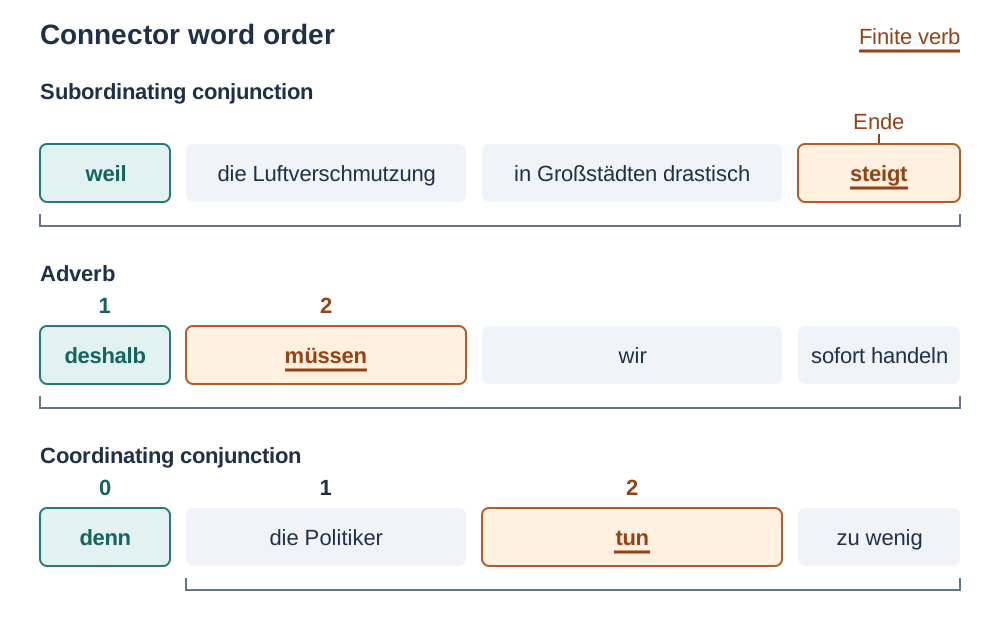
- Subordinating Conjunctions (weil, da, dass, obwohl, während) send the conjugated verb to the end of the clause:
- ..., weil die Luftverschmutzung in Großstädten drastisch steigt.
- Adverbs (deshalb, deswegen, trotzdem, außerdem) occupy position 1 in main clauses, forcing immediate verb-subject inversion (verb in position 2):
- Die Temperaturen steigen; deshalb müssen wir sofort handeln.
- Coordinating Conjunctions (und, aber, oder, denn, sondern) occupy position 0, leaving normal subject-verb order untouched:
- Wir demonstrieren, denn die Politiker tun zu wenig.
Reported Speech (indirekte Rede: Konjunktiv I)
Newspaper reports on politics use Konjunktiv I to report statements neutrally without declaring them factual:
- sein -> sei (Der Minister behauptet, die Krise sei bald vorbei.)
- haben -> habe (Die Polizei meldet, sie habe keine Hinweise.)
- werden -> werde (Die Sprecherin erklärt, das Projekt werde fortgesetzt.)
- können -> könne / müssen -> müsse
- Other verbs use stem + -e (er komme, sie sage).
In your own writing, using dass with standard indicative verbs is acceptable (Er sagt, dass die Lage ernst ist), but recognising Konjunktiv I in reading comprehensions is essential.
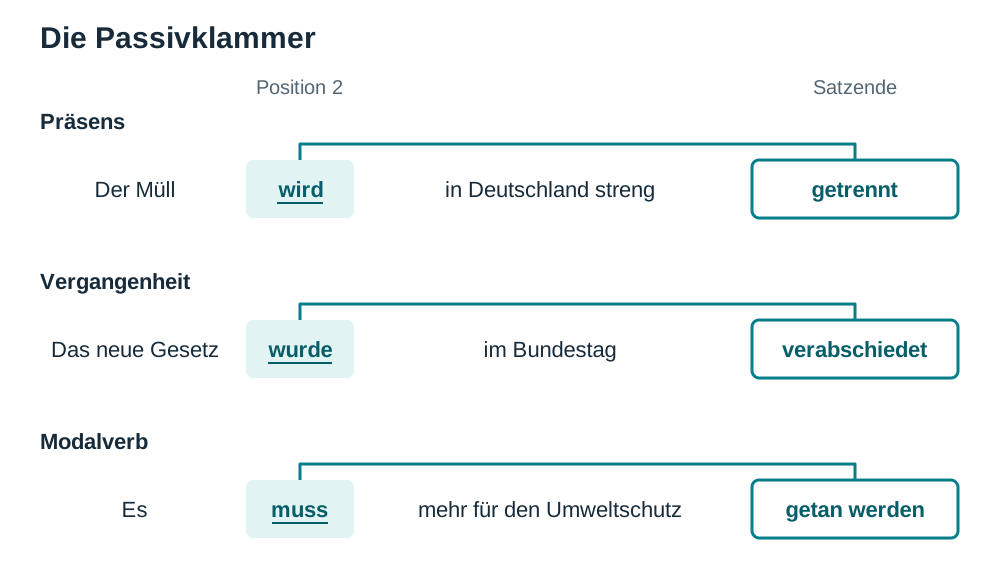
The Passive Voice (das Passiv)
Use the passive when an action or policy is more important than who executes it.
- Present Passive: form of werden + past participle at the end.
- Der Müll wird in Deutschland streng getrennt.
- Past Passive: past tense of werden (wurde / wurden) + past participle at the end.
- Das neue Gesetz wurde im Bundestag verabschiedet.
- With Modals: modal verb conjugated in position 2, past participle and werden at clause end.
- Es muss mehr für den Umweltschutz getan werden.
- To indicate the agent, use von + dative: Die Anlaufstelle wird von Freiwilligen geleitet.
Oral Examination Strategies: Discussion and Nuance
The oral examination accounts for 25% of Higher Level marks. Examiners look for the ability to defend viewpoints, introduce nuance, and discuss social realities in both Ireland and Germany.
Discussion Starters and Nuance
- Meiner Meinung nach + verb: Meiner Meinung nach könnte der Staat mehr tun. (Never place a comma or subject directly after this phrase).
- Ich bin davon überzeugt, dass...: I am convinced that...
- Da haben Sie / hast du recht, aber...: You are right there, but...
- Das ist wohl möglich, aber...: That is quite possible, but...
- Ich bin anderer Meinung, weil...: I am of a different opinion, because...
- Ich will nicht damit sagen, dass...: I do not mean to say that...
- Einerseits... andererseits...: On the one hand... on the other hand... (both trigger inversion).
Oral Practice: Model Questions and Responses
1. Was machst du persönlich für den Umweltschutz? Ich versuche, im Alltag umweltbewusst zu leben. Ich trenne meinen Müll zu Hause sorgfältig und fahre meistens mit dem Bus oder gehe zu Fuß zur Schule, anstatt mich mit dem Auto bringen zu lassen. Außerdem kaufe ich wiederverwendbare Trinkflaschen, um Plastikmüll zu vermeiden.
2. Gibt es Obdachlosigkeit in deiner Gegend? Ja, leider ist Obdachlosigkeit auch in Irland ein ernstes Problem, besonders in Großstädten wie Dublin oder Cork. Wegen der akuten Wohnungsnot können sich viele Familien die hohen Mieten nicht mehr leisten. Viele Freiwillige engagieren sich bei Suppenküchen, aber der Staat muss dringend mehr bezahlbare Wohnungen bauen.
3. Sollte man ab 16 Jahren wählen dürfen? Das ist eine schwierige Frage. Einerseits betreffen politische Entscheidungen über Bildung und Klima direkt unsere Zukunft, deshalb sollten Jugendliche mitreden dürfen. Andererseits interessieren sich manche Sechzehnjährige noch nicht genug für Politik. Trotzdem bin ich der Ansicht, dass ein früheres Wahlrecht das politische Bewusstsein fördern würde.
4. Leiden Jugendliche in Irland unter Leistungsdruck? Auf jeden Fall. Das Leaving Certificate erzeugt enormen Stress, weil die Punkte über den Studienplatz entscheiden. Viele Schüler haben Zukunftsangst und fühlen sich überfordert. Es wäre sinnvoll, das Punktesystem zu reformieren und mehr kontinuierliche Beurteilungen einzuführen.
Key terms
- Meiner Meinung nach
- Introductory phrase meaning 'in my opinion'. It fills position one in the clause and must be followed immediately by the conjugated verb in position two.
- dass
- Subordinating conjunction meaning 'that'. It sends the conjugated verb to the very end of the clause. (Modern standard spelling of 'daß').
- an deiner Stelle würde ich
- Formula for giving informal advice meaning 'if I were you / in your place, I would', followed by an infinitive at the end of the clause.
- dürfen
- Modal verb meaning 'to be allowed to / may'. Used for asking or granting permission. Combined with 'nicht', it signifies a strict ban ('must not').
- müssen nicht
- Phrase expressing absence of obligation ('do not have to'), in sharp contrast to 'dürfen nicht' ('must not / forbidden').
- weil vs denn
- Two ways to say 'because'. 'Weil' is subordinating and sends the verb to the end; 'denn' is coordinating and keeps normal subject-verb order.
- trotz (+ Genitiv)
- Preposition meaning 'despite'. In standard written German, it governs the genitive case (for example, 'trotz des Verbotes').
- zustimmen (+ Dativ)
- Separable verb meaning 'to agree with'. The person or idea agreed with must be in the dative case (for example, 'Dem stimme ich zu').
- widersprechen (+ Dativ)
- Inseparable verb meaning 'to contradict / disagree with'. It requires the dative case (for example, 'Da muss ich dir widersprechen').
- einerseits ... andererseits
- Paired linking adverbs meaning 'on the one hand ... on the other hand', used to weigh contrasting points. Each takes position one and forces verb-second order.
- behaupten
- Reporting verb meaning 'to claim / assert', frequently found in reading texts to introduce claims that may require critical evaluation.
- der Konjunktiv I
- Subjunctive forms (sei, habe, werde, könne) used in news and reports to indicate reported speech without confirming the statement as fact.
- Äußerung zum Thema
- A short written reaction piece of approximately 100 words worth 25 marks, requiring direct answers to stimulus points.
- Schriftliche Produktion
- The extended written production section of approximately 160 words worth 50 marks, split equally between Content (25) and Expression (25).
- Inhalt
- The content mark awarded for addressing every bullet point in the prompt with supporting detail and elaboration.
- Ausdruck
- The expression mark assessing grammatical accuracy, vocabulary range, idiomatic phrasing, and word order.
- Verb-Zweit-Stellung (V2)
- The German main-clause rule where the conjugated verb must stand in second position, directly after an introductory element.
- Nebensatz
- A subordinate clause introduced by a conjunction like 'weil', 'dass', or 'obwohl', placing the conjugated verb at the very end.
- um ... zu + Infinitiv
- A purpose structure ('in order to') used when the subject of both clauses is identical, placing 'zu' directly before the final infinitive.
- Konjunktiv II
- The subjunctive mood used to express wishes, polite suggestions, and unreal conditions (e.g. 'wäre', 'könnte', 'würde').
- Da-Verbindung
- A compound of da(r)- + preposition (e.g. 'darüber', 'davon') that points forward to a dass/infinitive clause or refers back to an idea.
- anrufen + accusative
- The verb meaning to call by phone; it takes a direct object in the accusative case (e.g. 'Ich rufe ihn an', not 'ihm').
- Hier spricht ...
- Standard polite telephone formula meaning 'This is [Name] speaking', used to identify yourself when making a call.
- Auf Wiederhören
- Formal closing formula used exclusively at the end of telephone conversations ('hören' = to hear).
- die Mailbox
- Feminine noun for mobile phone voicemail or answering service; not used to refer to an email inbox.
- indirekte Rede
- Reported speech in German, used to relay statements objectively using indicative 'dass'-clauses or formal Konjunktiv I forms.
- Konjunktiv I
- The mood used for formal reported speech, formed from the infinitive stem plus the endings -e, -est, -e, -en, -et, -en (e.g. 'er habe', 'er sei').
- Konjunktiv II
- The subjunctive mood expressing hypothetical conditions, wishes, and polite suggestions (e.g. 'wäre', 'hätte', 'könnte', 'sollte', 'würde + infinitive').
- separable verb
- A verb whose prefix detaches to the end of a main clause in the present, simple past, and imperative, but remains attached in subordinate clauses.
- verb second (V2)
- The fundamental word-order rule in German main clauses requiring the conjugated verb to sit immediately after the first sentence unit (e.g. after 'Meiner Meinung nach' or 'Einerseits').
- einerseits / andererseits
- Paired contrastive adverbs meaning 'on the one hand / on the other hand', each occupying position 1 and requiring immediate verb-second inversion.
- Meiner Meinung nach
- Common opinion phrase meaning 'in my opinion'; acts as position 1 in the clause and must be followed directly by the conjugated verb without a comma.
- Äußerung zum Thema
- A short written task (approx. 100 words) linked to a reading text, in which you answer the specific instructions given (e.g. give two reasons, describe the situation in Ireland).
- der Klimawandel
- Climate change; masculine compound noun without a plural form.
- der Umweltschutz
- Environmental protection; masculine compound noun (Umwelt + Schutz) used without a plural.
- das Pfand
- Refundable deposit paid on recyclable bottles and drink cans in Germany and Ireland.
- der Leistungsdruck
- Pressure to achieve academically; exam-related stress placed on students.
- die Zukunftsangst
- Anxiety concerning future prospects, such as exams, careers, or housing.
- das Mobbing
- Bullying, particularly in school or online (das Cybermobbing); used with 'gemobbt werden'.
- die Wohnungsnot
- Housing shortage or crisis, leading to rising rents and homelessness.
- ehrenamtlich
- Voluntary or unpaid; describes community and charitable service done for the public good.
- die Gleichberechtigung
- Equal rights and legal equality, particularly regarding gender and minority protections.
- die Stimme
- An individual's personal vote in an election, as well as the physical voice.
- die Abstimmung
- A collective ballot, referendum, or voting procedure.
- der/die Abgeordnete
- Member of parliament (equivalent to a TD); an adjectival noun that declines like an adjective.
Check yourself
Which word order error is present here: 'Meiner Meinung nach viele Schüler schlafen zu wenig'?
'Meiner Meinung nach' occupies position one, so the conjugated verb must come second: 'Meiner Meinung nach schlafen viele Schüler zu wenig.'
Correct the syntax error in this subordinate clause: 'Ich bin dafür, weil es ist billig.'
'Weil' sends the conjugated verb to the end of the clause: 'Ich bin dafür, weil es billig ist.' (Alternatively with 'denn': 'Ich bin dafür, denn es ist billig.')
Translate into German: 'You must not do that' and 'You don't have to do that'.
'Das darfst du nicht machen' (ban) and 'Das musst du nicht machen' (no obligation).
How do you advise a friend politely in a letter: 'If I were you, I would speak to your parents'?
'An deiner Stelle würde ich mit deinen Eltern sprechen.' (Uses 'an deiner Stelle' followed by the Konjunktiv II verb 'würde', with the infinitive 'sprechen' at the end).
Combine these two opposing statements using 'Einerseits ... andererseits': 'Der Tourismus bringt viel Geld.' / 'Er schadet der Umwelt.'
'Einerseits bringt der Tourismus viel Geld, andererseits schadet er der Umwelt.' (Both linking adverbs occupy position one and require the verb in position two).
Rewrite this sentence with correct German word order: 'Meiner Meinung nach viele Schüler haben zu viel Stress.'
'Meiner Meinung nach haben viele Schüler zu viel Stress.' The phrase 'Meiner Meinung nach' takes Position 1, so the conjugated verb 'haben' must take Position 2.
Complete the reaction clause using the correct word order: 'Ich finde es schade, dass viele Jugendliche ... (wenig lesen)'.
'..., dass viele Jugendliche wenig lesen.' In a subordinate clause introduced by 'dass', the conjugated verb 'lesen' must stand at the very end.
Fill in the blanks with the correct past tense (Perfekt) forms of 'fahren': 'Ich _ letztes Jahr nach Berlin _.'
'Ich bin letztes Jahr nach Berlin gefahren.' 'Fahren' denotes motion, requiring the auxiliary 'sein' (bin) in Position 2 and the past participle (gefahren) at the end.
Why does 'Die Schule kauft Tablets, damit die Schüler besser lernen können' use 'damit' rather than 'um ... zu'?
'damit' must be used because the subjects of the two clauses are different ('Die Schule' buys, but 'die Schüler' learn). 'um ... zu' can only be used when both clauses share the same subject.
What are the word counts and mark totals for the two Leaving Certificate German writing tasks (ÄZT vs Schriftliche Produktion)?
The Äußerung zum Thema (ÄZT) is approximately 100 words worth 25 marks. The Schriftliche Produktion is approximately 160 words worth 50 marks (split 25 for Content / 25 for Expression).
What is the Konjunktiv I form of 'er lädt das Foto hoch'?
er lade das Foto hoch (formed from the infinitive stem 'lad-', not the present tense stem 'lädt').
Correct this sentence: 'Ich rufe ihm morgen um acht Uhr an.'
'Ich rufe ihn morgen um acht Uhr an.' ('anrufen' requires the accusative pronoun 'ihn', not dative 'ihm').
How do you offer to take a phone message politely in German?
'Kann ich etwas ausrichten?' (or 'Möchten Sie eine Nachricht hinterlassen?').
What word order is required immediately after 'Einerseits' or 'Andererseits' in a main clause?
Verb-second (V2) inversion: the conjugated verb must immediately follow, before the subject (e.g. 'Einerseits bieten Smartphones viele Vorteile...').
How do you say 'Without my smartphone it would be very difficult for me' using Konjunktiv II?
'Ohne mein Smartphone wäre es für mich sehr schwierig.'
What does 'die Mailbox' mean in German telephone terminology?
Voicemail or answering machine service on a phone (not an email inbox).
Identify the word-order error in this sentence and correct it: 'Deshalb wir müssen den Müll trennen.'
'Deshalb' is an adverb taking position 1, requiring verb-subject inversion in position 2. The correct sentence is: 'Deshalb müssen wir den Müll trennen.'
What is the grammatical case difference between 'schützen' and 'schaden'?
'Schützen' governs the accusative case ('die Umwelt schützen'), whereas 'schaden' governs the dative case ('der Umwelt schaden').
What does 'Der Minister sagt, die Lage sei ernst' mean, and why is the verb 'sei' used instead of 'ist'?
It means 'The minister says the situation is serious.' The verb form 'sei' is Konjunktiv I, used in journalistic German to report speech neutrally without verifying it as a personal fact.
Convert this active statement into the passive voice: 'Man trennt den Müll in Deutschland streng.'
'Der Müll wird in Deutschland streng getrennt.' (Form of 'werden' in position 2, past participle 'getrennt' at clause end).
Translate into German with correct word order: 'In my opinion, homelessness is a major problem in Dublin.'
'Meiner Meinung nach ist Obdachlosigkeit ein großes Problem in Dublin.' ('Meiner Meinung nach' takes position 1, so the finite verb 'ist' must be in position 2).
What is the difference between 'das Meer', 'die See', and 'der See'?
'Das Meer' is the sea/ocean (neuter); 'die See' is also the sea (feminine, used in 'die Nordsee' and 'an die See fahren'); 'der See' means a lake (masculine, like 'der Bodensee').
Social Inequality, Homelessness, and Integration
To develop an answer, name a problem, explain a cause and suggest a realistic solution.
Youth Homelessness and Street Children
Civic Duty and Community Action
Volunteering is a useful way to discuss solutions to social problems, for example in a letter or the oral:
Racism, Refugees, and Pluralism
Man sollte Vorurteile abbauen und Geflüchtete unterstützen, anstatt rechtsextreme Parolen zu verbreiten.