

Written production carries 25% of the marks at Higher Level — 100 marks out of the 400 available for the whole examination, the exact same weighting as the oral. Picture stimuli turn up in two main places: as a prepared option in the oral examination (Picture Sequence), and as a visual prompt for written tasks. Everything you learn here about narrating past events and expressing character reactions serves both parts of the course — learn it once, use it twice. To score at the top standard, avoid simple photo captioning. Instead, follow a clear three-part plan: set the visual scene, recount the unfolding events and character feelings using secure past tenses, and broaden out into a thoughtful commentary on the underlying theme.
A Three-Part Plan for Picture Questions
A common trap in picture writing is treating the stimulus as nothing more than a photo description. At Higher Level, examiners look for your ability to describe, narrate, explain causes, and share personal opinions.
Structure your response across three natural stages:
- Describe the scene (Präsens): In two or three clear sentences, identify who is in the picture, where they are, what they are doing right now, and the overall atmosphere.
- Relate the backstory and feelings (Präteritum / Perfekt / Passiv): Explain what triggered the situation. What happened five minutes earlier? What went wrong, and how did the characters react? This is where your narrative vocabulary earns marks.
- Comment on the wider theme (Meinung / Konjunktiv II / Vergleich): Step back from the specific image to the bigger social topic (such as screen addiction, road safety, the environment, or exam pressure). Offer your personal opinion, propose an alternative using the conditional (Konjunktiv II), and draw a relevant comparison with life in Ireland.
Always check the mark value printed beside each written question on your paper and budget your time in proportion to it.
How Long Should the Answer Be?
The examination question always specifies an approximate length (for example, ungefähr 100 Wörter). Write that target at the top of your rough plan before you begin.
- Count lines instead of individual words: about 10–12 words per line means ten lines usually gets you to 100 words.
- Writing too little is the most damaging mistake. If you write 60 words, you simply cannot cover all the required points, and you will lose communication marks before grammar is even assessed.
- Writing far too much is also risky. Extra sentences create extra opportunities for case and word-order errors, and examiners do not reward irrelevant padding.
- Underline each specific instruction in the exam prompt and tick it off as you write. If the question asks you to describe, explain a problem, and give a recommendation, ensure your text clearly addresses all three.
Dress the Story in the Right Format
Picture tasks on the written paper are almost never isolated paragraphs; they are usually framed inside a specific format. Checking what format you have been asked to produce ensures you use the correct register and opening/closing formulae.
Tagebucheintrag (Diary Entry)
Personal, reflective, and written on the evening after the events occurred:
- Freitag, den 12. Juni (date top left)
- Liebes Tagebuch, (followed by a comma; start the next line with a lower-case letter)
- du glaubst nicht, was mir heute passiert ist! (you won't believe what happened to me today!)
- Ich bin immer noch ganz durcheinander. (I am still completely shaken.)
- Jetzt bin ich todmüde. Gute Nacht! (Now I am dead tired. Good night!)
In a diary, the Perfekt is the most natural narrative tense because you are reflecting on your own day.
Informeller Brief / E-Mail (To a Friend)
Always maintain the informal du / dein throughout:
- Dublin, den 3. Juni 2027 (top right)
- Liebe Anna, / Lieber Max,
- vielen Dank für deine letzte E-Mail. (many thanks for your last email.)
- Es tut mir leid, dass ich mich so lange nicht gemeldet habe. (sorry I haven't been in touch for so long.)
- Schreib mir bald zurück! (write back soon!)
- Viele Grüße, deine Sarah / dein Conor
Formeller Brief (To an Official, Firm, or Newspaper)
Use the formal Sie throughout:
- Sehr geehrte Damen und Herren, (if addressing an unknown recipient)
- Sehr geehrter Herr Braun, / Sehr geehrte Frau Braun,
- Ich schreibe Ihnen, weil ... (I am writing to you because ...)
- Mit freundlichen Grüßen (note: no comma after this closing phrase in standard German), followed by your full name.
Setting the Scene: Visual Description and Prepositions
Open your response with clear scene-setting in the present tense (Präsens).
| German Phrase | English Meaning | Grammatical Rule |
|---|---|---|
| Auf dem Bild sieht man (+ Akk.) | In the picture you can see | Governs accusative: einen Mann, eine Frau, ein Auto |
| Das Bild zeigt (+ Akk.) | The picture shows | Takes a direct object in accusative (einen Jungen) |
| Es handelt sich um (+ Akk.) | It is a matter of / it concerns | Fixed phrase to introduce the central topic |
| Im Vordergrund / Im Hintergrund | In the foreground / background | Place expression in position 1 — verb comes second |
| Auf der linken / rechten Seite | On the left / right side | Place expression in position 1 — verb comes second |
| Die Stimmung wirkt bedrückt / heiter | The atmosphere seems gloomy / cheerful | Useful bridge from visual detail into character emotion |
| Er / Sie sieht ... aus | He / She looks ... | Separable verb aussehen: prefix aus goes to the end |
| Es scheint, dass ... | It seems that ... | Subordinating conjunction dass sends verb to the end |
Use adverbs to distinguish observed facts from assumptions: Vielleicht wartet er auf den Bus (Perhaps he is waiting for the bus) or Wahrscheinlich hat sie ihre Tasche verloren (She has probably lost her bag).
Two-Way Prepositions (Wechselpräpositionen)
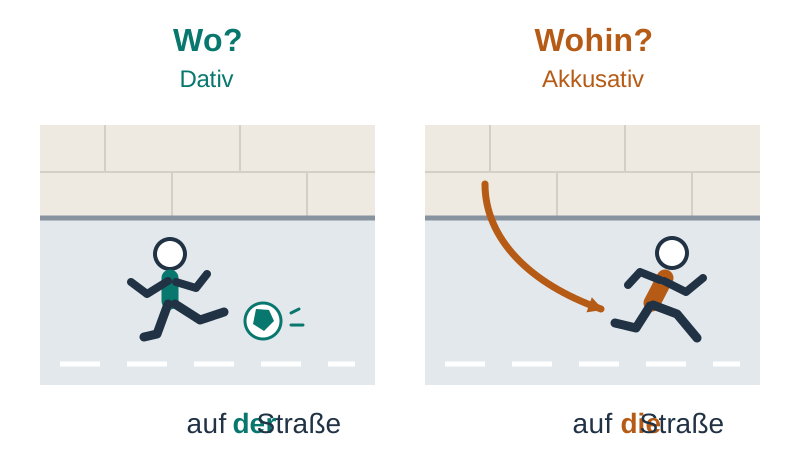
When placing people and items, apply Wechselpräpositionen (an, auf, hinter, in, neben, über, unter, vor, zwischen):
- Static Location (Dative): Das Kind spielt auf der Straße. (The child is playing on the road.)
- Directional Movement (Accusative): Das Kind läuft auf die Straße. (The child runs out onto the road.)
Relating Past Events: Tense Choice and the Satzklammer
Once the scene is established, move into your past narration. You have two valid systems for past storytelling:
- Präteritum (Simple Past): Best suited to third-person narratives and formal storytelling (ging, sah, kam, rief, stand, verlor).
- Perfekt (Compound Past): The natural choice for first-person diary entries or letters to friends (ich bin gefahren, ich habe gehört).
Choose one main past tense and stay with it. Drifting back and forth between er ging and er ist gegangen in the same paragraph reads as carelessness. Whichever system you choose, four verb groups almost always stay in the Präteritum:
- sein -> war (not ist gewesen): Ich war total schockiert.
- haben -> hatte (not hat gehabt): Er hatte keine Ahnung.
- Modal verbs -> konnte, musste, wollte, durfte, sollte: Wir konnten nichts tun.
- es gibt -> es gab (not es hat gegeben).
Additionally, a subordinate als-clause commonly keeps the Präteritum (als ich herauskam) even in a Perfekt narrative.
The Sentence Bracket (Die Satzklammer)
In main clauses using compound tenses or modal verbs, the conjugated auxiliary or modal sits in position 2, while the past participle, infinitive, or separable prefix is locked at the end of the clause:
- Der Polizist hat den Dieb sofort verhaftet. (hat in position 2; participle verhaftet at the very end).
- Lukas musste sein kaputtes Fahrrad nach Hause schieben. (musste in position 2; infinitive schieben at the very end).
Word Order Inside the Middle Field: Time – Manner – Place (TeKaMoLo)
When adding multiple details after the verb, arrange them in order: when -> how -> where.
- Er fuhr gestern (time) mit dem Rad (manner) in die Stadt (place).
If you pull the time expression to position 1 for variety, the verb still comes second: Gestern fuhr er mit dem Rad in die Stadt.
Word Order, Conjunctions, and the Plusquamperfekt
To connect your sentences smoothly, use connectors from three grammatical groups:
Group 1: Coordinating Conjunctions (Position 0)
These connect clauses without altering normal subject-verb order (und, aber, denn, oder, sondern):
- Er suchte seine Tasche, aber er fand sie nicht. (He looked for his bag, but he did not find it.)
Group 2: Adverbs Requiring Inversion (Position 1)
When an adverb opens a clause, the finite verb stays in position 2, pulling the subject into position 3:
- Connectors: dann, danach, plötzlich, schließlich, deshalb, trotzdem, in diesem Moment.
- Correct: Plötzlich hörte der Vater einen lauten Schrei. (Suddenly the father heard a loud cry.)
- Incorrect: Plötzlich der Vater hörte ...
Group 3: Subordinating Conjunctions (Verb-Final)
Subordinating conjunctions push the conjugated verb to the very end of the clause (weil, da, obwohl, während, dass, als):
- Während die Mutter kochte, sah das Kind fern. (While the mother cooked, the child watched television.)
Single Past Events: als vs. wenn vs. wann
- als: Use exclusively for a single, completed event or specific point in the past: Als der Zug ankam, stieg sie aus. (When the train arrived, she got off.)
- wenn: In past contexts, use only for repeated, habitual events ('whenever'): Immer wenn es regnete, nahm er den Bus. (Whenever it rained, he took the bus.)
- wann: Use only for direct or indirect questions about time: Ich weiß nicht, wann er kommt.
The Sequence Rule with 'nachdem'
The conjunction nachdem (after) introduces an action that took place prior to the main storyline. In past-tense storytelling, pair nachdem with the Plusquamperfekt (hatte/war + participle), followed by a main clause in the Präteritum:
Pattern: Nachdem + subject + ... + hatte/war + past participle, verb in Präteritum + subject ...
- Nachdem er das Fahrrad abgeschlossen hatte, ging er ins Geschäft. (After he had locked the bicycle, he went into the shop.)
Adjective Endings in Front of a Noun
Picture descriptions demand precise descriptive language (ein aufgeregter Junge, das kaputte Fahrrad, mit großen Augen). An adjective takes an ending only when it stands directly before a noun. Compare Der Junge ist müde (no ending) with der müde Junge (ending applied).
- After definite articles (der, die, das, dieser, jeder):
- Add -e in nominative singular, and in accusative feminine/neuter.
- Add -en in all other cases (all datives, all genitives, masculine accusative, and all plurals).
- Example: der kleine Junge -> den kleinen Jungen -> mit dem kleinen Jungen.
- After indefinite articles (ein, kein, mein, sein, ihr):
- Follows the same pattern as above, except masculine nominative takes -er (ein alter Mann) and neuter nominative/accusative takes -es (ein kleines Kind), because ein does not show gender on its own.
- Accusative masculine and all datives take -en: einen kleinen Jungen, mit einem kleinen Kind.
- Unpreceded adjectives (no article, common in plural):
- The adjective takes the ending the definite article would normally carry: kalter Wind (masc. nom.), frische Luft (fem. nom.), mit großen Augen (dative plural -en).
The Vorgangspassiv and Reporting Incidents
Picture prompts frequently illustrate incidents such as accidents, thefts, or breakdowns, where the perpetrator is unknown or the event itself is the focus. The German process passive (Vorgangspassiv) is the natural grammatical tool here.
Passive Tenses in Incident Accounts
- Präteritum Passiv: wurde / wurden + Partizip II
- Das Fenster wurde gestern Nacht eingeschlagen. (The window was smashed last night.)
- Der Verletzte wurde sofort ins Krankenhaus gebracht. (The injured person was brought to hospital immediately.)
- Perfekt Passiv: ist / sind + Partizip II + worden (always worden, never geworden):
- Das Fahrrad ist gestohlen worden. (The bicycle has been stolen.)
One or two passive sentences in an accident or theft story show the examiner that you can control varied syntax. Two are plenty; a whole paragraph written in the passive sounds unnatural.
Character Reactions, Emotions, and Register
Top scripts do more than list physical actions: they explore what the characters were thinking and feeling. Using idiomatic expressions lifts your writing above basic phrasing.
Expressing Emotional States
- Relief: Ein Stein fiel ihr vom Herzen. (A weight was lifted off her mind / she was hugely relieved.)
- Shock: Er erstarrte vor Schreck. (He froze in fright.) / Sie war zu Tode erschrocken. (She was scared to death.)
- Disbelief: Sie traute ihren eigenen Augen nicht. (She couldn't believe her own eyes.)
- Frustration: Er ärgerte sich maßlos über die Verspätung. (He was immensely annoyed about the delay.)
Dative Impersonal Verbs
Take care with verbs where the person experiencing the feeling is placed in the dative case:
- Es tat ihm schrecklich leid. (He was terribly sorry.)
- Die Situation gefiel ihr überhaupt nicht. (She did not like the situation at all.)
- Es gelang ihnen, das Problem zu lösen. (They succeeded in solving the problem.)
Fixed Prepositions with da-Compounds
When a prepositional verb introduces an infinitive clause, insert a da- compound:
- warten auf (+ Akk.): Er wartete darauf, dass die Polizei endlich kam. (He waited for the police to come at last.)
- sich freuen auf (+ Akk.): Sie freute sich darauf, ihre Freunde zu treffen. (She was looking forward to meeting her friends.)
- Note: with hoffen, drop the da-compound before a dass clause: Er hoffte, dass die Polizei das Rad finden würde.
Punctuation and Direct Speech
- Commas are compulsory before subordinators (dass, weil, als, obwohl, nachdem, damit) and relative pronouns: Ich wusste, dass er Recht hatte.
- Use a comma before um ... zu whenever the phrase includes extra information: Er ging in die Stadt, um ein Geschenk zu kaufen.
- Direct speech in German uses low opening marks and high closing marks: Er sagte: „Können Sie mir helfen?“
- Reporting verbs after speech invert: „Das ist mein Rad“, rief er.
Thematic Commentary, Comparisons, and Konjunktiv II
In your concluding section, broaden the response to address the wider theme.
Stating an Opinion
- Meiner Meinung nach ist dieses Problem heute sehr weit verbreitet. (In my opinion, this problem is widespread today. Remember: verb is second after Meiner Meinung nach!)
- Ich bin der festen Ansicht, dass Jugendliche zu viel Zeit online verbringen. (I am of the firm view that young people spend too much time online.)
- Einerseits bietet Technologie viele Vorteile, andererseits führt sie zu Einsamkeit. (On the one hand ... on the other hand ...)
Comparing with Ireland
Make comparisons only where they fit the prompt naturally. Connecting school pressure to the Leaving Certificate works well (In Irland stehen Schüler im Leaving-Cert-Jahr unter ähnlichem Leistungsdruck), whereas inserting that sentence into a road-accident story looks like a memorised filler.
Speculating with Konjunktiv II
Use wäre (would be), hätte (would have), or würde + Infinitiv to propose hypothetical solutions:
- Wenn ich in dieser Situation wäre, würde ich sofort die Polizei anrufen. (If I were in this situation, I would call the police immediately.)
Purpose Clauses: 'um ... zu' vs. 'damit'
- Use um ... zu + Infinitiv when the subject of both clauses is identical: Er sparte Geld, um sich ein neues Handy zu kaufen.
- Use damit + Nebensatz when the subjects differ, pairing with a modal verb for natural expression: Die Mutter schaltete das WLAN aus, damit die Kinder wieder miteinander reden konnten. (The mother turned off the wifi so that the children could talk to each other again.)
Key terms
- Schriftliche Produktion
- The written production section of the Leaving Certificate German examination, carrying 25% of Higher Level marks (100 marks total).
- Die Satzklammer
- The 'sentence bracket' in German syntax, where the conjugated auxiliary or modal verb stands in position 2 and non-finite verbal parts (participle, infinitive, prefix) sit at the absolute end of the clause.
- Das Präteritum
- The simple past tense (e.g. ging, sah, kam), standardly used for third-person continuous written narratives and storytelling.
- Das Perfekt
- The compound past tense formed with haben or sein plus Partizip II, standardly used when recounting personal events in informal letters and diary entries.
- Das Plusquamperfekt
- The past perfect tense formed with hatte or war plus a past participle, required in subordinate clauses introduced by nachdem to denote an action completed before the main narrative.
- Das Vorgangspassiv
- The process passive voice, formed with werden plus Partizip II, used to report accidents, thefts, and incidents where the action matters more than the actor.
- Wechselpräpositionen
- Two-way prepositions (an, auf, hinter, in, neben, über, unter, vor, zwischen) that govern the dative for stationary location (Wo?) and the accusative for directional motion (Wohin?).
- Konjunktiv II
- The subjunctive/conditional mood (e.g. wäre, hätte, würde + Infinitiv) used to express polite requests, unreal conditions, and hypothetical reflections.
- Bildergeschichte
- A picture story told across a sequence of visual frames, requiring orderly narrative linking from first frame to final resolution.
- TeKaMoLo
- The rule for word order inside the middle field of a German clause: Temporal (time), Kausal (reason), Modal (manner), Lokal (place).
Check yourself
If your picture task asks you to write a diary entry, what are the standard opening two lines?
A date on the top left followed by the greeting: 'Freitag, den 12. Juni' and 'Liebes Tagebuch,' (with the text beginning on the next line with a small letter).
Fill in the correct adjective endings: 'Ein __ (aufgeregt) Junge stand vor dem __ (groß) Kaufhaus.'
'Ein aufgeregter Junge' (masculine nominative after ein takes -er) 'stand vor dem großen Kaufhaus' (neuter dative after dem takes -en).
Correct the word order: 'Plötzlich der Mann bemerkte, dass sein Koffer weg war.'
'Plötzlich bemerkte der Mann, dass sein Koffer weg war.' Because 'Plötzlich' occupies position 1, the conjugated verb 'bemerkte' must take position 2.
Which conjunction ('als', 'wenn', or 'wann') is required: '______ Lukas die Haustür aufschloss, hörte er ein Geräusch.'?
'Als', because it introduces a single, specific past event.
Complete the clause: 'Nachdem sie ihre Hausaufgaben ______ (machen), ging sie in die Stadt.'
'gemacht hatte'. The conjunction 'nachdem' in past storytelling requires the Plusquamperfekt (hatte/war + past participle) with the auxiliary at the end.
Rewrite this sentence into the Präteritum Passiv: 'Die Polizei fand das Fahrrad.'
'Das Fahrrad wurde (von der Polizei) gefunden.' (Using wurde + Partizip II).
Why is the sentence 'Es gefällt sie' grammatically incorrect?
The verb 'gefallen' takes an indirect object in the dative case for the person experiencing pleasure; the correct German is 'Es gefällt ihr' (or 'Es gefällt ihm').