

In the Leaving Certificate Higher Level German examination, Listening Comprehension (Hörverstehen) accounts for 20% of the total marks. The dialogue section tests your ability to overhear authentic conversations between native speakers and accurately transfer meaning into English or Irish. Success depends on catching concrete details like times, dates, prices, and spelled-out names, recognising how separable verbs and small limiting words alter meaning at the end of a sentence, following shifts from formal to informal register, and identifying agreed compromises when plans change.
Anatomy of the Dialogue Task and Exam Strategy
Dialogue questions present everyday conversations set in real-life contexts: friends organising weekend outings, colleagues sorting out workplace appointments, customers making enquiries or complaints in shops and stations, or an exchange student meeting a host family. Questions are printed in English (or Irish), and your answers must be written in English or Irish.
Marks are given for getting the meaning across, not for polished English. At Higher Level the recordings and questions make greater demands on you, requiring finer detail, faster speech processing, and accurate inference.
The recording is played over the exam centre's sound system. You cannot pause it or ask for an extra play, so the printed instructions and the announcer's words at the start of each section telling you how many times it will be played and where the pauses come are your timetable for the whole task. Manage the process deliberately across the listening phases:
Silent reading window
Read the questions actively before the audio begins. Underline interrogative prompts such as Wann (when), Wo (where), Warum (why), Wer (who), Wie lange (how long), or Wie viel (how much). This tells you immediately whether you are hunting for a duration, a location, an explanation, or a person.
First listening
Get the big picture first. Identify who is speaking, their relationship, and the central problem. Jot down raw figures, names, or places in rough notes as you hear them.
Second listening and pauses
Check whether initial suggestions were modified or rejected, confirm the final compromise, and write your answer clearly on the lines provided.
Answer booklet rules
- Give exactly the number of details asked for. If a question asks for two reasons, write two distinct points on separate lines.
- Note form is completely acceptable. A short phrase like flight delayed 2 hours secures full marks.
- Never leave a blank space. Use the context and any German word you recognised to make an educated attempt.
- Never hedge by offering two contradictory choices like either Tuesday or Thursday. Commit to the decision the speakers settled on.
Numbers, Clock Times, Dates, Prices, and Spelling
Factual questions frequently target numerical details and spelling. Careless mechanical slips here cost easy marks.
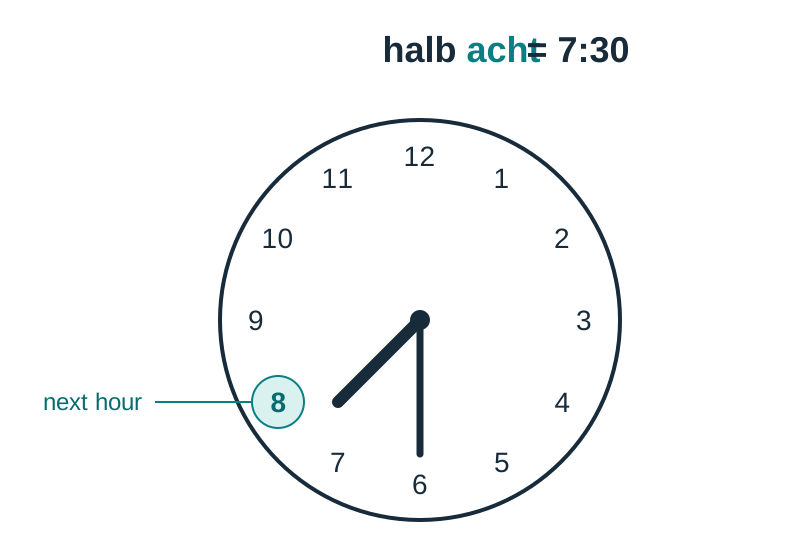
The halb trap
In German, halb always means thirty minutes before the named hour (halfway towards that hour). Halb acht is 7:30, never 8:30. Similarly, halb drei is 2:30, and halb zwölf is 11:30. For quarter hours, Viertel nach sieben is 7:15, Viertel vor acht is 7:45, and zehn vor halb acht is 7:20 (ten minutes before 7:30).
Two-digit number inversion
German pronounces the unit digit before the tens digit with und. Fünfundzwanzig is 25 (five-and-twenty), whereas zweiundfünfzig is 52. When you hear prices or ages like siebenundvierzig, write 47 immediately, not 74.
Dates, ordinals, and years
- Ordinal numbers take a -ten ending in dates: am ersten Mai (1 May), am dritten Juli (3 July), am fünfzehnten August (15 August), am einunddreißigsten Oktober (31 October).
- Years up to 1999 are read in hundreds: neunzehnhundertachtundneunzig (1998). Years from 2000 onward are read as thousands: zweitausendsechsundzwanzig (2026).
- On recordings, speakers often say zwo instead of zwei so that it is not misheard as drei. Pay close attention to the final consonant of the month: Juni ends with an -n sound, whereas Juli ends with an -l sound.
24-hour clock and prices
Official announcements and transport timetables rely on the 24-hour clock: sechzehn Uhr fünfundvierzig is 16:45; zwanzig Uhr dreißig is 20:30. In prices, the word Komma marks decimals: zwölf Euro fünfzig is €12.50, and drei Komma fünf Prozent is 3.5%. Note that anderthalb or eineinhalb Stunden means 1.5 hours (an hour and a half), while ein halbes Jahr means six months.
Spelling of names and telephone numbers
When names or addresses are spelled out (Ich buchstabiere:), native speakers use German alphabet sounds that catch out unprepared listeners:
- Vowels: A (ah), E (ay), I (ee), O (oh), U (oo).
- Tricky consonants: C (tsay), G (gay), H (haa), J (yot), V (fau), W (vay), Y (üpsilon), Z (tset).
- Special characters: ä (a-Umlaut), ö (o-Umlaut), ü (u-Umlaut), ß (Eszett or scharfes S). A speaker saying Doppel-t means double t, and großes M indicates a capital M.
- Telephone numbers: die Vorwahl is the area code, and null is zero. Digits are read individually or in pairs. For example, null-eins-sieben-eins, vierundzwanzig, neunundsechzig gives the number 0171 24 69.
Small Words and Separable Verb Traps
The single most common reason candidates lose marks on dialogue details is writing an answer before the clause has finished. In German, the prefix of a separable verb jumps to the very end of the clause, and that prefix determines the actual event.
Wait for the end of the sentence
- Die Fahrstunde fällt heute aus. – The driving lesson is cancelled. The verb fallen means to fall, but ausfallen means to be cancelled or called off.
- Ich sage den Termin ab. – I am cancelling the appointment. Compare absagen (to cancel) with zusagen (to accept/confirm).
- Wir verschieben das Treffen auf Freitag. – We are postponing the meeting to Friday. Verschieben means to postpone or reschedule.
- Ich rufe dich später an. – I will ring you later (anrufen).
- Ich hole dich um sieben ab. – I will collect you at seven (abholen).
- In Köln müssen Sie umsteigen. – In Cologne you have to change trains (umsteigen).
- Der Film fängt um acht an. – The film starts at eight (anfangen).
Small words that reverse or restrict meaning
Questions asking Why? or When exactly? frequently hinge on short qualifying words that students overlook:
- erst = not until / only (for time): Ich komme erst um neun means I am not arriving until 9:00, not that I am arriving early.
- nur = only (for amounts or quantities): Das Ticket kostet nur zehn Euro (It only costs ten euros).
- noch nicht = not yet; nicht mehr = no longer (Sie wohnt nicht mehr in Bonn – She no longer lives in Bonn).
- kein... sondern = not... but rather (Keine Pizza, sondern einen Salat – Not pizza, but rather a salad).
- fast / ungefähr / gegen = almost / about / around (Wir treffen uns gegen acht – around eight o'clock).
- mindestens = at least; höchstens = at most.
- Conditional forms signal that something is unreal or not taking place. Wenn ich Zeit hätte, würde ich mitkommen means the speaker has no time and is not coming. Contrast this with Wenn ich Zeit habe, komme ich mit, which describes a genuine possibility.
Topic Vocabulary for Everyday Dialogue Settings
Listening marks reward the extraction of concrete facts, and factual information is carried in nouns and verbs. Dialogues are set in familiar daily situations with recurrent vocabulary clusters:
Health and mishaps
- sich erkälten – to catch a cold
- Halsschmerzen – sore throat
- der Termin – appointment
- die Sprechstunde – surgery hours
- die Apotheke – pharmacy / chemist
- das Rezept – medical prescription
- sich das Bein brechen – to break one's leg
Shopping and customer service
- anprobieren – to try on clothes
- umtauschen – to exchange an item
- die Größe – clothing or shoe size
- die Kasse – checkout / till
- die Rechnung – bill / receipt
- im Angebot – on special offer
- kaputt – broken / out of order
Travel and transport
- der Bahnsteig / das Gleis – railway platform
- die Verspätung – delay
- die Hin- und Rückfahrt – return journey / round trip
- die Haltestelle – bus or tram stop
- das Fundbüro – lost property office
School, study, and work
- der Stundenplan – school timetable
- die Klassenarbeit – written classroom test
- das Praktikum – work experience / internship
- die Ausbildung / die Lehre – apprenticeship / vocational training
- der Ferienjob – holiday job / summer job
- die Bewerbung – job application
Family and personal circumstances
- die Zwillinge – twins
- der Neffe / die Nichte – nephew / niece
- die Enkelin – granddaughter
- geschieden – divorced
- alleinerziehend – single-parent
- berufstätig – employed / working
Register and Conversation Management
German grammar distinguishes strictly between informal and formal modes of address. Recognising the register tells you immediately who is talking and what their relationship is.
Informal register (du-Form / ihr-Form)
Used between friends, family members, teenagers, and school peers. You will hear familiar greetings like Hallo! or Na, wie geht's?, direct invitations like Hast du Lust...?, and casual exclamations like Spinnst du? (Are you crazy?).
Formal register (Sie-Form)
Used with adult strangers, officials, employers, hotel staff, and shopkeepers. Grammatical markers include capitalised Sie, third-person plural verbs, and formal phrases: Guten Tag, Könnten Sie das bitte wiederholen?, or Darf ich Sie einen Augenblick stören? (May I trouble you for a moment?).
Register shifts
Listen for the phrase Wollen wir uns duzen? (Shall we use du with each other?). This formal-to-informal shift indicates that the speakers are dropping formal distance and moving to a first-name, friendlier footing.
Spoken formulas for managing interactions
- Polite opening: Entschuldigung, darf ich kurz stören? (Excuse me, may I interrupt for a moment?)
- Clarification request: Wie bitte? Könnten Sie das bitte erklären? (Pardon? Could you explain that, please?)
- Partial comprehension: Ich habe Sie nicht ganz verstanden (I didn't quite understand you).
- Confirmation: Ach so, jetzt verstehe ich! (Oh I see, now I understand!) or Alles klar (All clear / Understood).
- Social well-wishes: Gute Besserung! (Get well soon!) or Viel Erfolg! (Best of luck / Much success!)
- Parting formula: Ich muss jetzt leider los. Bis bald! (I have to rush off now, unfortunately. See you soon!)
Tracking Changed Plans, Obstacles, and Distractors
In everyday conversation, the first proposal mentioned is rarely the final outcome. Native dialogues are constructed around proposals, counter-arguments, and compromises. Details mentioned early on that get cancelled or altered are distractors designed to penalise candidates who write an answer too quickly.
Follow the conversational exchange through its predictable stages:
1. Initial suggestion
One speaker puts forward a time, venue, or activity: Treffen wir uns am Samstag um sieben vor dem Kino? (Shall we meet on Saturday at seven outside the cinema?).
2. Rejection or obstacle
The other speaker points out a problem: Samstag geht leider gar nicht (Saturday unfortunately doesn't suit at all); Ich muss meiner Oma helfen (I have to help my grandmother); Mein Auto ist kaputt (My car is broken).
3. Counter-proposal
An alternative is introduced using preference phrases: Wie wäre es mit...? (How about...?); Eigentlich wäre mir Sonntag lieber (Actually, Sunday would suit me better); Wir könnten stattdessen... (We could instead...).
4. Overruling a negative statement
If speaker A asks a question containing a negative (Kommst du heute nicht mit? – Are you not coming along today?), and speaker B replies Doch!, that doch contradicts the negative assumption and means Yes, I am coming!.
5. Final agreement
Do not commit your answer to paper until you hear a closure phrase confirming agreement: abgemacht (it's a deal / agreed), einverstanden (agreed), or Also gut, dann machen wir das so (All right then, let's do that).
Interpreting Tone, Attitudes, and Modal Particles
Some questions do not ask what happened, but rather how a speaker feels about an event: enthusiastic, sceptical, disappointed, relieved, or annoyed. You work this out from the words chosen and the tone of voice.
Conversational modal particles (Abtönungspartikeln)
These untranslatable short words colour the speaker's attitude:
- denn softens a question to make it sound friendly rather than demanding: Was ist denn los? (What's wrong, then?).
- doch mal turns a blunt imperative into an encouraging invitation: Komm! sounds abrupt, but Komm doch mal mit! sounds warm and persuasive.
- ja indicates that a fact is already known or self-evident, sometimes carrying mild defensiveness: Das weiß ich ja (I know that already, obviously).
- wohl signals probability or sceptical concession: Das ist wohl möglich, aber... (That is probably possible, but...).
Expressing emotion and attitude
- Pleasure and relief: Ein Glück! (What a stroke of luck!), Gott sei Dank! (Thank goodness!), Das freut mich (I am delighted by that).
- Disappointment and annoyance: Wie schade! (What a pity!), So ein Mist! or So ein Pech! (What a nuisance! / What bad luck!), Das darf doch nicht wahr sein! (That can't possibly be true!).
- Scepticism: Ja, meinst du? (Do you really think so?), Das wundert mich (That surprises me).
- Indifference: Das ist mir egal or Das ist mir völlig Wurst (I don't care / it's all the same to me).
Sarcasm alert
On audio recordings, a speaker saying Na toll! or Super! with a flat, falling intonation after hearing unwelcome news is expressing annoyance or frustration, not genuine joy. In a transcript, sarcasm is proven by checking the context: if the phrase follows a problem or complaint, it means the opposite of its literal definition.
Messages, Answering Machines, and Reported Speech
Dialogue tasks often test your ability to take a phone message, understand a voicemail recording, or relay information from a third party. You need to distinguish between what the speaker personally did and what they are reporting on behalf of someone else.
Reporting verbs
Watch for verbs introducing second-hand information: ausrichten (to pass on a message), mitteilen (to inform), behaupten (to claim), zugeben (to admit), and hinterlassen (to leave behind a message).
Reported speech forms
Native speakers often use the subjunctive sei (the Konjunktiv I form of sein) when relaying someone else's statement: Er sagte, er sei krank (He said that he was ill), or Sie meinte, die Veranstaltung falle aus (She said the event was cancelled). In everyday conversational speech, you will also hear standard clauses introduced by dass or direct inversion: Sie hat gesagt, dass der Zug Verspätung hat* (She said that the train is delayed).
Urgency indicators
Voicemail messages frequently specify deadlines. Note the exact adverb used:
- dringend = urgently
- sofort / gleich = immediately / straight away
- umgehend = without delay / promptly
- spätestens = at the latest (spätestens morgen früh = by tomorrow morning at the latest)
- heute noch = before the day is out
Necessity versus intention
Keep modal verbs strictly separated in your notes: Ich will means I want to (intention), Ich soll means I am supposed to or someone told me to (instruction), and Ich muss means I have to (obligation).
Key terms
- halb (Uhrzeit)
- A German clock time expression meaning thirty minutes before the named hour (e.g., halb acht is 7:30, not 8:30).
- ausfallen
- A separable verb meaning to be cancelled or not take place (e.g., 'Die Stunde fällt aus' – the class is cancelled).
- verschieben
- A verb meaning to postpone or reschedule an appointment to another date or time.
- erst
- A limiting time adverb meaning 'not until' or 'only at' (e.g., 'Er kommt erst um acht' – He is not coming until eight).
- die Verspätung
- A transport or arrival delay (e.g., 'zehn Minuten Verspätung' – a ten-minute delay).
- die Absage
- A formal or informal cancellation or refusal of an appointment, invitation, or booking.
- die Zusage
- An acceptance or confirmation of an invitation, job offer, or arrangement.
- duzen
- To address someone informally using 'du' and first names, contrasted with the formal 'siezen'.
- die Abtönungspartikel
- A conversational modal particle (such as denn, doch, mal, ja, or wohl) that shades spoken tone to show friendliness, urgency, or scepticism.
- umgehend
- An adverb meaning promptly, immediately, or without delay.
- spätestens
- An adverb meaning at the latest (e.g., 'spätestens am Freitag' – Friday at the latest).
- die Vorwahl
- The telephone area or dialing code spoken before the local subscriber number.
Check yourself
What digital clock time is meant by 'halb elf'?
10:30 (half an hour before eleven).
If a speaker says 'Das Konzert fällt leider aus', what has happened to the concert?
The concert is cancelled.
Translate the sentence 'Der Bus kommt erst um Viertel nach zwei'.
The bus is not coming until 2:15 (a quarter past two).
What digital time and price should you record for 'fünfzehn Uhr fünfundvierzig' and 'achtzehn Euro fünfzig'?
15:45 (3:45 pm) and €18.50.
If someone asks 'Kommst du nicht mit?' and the other person replies 'Doch!', what does the reply mean?
It means 'Yes, I am coming along!' ('Doch' reverses the negative question).
What change in social relationship is signalled by the question 'Wollen wir uns duzen?'?
The speakers are switching from the formal mode of address ('Sie') to the informal mode ('du'), adopting a friendlier, first-name footing.
What does a speaker mean when they exclaim 'So ein Mist!'?
They are expressing annoyance or frustration ('What a nuisance!' or 'What bad luck!').
What figures correspond to this spoken list: 'am zweiundzwanzigsten März, zweitausendfünfundzwanzig, anderthalb Stunden'?
22 March, 2025, 1.5 hours (or 1½ hours).