

In Role Play 5 ('Problem mit Touristen'), you play an Irish tour guide meeting a coach party of German-speaking tourists at the airport. You have arrived late due to a motorway traffic jam, the Irish weather is typically wet, and one particular tourist—played by your oral examiner—is frustrated and complaining. The oral examination accounts for 25% of your total Leaving Certificate Higher Level German mark and lasts approximately fifteen minutes. It consists of three parts: general conversation, a project or picture sequence, and a role-play situation. Role-play situations are issued in advance through your school. You must prepare every situation on the prescribed list, as you cannot choose which one you receive on exam day. In this scenario, marks reward completing every task printed on your card so that meaning is clearly transferred, alongside your grammatical accuracy, vocabulary range, and pronunciation. To score at the highest standard, you need to stay with the formal Sie the whole way through, give two reasons wherever the card asks for two, and calm the tourist down the way a professional guide would.
Format, Register Control, and Pronunciation
The oral examination contributes 25% of your overall Higher Level mark and lasts about fifteen minutes. The role play forms one of its three core components, alongside the general conversation and your choice of a picture sequence or project. The examiner assesses two main criteria: your ability to transfer meaning by completing every task on your card, and the accuracy and appropriateness of your German, including your vocabulary range, grammatical structures, and pronunciation.
Treat the numbered instructions on your prompt card as a strict checklist. If you skip a prompt or leave an instruction half-done, you forfeit marks immediately. Do not let one complaint turn into a long argument; answer it calmly, address the required point, and move on to the next task on the card, or you will run out of time before the final task.
Throughout this role play, you represent an Irish travel company speaking to paying clients whom you do not know personally. You must maintain an unwavering formal register from your opening greeting to your final departure:
Addressing the group and individual tourists
Always address the party collectively with meine Damen und Herren or Herzlich willkommen in Irland. When speaking to the complaining tourist, use the formal nominative Sie, the dative Ihnen, and the capitalised possessive Ihr / Ihre / Ihren. Never slip into the informal singular du or informal plural ihr.
Formal imperatives
To give polite instructions, use the formal Sie form of the verb, place it first, and always keep Sie in the sentence: Kommen Sie bitte mit (Please come along), Beruhigen Sie sich bitte (Please calm down), or Folgen Sie mir bitte (Please follow me). The irregular imperative form to remember is sein: Seien Sie bitte so gut … (Please be so good as to …), never Sind Sie so gut.
Phonetic accuracy under pressure
Phonetic accuracy forms a direct part of your assessment. Practise these sounds until they are second nature:
- Initial st- and sp-: When st or sp begins a word or syllable, pronounce it as 'sht' or 'shp': der Stau ('shtow'), stehen ('shtehen'), and die Verspätung ('fershpaytung').
- Soft palatal ch vs. Hard ch: Words like ich, nicht, and möchte require a soft hissed sound produced against the hard palate, never a hard English 'k' (ik). By contrast, nach and Bruch use the deeper throat sound.
- The Rounded ü and ö: For beruhigen, für, and schön, round your lips forward tightly into a circle while voicing 'ee' or 'eh'.
- Vowel combinations (ei vs. ie): Say the name of the second letter. Die Reise and der Reiseleiter use an 'eye' sound, whereas Sie and bieten use a long 'ee'.
Managing Conversation, Polite Suggestions, and Repair Strategies
A strong role play is a genuine interaction, not a recited monologue. Examiners deliberately interrupt or challenge you to see if you can manage the conversation in German.
If you do not catch what the tourist says
Never freeze and never switch into English. Buying time politely in German earns credit for conversation management under the syllabus:
- Wie bitte? Das habe ich leider nicht ganz verstanden. (Pardon? Unfortunately I did not quite catch that.)
- Könnten Sie das bitte wiederholen? (Could you please repeat that?)
- Könnten Sie das bitte etwas langsamer sagen? (Could you please say that a little more slowly?)
- Sie meinen also, dass das Hotel zu weit weg ist? (So you mean that the hotel is too far away?)
- Habe ich Sie richtig verstanden? Sie möchten ein anderes Zimmer? (Have I understood you correctly? You would like a different room?)
In these inversion questions, the conjugated verb takes first position, and the infinitive (wiederholen, erklären) sits at the very end after the modal könnten.
Suggesting solutions politely with Konjunktiv II
Using conditional forms elevates your tone from defensive to polished customer service:
- Ich würde Ihnen vorschlagen, zuerst ins Hotel zu fahren. (I would suggest to you that we drive to the hotel first.)
- Wie wäre es, wenn wir morgen etwas später abfahren? (How would it be if we set off a bit later tomorrow?)
- Wäre es möglich, Ihnen ein anderes Zimmer anzubieten? (Would it be possible to offer you a different room?)
- Dürfte ich Ihnen einen Vorschlag machen? (Might I make you a suggestion?)
The auxiliary würde, wäre, könnte, or dürfte occupies position two, while the infinitive clause sits at the end (zu fahren, anzubieten—note how zu slots inside the separable verb anbieten).
Asking the tourists questions
Role-play prompts often direct you to ask the tourist something. Have two patterns ready:
- Yes/No questions (verb first): Haben Sie Ihr Gepäck schon abgeholt? (Have you already collected your luggage?) or Möchten Sie noch etwas trinken? (Would you like something to drink?)
- W-questions (question word, then verb): Wie war Ihr Flug? (How was your flight?), Wann möchten Sie morgen abfahren? (When would you like to depart tomorrow?), or Wie viele Koffer fehlen? (How many bags are missing?)
- Useful group closers: Haben Sie noch Fragen? (Do you have any further questions?) and Sind alle mitgekommen? (Has everyone come along?)
The six-line fallback block
If you blank momentarily under exam nerves, deploy this rescue block to stay in character and in German:
- Entschuldigen Sie bitte. (Excuse me, please.)
- Es tut mir leid. (I am genuinely sorry.)
- Das kann ich gut verstehen. (I can well understand that.)
- Ich kümmere mich sofort darum. (I will look after it right away.)
- Wir finden bestimmt eine Lösung. (We will certainly find a solution.)
- Vielen Dank für Ihr Verständnis. (Thank you very much for your understanding.)
Tasks 1 and 2: Arrival, Inversion, and Delay Explanations
Task 1: Greeting, introduction, and the weather
Open warmly by introducing yourself to the entire party. A male guide says Ich bin Ihr Reiseleiter, while a female guide says Ich bin Ihre Reiseleiterin. Next, comment on the weather. Mention the rain, but shrug it off cheerfully as normal Irish weather: Leider ist das Wetter heute regnerisch und kühl, aber das ist bei uns ganz normal.
Word order: Inversion after sentence starters
In a German main clause, the conjugated verb is always the second idea. If you begin with anything other than the subject—such as heute, leider, deshalb, außerdem, or zuerst—the verb comes immediately next and the subject shifts behind it:
- Heute fahren wir direkt zum Hotel. (Today we drive straight to the hotel.)
- Leider ist das Wetter schlecht. (Unfortunately the weather is bad.)
- Deshalb konnte ich Sie nicht anrufen. (That is why I could not ring you.)
Task 2: Journey inquiry, delay explanation, and notification apology
Begin Task 2 by inquiring about their journey: Wie war Ihre Reise? or Wie war Ihr Flug?
Expect the examiner, in the role of the tourist, to interrupt with a complaint at some point here—most often about having been left waiting at the terminal. Whatever the exact complaint, your reply needs three specific moves:
- A sincere apology: Use Es tut mir leid, dass Sie warten mussten. Remember that leidtun takes the dative pronoun mir, never mich.
- A clear cause for the delay: Explain the traffic issue using der Stau: Es gab einen langen Stau auf der Autobahn, weil ein schwerer Unfall passiert war, und der Verkehr stand komplett still. If you mention your phone: Außerdem war mein Handy-Akku leer, deshalb konnte ich Sie leider nicht erreichen.
- Apologising for the communication breakdown: Use the perfect passive to acknowledge that the tourists were left without information: Ich entschuldige mich dafür, dass Sie nicht rechtzeitig informiert worden sind. In this subordinate dass-clause, the auxiliary verb sind goes to the very end.
Promising concrete remedies
After apologising, reassure the tourist by taking responsibility with the future tense (werden + infinitive) or the reflexive verb sich kümmern um (+ accusative):
- Ich kümmere mich sofort um Ihr Gepäck. (I will see to your luggage immediately.)
- Ich werde gleich mit dem Hotel telefonieren und alles klären. (I will ring the hotel right away and sort everything out.)
- Als Entschuldigung bekommen Sie heute Abend ein Getränk von uns. (By way of apology you will get a complimentary drink from us this evening.)
Tasks 3 and 4: Schedule Outline, Paired Reasons, and De-escalation
The two reasons reading skill
Read the instructions on your card like a marking scheme. If a task says give two reasons, nennen Sie zwei Gründe, or mention three things, the examiner is counting. Giving one reason when two are requested leaves the task incomplete. In this scenario, the prompts about your programme choice and about previous guests' satisfaction typically demand two distinct reasons. Rehearse them in linked pairs.
Task 3: Itinerary outline and programme defence
Lay out the schedule for the first two days using present-tense verbs with specific times: Heute fahren wir direkt zum Hotel in Galway, und um neunzehn Uhr gibt es Abendessen. Morgen besichtigen wir die berühmten Cliffs of Moher und die Burren-Region.
When the tourist criticises this itinerary as too exhausting or full of long coach journeys, defend your programme using erstens … zweitens … or two linked weil clauses:
- Wir haben dieses Programm gewählt, erstens weil die Fahrt dorthin nicht zu lang ist, und zweitens weil diese Orte die bekanntesten Sehenswürdigkeiten im ganzen Westen sind.
Remember the subordinate clause rule: after weil, the conjugated verb moves to the very end of each clause (lang ist, sind).
Task 4: The concede-then-counter technique
The tourist will continue to grumble about tour pricing, organisation, or hotel location. Do not argue aggressively or snap Das ist nicht meine Schuld. Apply professional customer-service etiquette: concede, then counter. Acknowledge their frustration first, state the tour's value, and supply two reasons why previous guests were delighted:
- Ich kann Sie gut verstehen, aber das gesamte Programm stand ausführlich in der Broschüre, und Sie haben einen günstigen Sonderpreis von nur sechshundert Euro bezahlt.
- Give two satisfaction reasons: Bisher waren alle unsere Gäste sehr zufrieden, weil unsere Partnerhotels erstklassig sind und weil unsere Reiseleiter alle aus der Region kommen und sich bestens auskennen.
Task 5: De-escalation, Schedules, and Departure
Task 5: Calming the tourist, amenities, and closing
Task 5 requires you to settle the tourist's irritation by mentioning three specific comfort factors—the hotel, relaxation, and dining—before bringing the exchange to a polite close.
- Calming down: Deliver the reflexive imperative: Beruhigen Sie sich bitte, ab jetzt kümmere ich mich um alles.
- Hotel and relaxation: Highlight amenities using the reflexive verb sich entspannen: Unser Hotel hat einen herrlichen Wellnessbereich, wo Sie sich wunderbar entspannen können.
- Food recommendation: Make a concrete local food suggestion: Im Restaurant serviert man ausgezeichneten frischen Fisch und traditionelles irisches Lammfleisch.
- Courteous closing: Reassure them (Ich bin sicher, dass Ihnen die Reise trotzdem gut gefallen wird), thank them for their patience (Vielen Dank für Ihr Verständnis), and invite them to board: Kommen Sie bitte mit, unser Reisebus wartet bereits vor der Tür or Wenn Sie mir bitte folgen würden, unser Bus steht draußen.
Schedules and the half-hour time trap
German times and numbers frequently cause slips under exam pressure:
| Expression | German Phrasing | English Meaning |
|---|---|---|
| Exact Clock Time | um sieben Uhr / um neunzehn Uhr | at 7:00 / at 19:00 (7:00 pm) |
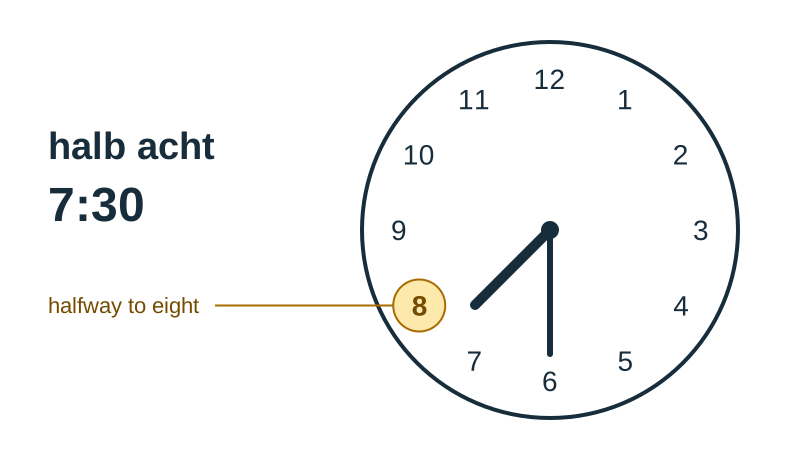
| The 'Half-Hour' Trap | um halb acht | at 7:30 (halfway to eight, not 8:30!) |
| Quarter past / to | Viertel nach acht / Viertel vor neun | 8:15 / 8:45 |
| Duration with dauern | Die Fahrt dauert etwa zwei Stunden. | The journey takes about two hours. |
| Tour Price | sechshundert Euro | 600 euro |
| Duration phrase | eine zweistündige Busfahrt | a two-hour coach journey |
In Irish English, 'half seven' means 7:30. In German, halb sieben is 6:30, and 7:30 is halb acht. If you worry about confusing these under nerves, use the unambiguous 24-hour clock: um neunzehn Uhr dreißig.
Link to the listening paper
The complaint-and-remedy vocabulary drilled in this role play (die Beschwerde, die Verspätung, sich beschweren, eine Lösung finden) appears regularly in the note-taking section of the Leaving Certificate German listening paper, where you must record a caller's name, problem, and outcome in German. Learning these words thoroughly serves two examination components at once.
Key terms
- der Reiseleiter / die Reiseleiterin
- The professional tour guide who accompanies and manages travel arrangements for a tour group.
- die Verspätung
- A delay or lateness in arrival or schedule.
- der Stau
- A traffic jam, especially on a motorway (die Autobahn) or main road.
- sich beschweren (über + Akk.)
- To complain formally or emphatically about a service, product, or inconvenience.
- sich entschuldigen (für + Akk.)
- To apologise for an error, misunderstanding, or inconvenience.
- sich beruhigen
- To calm down; used in customer service as the polite formal imperative 'Beruhigen Sie sich bitte'.
- die Sehenswürdigkeit
- A tourist attraction or place of cultural and historical interest.
- der Sonderpreis
- A discounted special promotional rate or package tour price.
- sich entspannen
- To relax or unwind; a reflexive verb requiring a matching reflexive pronoun (e.g. 'wo Sie sich entspannen können').
- das Verständnis
- Understanding or patience; used in the standard customer service closing formula 'Vielen Dank für Ihr Verständnis'.
- die Gepäckausgabe
- The baggage reclaim area at an airport or terminal.
- die Panne
- A mechanical breakdown or mishap during travel.
Check yourself
What proportion of your Leaving Certificate Higher Level German mark comes from the oral examination, and which three parts make up the oral?
The oral examination accounts for 25% of your total mark. It consists of three parts: general conversation, your choice of a project or picture sequence, and a role-play situation.
Say in German that you are very sorry the group had to wait, and give a traffic jam on the motorway as the reason.
Es tut mir wirklich leid, dass Sie warten mussten. Es gab einen langen Stau auf der Autobahn.
Ask the tourist politely, using an inversion question with 'könnten', to repeat what they said, and then confirm you have understood.
Könnten Sie das bitte wiederholen? … Ah, Sie meinen also, dass das Zimmer zu klein ist.
What time is 'um halb acht' in German, and how can you say it safely using the 24-hour clock?
'Um halb acht' means 7:30 (halfway to eight, or half past seven in Irish English). The safe 24-hour alternative is 'um neunzehn Uhr dreißig'.
Correct the word order in this sentence: 'Leider das Wetter ist heute regnerisch, weil der Bus hat eine Panne.'
'Leider ist das Wetter heute regnerisch, weil der Bus eine Panne hat.' (Invert verb and subject after 'Leider', and send the conjugated verb 'hat' to the end after 'weil').
Which three comfort factors should you mention in Task 5 to settle the tourist's irritation before inviting them to the coach?
You should highlight the hotel amenities (such as a wellness area), the opportunity to relax, and local food (such as fresh fish or Irish lamb).