

Picture Sequence 3 (Die Abi-Tour) is one of the picture sequences issued for the Leaving Certificate German oral examination. The oral examination accounts for 25% of your total marks at Higher Level and lasts approximately 15 minutes. It consists of three parts: general conversation, one choice between a project or a picture sequence, and a role-play. If you choose the picture sequence option, you must prepare every card in the current set, as one will be chosen at random on the day. The task itself unfolds in three phases: an uninterrupted narration of the six pictures, examiner questions exploring how the story continues and clarifying unresolved details, and a wider opinion discussion on related social themes like post-exam holiday culture, holiday preferences, and school completion traditions in Germany and Ireland. If you know the vocabulary of travel planning and voting, plus a handful of sequencing words, this card becomes one of the most predictable parts of the whole oral.
Oral Exam Format and Timing Strategy
The oral examination is worth 25% of your Higher Level grade and lasts about 15 minutes. It consists of a general conversation, followed by either a project or a picture sequence, and finishes with a role-play. You and your teacher choose between the project and picture sequence options ahead of time. If you opt for picture sequences, you must prepare all cards in the official set released by the State Examinations Commission (SEC), as one will be drawn at random on the day.
The Three Phases of the Task
Within the roughly four to five minutes allotted to the picture sequence, your assessment covers three distinct phases. Think of them as carrying roughly equal weight:
- Phase 1: Narration: You tell the story across all six pictures clearly and without interruption. Aim for roughly two sentences per picture (about twelve sentences in total), using simple, accurate German in the present tense (Präsens).
- Phase 2: Story Continuation and Clarification: The examiner asks how the story proceeds (Wie geht die Geschichte weiter?) and asks you to clarify details left open on the card (such as why a vote was needed or who counted the votes).
- Phase 3: Wider Discussion: The examiner broadens the topic into a conversation about school-leaving trips, travel preferences, budgeting, independence, and comparisons between Irish and German youth culture.
Managing Your Time: The Four-Minute Guideline
Spend roughly ninety seconds to two minutes delivering your narration. Do not sprint through it in forty seconds, but do not talk so long that the examiner must cut you off. In Phases 2 and 3, answer the examiner's prompts in two or three well-developed sentences rather than trying to launch another memorised monologue.
Register and Address
Listen carefully to how the examiner addresses you. Some examiners use the formal Sie (Wie sehen Sie das?), while others use du with school candidates (Wie siehst du das?). Mirror the register the examiner uses with you, and ensure you know both sets of phrasing. Never mix registers within the same conversation.
Frame-by-Frame Narrative Breakdown
The visual sequence follows a group of final-year secondary school pupils planning their celebratory school-leaving trip (die Abi-Tour). Quoting the German captions printed on the sheet gives you vocabulary you know is spelled and phrased correctly, but you should always integrate those words into full sentences of your own.
Bild 1 – Planning at Home
Five final-year pupils (die Abschlussklasse) meet in a living room. Three girls are sitting on the sofa and two boys are sitting in armchairs (die Sessel, singular der Sessel). On the coffee table are two open laptops, pizza slices, and soft drinks. The pupils are researching travel deals online.
Bild 2 – The Boys' Preference
A close-up of one laptop shows the website Abitours.de with the headline „Mallorca: Party und Strand am Ballermann“. The image shows sunbathers, a beach, and a palm tree. The boys prefer a lively beach break with sunshine and nightlife.
Bild 3 – The Girls' Preference
A close-up of the second laptop displays IrlandTipps.com featuring „Surfers Paradies Bundoran“. Surfers in wetsuits carry boards near the Atlantic waves. The girls are sporty and want an outdoor activity holiday (der Aktivurlaub).
Bild 4 – The Library Noticeboard
In the school library (die Schulbibliothek), a noticeboard announces: „Die Abi-Tour – Wohin? Information um 11.15“. Promotional posters for Mallorca and Ireland hang side by side on the wall, while pupils work at desktop computers.
Bild 5 – Heated Discussion at 11:15
At quarter past eleven, a large crowd of classmates gathers in the library. A loud, passionate argument breaks out under the two posters because the class cannot agree on a destination (sie können sich nicht einigen).
Bild 6 – The Democratic Ballot
To resolve the argument fairly, the class organises a democratic vote (die Abstimmung). Two ballot boxes (die Wahlurne, plural die Wahlurnen; often shortened to die Urne, plural die Urnen) stand ready, one labelled IRLAND and one MALLORCA. Pupils line up in a queue (Schlange stehen) to drop their voting slips (der Stimmzettel) into the boxes. Crucially, the outcome remains open.
Safety Net: If you forget the German word for a minor background object during your exam, do not freeze. Describe what you are certain of and move forward smoothly: Auf diesem Bild sieht man auch noch andere Details, aber das Wichtigste ist, dass die Schüler abstimmen.
Spatial and Picture-Description Phrases
Examiners frequently ask where particular characters or items are located (Wer sitzt links? Was steht auf dem Tisch?). Vary your sentence openings using accurate positional phrases rather than repeating Auf dem Bild:
- im Vordergrund – in the foreground
- im Hintergrund – in the background
- in der Mitte – in the middle
- links / rechts – on the left / on the right
- oben / unten – at the top / at the bottom
- auf dem Tisch / an der Wand / vor der Tür – on the table / on the wall / in front of the door
- daneben – next to it / beside it; dahinter – behind it
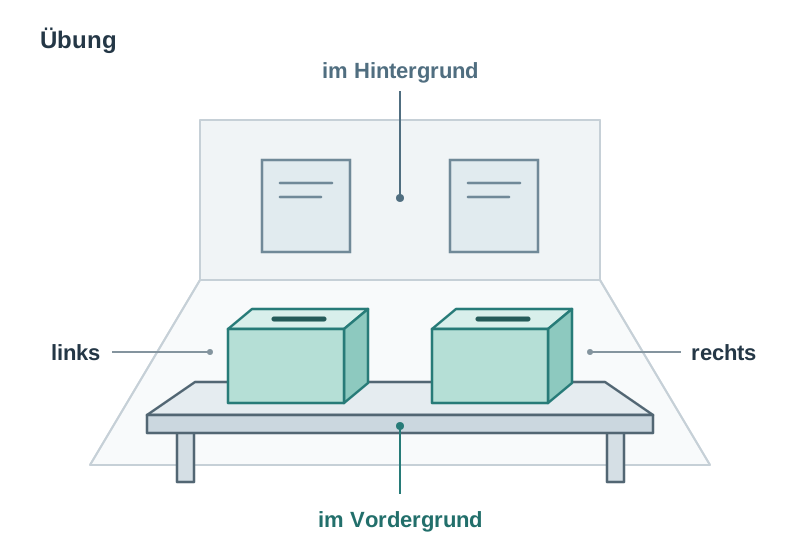
Notice that the verb remains in position 2 after these fronted phrases:
- Im Vordergrund stehen zwei Wahlurnen auf einem Tisch. (In the foreground two ballot boxes stand on a table.)
- Links sitzen drei Mädchen auf dem Sofa, rechts sitzen zwei Jungen in den Sesseln. (On the left three girls sit on the sofa, on the right two boys sit in the armchairs.)
- An der Wand hängen zwei Werbeplakate, und daneben steht ein Schild. (On the wall hang two promotional posters, and beside them stands a sign.)
Grammar: Word Order and Two-Way Prepositions
Accurate sentence construction is what distinguishes top-grade oral performances. Keeping your narration in the present tense keeps your delivery fluent and avoids irregular past participles.
Group 1: Coordinating Conjunctions (Position 0 – ADUSO)
Coordinating conjunctions connect two main clauses without moving the verb. Use the acronym ADUSO (Aber, Denn, Und, Sondern, Oder):
- Die Jungen wollen nach Spanien fliegen, denn sie möchten am Strand feiern. (The boys want to fly to Spain, for they want to celebrate on the beach.)
Group 2: Fronted Adverbs and Prepositional Phrases (Verb-Second Inversion)
When you open a sentence with a time phrase, location, or connector, the finite verb must stay in position 2, placing the subject directly after it:
- Auf dem ersten Bild sitzen die Schüler im Wohnzimmer. (In the first picture the pupils sit in the living room.)
- Danach suchen die Mädchen eine andere Webseite. (After that the girls look for a different website.)
- Um 11.15 Uhr versammelt sich die Klasse in der Bibliothek. (At 11:15 the class gathers in the library.)
Group 3: Subordinating Conjunctions (Verb-Final)
Subordinating conjunctions like weil (because), dass (that), obwohl (although), and wenn (if/when) send the conjugated verb to the end of the clause:
- Sie streiten, weil sie sich über das Reiseziel nicht einig sind. (They argue because they are not agreed on the travel destination.)
Compare this before-and-after pair to hear how these rules fix common word-order errors:
- Incorrect: Danach die Mädchen suchen eine andere Webseite, weil sie wollen surfen.
- Correct: Danach suchen die Mädchen eine andere Webseite, weil sie surfen wollen.
(Fix 1: finite verb 'suchen' takes second position after 'Danach'. Fix 2: conjugated modal 'wollen' moves to the end of the 'weil' clause).
Two-Way Prepositions: Position vs Movement
With prepositions of location (in, an, auf, unter, vor, hinter, neben, zwischen), the case depends entirely on whether you are describing static location or movement toward a destination:
- Position (Wo? / Where?) → Dative: Die Schüler sitzen im Wohnzimmer. (in dem = im) / Alle versammeln sich in der Bibliothek. / Das Plakat hängt an der Wand.
- Movement toward a destination (Wohin? / Where to?) → Accusative: Sie gehen in die Bibliothek. / Sie werfen den Stimmzettel in die Urne. / Er hängt das Plakat an die Wand.
Handling the Past: The Perfekt Tense
While you should deliver your main narration in the present tense, examiners routinely ask follow-up questions using the past tense (Was haben die Schüler zuerst gemacht? Warum haben sie gestritten?). You must be able to respond in the Perfekt.
The conversational past in German is formed with haben or sein in position 2 and the past participle (Partizip II) placed at the end of the clause. Most verbs take haben; verbs expressing movement from one place to another or a change of state take sein.
High-Frequency Verbs for This Picture Sequence
| Present Tense | Perfekt Form | English Meaning |
|---|---|---|
| sie planen | sie haben geplant | they planned |
| sie essen Pizza | sie haben Pizza gegessen | they ate pizza |
| sie diskutieren | sie haben diskutiert | they discussed / argued |
| sie gehen in die Bibliothek | sie sind in die Bibliothek gegangen | they went to the library |
| sie stimmen ab | sie haben abgestimmt | they voted |
| sie einigen sich | sie haben sich geeinigt | they agreed |
Safe Past-Tense Model Answers
- Zuerst haben die Schüler im Wohnzimmer Pizza gegessen und im Internet nach Angeboten gesucht. (First the pupils ate pizza in the living room and searched the internet for deals.)
- Sie haben gestritten, weil sich die Jungen und die Mädchen nicht einigen konnten. (They argued because the boys and the girls could not agree.)
Notice that in a subordinate clause with weil, the auxiliary or modal verb sits at the end: nicht einigen konnten.
Continuation and Clarification: werden and Passive
Because picture 6 stops at the ballot box without revealing who won, the examiner is almost certain to ask what happens next: Wie geht die Geschichte weiter? Keep that outcome in reserve—never announce a winner in Phase 1.
The Three Jobs of werden
Candidates frequently confuse the auxiliary verb werden across its different grammatical functions:
| Pattern | Function | Example | English |
|---|---|---|---|
| werden + Infinitive | Future active | Die Klasse wird buchen | The class will book |
| werden + Partizip II | Present passive | Die Stimmen werden gezählt | The votes are counted |
| werden + Noun/Adjective | Change of state | Er wird müde / Lehrer | He gets tired / becomes a teacher |
Projecting the Narrative: werden + Infinitive
When predicting the next steps, place conjugated werden in position 2 and the action infinitive at the end:
- Ich glaube, Mallorca wird die Wahl knapp gewinnen. (I believe Mallorca will narrowly win the vote.)
- Note: die Mehrheit (the majority) is a grammatically singular noun in German and takes a singular verb: Die Mehrheit wird für Mallorca stimmen (not werden).
Extend your answer with practical follow-up arrangements:
- Asking parents: Danach werden die Schüler ihre Eltern um Erlaubnis bitten.
- Group bookings: Die Klassensprecher werden die Flüge und die Unterkunft buchen.
- Budgeting: Viele Jugendliche werden einen Nebenjob suchen, um Geld zu sparen.
Explaining the Vote and Voting Procedures
Use the present passive to describe the mechanics of the ballot: Nach der Abstimmung werden die Stimmen von zwei Schülern gezählt. (After the vote, the ballots are counted by two students).
If asked why the vote was held: Es gibt eine Abstimmung, weil die Schüler sich nicht einigen können. Eine geheime Wahl ist die fairste Lösung, denn so entscheidet die Mehrheit.
Discussion, Opinions, and Examiner Pushback
In Phase 3, the conversation shifts to wider topics: post-exam trips, holiday styles, budgeting, and cultural traditions in Ireland and Germany.
Cultural Comparison: Abitur vs Leaving Certificate
In Germany, completing secondary school culminates in the Abitur (or Abi). Passing is marked not only by an Abi-Tour, but also by an Abi-Ball (a formal graduation evening attended by students, teachers, and parents) and the Abi-Streich (prank day). In Ireland, students traditionally travel abroad in late June or July, immediately after the Leaving Certificate, to decompress from the pressure of the CAO points system (das Punktesystem).
The Four-Step Answer Framework
Deliver well-rounded answers using this structured approach:
- State your view: Meiner Meinung nach ist so eine Reise eine tolle Belohnung...
- Give a reason: ... weil man nach dem großen Prüfungsstress endlich abschalten kann.
- Add an Irish comparison: In Irland fliegen viele Schüler im Juni nach Spanien, um das Ende der Schulzeit zu feiern.
- Provide balance: Einerseits lernt man Selbstständigkeit, andererseits geben manche Jugendliche zu viel Geld aus oder trinken zu viel Alkohol.
Responding to Examiner Counter-Arguments
Examiners often test your spoken resilience by offering counter-arguments (e.g. Aber sind solche Reisen ohne Eltern nicht viel zu gefährlich?). Do not give up your position; use concession and polite disagreement:
- Partly conceding: Das ist wohl möglich, aber... / Da haben Sie recht, trotzdem finde ich... (That may well be so, but... / You're right there, nevertheless I think...)
- Disagreeing politely: Das sehe ich etwas anders, denn... / Da bin ich nicht ganz Ihrer Meinung. (I see that a bit differently, because... / I don't entirely agree with your view.)
- Reinforcing your point: Ich bin davon überzeugt, dass... (I am convinced that... [verb to the end]).
- Offering a compromise: Am besten wäre ein Kompromiss: eine Woche Sport und Aktivitäten, und eine Woche Strand. (The best solution would be a compromise: one week of sport and activities, and one week of beach.)
Connecting to Your Own Plans
Have three sentences prepared for when the examiner turns the question on you (Und Sie? Was machen Sie nach den Prüfungen?):
- Nach den Prüfungen werde ich zwei Wochen mit meinen Freunden nach Portugal fliegen, um mich endlich zu erholen. (After the exams I will fly to Portugal for two weeks with my friends in order to finally recover.)
- Im Juli und August arbeite ich in einem Café, weil ich Geld für die Universität sparen muss. (In July and August I am working in a café because I have to save money for university.)
- Im September möchte ich in Galway studieren, wenn ich genug Punkte bekomme. (In September I would like to study in Galway if I get enough points.)
Spoken Delivery, Repair Strategies, and Pronunciation
Oral assessment rewards clarity, authentic sounds, and the ability to maintain communication when difficulties arise.
Repair Strategies: Stay in German
If you do not catch a question or lose a word, keep speaking German. Using authentic repair phrases protects your marks:
- Wie bitte? Könnten Sie die Frage bitte wiederholen? (Pardon? Could you repeat the question, please? – formal)
- Kannst du das bitte noch einmal sagen? (Can you say that once more, please? – informal)
- Könnten Sie das bitte etwas langsamer erklären? (Could you explain that a bit more slowly, please?)
- Das Wort weiß ich leider nicht auf Deutsch – ich meine das Papier, worauf man seine Stimme schreibt. (I'm afraid I don't know the word in German – I mean the paper on which you write your vote.)
- Wie sagt man „ballot box“ auf Deutsch? (How do you say 'ballot box' in German?)
- Use conversational fillers to buy thinking time: also..., na ja..., moment mal...
Pronunciation Essentials for Picture 3
- Initial st-: In words starting with st-, pronounce the letters as 'sht'. Practice der Strand (shtrant), die Abstimmung (ap-shtim-moong), and der Stimmzettel (shtim-tset-tel).
- Final b, d, g harden: At the end of a word or syllable, b, d, and g are pronounced crisp like p, t, and k. Der Strand ends in a sharp 't' sound, and der Urlaub ends in a crisp 'p'.
- Distinct Umlauts (ü vs ö):
- For ü (die Schüler, für): set your mouth to say 'ee', keep your tongue forward, and round your lips into a tight circle.
- For ö (können, hören): say the 'e' of 'bed' and round your lips forward.
- Neither sound is the English 'oo'.
- The Soft ch in das Mädchen: The ending -chen is a diminutive suffix and is always pronounced with the soft ich-sound (a light hiss produced with the tongue arched against the hard palate near the front of the mouth). The throaty ach-sound only follows a, o, u, au (das Buch, machen).
Key terms
- das Abitur (das Abi)
- The German secondary school leaving certificate examination, equivalent to the Irish Leaving Certificate.
- die Abi-Tour (die Abifahrt)
- The end-of-school celebratory trip organised by graduating German secondary school classes.
- die Abschlussklasse
- The final-year graduating class in a secondary school.
- sich einigen auf (+ akk.)
- To agree on or reach a consensus regarding a shared plan (e.g. Sie können sich nicht einigen).
- die Abstimmung
- The formal vote or ballot held to decide an issue democratically.
- die Wahlurne (die Urne)
- The ballot box into which voters cast their voting slips.
- der Stimmzettel
- The ballot paper or voting slip marked by an individual voter.
- die Mehrheit
- The majority. A collective noun that is grammatically singular and takes a singular verb (e.g. Die Mehrheit stimmt für Irland).
- Schlange stehen
- To stand in a queue or line up (e.g. Die Schüler stehen vor den Urnen Schlange).
- der Ballermann
- A famous beach resort strip in Mallorca known for German tourism, parties, and nightlife.
- das Reiseziel
- The travel destination.
- das Angebot
- The offer, deal, or package available for booking.
- die Unterkunft
- The accommodation (e.g. a hotel, apartment, or youth hostel).
- die Jugendherberge
- The youth hostel.
- buchen / reservieren
- To book / to reserve flights, transport, or rooms.
- sich etwas leisten können
- To be able to afford something (e.g. Das kann ich mir nicht leisten).
- sparen
- To save money (e.g. Geld für die Reise sparen).
- begeistert sein von (+ dat.)
- To be thrilled or enthusiastic about something (e.g. Die Jungen sind von der Idee begeistert).
- sich freuen auf (+ akk.)
- To look forward to a future event (e.g. Sie freuen sich auf die Reise).
- der Aktivurlaub
- An activity holiday focused on sport, hiking, or surfing, contrasted with a passive beach holiday.
- die Erlaubnis
- Permission (e.g. die Eltern um Erlaubnis bitten – to ask parents for permission).
- das Punktesystem
- The competitive CAO points system used for Irish third-level admissions.
Check yourself
What are the three assessment phases of the picture sequence task in the oral exam?
Phase 1: uninterrupted story narration; Phase 2: story continuation and clarification of unresolved details; Phase 3: discussion expressing opinions on wider social themes.
Which destination do the boys prefer in Bild 2, and what specific website headline is printed on their screen?
The boys prefer Mallorca for beach and parties; the website is 'Abitours.de – Mallorca: Party und Strand am Ballermann'.
Which destination do the girls choose in Bild 3, and what type of holiday does it offer?
The girls choose Bundoran in Ireland ('IrlandTipps.com – Surfers Paradies Bundoran') because they prefer an active sporting holiday (der Aktivurlaub) with surfing.
Which is correct: 'Um 11.15 Uhr versammeln sich alle in die Bibliothek' or '... in der Bibliothek'?
'In der Bibliothek' is correct: the pupils are gathering and staying within that location, which indicates position (dative case: in + der).
Put this sentence into the Perfekt: 'Die Klasse organisiert eine Abstimmung.'
'Die Klasse hat eine Abstimmung organisiert.'
Translate into German using um ... zu: 'They will look for a part-time job in order to save money.'
'Sie werden einen Nebenjob suchen, um Geld zu sparen.' (Note: 'um' opens the clause, 'zu' sits directly before the final infinitive).
Why is 'Die Mehrheit werden für Mallorca stimmen' grammatically incorrect?
'Die Mehrheit' is a singular collective noun in German and requires the singular verb form 'wird': 'Die Mehrheit wird für Mallorca stimmen'.