

No business stands still. Customers change, rivals arrive, and costs rise, so a business has to keep changing too, sometimes by growing and sometimes by reorganising what it already does. This topic examines four core questions: Who are we competing against and how tough is this market? What is it we do better than them? How can we grow or adapt? And is that growth actually worth the money and effort? Along the way, you will master two vital tools: Porter's five forces model for analysing competition, and cost-benefit analysis for evaluating expansion decisions.
Growth, Development, and Adaptation
A business must decide what it wants to achieve before putting money into scaling up operations.
- Business expansion (growth) means increasing the physical size or commercial reach of a business, such as opening new shops, building a larger factory, or selling into export markets.
- Business development focuses on improving internal efficiency, capabilities, and quality, such as upskilling staff, installing new stock control software, or upgrading production machinery.
- Business adaptation means altering products, processes, or commercial structures to stay viable when the market around the firm changes.
Financial Sustainability and Scale
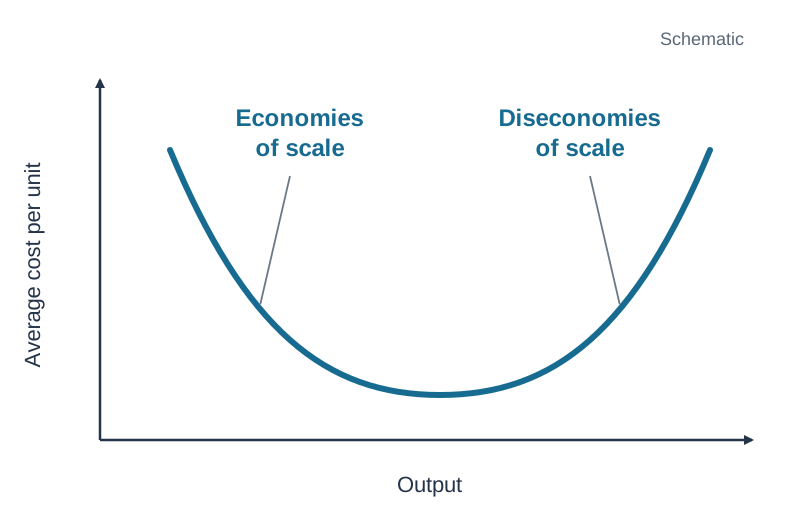
Enterprises usually expand to increase revenue, spread overheads, and achieve economies of scale. Economies of scale occur when the average cost per unit falls as output increases. This happens through bulk-buying discounts on materials, specialised staff roles, or spreading fixed overheads over a larger volume of sales.
Growth also brings serious risks. Expanding too fast without enough cash causes overtrading, where a firm runs out of money to pay daily bills despite having full order books. Expanding too large can cause diseconomies of scale, where poor communication, administrative bottlenecks, and low morale push average unit costs back up. Any growth decision must protect financial sustainability, meaning the business can cover its running costs, service its debts, and maintain working capital.
Adapting by Cutting Back
When demand drops or costs jump, adapting may mean shrinking or restructuring rather than growing:
- Rationalisation / consolidation: Closing loss-making branches, dropping unprofitable product lines, and concentrating production in fewer locations. It reduces fixed costs and protects cash flow, but often results in redundancies and hurts staff morale.
- Outsourcing: Paying an external specialist to handle activities like distribution, payroll, or IT. This turns a fixed overhead into a variable cost, though the firm surrenders some control over quality.
- Delayering: Removing a layer of middle management to lower wage bills and speed up decision-making, which can overload the remaining staff.
- Retrenchment: Withdrawing from an unprofitable market segment or geographic region to protect the healthy core business.
Paying for Expansion
Expansion can be financed through retained profits (no debt or interest, but slow to accumulate), bank term loans (repaid with interest, which increases when interest rates rise), equity such as share issues or venture capital (no interest repayments, but dilutes ownership), and leasing assets to preserve capital. State agencies provide vital grant aid and mentoring. You must name the correct agency: the Local Enterprise Office (LEO) for micro-enterprises up to 10 employees, Enterprise Ireland for Irish manufacturing and internationally traded services businesses with export ambition, IDA Ireland for foreign direct investment, and Údarás na Gaeltachta in Gaeltacht areas.
Identifying Competition and Building Competitive Advantage
Knowing who you are up against is the starting point for any business strategy. Competition is the rivalry between businesses trying to win customer spending and market share.
Types of Competition
- Direct competition: Businesses selling identical or very similar goods and services to the same target market. For example, SuperValu and Tesco compete directly for Irish household grocery spending.
- Indirect competition: Businesses selling different goods or services that satisfy the same consumer need or fight for the same discretionary spend. For example, Irish Rail faces indirect competition from Citylink express coaches and private cars, as all three provide intercity travel.
Competitor Analysis
Competitor analysis is the structured process of finding out who your rivals are, examining their strengths, weaknesses, prices, and customer service, and comparing them against your own business. Doing this helps a firm spot gaps in the market, anticipate price wars, and avoid copying rival mistakes.
Sources of Competitive Advantage
A competitive advantage is any distinctive asset or capability that lets a business outperform rivals and protect profit margins. Michael Porter identifies three basic routes to building one:
- Cost leadership: Becoming the lowest-cost operator in the industry through lean overheads, scale, and high operational efficiency (e.g. Ryanair). Charging a low price is only a competitive advantage if your underlying cost structure is lower than everyone else's; otherwise, price discounting simply destroys profits.
- Differentiation: Offering superior design, exceptional customer service, or brand prestige that convinces buyers to pay a premium price (e.g. Apple or Sculpted by Aimee).
- Focus (niche): Serving one narrow market segment better than anyone else, either at low cost or with a tailored product, such as a pharmacy that specialises in mobility aids for older citizens or an artisan gluten-free bakery.
A unique selling point (USP) is the specific feature highlighted in advertising. A competitive advantage is broader, often rooted in patents, supplier contracts, or skilled staff that rivals cannot easily replicate.
Capitalising on a Competitive Advantage
Identifying an advantage is pointless unless the business turns it into revenue. A firm capitalises on its edge by:
- Using it as the USP in promotion: Building marketing around the one thing competitors cannot match (e.g. certified organic, West Cork provenance).
- Charging a premium price: A differentiation advantage allows the firm to maintain its prices even when discount rivals cut theirs.
- Protecting it legally: Registering trademarks, patents, or protected geographical indications so competitors cannot copy it.
- Winning retail distribution: Using strong brand demand to secure prime shelf space with supermarket buyers.
- Selling the format: Licensing or franchising the proven model to earn royalties without committing extra capital.
Porter's Five Forces Model
Before expanding into a new market, a business needs to evaluate whether that industry is attractive and profitable. Michael Porter's Five Forces framework looks at five structural pressures that squeeze profit margins.
| Force | When the Force is High | What the Business Can Do About It |
|---|---|---|
| Competitive Rivalry | Many similar-sized competitors operate, market growth has stalled, or products are all much the same. | Differentiate products, create customer loyalty schemes, and build brand identity. |
| Bargaining Power of Suppliers | Only a few suppliers exist, raw materials are scarce, or switching suppliers is difficult and expensive. | Negotiate long-term fixed contracts, find alternative materials, or dual-source critical supplies. |
| Bargaining Power of Customers | Buyers purchase in bulk volumes, products are standard, or customers can switch to rivals at zero cost. | Offer unique customer service, introduce loyalty rewards, or sell direct-to-consumer online. |
| Threat of Substitutes | Products from a different industry offer better value and satisfy the same underlying customer need. | Improve product features, highlight Irish origins, or bundle extra services. |
| Threat of New Entrants | Start-up capital is low, brand loyalty is weak, and distribution channels are easy to access. | Build economies of scale, patent recipes or designs, and secure exclusive distribution deals. |
When these forces are strong, profit margins are driven down. When entry barriers are high, substitutes are rare, and customer loyalty is strong, established businesses can sustain healthy profits.
Try This: Applying the Five Forces
A new independent café opens on a street that already has four cafés, two of which are national chains. Coffee beans can be bought from dozens of wholesale roasters. Setting up the café costs roughly €40,000. Which two forces are strongest, and what does this mean for potential profits?
Answer: Competitive rivalry is high because there are four established competitors selling a similar product in a small area, making it easy for customers to switch. The threat of new entrants is moderate to high because €40,000 is a relatively low barrier to entry. Meanwhile, supplier power is low because coffee roasters are plentiful. High rivalry and easy entry mean profit margins will be under constant pressure, so the new café must establish a focus or differentiation advantage, such as specialty baking or a mobile loyalty app.
Growth Strategies: Internal, External, and Collaborative
A business must choose both the direction it wants to grow in and the method it will use to get there.
Directions of Growth
- Market penetration: Selling more of your existing products to existing customers through loyalty schemes, extended opening hours, or sharper promotion.
- Product development: Launching new or modified products into your existing market (e.g. an Irish dairy co-op launching high-protein yoghurts).
- Market development: Selling existing products to a new geographic area or customer demographic (e.g. an Irish distillery exporting whiskey to the United States).
- Diversification: Launching completely new products into completely new markets. This spreads commercial risk across multiple industries, but carries the highest risk of failure because the firm is operating outside its core expertise.
These directions describe where a business grows. How it grows is a separate choice: it can develop the new operation itself (organic) or join with another business (inorganic).
Internal (Organic) Growth
Organic growth means expanding gradually by using the firm's own resources, financed by retained profits or bank loans. It takes longer, but it protects the firm's culture, keeps control firmly with the owners, and avoids sudden debt burdens.
External (Inorganic) Growth and Collaborative Models
External growth involves buying or combining with other businesses. It delivers immediate market share, existing customers, and proven staff, but requires large amounts of capital and carries high integration risks.
- Merger: Two or more independent businesses mutually agree to combine to form a brand-new single legal entity, sharing future governance, assets, and profits.
- Acquisition (takeover): One company purchases a controlling interest (more than 50% of the voting shares) in another business, absorbing it into its corporate structure (e.g. Kerry Group acquiring international flavour manufacturers).
- Strategic alliance: Two or more independent firms formally agree to co-operate on a specific project or shared service while remaining separate legal entities. Neither firm creates a new company or surrenders ownership.
- Joint venture: Two or more businesses set up a new, separate company together, sharing set-up costs, operating risks, control, and profits for a specific venture. Unlike a merger, the founding parent companies continue their existing operations independently.
- Licensing: A business gives another firm the legal right to manufacture its goods, use its brand name, or deploy its patented technology in return for a royalty on sales. The licensee only receives rights to that specific product or patent, not the entire business structure.
- Franchising: A contractual model where the business owner (the franchisor) sells an independent operator (the franchisee) the right to trade using its complete business format, brand name, and operating systems in exchange for an upfront fee and ongoing royalties on turnover. Franchising allows rapid national or international expansion using third-party capital while preserving strict operational standards.
Technology and Digital Transformation in Expansion
Digital technology allows smaller firms to scale up rapidly, enter international markets, and manage complex operations without hiring proportionate numbers of administrative staff.
- Digitalisation: Converting manual, paper-based processes into digital workflows. This allows head office to coordinate multiple locations and warehouses with the same administrative team.
- Artificial Intelligence (AI): Software that handles tasks previously requiring human judgement. In expansion, AI powers 24/7 customer service chatbots across different languages, automates translation of online marketing, and forecasts stock demand to prevent over-ordering.
- Big data: Analysing massive volumes of customer transaction records collected from payment tills, loyalty apps, and websites. This reveals customer shopping habits, helping a firm decide where to open its next branch based on real data rather than guesswork.
- E-commerce: Digital storefronts and secure payment systems enable local businesses to sell directly to global customers 24/7 without paying high-street retail rents.
- Cloud ERP and CRM systems: Enterprise Resource Planning (ERP) connects purchasing, stock levels, and accounts across all branches in real time. Customer Relationship Management (CRM) tracks buyer interactions, allowing targeted promotions that drive repeat sales.
Example: A Kilkenny candle maker that originally sold only at regional craft fairs launched on Shopify and Etsy. The business began shipping orders across the UK and the EU. Fixed overheads rose only by the monthly software platform fee, and sales analytics showed that German orders peaked in November, allowing the maker to produce stock in September to meet demand.
Limitations and Risks: Technology requires significant upfront capital investment, ongoing cybersecurity protection, and staff retraining. Over-reliance on automation risks customer backlash if human support disappears, and collecting personal data brings strict legal responsibilities under General Data Protection Regulation (GDPR) rules.
Conducting a Cost-Benefit Analysis (CBA)
Before committing funds to an expansion project, managers must conduct a Cost-Benefit Analysis (CBA) to compare all financial and non-financial implications of the proposal.
Five Steps to Conduct a CBA
- List every cost: Identify one-off capital set-up expenses (premises fit-out, machinery, software licences) and ongoing operating costs (wages, raw materials, insurance, loan interest).
- List every benefit: Forecast additional sales revenue, production cost savings, and any state grants received.
- Put a money value on each: Assign euro figures over a clear timeframe, usually Year 1 or the lifespan of the equipment.
- Compare the monetary totals: Calculate the net benefit using the formula: Net benefit = total benefits − total costs. A positive result means the project pays for itself over that period.
- Evaluate non-monetary factors and make a recommendation: Weigh intangible costs and benefits (staff stress, reputation, community impact, ethics) and make a justified decision.
Testing Sensitivity
At Higher Level, you should evaluate what happens if key assumptions go wrong. A sensitivity analysis recalculates the net benefit if revenue falls (e.g. by 20%) or if input costs rise. If a modest drop in sales turns a positive net benefit into a heavy loss, the expansion carries serious insolvency risk.
Qualitative Factors and Growing Responsibly
Numbers alone do not tell the full story. Sustainable expansion requires looking at broader stakeholder issues through an ethical and environmental lens:
- Qualitative costs: Increased pressure and stress on existing workers, potential loss of artisan quality, executive distraction from the core business, and community disruption like delivery traffic or noise.
- Qualitative benefits: Career development and promotion opportunities for staff, job creation in local communities, and improved brand standing.
- Environmental impact: Larger operations generate more transport emissions, packaging waste, and energy use. Sustainable businesses incorporate circular economy practices (refill schemes, repair services, recyclable packaging).
- Ethical sourcing and ESG: Sourcing from cheap overseas suppliers can cut unit costs but exposes the business to reputational damage if labour standards are poor. Larger enterprises are expected to publish ESG (Environmental, Social, and Governance) performance records, which influence bank lending terms and institutional investment.
Adapting the Marketing Mix (7 Ps) and Business Model
Firms must adjust their commercial strategy in response to three major external drivers: customer demographics, competitor actions, and economic conditions.
External Drivers of Change
- Customer demographics: An ageing population in Ireland increases demand for accessible packaging and home healthcare services, while smaller average household sizes increase demand for single-portion meals.
- Competition: New entrants offering discount pricing or digital platforms force existing firms to defend their margins and sharpen their customer service.
- Economic factors: High inflation and rising interest rates reduce consumer disposable income and make bank borrowing more expensive for businesses.
Adapting the Extended Marketing Mix (7 Ps)
When an exam question asks how a business should adapt its marketing mix, select the elements that address the scenario's specific problems:
- Product / Service: Reformulating recipes, adding vegan or gluten-free options, or introducing eco-friendly product lines.
- Price: Shifting between premium pricing, cost-plus, or promotional discounting, and introducing tiered options for price-sensitive shoppers.
- Promotion: Moving promotional spend from traditional print media to targeted social media, micro-influencer campaigns, and loyalty apps.
- Place: Selling through multiple channels (omnichannel), establishing local delivery hubs, or offering click-and-collect.
- People: Training customer service staff to offer expert advice that online competitors and discount chains cannot match.
- Packaging: Replacing single-use plastics with compostable, refillable, or easily recycled materials to meet customer expectations and legal regulations.
- Process: Introducing self-service checkouts, mobile ordering apps, or automated booking systems to eliminate queues.
Adapting the Business Model
A business model is the section of the business plan explaining how an enterprise operates, creates, delivers, and captures value. In plain terms, it sets out what it sells, who it sells to, and how it gets paid. When under external pressure, a firm can change how it makes its money:
- Retail to online marketplace: Selling through platforms like Etsy or Amazon to reach national buyers without paying high-street rent.
- One-off sales to subscription: Charging a recurring monthly fee for ongoing deliveries (e.g. coffee beans, software, personal care), ensuring predictable cash flow.
- Adding an affiliate stream: Earning commission by recommending complementary products from partner businesses on your website.
- Advertising-supported model: Providing content or an app for free to build a large user base, then charging advertisers for access.
- Franchise model: Expanding a proven business concept using franchisees' capital.
- Crowdfunding: Raising expansion finance directly from future customers online in exchange for early product access.
- Circular model: Leasing, repairing, and refurbishing products instead of selling them outright, extending product life and cutting waste.
Critical Analysis of Business News and Media Reports
Leaving Certificate Business requires you to read news stories about business expansion or restructuring and give an informed, balanced perspective.
When evaluating a published business report, follow four steps:
- Identify the strategic move: Determine whether the business is using organic growth, an acquisition, a merger, an alliance, or rationalisation, and spot which external driver triggered the decision.
- Look for PR spin and corporate bias: Press releases and chief executive interviews highlight projected turnover, new jobs, and synergies, while quietly ignoring borrowing risks, redundancy packages, or integration costs.
- Check for missing information: Look for unmentioned costs: How is the deal funded? What interest rate applies? Will store overlap cause cannibalisation (where a newly acquired branch simply takes sales away from an existing store down the road)?
- Formulate a balanced, reasoned judgement: Conclude with a clear verdict that weighs commercial opportunities against genuine operational risks, backed up by evidence from the text rather than corporate enthusiasm.
Key terms
- Competitive Advantage
- A distinctive asset, resource, or capability that enables a business to outperform its rivals and protect profit margins over time, achieved through cost leadership, differentiation, or focus.
- Direct Competition
- Commercial rivalry between businesses offering identical or very similar goods or services to the same target market.
- Indirect Competition
- Commercial rivalry between businesses selling different goods or services that satisfy the same underlying customer need or compete for the same discretionary spend.
- Porter's Five Forces Model
- A strategic management framework that analyses competitive rivalry, supplier power, buyer power, substitution threats, and new entrant threats to assess industry attractiveness.
- Economies of Scale
- The reduction in average cost per unit produced that occurs as an enterprise expands its operational scale and total output.
- Organic Growth
- Internal business expansion achieved gradually through the firm's own resources and activities, funded by retained profits or bank loans.
- Merger
- A mutual agreement where two or more independent commercial entities combine their assets and operations to form a brand-new single legal entity.
- Acquisition (Takeover)
- A transaction in which one company purchases a controlling interest (more than 50% of voting shares) in another firm to take operational control.
- Strategic Alliance
- A formal agreement where two or more independent firms cooperate on a specific project or shared service while remaining separate legal entities.
- Joint Venture
- An arrangement where two or more independent businesses set up a brand-new, separate company together, sharing set-up costs, risks, profits, and operational control.
- Licensing
- A contract where a business gives another firm legal permission to manufacture its product, use its brand, or deploy its patent in return for royalty payments.
- Franchising
- A contractual model where a franchisor grants an independent franchisee the right to run its complete business format and brand in exchange for an upfront fee and ongoing sales royalties.
- Cost-Benefit Analysis (CBA)
- A structured appraisal tool that compares the projected quantitative financial returns and costs of an expansion alongside qualitative stakeholder impacts.
- Sensitivity Analysis
- A testing method that recalculates project viability when key assumptions, such as sales volumes or raw material costs, turn out worse than expected.
- Rationalisation
- Restructuring a business by closing unprofitable units, merging facilities, or cutting jobs to reduce fixed operating costs and protect cash flow.
- Business Model
- The section of a business plan outlining how an enterprise operates, creates, delivers, and captures economic, social, and cultural value.
- Disruptive Impact
- The transformative effect of digital technology on how markets function, workplace processes operate, and consumers engage with commercial businesses.
- Cannibalisation
- A loss in sales caused by an enterprise introducing a new product or opening a new branch that takes customers directly from its own existing stores or lines.
Check yourself
What is the key difference between direct and indirect competition?
Direct competitors sell identical or very similar products to the same target market (e.g. two rival supermarkets). Indirect competitors sell different products that satisfy the same underlying customer need (e.g. an artisan sandwich bar and a casual burrito shop competing for lunch spending).
Name the five forces in Michael Porter's competitive framework.
Competitive Rivalry, Threat of New Entrants, Threat of Substitutes, Bargaining Power of Suppliers, and Bargaining Power of Customers.
Match each expansion method to its definition: merger / acquisition / strategic alliance / joint venture / franchising. (a) One firm buys over 50% of another company's shares. (b) Two firms co-operate on a project but remain separate legal entities. (c) Two firms combine to create one new legal entity. (d) Two firms set up a brand-new company together to share a project. (e) An independent operator pays a fee and royalties to trade under another firm's name and format.
(a) Acquisition, (b) Strategic alliance, (c) Merger, (d) Joint venture, (e) Franchising.
State the formula used to calculate Net Benefit in a quantitative cost-benefit appraisal.
Net benefit = total additional benefits − total additional costs (in €).
How does transitioning from one-off sales to a subscription business model improve financial sustainability?
A subscription model delivers predictable, recurring cash inflows on an agreed weekly or monthly basis. This improves cash-flow forecasting and protects the business from sudden drops in discretionary one-off purchases.
Which State agencies should you name for an Irish micro-enterprise expanding locally versus an Irish business expanding into export markets?
Name the Local Enterprise Office (LEO) for micro-enterprises with up to 10 employees, and Enterprise Ireland for Irish-owned businesses with export ambition.