

Idea development is the process of generating, shaping, testing, and evaluating new product or service concepts before committing substantial capital. In Leaving Certificate Business, this topic explores the sources of business ideas, the internal and external factors that shape their progress, the four phases of design thinking (Clarify, Ideate, Develop, and Implement), and how to carry out a feasibility study that checks three things — the market, whether the product can actually be made or delivered, and the finances — in order to judge whether the idea can make money.
Idea Sources versus Factors Shaping Development
A business concept begins with an initial spark, but that spark is distinct from the forces that govern whether an enterprise can actually build and sell it.
Where Ideas Originate (Sources)
- Internal Sources: Ideas generated from within the founder or organisation. These include personal hobbies, interests, or daily frustrations; dedicated research and development (R&D) departments; and intrapreneurship, where employees inside an existing firm use their enterprise initiative to develop new products or processes (such as a chef adding a new takeaway line to an existing restaurant menu).
- External Sources: Opportunities identified outside the business. These include customer complaints or feedback, monitoring competitors' offerings, identifying market gaps, attending trade exhibitions, and scanning import-substitution opportunities.
Factors Governing Development: Internal versus External
Once an idea emerges, specific factors decide whether it progresses towards launch. Dividing these into internal and external elements helps structure exam answers.
Internal Factors (inside the entrepreneur's control):
- Finance Available: The founder's own equity, savings, and ability to borrow or obtain grant aid determine the scale of development. A lack of capital may restrict a national launch to a small local pilot.
- Skills and Competencies: The technical, commercial, and financial abilities of the entrepreneur and their team determine whether complex designs can be executed.
- Time and Personal Motivation: The degree of commitment and resilience the founder can sustain full-time.
- Premises, Equipment, and Capacity: Access to adequate workshops, commercial kitchens, vehicles, or digital systems needed to operate.
External Factors (outside the entrepreneur's control):
- Customer Demand and Market Trends: The presence of a sufficiently large target market willing and able to pay for the proposed solution.
- Competition and the Unique Selling Point (USP): The number and strength of rival firms, and whether the proposed idea offers a distinctive Unique Selling Point (USP) that gives it a sustainable competitive edge.
- Economic Climate: Prevailing economic conditions such as inflation, interest rates, consumer disposable income, and employment levels.
- Suppliers and Supply Chains: The availability, reliability, and pricing of raw materials and distribution channels.
- Legal, Regulatory, and Environmental Standards: Mandatory health and safety rules, food safety (HACCP) standards, data protection (GDPR), consumer law, and licensing rules.
- Government Supports: Backing from state agencies offering advice, training, and start-up funding.
- Digital Technology: Digital tools that make delivery cheaper and faster, while also risking rapid product obsolescence.
Using STEEPLE to Organise External Factors
A STEEPLE analysis is an analytical checklist used to review the external business environment and identify external issues that help or hinder an idea. Examiners reward applying this structured framework rather than listing external points at random.
Consider applying STEEPLE to a proposal for an eco-friendly mobile coffee van:
- S – Social: Rising consumer demand for premium specialty coffee and plant-based milk alternatives among office workers.
- T – Technological: Widespread customer expectation of contactless card payments and mobile pre-ordering apps.
- E – Economic: Increases in wholesale coffee bean and electricity costs that squeeze operating profit margins.
- E – Environmental: Single-use coffee cup levies that encourage customers to use reusable travel mugs or certified compostable cups.
- P – Political: Local authority policy regarding trading permits, public parking access, and small business support.
- L – Legal: The requirement to obtain a casual trading licence from the local council and register with environmental health inspectors.
- E – Ethical: Sourcing fair-trade beans and guaranteeing that workers along the coffee supply chain receive fair wages.
Design Thinking: Principles, Mindset, and the Four Phases
Learn this definition word for word: design thinking is an innovative, non-linear approach to the development of products and services which focuses on solutions for the end user.
Unlike traditional product development, which starts with company equipment ('What can our machinery make?'), design thinking begins by understanding the user ('What difficulty does the customer encounter daily?').
Core Characteristics
- Person-Centred: Decisions come from listening to and watching real users in their everyday setting, instead of guessing what customers want from inside the office.
- Solution-Centred: Once the problem is properly understood, the team's energy goes into coming up with solutions and testing them, not into analysing the problem forever.
- Iterative and Non-Linear: 'Non-linear' means teams do not move through stages in a rigid straight line. They move back and forth. Feedback gained from testing a prototype sends the team back to earlier stages to rethink the problem or refine the idea. Prototyping is an inexpensive way to de-risk a project: discovering flaws on a low-cost mock-up prevents costly commercial failures on launch day.
The Four Official Phases
The Leaving Certificate specification organises design thinking into four phases: Clarify, Ideate, Develop, and Implement.
You may meet a five-stage model elsewhere (Empathise, Define, Ideate, Prototype, Test). In this specification, understanding the user and defining the challenge both belong inside Clarify, while building and testing mock-ups sit inside Develop. Always use the four official names in your examination answers.
| Phase | Primary Objective | Key Activities | Applied Example: Arthritis-Friendly Medicine Packaging |
|---|---|---|---|
| 1. Clarify | Define the specific user problem without bias | Interviewing, shadowing customers, and framing a clear challenge question | Watching older patients struggle to pop tablets out of foil blisters; framing the question: How might we allow pain-free access to daily medication? |
| 2. Ideate | Generate a wide volume of creative potential answers | Brainstorming, lateral thinking, suspending early criticism, and sharing concepts | Generating ideas: lever presses, dissolvable strip pouches, twist-dial dispensers, and pre-sorted blister packs |
| 3. Develop | Turn top concepts into physical, testable forms | Building low-cost prototypes (foam mock-ups, digital wireframes) and running user trials | Producing 3D-printed plastic push-lever dispensers and testing hand-grip comfort with ten patients |
| 4. Implement | Put the refined solution into action and monitor results | Launching a small-scale pilot, analysing real-world use, and ongoing refinement | Supplying 150 dispensers to three community pharmacies and recording feedback from patients and pharmacists |
Design thinking applies just as directly to services and internal processes as it does to physical goods, such as redesigning a hospital appointment booking system to cut patient wait times.
Try It Yourself: Canteen Queues
A school wants to cut lunchtime canteen queues using design thinking. Write one sentence for each phase:
- Clarify: Survey and observe students at 1:00 p.m. to pinpoint where the queue stalls, defining the problem as slow payment processing.
- Ideate: Brainstorm solutions with students and canteen staff, such as pre-packed lunch grab bags, a tap-and-go student ID card, or staggered lunch slots.
- Develop: Set up a temporary card-tap checkout station for one senior class for three days to test transaction speed.
- Implement: Roll out contactless card readers across all tills and monitor daily lunchtime queue clearance times.
Conducting a Feasibility Study
Keep this sequence in mind:
Use this memory line to keep the phases and evaluation areas separate: Clarify, Ideate, Develop, Implement — then Market, Production, Finance.
A feasibility study is a systematic investigation carried out to assess the commercial viability of a business idea before committing heavy financial resources or writing a comprehensive business plan. Commercial viability means the idea has the capacity to generate sufficient ongoing revenue to cover all costs and yield an acceptable profit.
Why Conduct a Feasibility Study?
- It reduces risk: Flaws are uncovered on paper and fixed before real money is lost. Example: A food producer finds its packaging cannot meet legal shelf-life requirements, redesigning it before printing €15,000 worth of boxes.
- It saves time and money: Abandoning an unworkable idea early protects personal savings and prevents wasted labour on a product nobody wants.
- It provides evidence for lenders and grant agencies: Commercial banks, credit unions, and state bodies such as the Local Enterprise Office require research-backed figures before approving finance.
- It improves the idea: The findings point to needed adjustments in price, target audience, materials, or distribution channels.
- It forms the groundwork for the business plan: The findings flow directly into the detailed operational business plan and the value proposition on the business model canvas.
Short Exam Answer Model (4–6 marks):
- State: A feasibility study reduces financial risk.
- Explain: It systematically tests customer demand and production costs on paper so flaws are identified before money is committed.
- Example: Discovering through market research that customers will not pay €5 for a reusable bottle prevents an entrepreneur from signing a costly manufacturing contract.
The Three Core Dimensions
Market, production, and financial feasibility are the three standard areas to check. If a scenario clearly introduces other factors — such as planning permissions, environmental licences, or staff recruitment shortages — address those directly alongside these core headings.
1. Market Feasibility
Assesses customer demand, willingness to pay, and rival offerings:
- Is there a clearly defined target market with an unmet need?
- What price will consumers genuinely pay?
- Who are the direct and indirect competitors, and what is the venture's Unique Selling Point (USP)?
2. Production (Technical) Feasibility
Examines whether the firm can physically make the product or deliver the service:
- Are raw materials, machinery, premises, and transport reliably available?
- Does the team possess the necessary technical skills and capacity to produce at scale?
- Can the operation satisfy regulatory requirements (such as CE marking, health and safety standards, and waste directives)?
3. Financial Feasibility
Calculates whether the proposition can be commercially viable and generate sustainable cash flow:
- Start-Up Capital: Total cash needed for machinery, leases, licences, and working capital.
- Fixed Costs: Overheads that do not change with the level of output (such as workshop rent, insurance, and interest charges).
- Variable Costs: Costs that rise and fall directly with output (such as ingredients, direct wages, and packaging).
- Cash-Flow Timing: Forecasting cash receipts and payments over the first 12 months to prevent cash shortages.
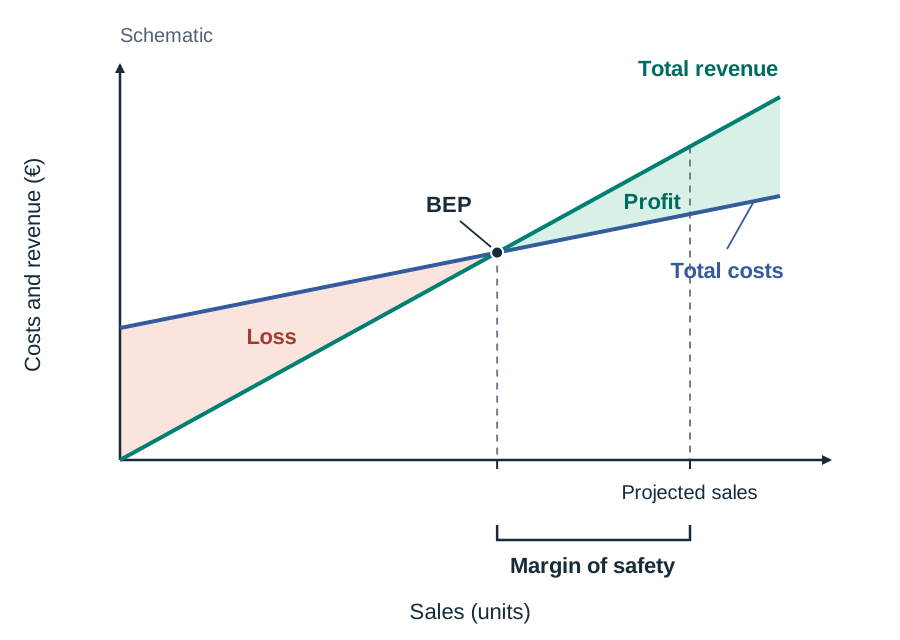
Contribution per unit and the break-even point provide a handy way to test financial viability in figures:
If market research shows projected demand is comfortably above the break-even point (BEP), the proposal has a healthy margin of safety. If projected sales fall below break-even, the business makes an operating loss.
Research Evidence, State Supports, and Strategic Decisions
Gathering Feasibility Evidence
Evidence collected during a feasibility study comes from two categories:
- Primary Research: First-hand data gathered directly by the entrepreneur (such as surveys, interviews, focus groups, observation, pop-up stalls, and product tastings). It is specific to the idea and fully up to date, but costs time and money to collect.
- Secondary Research: Existing information published by third parties (such as Central Statistics Office (CSO) census and spending figures, trade publications, competitor price lists, newspaper business reports, and Local Enterprise Office sector guides). It is quick and cheap to access, but may be outdated or too general.
- Evaluating Evidence: Entrepreneurs must evaluate the reliability of sources, look out for survey bias (such as friends giving polite answers), and acknowledge all sources used.
Named Irish Enterprise Supports
When a feasibility study shows an idea has potential, entrepreneurs can turn to state agencies for advice, mentoring, and start-up funds:
- Local Enterprise Office (LEO): The first stop for local micro-enterprises (employing up to 10 people). Offers mentoring, Start Your Own Business training courses, feasibility study grants, and priming business grants.
- Enterprise Ireland: Supports high-potential start-ups (HPSUs) and established Irish-owned manufacturing and export-focused companies looking to scale into international markets.
- Microfinance Ireland: Provides small business loans (up to €25,000) to newly established or existing micro-enterprises that cannot secure traditional bank lending.
- Údarás na Gaeltachta: Provides enterprise supports, industrial sites, and grant aid specifically within Gaeltacht regions.
- Note on IDA Ireland: IDA Ireland attracts Foreign Direct Investment (multinational corporations) into Ireland. It does not fund or support domestic Irish start-ups.
Sources of Finance
Financial feasibility includes identifying suitable sources of finance: personal savings, equity investment, commercial bank term loans, equipment leasing, business angel finance, venture capital, and crowdfunding.
Strategic Decisions After Feasibility
Once all findings are analysed, the entrepreneur makes one of three strategic decisions:
- Proceed: The study confirms strong demand, practical production, and sales well above break-even. The entrepreneur advances to writing the full business plan and mapping the business model canvas.
- Adapt (pivot): The core idea has value, but one element fails. The entrepreneur adapts by altering the marketing mix (changing price, packaging, or promotion channels), switching the business model (from direct retail to a subscription service), targeting a different market segment, or sourcing alternative materials to cut variable costs.
- Abandon: The study reveals an unfixable flaw: the cost per unit is too high, the law does not allow it, or demand is too weak. Dropping the idea preserves capital and avoids insolvency.
Critical Evaluation: Limitations of Feasibility Data
Higher-level answers require candidates to recognise the limitations of research evidence:
- The Intention-Action Gap: People often tell a survey interviewer that they 'would buy' an innovative product, but refuse to spend their own money when the product appears on a retail shelf.
- Sampling Bias: Gathering opinions only from friends, classmates, or online social circles produces skewed, overly positive results that do not reflect the wider public.
- Changing External Environment: Rapid inflation, sudden increases in raw material prices, or a competitor slashing prices can destroy projected profit margins before trading even starts.
Key terms
- Design Thinking
- An innovative, non-linear approach to the development of products and services which focuses on solutions for the end user.
- Feasibility Study
- A systematic investigation carried out to assess the commercial viability of a business idea across market, production, and financial dimensions before investing significant resources.
- Commercial Viability
- The capacity of a business proposition to generate sufficient ongoing revenue to cover all fixed and variable costs and provide a sustainable profit.
- Intrapreneurship
- Enterprising behaviour where employees inside an existing business develop innovative ideas, products, or cost-saving processes on behalf of their employer.
- Unique Selling Point (USP)
- The distinctive feature or benefit that makes a product or service stand out from its competitors.
- Prototype
- A simple, low-cost preliminary model, sample, or mock-up of a product built to test technical performance, usability, and customer reaction.
- Iterative Process
- A repeating, cyclical procedure of testing, learning, and modifying where feedback from later stages is used to refine earlier stages.
- Market Feasibility
- The investigation of potential customer demand, market size, target demographics, and competitor dynamics for a proposed product or service.
- Production Feasibility
- The assessment of whether an enterprise possesses the materials, machinery, technical skills, operational capacity, and regulatory approvals needed to physically produce a good or deliver a service.
- Financial Feasibility
- The assessment of capital requirements, fixed and variable costs, pricing, break-even point, and projected cash flow to determine if an idea can be profitable.
- Contribution per Unit
- The revenue remaining from each unit sold after deducting its variable cost, calculated as Selling Price minus Variable Cost per Unit.
- Break-Even Point (BEP)
- The level of output where total sales revenue exactly equals total costs, calculated as Fixed Costs divided by Contribution per Unit.
- Circular Economy
- A model of production and consumption which extends the life cycle of products, reduces waste, and creates further value.
- STEEPLE Analysis
- An analytical tool used to assess the impact of external factors on a business, covering Social, Technological, Economic, Environmental, Political, Legal, and Ethical factors.
Check yourself
What is the official Leaving Certificate definition of design thinking?
An innovative, non-linear approach to the development of products and services which focuses on solutions for the end user.
Distinguish between intrapreneurship and entrepreneurship.
Entrepreneurship involves an individual taking the personal and financial risk of setting up a new enterprise, whereas intrapreneurship involves an employee acting creatively within an existing business to develop new ideas or processes for their employer.
Name the four phases of design thinking in the Leaving Certificate specification.
Clarify, Ideate, Develop, and Implement.
What three core areas are examined in a standard feasibility study?
Market Feasibility (demand and competition), Production/Technical Feasibility (practical delivery, skills, and regulatory standards), and Financial Feasibility (costs, capital, break-even point, and profit).
A product sells for €20 and has a variable cost of €8. Fixed costs are €24,000. Calculate its Break-Even Point in units.
Contribution per Unit = €20 − €8 = €12. Break-Even Point = €24,000 / €12 = 2,000 units.
Why is customer survey data considered a potential limitation when assessing market feasibility?
Surveys suffer from the intention-action gap, where respondents express positive interest but fail to buy when spending actual money, alongside potential sampling bias if surveyed groups are unrepresentative.