

Managing operational resources, controlling costs, and securing suitable finance determine whether an enterprise survives day-to-day trading and grows. This note covers the operational building blocks of the Business Model Canvas—key activities, resources, and partners—alongside cost behaviour, modern revenue streams, cash flow forecasting, and the evaluation of short-, medium-, and long-term sources of finance across the business life cycle.
Key Activities, Key Resources, and Key Partners
The Business Model Canvas outlines how an enterprise operates, creates, delivers, and captures value. At the operational level, every business coordinates three core elements: what it does (key activities), what it needs (key resources), and who it works with (key partners).
Key Activities
Key activities are the essential operational tasks a business executes to produce goods, provide services, and generate revenue. These centre on four functional areas:
- Research and Development (R&D): Designing new products, improving existing lines, and running safety and quality checks to meet changing consumer preferences.
- Production: Converting raw materials into finished merchandise, operating machinery, maintaining quality standards, and minimising factory waste.
- Marketing: Identifying target markets, deciding on product features and pricing, and running promotional campaigns.
- Sales and Customer Service: Managing sales channels, processing orders, answering customer queries, and handling returns to build loyalty.
Key Resources
To deliver these activities, an enterprise uses four main types of resources:
- Physical resources: tangible assets such as manufacturing plants, warehouses, delivery vans, and retail premises.
- Intellectual resources: intangible assets such as brand names, patents, copyrights, and proprietary customer data.
- Human resources: the skills, experience, and effort of workers, from line assemblers to specialist engineers and managers.
- Financial resources: cash balances, bank credit lines, and working capital.
Key Partners
Businesses form external partnerships rather than trying to carry every facility, cost, and skill in-house. Organisations enter partnerships for three main reasons: to achieve economies of scale and cut costs, to reduce risk, and to gain vital resources or expertise they lack internally.
| Partnership Type | Arrangement | Commercial Example |
|---|---|---|
| Buyer–Supplier Contract | Long-term agreement between a firm and an independent supplier to guarantee regular delivery of materials at agreed prices and quality standards. | An Irish artisan cheesemaker contracting directly with local dairy farmers for a continuous fresh milk supply. |
| Strategic Alliance | Independent firms that are not direct competitors collaborate and share resources or distribution networks while remaining separate businesses. | In the mid-2010s, Uber partnered with Spotify to allow passengers to stream their personal playlists during journeys. |
| Co-opetition | Direct market rivals collaborate on expensive component manufacturing or non-core development while continuing to compete fiercely for retail sales. | Samsung manufactures advanced OLED displays for Apple iPhones, competing in handsets while cooperating in screen supply. |
| Joint Venture | Two or more parent firms set up and co-own an entirely new, separate legal entity to pursue a commercial goal, sharing capital, risk, and profits. | Starbucks and PepsiCo created the North American Coffee Partnership to bottle and distribute ready-to-drink coffee drinks. |
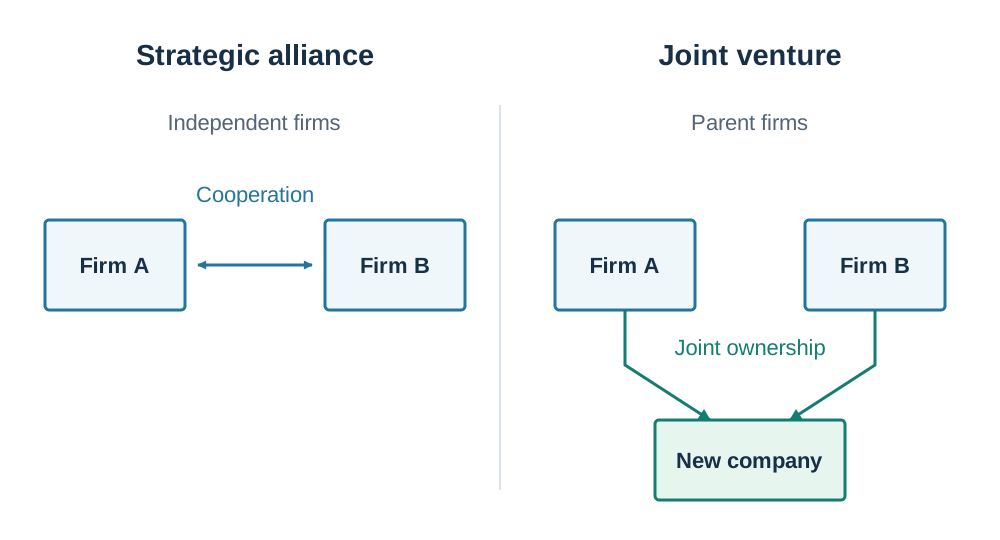
Evolution of the Operational Model
A firm's operational structure changes as it expands. When starting up, cash is tight. An entrepreneur often outsources delivery, works long unpaid hours, and uses flexible external partners. Once the business becomes established, it invests in its own machinery, builds automated production lines, hires internal specialist teams, and secures long-term supplier agreements to protect profit margins.
Costs, Revenue Models, and the Business Life Cycle
A business must understand how expenses behave as output changes, how income is structured, and how financial requirements evolve over the product life cycle.
Fixed Costs and Variable Costs
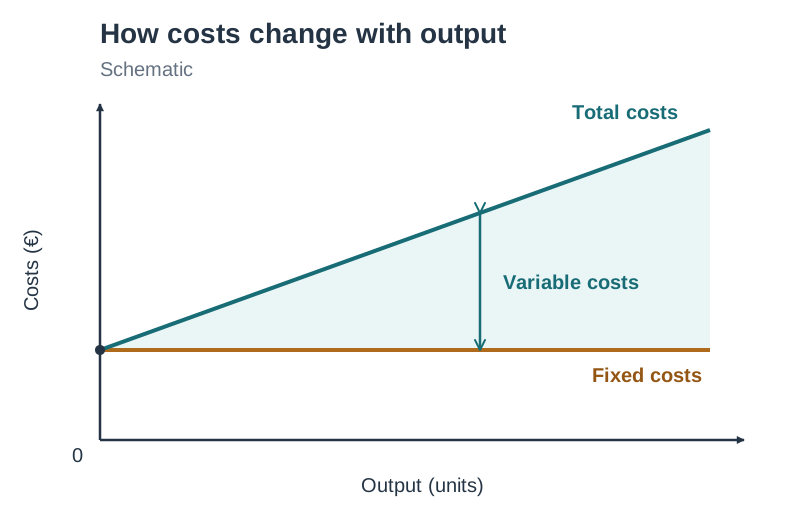
- Fixed costs: expenses that do not alter with changes in output in the short term. They must be paid even if production drops to zero units. Examples include factory rent, commercial rates, insurance premiums, executive salaries, and interest on loans. Repaying the principal of a loan is a cash outflow, not a cost in profit calculations. On a break-even chart, fixed costs appear as a flat, horizontal line.
- Variable costs: expenses that alter directly with the level of production output. If output stops, variable costs fall to zero; as output rises, these costs climb. Examples include raw materials, direct piece-rate wages, and packaging. On a break-even chart, variable costs are not usually plotted separately; they are represented by the total cost line, which starts at the level of fixed costs and slopes upward.
Modern Revenue Streams
Revenue is the total income earned from selling goods or services before deducting expenses. It is earned when the sale takes place, even if the customer pays on credit later.
- Single transactions: the customer buys once and pays once, rather than committing to recurring billing. Examples include purchasing a coat in a shop, dining in a restaurant, or fulfilling a one-off retail wholesale order. Payment can be made immediately or on agreed credit terms.
- Recurring sales: predictable, scheduled payments made by customers at regular intervals for continuous access to a product or service. Examples include software and entertainment subscriptions (such as Spotify or Netflix), gym memberships, and commercial maintenance contracts. Recurring revenue provides reliable cash inflows, reduces ongoing customer acquisition costs, and makes financial forecasting dependable.
How Finance and Costs Change Over the Life Cycle
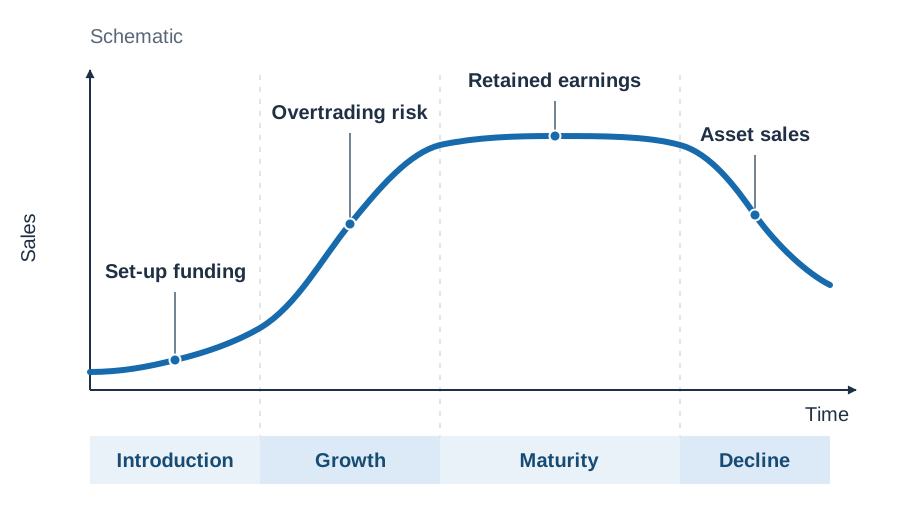
A product or service generally moves through four distinct stages, each bringing different cost pressures and funding needs:
| Stage | Costs and Cash Position | Suitable Sources of Finance |
|---|---|---|
| Introduction | Heavy set-up costs (prototyping, equipment, launch marketing) combined with low initial sales. Cash flow is almost always negative. | Owner's personal savings, government enterprise grants (such as Local Enterprise Offices or Enterprise Ireland), leasing, venture capital, and business angels. |
| Growth | Sales climb rapidly. However, the business must buy extra stock and pay additional staff before trade customers settle their bills, creating a high risk of overtrading. | Bank overdraft, trade credit, invoice factoring, medium-term bank loans, or equity issues to expand operational capacity. |
| Maturity | Sales peak and stabilise. Production reaches peak efficiency, bulk-buying lowers unit variable costs, and cash flow reaches its strongest point. | Retained earnings (reinvested profits). Surplus cash is often used to repay long-term debt or reward shareholders. |
| Decline | Sales, selling prices, and cash inflows fall as customer demand wanes or competitors innovate. | Cutting discretionary overheads, selling redundant assets, or sale and leaseback. The business should avoid taking on new long-term debt. |
Cash Flow Forecasting and Finding Missing Figures
A cash flow forecast is a financial schedule setting out expected cash inflows (receipts) and cash outflows (payments) month by month over an upcoming period. It serves four key business purposes:
- It highlights future cash shortages in advance so management can arrange bridge finance.
- It identifies expected cash surpluses so management can schedule debt repayments or short-term investments.
- It provides financial control, allowing actual receipts and payments to be compared against budgeted targets.
- It supports applications for bank loans or enterprise grants by showing that the venture is financially viable.
Core Formulas and Layout Rules
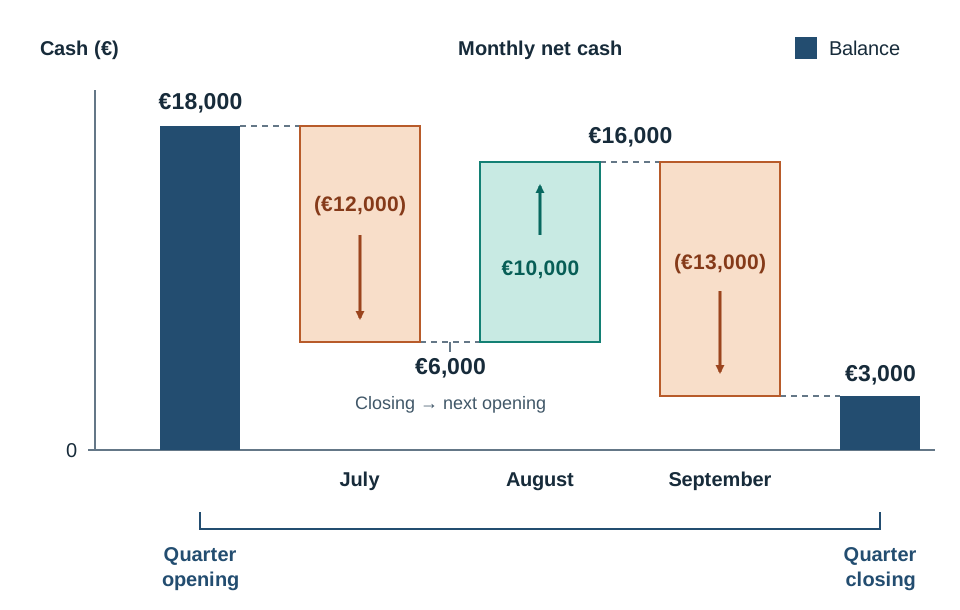
- The Carry-Forward Rule: The closing cash balance of one month becomes the opening cash balance of the following month.
- The Summary Column Rules: In a multi-month summary column, Total Opening Cash is strictly the opening cash balance of the first month, never the sum of all monthly opening balances. Similarly, Total Closing Cash is strictly the closing cash balance of the final month.
- Deficit Notation: In exam presentations, negative cash balances are conventionally shown inside brackets, such as (€15,000).
Illustrative Cash Flow Forecast Table
| Cash Flow Element | July (€) | August (€) | September (€) | Total Quarter (€) |
|---|---|---|---|---|
| Receipts | 40,000 | 55,000 | 35,000 | 130,000 |
| Payments | 52,000 | 45,000 | 48,000 | 145,000 |
| Net Cash | (12,000) | 10,000 | (13,000) | (15,000) |
| Opening Cash | 18,000 | 6,000 | 16,000 | 18,000 |
| Closing Cash | 6,000 | 16,000 | 3,000 | 3,000 |
Notice that in the Total column, Receipts (€130,000) minus Payments (€145,000) gives Net Cash of (€15,000). Adding Opening Cash from Month 1 (€18,000) gives Closing Cash of €3,000, which matches September's closing balance.
Finding Missing Figures in a Forecast
Leaving Certificate examination questions frequently provide an incomplete forecast table and ask candidates to calculate missing figures. Rearrange the basic formulas as required:
- If Net Cash is missing:
- If Closing Cash is missing:
- If Opening Cash is missing:
- If Receipts are missing:
- If Payments are missing:
Take extreme care with negative numbers when subtracting. For example, if Receipts are €125,000 and Net Cash is (€43,000):
How to Analyse a Cash Flow Forecast: Four Steps
- Identify the problem months: Look for months showing negative net cash or closing bank balances in brackets (overdrawn).
- Pinpoint the underlying cause: Compare problem months against other periods. Causes usually include seasonal trade (such as low winter receipts for a Kerry surf school), large one-off machinery payments, or extended credit granted to customers.
- Evaluate the severity: Determine whether the shortfall is a temporary one-month dip that self-corrects, or an ongoing trend where payments continuously outpace receipts.
- Recommend a matching remedy: A temporary deficit calls for a short-term bank overdraft; a deficit caused by capital asset purchases requires medium-term leasing or borrowing; slow collections require tighter credit terms or invoice factoring.
Cash Deficits vs Profitability: Managing Liquidity
One of the most vital principles in financial management is that profit is not the same as cash. Profit is measured over an entire accounting year, whereas cash is the liquid money available in the bank account today.
A company can report substantial profits in its annual accounts yet still face immediate insolvency for three distinct reasons:
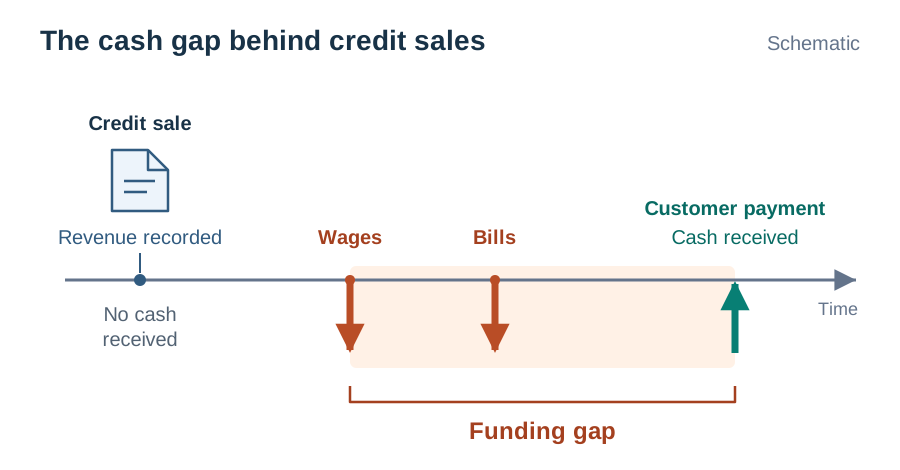
- Credit sales: Revenue is recorded the moment an invoice is sent, but the cash may not arrive for 60 to 90 days. If wages and utility bills fall due before customers settle, the bank account runs dry.
- Overtrading: A rapidly expanding firm accepts substantial new orders but lacks the liquid cash to buy raw materials and pay workers before customer payments arrive.
- Capital expenditure: Buying fixed assets like vehicles or factory equipment causes an immediate cash drain. In contrast, the profit and loss account records only that year's depreciation charge.
Five Practical Remedies for a Cash Deficit
- Tighten debtor credit control: Shorten credit terms offered to customers from 60 days to 30 days, run credit checks on new buyers, and offer cash discounts (such as 3% off for payment within 7 days) to speed up inflows.
- Negotiate extended supplier credit: Request that trade suppliers extend terms from 30 to 60 days, deferring outgoing cash without incurring bank interest charges.
- Use invoice factoring: Sell unpaid customer sales invoices to a specialist financial firm for an immediate cash advance (usually 80% to 90% of book value), converting credit sales into instant liquidity.
- Postpone non-essential capital spending: Defer discretionary purchases, such as vehicle upgrades or office redecorating, until cash balances recover.
- Sale and leaseback: Sell existing premises or equipment to a finance house for an immediate lump sum of cash, and rent the asset back under a long-term commercial lease.
Choosing Sources of Finance: Matching to Purpose
When selecting finance, a business must match the source to the purpose: short-term needs should be funded with short-term finance, medium-term assets with medium-term finance, and permanent fixed assets with long-term capital.
Short-Term Sources (Repayable within 1 Year)
Used for day-to-day operating costs, routine bills, and seasonal inventory needs:
- Bank overdraft: An agreement allowing a business to withdraw funds up to an approved limit past zero on its current account. Interest is calculated daily on the overdrawn balance. It is flexible, but interest rates are relatively high and the bank can demand repayment at short notice.
- Trade credit: Purchasing goods and raw materials from suppliers with an agreement to pay 30 to 60 days later. It serves as interest-free working capital, though missing agreed dates harms supplier relationships.
- Factoring: Selling trade debts to a factoring company for immediate cash (typically 80% to 90% of invoice value). The factor collects payment directly from the customers. It generates quick liquidity, but the factor retains a fee (usually 2% to 5%).
- Invoice discounting: Borrowing against unpaid customer invoices; the business still collects the debts from its customers itself.
- Accrued expenses: Delaying the payment of routine utility, tax, or rent bills until the final due date, retaining cash inside the business.
Medium-Term Sources (Repayable across 1 to 5 Years)
Used to purchase delivery vans, computers, and light manufacturing equipment:
- Medium-term loan: A fixed lump sum borrowed from a commercial bank and repaid in regular instalments of capital and interest over 1 to 5 years. Banks generally require security (collateral).
- Leasing: Hiring machinery or vehicles for an agreed period without taking legal ownership. The leasing company handles depreciation, and monthly payments are tax-deductible trading expenses.
- Hire purchase: Buying equipment by paying an upfront deposit followed by fixed instalments over 1 to 5 years. Ownership passes to the buyer upon payment of the final instalment.
Long-Term Sources (Repayable after 5+ Years or Permanent)
Used for purchasing land, building factories, or major corporate acquisitions:
- Retained earnings: Reinvesting accumulated trading profits back into the company. It carries no interest charges, requires no fixed repayments, and causes no dilution of control, but relies entirely on past profitability.
- Ordinary share capital: Selling shares to new investors. The funds are permanent and do not require repayment. Dividends are discretionary. However, issuing new shares dilutes the voting control of original shareholders.
- Debentures: Long-term loans secured against company assets, carrying a fixed rate of interest that must be paid annually regardless of profit. Ownership control is preserved, but failure to repay risks liquidation.
- State enterprise grants: Non-repayable capital funding provided by bodies like Enterprise Ireland or Local Enterprise Offices for projects that generate employment, regional development, or export sales.
- Venture capital and business angels: Venture capital firms invest significant funds into high-growth potential businesses in exchange for substantial equity and board seats. A business angel is a wealthy private investor who provides start-up capital and personal mentoring in exchange for a share in the business.
Debt vs Equity Capital
When funding major expansion, management must evaluate whether to borrow (debt) or sell shares (equity):
| Feature | Debt Capital (Term Loans, Debentures) | Equity Capital (Share Issues, Retained Earnings) |
|---|---|---|
| Ownership Control | Full control is retained; lenders do not get voting rights. | Issuing new shares dilutes original ownership control and voting power. |
| Cost of Funds | Fixed interest must be paid regardless of profit; interest is tax-deductible. | Dividends are paid only if profits allow and the board approves; dividends are not tax-deductible. |
| Repayment | Must be repaid in full by the agreed maturity date. | Equity capital is permanent and is never repaid by the company during operations. |
| Financial Risk | Increases risk; high levels of debt create high gearing, which threatens solvency if trading falls. | Lower risk; the business cannot be forced into liquidation if it fails to pay dividends. |
Key terms
- Key Activities
- The most important operational tasks an enterprise must execute to manufacture goods, deliver services, and earn revenue.
- Key Resources
- The essential physical, intellectual, human, and financial assets required to make an enterprise's operational model work.
- Key Partners
- External independent organisations, suppliers, and collaborators that help a business reduce costs, lower operational risk, and acquire essential resources.
- Strategic Alliance
- A cooperative arrangement where two or more independent firms that are not competitors share resources or distribution networks while remaining separate businesses.
- Co-opetition
- A commercial strategy where direct competitors collaborate on expensive component manufacturing or non-core development while continuing to compete for retail market share.
- Joint Venture
- A formal partnership in which two or more independent businesses create and co-own an entirely new, separate legal company to undertake a specific commercial project.
- Fixed Costs
- Operating overheads that do not alter in total with changes in output volume in the short term, such as factory rent, rates, insurance, and loan interest.
- Variable Costs
- Operating expenses that rise or fall in direct proportion to the volume of goods manufactured or services delivered, such as raw materials and direct labour.
- Recurring Sales
- Predictable, ongoing revenue collected at scheduled intervals through subscription fees, memberships, or service maintenance contracts.
- Cash Flow Forecast
- A forward-looking financial schedule estimating expected cash receipts, cash payments, net cash flow, and bank balances over a series of future trading months.
- Net Cash
- The difference between total cash receipts and total cash payments for a specific trading period, before adding the opening cash balance.
- Overtrading
- A situation where a business expands production and sales too quickly without having sufficient liquid cash to pay for the extra stock, wages, and running costs before customer payments are received.
- Bank Overdraft
- A flexible short-term credit facility allowing a business to withdraw funds beyond a zero balance on its current account up to an agreed limit, with interest charged daily on the overdrawn sum.
- Factoring
- Selling a business's unpaid customer invoices to a specialist finance company for immediate cash, with the factor taking over collection of the debts in exchange for a fee.
- Leasing
- A medium-term contract allowing a business to use equipment or vehicles for an agreed period in return for regular rental payments, without acquiring legal ownership.
- Hire Purchase
- A medium-term financing method where a business acquires an asset by paying an initial deposit followed by regular instalments, with legal ownership transferring only upon payment of the final instalment.
- Retained Earnings
- Accumulated trading profits kept inside the company and reinvested into business operations rather than paid out as dividends to shareholders.
- Gearing
- The proportion of a company's long-term capital that is funded through debt (borrowings) compared with equity (shareholders' funds).
Check yourself
A business forecast shows Receipts of €40,000 and Net Cash of (€6,000). Calculate Total Payments.
Payments = Receipts - Net Cash = €40,000 - (-€6,000) = €40,000 + €6,000 = €46,000.
A Galway café requires €30,000 for a new commercial espresso machine and €4,000 to cover wages during a quiet January. Recommend a suitable source of finance for each and give a reason.
For the espresso machine: a medium-term loan or leasing, because the machine will generate revenue over several years. For January wages: a short-term bank overdraft, because the shortfall is temporary and will be cleared when seasonal summer trade returns.
Distinguish between debt capital and equity capital on the basis of ownership control and repayment obligations.
Debt capital involves borrowing money; lenders receive no voting shares so ownership control is retained, but the principal must be repaid by an agreed date. Equity capital is money raised from shareholders; it never has to be repaid, but issuing shares dilutes voting control.
Explain how overtrading can push a rapidly expanding, profitable company into liquidation.
Overtrading occurs when a firm increases production and sales too quickly without having enough liquid cash to pay for raw materials, wages, and overheads before customer payments on credit are collected. The firm then cannot pay suppliers, wages or loan repayments when they fall due, so it becomes insolvent even though it is making a profit, and creditors may force it into liquidation.
Distinguish between a strategic alliance and co-opetition.
A strategic alliance is a cooperative agreement between non-competing firms sharing resources, whereas co-opetition occurs when direct commercial rivals cooperate on non-core activities to cut costs while continuing to compete for retail sales.
Distinguish between invoice factoring and invoice discounting.
In factoring, the business sells its unpaid invoices to a finance company that takes over debt collection directly from customers. In invoice discounting, the business borrows money against its unpaid invoices while continuing to collect payments from customers itself.