

Enterprise is all about taking the initiative to try something new. An enterprising person spots an unmet need or a fresh opening, pulls together resources, and takes on personal and financial risk to make things happen. In Leaving Certificate Business, this topic looks at why people set up ventures, the competencies that innovators rely on, how intrapreneurs drive change inside established firms, and where enterprise shows up across everyday life, communities, businesses, and public services. It also looks at how government agencies like Local Enterprise Offices (LEOs) and Enterprise Ireland help new ideas get off the ground.
Enterprise, the Entrepreneur, and Why People Start Businesses
Enterprise means taking the initiative to begin something new. Enterprising people do not wait around for others to fix a problem. They spot an opportunity, gather what they need, and take action.
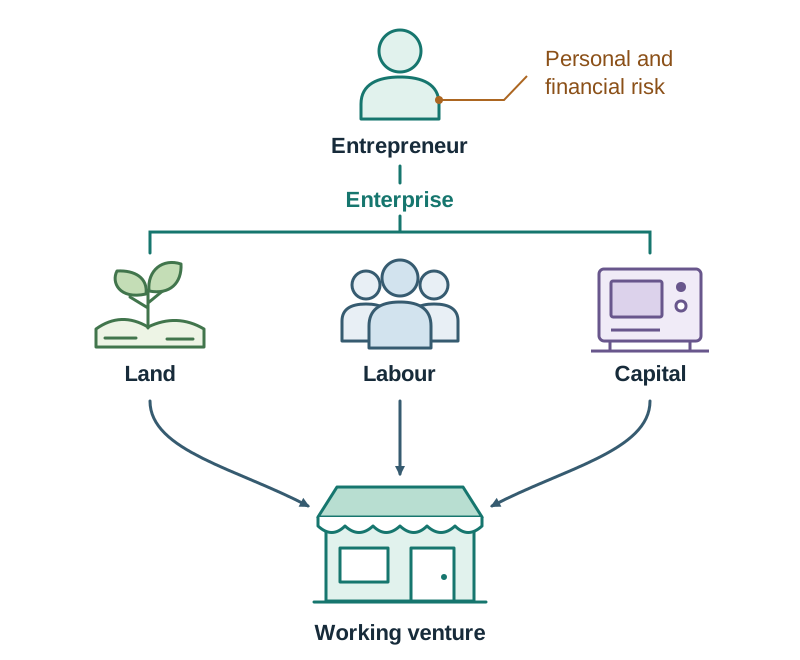
In economics, production relies on four basic factors: land, labour, capital, and enterprise. The entrepreneur provides that fourth factor. Entrepreneurs combine natural resources, workers' effort, and equipment or finance, taking real financial and personal risks in the hope of making a profit or building a worthwhile venture.
Why People Start an Enterprise
People set up ventures for many reasons, usually sorted into push factors and pull factors.
Push factors happen when external pressures force someone into self-employment. Redundancy or sudden job loss is a classic trigger; an experienced head chef let go from a restaurant might convert a horsebox into a mobile coffee unit to earn a living. Frustration with rigid hours, low pay, or poor promotion prospects in an existing job also pushes people to go out on their own.
Pull factors are positive attractions that draw someone toward starting a business. An individual might spot an obvious gap in the local market, like a town with no bicycle repair shop. Others want autonomy and independence, preferring to be their own boss and choose their own working hours. The chance to keep the financial rewards of hard work rather than earning a fixed wage is a powerful pull, as is the desire to turn a lifelong hobby into a living or tackle an environmental issue in the community.
Enterprise versus Management
Enterprise and management are not the same thing, though one person often handles both.
Enterprise is about starting from scratch. It involves spotting openings, taking commercial risks, and turning an untested idea into a functioning reality. Management is the day-to-day work of coordinating people, keeping records, controlling budgets, and making sure an established operation runs smoothly.
Think of a graphic designer who quits their job to start a studio. On day one, they act as an entrepreneur by risking their savings and finding their first clients. Six months later, when they are scheduling project deadlines, paying utility bills, and invoicing clients, they are working as a manager.
| Feature | Enterprise | Management |
|---|---|---|
| Main Focus | Creating a new venture, product, or service. | Running and coordinating an existing organisation. |
| Timing | Crucial during start-up, product launches, and expansion. | Ongoing every working day. |
| Risk Profile | Carries direct personal and financial risk. | Manages operational and project risks for the firm. |
| School Example | A student pitching and launching a new lunchtime debate society. | The society treasurer tracking dues and booking rooms each week. |
Competencies of Innovators and Start-Up Success
The Business specification defines competencies as the blend of knowledge, skills, values, and personal dispositions that support innovation. A great idea alone will not keep a business afloat. Founders rely on specific competencies to survive the unpredictable start-up phase.
- Opportunity Recognition: This is the skill of spotting customer frustrations or gaps in the market that competitors have overlooked. Without it, founders risk sinking time and money into products nobody actually wants to buy.
- Calculated Risk-Taking: Good entrepreneurs do not gamble blindly. They do their homework, run surveys, and evaluate costs so that the expected return justifies risking their personal savings and career security.
- Flexibility and Adaptability: Early business plans almost never survive contact with real buyers. When customer feedback or supplier prices turn out differently than expected, an adaptable founder tweaks the product or pricing model instead of stubbornly sticking to a failing plan.
- Resilience and Stamina: Starting a business brings constant setbacks, from delayed shipments to rejected loan applications. Resilient founders take the hit, learn what went wrong, and keep pushing forward.
- Decisiveness: Start-ups move fast and do not have layers of advisory committees. A founder has to make clear choices about suppliers, pricing, and launch dates even when information is incomplete.
- Self-Confidence: Believing in the venture gives an entrepreneur the persuasive edge needed to win over sceptical bank managers, early suppliers, and initial customers.
- Networking and Communication: A brand-new business has no track record. Founders must build relationships with local traders, trade associations, and mentors to earn word-of-mouth trust and secure trade credit.
Innovation and Where Enterprise Appears
Innovation means turning a clever idea into a practical product, service, or process that people actually use or pay for. It is quite different from invention. An invention is simply creating something new in a workshop or laboratory; it only becomes an innovation once it is brought to market and adopted by customers.
Why Businesses Must Innovate
Businesses that stand still get left behind. Fresh designs or clever services give a firm a distinct edge over rivals, giving customers a compelling reason to buy from them. Innovation also protects a business from obsolescence when consumer tastes change. Process innovation matters just as much as new products; automated booking systems or energy-efficient ovens cut operating waste and lower overhead costs, making the business more durable.
Enterprise in Different Contexts
Enterprise is not just about commercial balance sheets. It shows up in every corner of life:
- Personal Life: Taking charge of your own path requires enterprise. Organising an independent study timetable, pitching a new school club, or setting up a weekend car-valeting service shows initiative, time management, and a willingness to take responsibility.
- In the Community: Community enterprise relies on locals stepping forward to solve local issues. Voluntary Tidy Towns committees, community-run childcare facilities, and charity 5k runs all depend on enterprising volunteers gathering resources for the public good.
- In Government and Public Bodies: Public sector organisations often innovate to deliver better services. Revenue's Online Service (ROS) and myAccount replaced slow paper filings with fast electronic tax management for citizens and firms.
- In Commercial Business: Ranging from small neighbourhood sole traders to large multinational employers expanding into overseas markets.
Examples Across Three Levels
At a local level, think of a neighbourhood mechanic setting up a mobile van repair service to fix farm machinery directly on site. Nationally, Irish brothers Patrick and John Collison founded Stripe, transforming digital payments for online commerce, while FoodCloud built a platform connecting supermarkets with local charities to distribute edible surplus food. Internationally, an engineer at Sony championed the original PlayStation project from within the firm, reshaping the global video games sector.
Forms of Enterprise and the Role of Intrapreneurship
Enterprises can be grouped by who owns them and what they set out to achieve:
- Private Enterprise: Commercial businesses run by sole traders, partners, or corporate shareholders. Their main goal is making a profit and growing capital value (such as Dunnes Stores or Ryanair).
- Not-for-Profit Enterprise: Organisations set up to achieve social, charitable, or environmental aims rather than handing profits to private owners. Any surplus cash earned is ploughed back into their core work. Social enterprises like FoodCloud and community sporting clubs fall into this group.
- Public and Semi-State Enterprise: State-owned bodies set up by the government to provide essential national infrastructure, public utilities, or transport services (such as ESB or Dublin Bus).
Intrapreneurship: Innovating on the Payroll
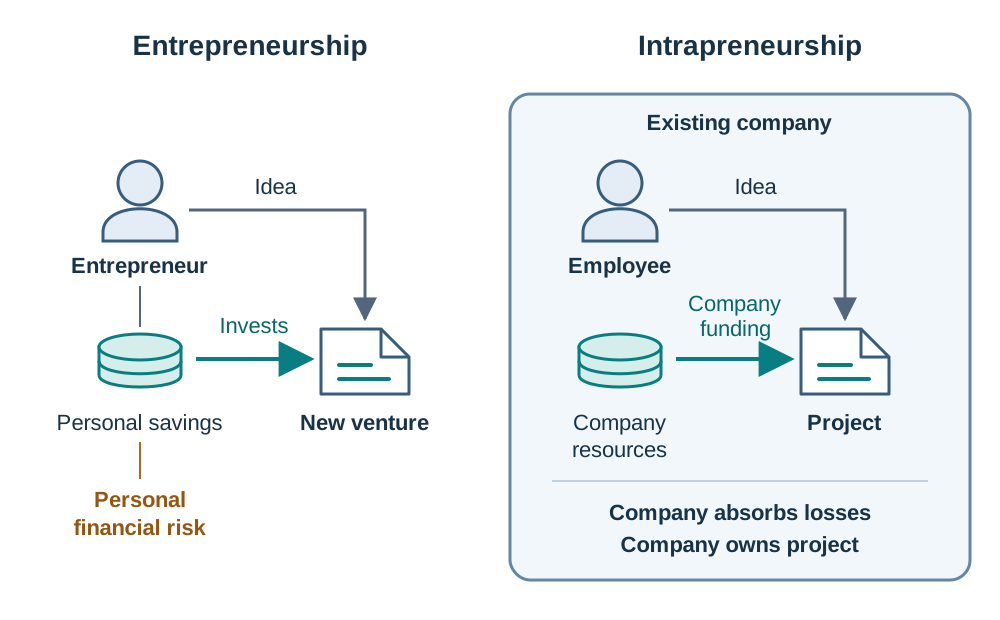
Intrapreneurship is entrepreneurship inside an existing organisation. An intrapreneur is an employee who uses their initiative, creativity, and problem-solving skills to improve products, cut down waste, or invent new services using their employer's resources. The defining difference is financial risk: the company funds the project, absorbs any losses, and retains ownership of the resulting asset.
Giving employees room to act like intrapreneurs brings major advantages. It unlocks fresh revenue streams, such as 3M scientists developing Post-it Notes from an unpromising laboratory adhesive. It also lowers operating costs because workers on the factory floor or checkout desks often see practical inefficiencies that senior managers miss. Furthermore, allowing staff to run with good ideas boosts job satisfaction and keeps talented workers from leaving for competitors.
Fostering an Intrapreneurial Culture
Companies cannot just order employees to be creative; they have to build an environment that supports it. Management can encourage this behaviour by:
- Removing the fear of failure so employees know that a well-planned trial that misses its targets won't derail their careers.
- Setting aside dedicated work time and modest prototype budgets for staff to explore side projects.
- Offering tangible recognition through bonuses, profit-sharing, or public praise when ideas deliver results.
- Keeping organisational structures relatively flat so frontline staff can present ideas directly to managers without clearing multiple bureaucratic hurdles.
Value of Enterprise to the Wider Economy
When individuals take the initiative to launch new ventures, the benefits extend far beyond their own bank accounts.
Benefits for Government and Public Finances
A healthy enterprise sector strengthens state finances. Profitable businesses pay Corporation Tax and local authority rates. Their employees pay income tax (PAYE) and the Universal Social Charge (USC), and consumer spending generates VAT receipts for the Exchequer. By providing steady jobs, thriving businesses also reduce the need for state social protection payments, freeing up public funds for schools, hospitals, and infrastructure.
The Economic Multiplier Effect
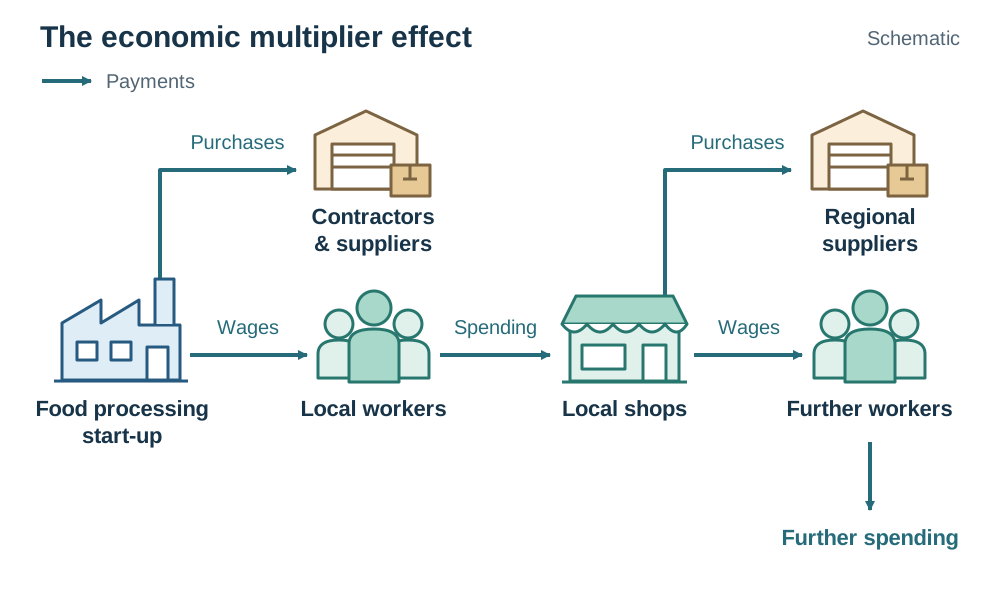
The multiplier effect describes how an initial injection of spending into an economy leads to a much bigger total increase in national income.
Imagine a food processing start-up opens in a provincial town. The business spends money immediately on local building contractors, specialist equipment, and haulage services. It then hires local workers and pays them weekly wages. Those workers do not leave their wages under the mattress; they spend them in the town's pharmacies, butcher shops, bakeries, and petrol stations. Those local shops see their own turnover rise, allowing them to take on extra staff or buy more stock from regional suppliers. That second wave of workers spends their wages in turn. Through this chain reaction, the initial investment circulates through the community, creating economic activity far greater than the original sums spent by the start-up.
Benefits for Society and Communities
Thriving local enterprises breathe life into rural areas, giving school leavers and graduates good reasons to build their careers locally rather than migrating to major cities. They introduce services that make everyday living easier, support local sports clubs through sponsorships, and foster a visible business culture that gives other people the confidence to start out on their own.
State Support and Government Levers for Enterprise
The Irish government uses broad economic policies and dedicated state agencies to help businesses take root and expand.
Creating a Positive Climate for Business
The state shapes the business climate through several everyday policy levers:
- Taxation Levers: Maintaining a competitive 12.5% Corporation Tax rate on trading profits lets businesses keep a higher portion of their earnings to reinvest in new machinery and hiring. Reliefs like the Start-up Relief for Entrepreneurs (SURE) help reduce early tax burdens for people leaving employment to launch ventures.
- Infrastructure Spending: Upgrading roads, port facilities, and regional broadband under the National Broadband Plan gives businesses outside large cities the physical transport and digital links they need to trade smoothly.
- Education and Skills: State agencies like SOLAS manage apprenticeships, while Springboard+ funds targeted higher-education conversion courses, ensuring employers can recruit skilled workers.
- Cutting Red Tape: Moving administrative tasks online through the Companies Registration Office (CRO) and Revenue's digital platforms saves small firms time and lowers compliance costs.
- Access to Credit: State-backed bodies like Microfinance Ireland offer small loans to micro-enterprises that cannot secure loans through mainstream commercial banks.
Key State Departments and Support Agencies
The Department of Enterprise, Trade and Employment (DETE) steers national enterprise strategy. It drafts company law, oversees worker and consumer protection rules, and coordinates Ireland's state agencies.
Local Enterprise Offices (LEOs) operate across 31 local authority locations, acting as the front door for anyone starting or growing a small local firm. Their direct grant supports focus primarily on micro-enterprises (businesses with 10 or fewer staff), particularly in manufacturing or internationally traded services:
- Feasibility Study Grants: Cover a portion of the costs of researching market demand and testing whether an unproven business concept can actually work.
- Priming Grants: Help eligible start-ups cover salary contributions and essential capital equipment during their first 18 months of trading, typically funding up to half of eligible start-up costs.
- Mentoring and Training: The LEO Mentor Programme pairs business owners with experienced commercial advisers to work through pricing, bookkeeping, or cash flow problems, alongside practical short courses in digital marketing and tax compliance.
Enterprise Ireland (EI) focuses on helping indigenous, Irish-owned companies scale up and compete internationally:
- High Potential Start-Up (HPSU) Support: Provides equity funding and growth advisory services to ambitious Irish firms with the technology and vision to achieve substantial overseas sales and hire 10 or more people within three to four years.
- International Market Access: Maintains an extensive overseas office network that helps Irish exporters find distributors, navigate foreign regulations, and attend international trade missions.
Targeted Support Programmes
- ACORNS (Accelerating the Creation Of Rural Nascent Start-ups): A dedicated peer-mentoring scheme that supports early-stage female entrepreneurs running businesses in rural Ireland.
- The Food Academy Programme: A joint initiative between LEOs, Bord Bia, and SuperValu that mentors artisan food and drink producers and provides a stepping stone to commercial supermarket shelf space.
Key terms
- Enterprise
- The initiative to start or attempt something new by spotting an opportunity, taking on risk, and gathering the required resources to turn an idea into action.
- Entrepreneur
- An individual who spots an opening, commits personal time and funds, and bears the financial risk of starting a business in pursuit of profit or a return.
- Competencies (of innovators)
- The combination of knowledge, skills, values, and dispositions that support and foster innovation.
- Intrapreneurship
- Enterprising initiative, creativity, and problem-solving shown by employees within an existing organisation using company resources without bearing personal financial risk.
- Innovation
- Turning a new idea into a new or improved product, service, or process that is commercially viable or adopted in practice.
- Multiplier Effect
- The ripple effect whereby an initial injection of spending into an economy circulates through wages and purchases, generating a larger total increase in economic activity.
- Not-for-Profit Enterprise
- An organisation driven by community, social, or environmental goals that reinvests any operating surplus back into its mission rather than distributing profit to private owners.
- Local Enterprise Office (LEO)
- A network of 31 local authority offices providing advice, business mentoring, practical training, and start-up grants primarily to local micro-enterprises.
- Enterprise Ireland (EI)
- The state development agency responsible for supporting the growth, scaling, and international export performance of indigenous Irish-owned enterprises.
- Feasibility Study Grant
- A financial grant from support agencies like LEOs that helps a business investigate market demand and verify the commercial viability of a new product or idea.
- Priming Grant
- A financial grant offered by LEOs to eligible start-ups in their first 18 months to help cover equipment costs, wages, and essential setup expenses.
Check yourself
What is the key difference between an entrepreneur and an intrapreneur?
An entrepreneur establishes a new venture and carries personal financial risk using their own capital. An intrapreneur innovates inside an existing firm using company resources, bearing no direct financial loss if the idea fails.
Give one push factor and one pull factor that might encourage someone to start a business.
A push factor is redundancy or unemployment (external pressure forcing self-employment). A pull factor is independence or spotting a profitable market opening (an opportunity attracting the person toward enterprise).
Give an example of enterprise in action within a school and explain what makes it enterprising.
A student founding a new lunchtime coding club. It is enterprising because the student identifies an interest, takes the initiative to organise venues and computers, and takes on the risk that classmates might not turn up.
How does the economic multiplier effect help a small town when a new craft workshop opens?
The wages paid to workshop staff and money spent on local hauliers circulate through the town when those workers buy groceries, lunches, and fuel locally, supporting further trade and employment across the area.
Which Irish state agency supports a local café owner with four staff seeking business guidance, and can they access direct grant aid to test an expansion idea?
The Local Enterprise Office (LEO). It can offer business advice, mentoring, and training. Direct grants such as a Feasibility Study Grant usually go to manufacturing or internationally traded services, so a purely local café would more likely receive mentoring and advice rather than direct grant aid.