

Ireland is a small, open economy: it trades extensively with other nations, meaning international trends, European Union policies, and domestic decisions swiftly impact Irish firms. This topic covers the business environment, stakeholder relationships and conflict management, the legal forms of business ownership, the structural value of the Irish business economy, six key macroeconomic indicators, the government's role in fostering enterprise, national policymaking and lobbying, European Union legal instruments, and Foreign Direct Investment.
Stakeholders, Power-Interest Mapping, and Conflict Management
A stakeholder is any individual, group, or organisation that has an interest in, or is affected by, the operations and decisions of a business.
- Internal stakeholders: Business owners and shareholders pursue profits and capital growth; managers seek operational success and career progression; employees look for fair pay, job security, and safe conditions.
- External stakeholders: Consumers demand quality and fair pricing; suppliers require dependable orders and prompt payment; the local community expects environmental care and local employment; the government requires statutory compliance and tax revenues.
Stakeholder Needs Change as a Business Evolves
Stakeholder priorities shift across a business lifecycle:
- Start-up stage: Founders focus on survival and cash flow; suppliers keep credit terms tight until trust is proven; initial employees often accept uncertainty in exchange for future opportunities.
- Growth stage: Outside investors demand measurable returns and dividend payouts; employees seek formal career structures; local communities focus on local planning, traffic, and noise.
- Mature or listed stage: Institutional shareholders require steady dividends and corporate governance; regulators review market conduct, tax compliance, and ESG disclosures.
Stakeholder Mapping: The Power-Interest Grid
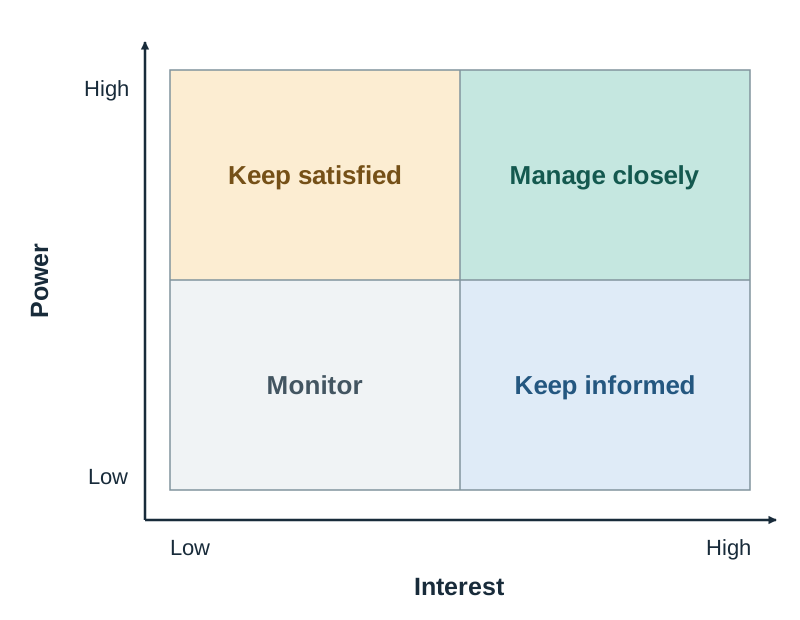
A power-interest grid is a stakeholder mapping matrix that categorises stakeholders by their influence (power) and level of concern (interest):
- High Power, High Interest (Manage Closely): Key players who require direct consultation, such as primary lenders, major shareholders, or vital regulators.
- High Power, Low Interest (Keep Satisfied): Influential groups who do not engage day-to-day but must be kept content so they do not intervene disruptively, such as the Revenue Commissioners.
- Low Power, High Interest (Keep Informed): Groups needing regular communication, such as frontline employees or local community associations. Ignoring them can erode goodwill or provoke industrial unrest.
- Low Power, Low Interest (Monitor): Groups requiring minimal operational effort. Monitor them with little effort, but check now and again in case they become more powerful or more interested.
Avoiding Conflict Before It Starts
- Regular communication and consultation: Works councils and regular staff briefings give employees a voice before executive decisions are finalised.
- Clear written procedures: Formal grievance and disciplinary procedures establish agreed, transparent steps for disputes.
- Shared financial rewards: Employee share-ownership plans or profit-sharing schemes align worker incentives with shareholder targets.
- Codes of practice and customer charters: Written ethical standards outline transparent payment terms for suppliers and service guarantees for consumers.
Resolving Conflict When It Occurs
- Negotiation: Direct discussions where conflicting parties talk face-to-face to reach a compromise without third-party intervention.
- Conciliation: An independent third party, such as a conciliation officer from the Workplace Relations Commission (WRC), facilitates dialogue, clarifies positions, and suggests possible compromises. The conciliator cannot impose a settlement.
- Mediation: A neutral mediator guides parties to design their own mutually acceptable agreement.
- Arbitration: Both sides agree to refer the dispute to an independent arbitrator, who examines evidence and issues a decision. Whether that decision is binding depends on what both parties agreed before the hearing.
- The Labour Court: The court of last resort for industrial relations disputes. It hears disputes referred from the WRC and issues a formal recommendation. This recommendation is not legally binding unless both parties agreed in advance to accept it, though it carries substantial moral weight.
Business Ownership, Enterprise Sectors, and Governance
Enterprises operate across three primary sectors of ownership:
- Private enterprise: Owned and financed by private individuals to generate a commercial profit.
- Public enterprise: State-owned bodies established by the government. They include commercial semi-states that sell goods or services (such as the ESB and An Post) and non-commercial semi-states providing regulatory or support functions (such as Enterprise Ireland).
- Not-for-profit enterprise: Organisations established for charitable, environmental, or community purposes rather than private profit, such as social enterprises and non-governmental organisations (NGOs).
Forms of Business Ownership
- Sole trader: Owned and controlled by one individual who keeps all profits. The owner faces unlimited liability, meaning personal assets can be seized to clear business debts (e.g. an independent tradesperson).
- Partnership: Owned by 2 to 50 partners (Companies Act 2014; some professional firms such as solicitors and accountants may exceed this), usually under a written partnership agreement. Partners share profits and typically share unlimited liability (e.g. an accountancy firm).
- Private limited company (LTD): Owned by 1 to 149 shareholders, registered under the Companies Act 2014. Shareholders enjoy limited liability, meaning they can only lose their invested capital. Shares cannot be offered to the general public.
- Designated Activity Company (DAC): A private limited company whose activities are restricted by its constitution to specific stated purposes. Often used by multinational subsidiaries and joint ventures.
- Public limited company (PLC): Owned by public shareholders whose shares are traded on a stock exchange (such as Euronext Dublin). Offers limited liability and can raise substantial equity from the public (e.g. Kerry Group).
- Franchise: The franchisor grants a franchisee the commercial right to trade using its brand name, systems, and products in exchange for an upfront fee and ongoing royalties (e.g. Supermac's).
- Co-operative: Owned and run democratically by its members (farmers, workers, or customers) on a one-member, one-vote basis. Members share limited liability and receive dividends based on patronage (e.g. Dairygold, credit unions).
- Public sector / semi-state body: Established by statute and owned by the State through a government Minister. It provides strategic infrastructure or national public services.
Lifecycle Changes in Ownership
A business often launches as a sole trader, incorporates as a private limited company (LTD) to protect personal wealth through limited liability, and later floats as a public limited company (PLC) to fund international expansion. The State can also change enterprise ownership:
- Privatisation: Selling a state-owned enterprise to private investors or public shareholders (e.g. Aer Lingus in 2006). It provides the exchequer with a once-off sum of money to fund national infrastructure or reduce debt, and commercial market competition can improve operational efficiency. However, the State loses annual dividend revenue, loses strategic control over essential infrastructure, and private owners may terminate unprofitable rural routes.
- Nationalisation: The government taking a private business into state ownership, such as the nationalisation of Anglo Irish Bank in 2009. It preserves systemic stability and protects essential public services during a crisis, but the taxpayer must cover all trading losses, commercial liabilities, and debt.
Regulation and Governance
Governance is the framework of rules, relationships, systems, and processes by which an enterprise is directed, administered, and controlled. It requires board accountability, transparent reporting, and independent external audits.
Statutory regulation is enforced by specialised Irish bodies:
- Companies Registration Office (CRO): Registers new companies and receives mandatory annual returns and financial statements for public inspection.
- Corporate Enforcement Authority (CEA): Investigates and prosecutes suspected breaches of company law and director misconduct.
- Central Bank of Ireland: Regulates financial institutions, insurance companies, and credit unions to protect stability and consumers.
- Competition and Consumer Protection Commission (CCPC): Enforces competition law, evaluates commercial mergers, and protects consumer rights.
- Health and Safety Authority (HSA): Enforces statutory occupational health and safety laws.
- Environmental Protection Agency (EPA): Licences and monitors industrial emissions, commercial waste, and environmental protection.
- Data Protection Commission (DPC): Supervises data privacy compliance under GDPR and domestic law.
Environmental, Social, and Governance (ESG) Reporting
Many enterprises report non-financial performance under three pillars:
- Environmental: Energy usage, greenhouse gas emissions, raw material sourcing, and waste handling under circular economy models.
- Social: Workplace health, fair pay, gender balance, diversity, and community engagement.
- Governance: Board independence, executive pay disclosures, anti-bribery policies, and risk management systems.
The Structure and Value of the Irish Business Economy
The Central Statistics Office (CSO) publishes data on enterprise scale, sector distribution, and wealth generation across the Irish business economy.
The Importance of SMEs
The European Union defines Small and Medium Enterprises (SMEs) as enterprises employing fewer than 250 persons, with an annual turnover not exceeding €50 million or an annual balance sheet total not exceeding €43 million.
According to CSO business-economy data:
- SMEs make up over 99% of all active businesses in Ireland and provide approximately two-thirds of business-economy employment.
- Micro-enterprises (fewer than 10 employees) account for roughly 92% of active businesses.
- Small enterprises (10–49 employees) represent about 6.5%.
- Medium enterprises (50–249 employees) account for roughly 1%.
- Large enterprises (250+ employees) make up less than 0.5% of business numbers, yet they generate nearly one-third of total business-economy employment and substantial export revenues.
Sectoral Employment in the Irish Business Economy
CSO figures illustrate how private business employment is spread across core economic sectors:
- Services: Generates over half of all business-economy jobs across technical, professional, hospitality, and commercial activities.
- Wholesale and Retail Trade: Employs roughly 18% of workers, serving as the essential route to market for consumer goods.
- Industry and Manufacturing: Accounts for roughly 13% of employment, generating high-value output in pharmaceuticals, medical devices, and food production.
- Construction: Employs approximately 8% to 9%, driven by housing and civil infrastructure projects.
- Financial and Insurance Activities: Employs roughly 5% to 6%, supporting international and domestic banking and asset management.
Turnover and Gross Value Added (GVA)
- Turnover: The gross revenue generated from sales of goods and services by an enterprise over a financial year, before deducting any expenses or taxes.
- Gross Value Added (GVA): The value a business adds through its own operations. It is calculated as the value of output minus the intermediate consumption of goods and services bought in to create that output ($$). GVA reflects the true economic contribution added by an organisation's capital, technology, and labour.
How the Irish Government Fosters Enterprise
The Irish government cannot direct private commercial operations, but it creates a positive climate for business through financial, regulatory, and infrastructural supports.
Methods of Government Support
- Low taxation: Ireland maintains a competitive 12.5% corporation tax rate on trading profits, allowing firms to reinvest earnings into expansion. Start-up tax exemptions reduce initial tax burdens for new ventures. The Employment and Investment Incentive (EII) provides personal income-tax relief to investors funding small Irish companies, simplifying early-stage capital raising.
- State agency grants, mentoring, and advice:
- Local Enterprise Offices (LEOs): Located in every local authority area, LEOs act as first-stop shops for micro-enterprises (fewer than 10 employees). They provide Priming Grants, Business Expansion Grants, Trading Online Vouchers, mentoring, and "Start Your Own Business" courses.
- Enterprise Ireland: Backs Irish-owned manufacturing and internationally traded services firms (typically with 10 or more employees) aiming to scale and export. It provides Innovation Vouchers, funding under the High Potential Start-Up (HPSU) programme, and market intelligence through global overseas offices.
- Access to finance: Microfinance Ireland offers commercial loans to micro-enterprises unable to secure traditional bank funding. The Strategic Banking Corporation of Ireland (SBCI) works through commercial lenders to provide low-cost loans for working capital and green transitions.
- National infrastructure investment: Capital funding through the National Development Plan improves road networks, water facilities, and energy capacity. The National Broadband Plan delivers high-speed fibre broadband to regional and rural communities, enabling businesses outside major cities to conduct digital trade.
- Education and workforce training: Subsidised higher education provides a skilled pipeline of graduates in science, engineering, and digital business. State bodies like SOLAS, local Education and Training Boards (ETBs), and Skillnet Ireland design apprenticeships and upskilling courses tailored to private-sector skills requirements.
- Minimising administrative red tape: Digital compliance tools, including the CRO online portal (CORE) for annual corporate filings and the Revenue Commissioners' Revenue Online Service (ROS) for commercial tax returns, reduce administrative overheads for small firms.
Key Economic Indicators and Business Impacts
Six economic indicators strongly affect Irish businesses. Most are tracked by the Central Statistics Office (CSO), benchmark interest rates are set by the European Central Bank (ECB), and consumer confidence is monitored via the Credit Union Consumer Sentiment Index.
1. Employment and the Labour Force
The labour force consists of everyone aged 15 and over who is either working or actively seeking work. The unemployment rate is the percentage of the labour force that is currently out of work. The employment rate measures the percentage of the working-age population (aged 15 to 64) currently in employment. Full employment exists when everyone willing and able to work can find employment, apart from those temporarily moving between roles; in Ireland this corresponds to an unemployment rate of roughly 4% or below.
- Business Impact: High employment boosts household disposable income, driving consumer spending across the retail, leisure, and automotive sectors. However, it creates recruitment bottlenecks and forces firms to raise wages to retain talent. High unemployment cuts retail sales of discretionary goods, but provides a wider applicant pool and moderates wage demands.
2. Inflation
Inflation is a sustained increase in the general level of prices over time, tracked in Ireland by the Consumer Price Index (CPI). It stems from demand-pull factors (aggregate demand outrunning production) or cost-push factors (spikes in wages, energy, or imported components).
- Business Impact: High inflation pushes up input overheads, squeezing gross margins unless businesses pass price increases to customers. Escalating consumer prices erode real purchasing power and can make Irish exporters uncompetitive against lower-cost overseas producers.
3. Interest Rates
Interest rates represent the cost of borrowed funds and the reward for holding deposits. Benchmark rates for Ireland are set by the European Central Bank (ECB) in Frankfurt to control eurozone inflation.
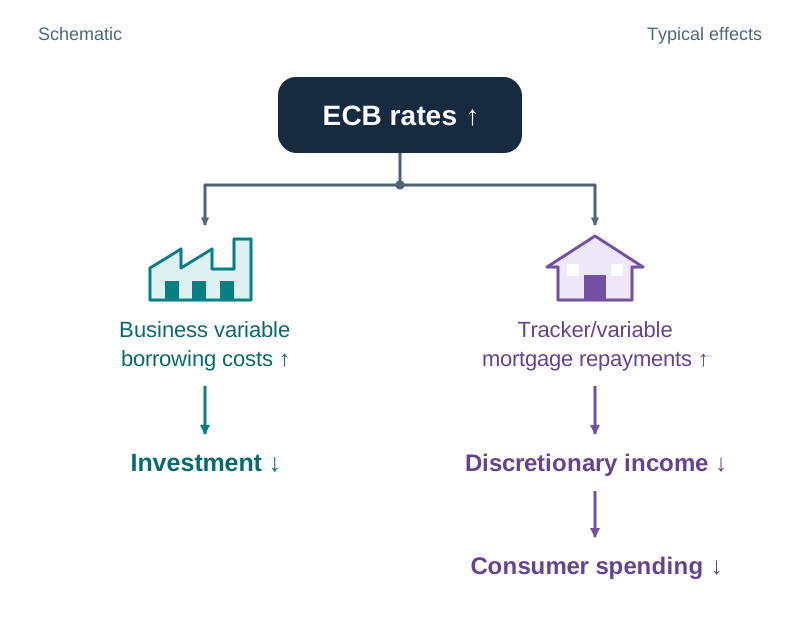
- Business Impact: Higher ECB interest rates increase borrowing expenses on commercial variable-rate loans, overdrafts, and equipment leasing, which discourages business investment. Concurrently, consumers face higher repayments on tracker and variable mortgages, leaving less discretionary income for consumer goods.
4. Economic Growth and Development
Economic growth is the quantitative increase in the volume of goods and services produced over a year, measured by Gross Domestic Product (GDP). In Ireland, multinational transfer pricing, contract manufacturing, and foreign-held intellectual property distort GDP. Consequently, Modified Gross National Income ($$) is used to track the true underlying domestic economy. Economic development represents qualitative improvements in citizen living standards, public health, education, and transport.
- Business Impact: Rapid economic growth increases turnover and investor confidence, but can inflate commercial rents and wage demands. Economic development (such as modern logistics corridors and high-speed broadband networks) lowers logistics expenses and simplifies workforce recruitment.
5. Exchange Rates
An exchange rate is the price of one currency expressed in terms of another.
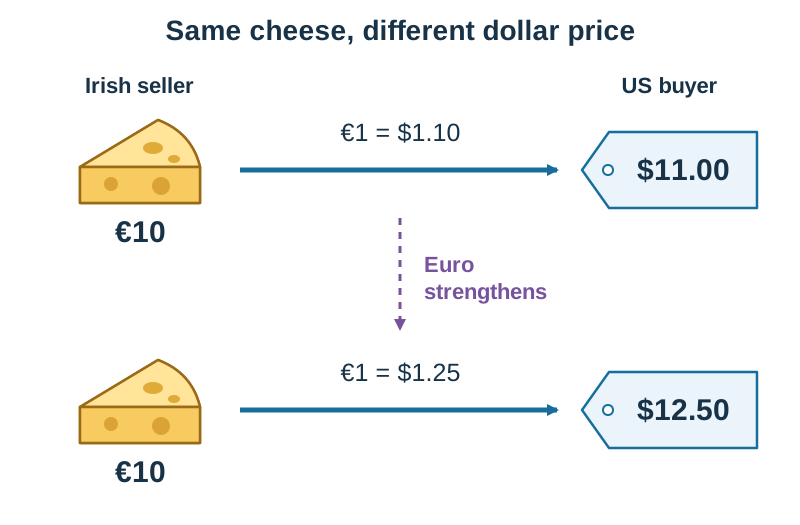
- Business Impact: A strengthening euro makes imported raw materials and stock cheaper for Irish firms, but increases the price of Irish exports abroad, harming export competitiveness in non-eurozone markets such as the UK and US. A weakening euro increases the cost of imported inputs, but makes Irish exports cheaper and more attractive overseas.
Worked currency example: An Irish artisan cheese retails for €10. At an exchange rate of €1 = 11.00. If the euro strengthens to €1 = 12.50 in the US, reducing price competitiveness. Conversely, if the euro weakens to £0.80 against sterling, a €10 cheese costs a UK buyer £8.00 instead of £8.80, boosting sales in Britain.
6. Consumer Confidence
Consumer confidence measures how optimistic households feel regarding their job security, personal finances, and the wider economic outlook.
- Business Impact: High confidence encourages consumers to spend on big-ticket, discretionary items such as new cars, home renovations, and travel. Low confidence leads to precautionary saving, delayed purchases, and lower footfall for retail and hospitality firms.
Irish Government Policy and Business Lobbying
A government policy is a set of strategic objectives and agreed statements of guidance adopted by Cabinet as a basis for executive decision-making. In contrast, legislation consists of formal statutory Acts passed by the Oireachtas that are legally binding and enforceable in court.
When developing policy, the government normally identifies a problem, consults with industry stakeholders, agrees on an official strategy, implements supports or regulations, and evaluates outcomes.
Three Policies Across Distinct CSO Economic Sectors
- CSO Sector: Industry (Manufacturing) — White Paper on Enterprise Policy 2022–2030: Targets sustainable job growth, digital transformation, decarbonisation of manufacturing, and export diversification among indigenous firms. Enterprise Ireland delivers capital grants and digital advisory programmes under this policy.
- CSO Sector: Water Supply, Sewerage, and Waste Management — National Waste Policy 2020–2025: Establishes a circular economy model by setting targets to halve food waste by 2030, introducing deposit-return systems, and mandating eco-design. This policy pushes industrial packagers to reduce virgin plastics and rewards firms reusing production by-products.
- CSO Sector: Agriculture, Forestry, and Fishing — Food Vision 2030: Outlines a strategy for the agri-food industry to become a world leader in sustainable food systems. It focuses on reducing biogenic methane emissions, protecting biodiversity, and developing premium organic export markets.
How Businesses Influence National Policy
Businesses do not passively accept government decisions; they inform and influence policy development:
- Business interest groups:
- IBEC (Irish Business and Employers Confederation) is the primary representative body for large employers, lobbying ministers on commercial costs, taxation, and infrastructure.
- ISME (Irish Small and Medium Enterprises Association) and the SFA (Small Firms Association) advocate for independent small businesses.
- Chambers Ireland represents regional chambers of commerce, promoting local commercial infrastructure and town-centre vitality.
- The IFA (Irish Farmers' Association) represents commercial farming and agri-business interests.
- Pre-Budget submissions: Every summer, employer bodies submit proposals to the Department of Finance outlining tax adjustments, capital spending priorities, and payroll cost protections.
- Public consultations: Government departments publish draft policy papers and invite formal written submissions from enterprises and industry federations.
- Formal social dialogue: Bodies participate in state advisory structures such as the Labour Employer Economic Forum (LEEF) and the National Economic Dialogue.
- Lobbying and transparency: Under the Regulation of Lobbying Act 2015, businesses with more than 10 employees, representative and advocacy bodies, and professional lobbyists who lobby designated public officials (e.g. Ministers, TDs, senior civil servants) must register with the Standards in Public Office Commission (SIPO) and file returns three times a year on the public Register of Lobbying. This guarantees transparency regarding outside influence on legislative decisions.
The European Union: Legal Instruments and Business Impact
Ireland's membership of the European Union provides domestic firms with tariff-free access to a Single Market of approximately 450 million consumers, alongside the free movement of goods, services, capital, and labour.
Key EU Decision-Makers
- European Commission: The executive institution. It proposes new European legislation, oversees implementation, manages the EU budget, and ensures member states uphold European treaties.
- Council of the European Union: Composed of national ministers from each member state. It examines, amends, and adopts EU legislation alongside the European Parliament.
- European Parliament: Directly elected by EU citizens. MEPs debate, amend, and pass EU laws, share budgetary authority, and supervise the Commission.
- European Central Bank (ECB): Manages the monetary policy of the eurozone, setting benchmark interest rates to preserve price stability.
How Ireland Responds to EU Legal Instruments
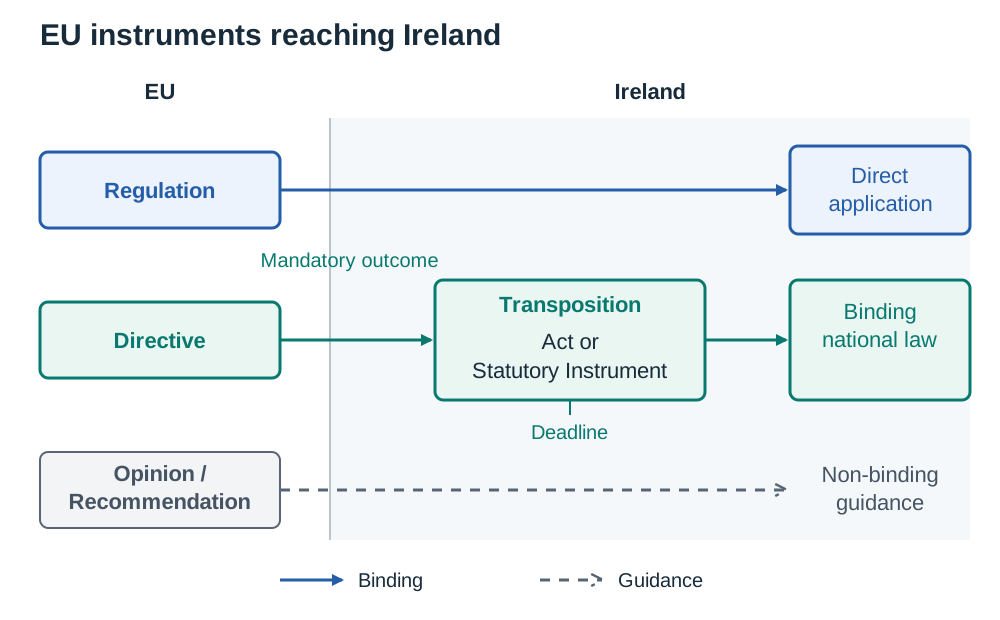
- EU Regulation: A legislative act that applies directly in full across all member states from its designated application date. The Oireachtas does not need to pass domestic transposing laws, and Irish law cannot contradict it. Ireland may introduce secondary legislation to assign local enforcement (e.g. appointing a supervisory authority).
- EU Directive: A legislative act that sets mandatory outcomes for all member states, but leaves the choice of form and method to national authorities. Ireland must transpose the directive into domestic law by passing an Act of the Oireachtas or a Statutory Instrument before a specified deadline. Failure to transpose in time results in European Commission infringement proceedings and potential fines from the Court of Justice of the European Union (CJEU).
- Opinion / Recommendation: Non-binding guidance that allows EU institutions to express a view. The Irish government may consider it, but faces no legal obligation to act.
Evaluating an EU Regulation: GDPR
General Data Protection Regulation (Regulation (EU) 2016/679)
- Purpose: To give EU citizens control over their personal data and harmonise data privacy laws across the Single Market.
- Implementation in Ireland: Enforced by the Data Protection Commission (DPC). Because major digital multinationals locate their European headquarters in Ireland, the DPC acts as the lead supervisory authority under GDPR's one-stop-shop mechanism for firms like Meta and Google.
- Positive effects: Increases customer trust when transacting online and establishes uniform data standards across Europe.
- Negative effects: Significant administrative compliance costs, including hiring Data Protection Officers and upgrading IT security, which disproportionately burden SMEs. Non-compliance risks fines up to €20 million or 4% of global annual turnover.
- Ethics and technology: Encourages ethical, transparent handling of customer data and pushes firms to invest in secure digital systems.
- Judgement: GDPR has delivered a net benefit to Irish enterprise. While initial compliance was expensive for small firms, strong regulatory trust underpins Ireland's digital export economy.
Evaluating an EU Directive: Work-Life Balance Directive
Work-Life Balance Directive (EU) 2019/1158
- Purpose: To increase labour-market participation among women, improve family-related leave, and facilitate flexible work arrangements.
- Implementation in Ireland: Transposed by the Oireachtas through the Work Life Balance and Miscellaneous Provisions Act 2023. It provides employees with statutory rights to request remote or flexible working and leave for medical care purposes, supported by a WRC Code of Practice.
- Positive effects: Enhances employee retention, boosts workforce wellbeing, and broadens talent recruitment in a tight labour market.
- Negative effects: Increases rota planning challenges and administrative overheads for small retail, hospitality, and manufacturing businesses that require on-site physical presence.
- Ethics and technology: Supports fair, family-friendly treatment of employees, and remote-working rights rely on digital collaboration tools.
- Judgement: Overall, the directive benefits the economy. In an environment of full employment, structured flexible working practices help firms attract and keep skilled workers without inflating basic pay rates.
Foreign Direct Investment (FDI) and Indigenous Enterprise
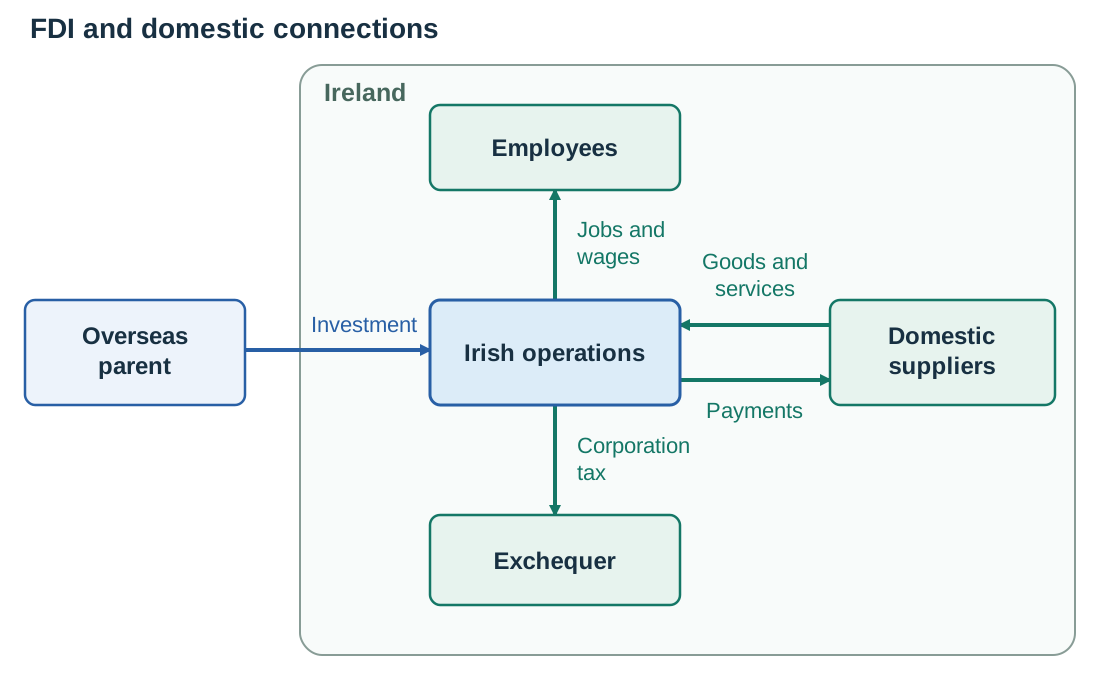
Foreign Direct Investment (FDI) occurs when an overseas business or multinational corporation (MNC) invests directly in building physical facilities, hiring staff, and establishing operations in Ireland.
Why Ireland Attracts FDI
- Pro-enterprise tax policy: A 12.5% corporation tax rate on trading profits, alongside the OECD Pillar Two 15% minimum effective tax rate applied to multinational groups with global revenues exceeding €750 million. Ireland also provides an R&D tax credit for qualifying research spending and the Knowledge Development Box.
- Human capital: Ireland possesses a highly educated, skilled, English-speaking workforce, supported by public funding in science, software engineering, and biopharma programmes.
- Access to markets: Seamless, tariff-free access to the EU Single Market and eurozone financial systems.
- Research and innovation ecosystem: Research Ireland (formed by merging Science Foundation Ireland and the Irish Research Council) funds university-industry research partnerships, creating research hubs in areas like medical technology in Galway and pharmaceuticals in Cork.
Contribution of FDI to the Irish Economy
- Employment and exchequer revenue: Multinationals employ over 300,000 workers directly in high-wage engineering, tech, and pharmaceutical positions, generating billions in corporation tax receipts and PAYE income tax.
- Technology and innovation spillovers: MNCs introduce modern management systems, digital technology, and advanced manufacturing practices. Irish employees gain international experience and frequently launch their own high-growth start-ups (skills transfer).
- Supply-chain linkages: Multinationals purchase products, security, logistics, and legal services from domestic businesses, expanding domestic turnover.
FDI vs Indigenous Enterprise
An indigenous firm is an enterprise established, owned, and managed by residents of the country in which it operates (e.g. InterSport Elverys, Glenveagh Properties). Indigenous firms keep profits within Ireland, show strong regional loyalty, and are less likely to relocate production abroad. However, they often lack the capital scale, global distribution networks, and marketing budgets of large foreign multinationals.
Evaluation of FDI in Ireland
On balance, Ireland's FDI strategy has been a commercial success, transforming an agricultural economy into a global innovation hub. However, excessive reliance on a small number of foreign tech and pharma conglomerates creates exchequer vulnerability if global corporate tax rules shift or international parent companies restructure. Furthermore, large multinationals place strain on domestic electricity infrastructure, water treatment, and the housing market. To ensure stability, the state balances FDI incentives with dedicated support for domestic exporters through Enterprise Ireland and Local Enterprise Offices.
Key Business and Economic Acronyms
- IDA Ireland: Industrial Development Agency Ireland
- EI: Enterprise Ireland
- LEO: Local Enterprise Office
- CRO: Companies Registration Office
- CEA: Corporate Enforcement Authority
- CCPC: Competition and Consumer Protection Commission
- HSA: Health and Safety Authority
- EPA: Environmental Protection Agency
- DPC: Data Protection Commission
- WRC: Workplace Relations Commission
- SIPO: Standards in Public Office Commission
- ECB: European Central Bank
- CSO: Central Statistics Office
- ESRI: Economic and Social Research Institute
- IBEC: Irish Business and Employers Confederation
- ISME: Irish Small and Medium Enterprises Association
- SFA: Small Firms Association
- IFA: Irish Farmers' Association
- SME: Small and Medium Enterprise
- MNC / TNC: Multinational Corporation / Transnational Corporation
- DAC: Designated Activity Company
- PLC: Public Limited Company
- FDI: Foreign Direct Investment
- GDP: Gross Domestic Product
- GNI:** Modified Gross National Income
- CPI: Consumer Price Index
- ESG: Environmental, Social, and Governance
- CAP: Common Agricultural Policy
Key terms
- Stakeholder
- Any individual, group, or organisation that has a direct interest in, or is affected by, the operations, decisions, and success of a business.
- Power-Interest Grid
- A stakeholder mapping matrix that classifies stakeholders by their authority and concern to determine the appropriate communication and management approach.
- Conciliation
- A voluntary dispute resolution process where an independent third party assists conflicting parties in communicating and exploring potential compromises without imposing a settlement.
- Arbitration
- A dispute resolution method where an independent arbitrator evaluates evidence from both sides and issues an award, which may be advisory or binding depending on prior agreement.
- Governance
- The system of rules, practices, and processes by which an organisation is directed, administered, and controlled to ensure accountability and transparency.
- Privatisation
- The sale of state-owned commercial enterprises or public assets to private investors or public shareholders.
- Nationalisation
- The transfer of privately owned businesses or assets into government ownership and control.
- Small and Medium Enterprises (SMEs)
- Enterprises employing fewer than 250 persons, with an annual turnover not exceeding €50 million or a balance sheet total not exceeding €43 million.
- Gross Value Added (GVA)
- The value an enterprise adds through its operations, calculated as the value of output minus intermediate consumption of raw materials and services.
- Labour Force
- All individuals aged 15 and over who are currently employed or actively looking for work.
- Full Employment
- A economic state where everyone who is willing and able to work has a job, corresponding in practice to an unemployment rate of roughly 4% or below.
- Consumer Price Index (CPI)
- The official measure of Irish inflation, calculated by the Central Statistics Office using price movements across a representative basket of consumer goods and services.
- European Central Bank (ECB)
- The independent central bank for the eurozone that sets monetary policy and benchmark interest rates to maintain price stability.
- Modified Gross National Income (GNI*)
- An economic indicator designed for Ireland that strips out multinational profit transfers, patent depreciation, and aircraft leasing distortions from GDP.
- Exchange Rate
- The price of one currency expressed in terms of another currency.
- Consumer Confidence
- A measure of how optimistic households feel about their personal financial security, employment prospects, and the general economy.
- Government Policy
- A set of agreed strategic principles, objectives, and actions adopted by the government to guide executive decision-making.
- Legislation
- Formal statutory Acts passed by the Oireachtas that create enforceable legal rights, obligations, and penalties.
- Lobbying
- The practice of individuals or interest groups attempting to influence government policy, administrative decisions, or legislation.
- EU Regulation
- A binding EU legislative act that applies directly and uniformly in every member state from its date of application, without the Oireachtas needing to pass a transposing law.
- EU Directive
- A binding European legislative measure setting a mandatory end goal that member states must transpose into domestic legislation by a set deadline.
- Foreign Direct Investment (FDI)
- Physical investment by an overseas enterprise to establish operating subsidiaries, manufacturing plants, or service hubs in a host country.
- Indigenous Firm
- An enterprise that is established, owned, and controlled by residents of the country in which it operates.
Check yourself
Why does the government target enterprise supports at micro-enterprises through Local Enterprise Offices?
Micro-enterprises make up over 90% of all active businesses in Ireland. Supporting them with mentoring and priming grants fosters regional employment and helps small local firms transition into scalable employers.
How does conciliation differ from arbitration in resolving stakeholder conflict?
In conciliation, an independent third party facilitates discussion and suggests potential compromises without imposing a decision. In arbitration, the third party evaluates evidence from both sides and issues an award or ruling.
Distinguish between the labour force and the employment rate.
The labour force includes everyone aged 15 and over who is either working or actively seeking employment. The employment rate measures the percentage of the working-age population (aged 15 to 64) that has a job.
The euro exchange rate against sterling weakens from £0.88 to £0.82. Does an Irish food item priced at €10 become cheaper or dearer for a UK shop?
It becomes cheaper: £8.20 instead of £8.80, making Irish exports more price-competitive in the UK market.
What is the primary requirement established by the Regulation of Lobbying Act 2015?
Businesses with more than 10 employees, representative and advocacy bodies, and professional lobbyists who lobby designated public officials (e.g. Ministers, TDs, senior civil servants) must register with SIPO and file returns three times a year on the public Register of Lobbying.