

An ownership structure is the legal framework a business chooses for how it operates. It determines who provides the capital, who makes decisions, how profits are shared, and whether the owners risk their personal belongings if debts cannot be paid. In Leaving Certificate Business, you must understand the different sectors in the Irish economy (public sector organisations, semi-state bodies, private enterprises, and not-for-profit organisations), commercial structures ranging from sole traders to public listed companies, and collaborative models such as franchises and co-operatives. You must also be able to explain how structures evolve over a business lifecycle through growth, privatisation, or nationalisation, and assess the corporate governance, internal controls, and Environmental, Social, and Governance (ESG) standards that hold modern organisations to account.
Sectors of Enterprise in the Business Environment
Every organisation operating in Ireland belongs to a broader sector of the economy based on its core purpose, ownership, and funding model.
1. Public Sector Organisations
Public sector organisations are government departments and state agencies established to deliver essential public services, public administration, and strategic infrastructure. They are funded directly through general taxation and exchequer revenues rather than commercial sales.
- Local contribution: They operate local schools, Garda stations, and hospitals, maintaining services in rural areas where commercial businesses could not run at a profit.
- National contribution: They maintain social stability and represent the country's largest employer, providing over 350,000 public service jobs across healthcare, education, and civil administration.
- Examples: The Department of Education, the Health Service Executive (HSE), and the Revenue Commissioners.
2. Semi-State Enterprises
Semi-state enterprises (also known as state-sponsored bodies) are owned wholly or largely by the Irish State, but they operate at arm's length from government with their own independent board of directors. There are two distinct types:
- Commercial semi-states: These enterprises sell goods or services commercially. They are expected to generate sufficient trading income to cover their running costs, aim for an operational surplus, and may pay a dividend back to the Exchequer. Examples include the Electricity Supply Board (ESB), An Post, Bord na Móna, and Coillte.
- Non-commercial semi-states: These bodies provide dedicated national services, support enterprise development, or act as regulatory authorities. They do not trade for commercial profit and rely primarily on government grant funding. Examples include Enterprise Ireland, the IDA Ireland, and Fáilte Ireland.
3. Private Enterprises
Private enterprises are owned, financed, and managed by private individuals or commercial investors. Their central driving objective is profit generation and wealth creation for the owners or shareholders.
- Local contribution: They provide direct retail, trade, and service jobs, rent commercial premises, and purchase stock from local suppliers.
- National contribution: They drive economic innovation, export Irish goods globally, and contribute substantial tax revenue through Corporation Tax, Value Added Tax (VAT), and employer Pay Related Social Insurance (PRSI).
- Examples: Local independent businesses such as pharmacies and cafés, as well as large Irish plcs such as Kerry Group plc.
4. Not-for-Profit Enterprises
Not-for-profit enterprises are driven by charitable, social, cultural, or environmental missions rather than financial gain for private owners. They include registered charities, non-governmental organisations (NGOs), and social enterprises. Under the Charities Act 2009, charities must register with the Charities Regulator and demonstrate that their primary purpose provides a clear public benefit. Social enterprises trade commercially to earn revenue, but they ring-fence their entire operating surplus to reinvest into their social cause.
- Local contribution: They run local community childcare, emergency food banks, and youth drop-in centres.
- National contribution: They provide vital community safety nets, relieve financial burdens on government budgets, and advocate for social and legal change.
- Examples: Focus Ireland, the Irish Cancer Society, and local community credit initiatives.
Sector Comparison
| Sector | Primary Objective | Ownership | Main Source of Finance | Irish Example |
|---|---|---|---|---|
| Public Sector | Essential public service delivery | The State (run via government departments) | General taxation | HSE |
| Semi-State (Commercial) | Commercial service delivery and viable return | The State (arm's-length board) | Commercial sales revenue and borrowings | ESB |
| Semi-State (Non-Commercial) | State enterprise support and regulation | The State (arm's-length board) | Government exchequer grants | Enterprise Ireland |
| Private Sector | Profit maximisation and owner returns | Private individuals / shareholders | Owner savings, equity investment, commercial debt | Kerry Group plc |
| Not-for-Profit | Social, charitable, or community benefit | Community or trustees (no private owners) | Grants, public donations, and commercial trading surplus | Focus Ireland |
Commercial Ownership Structures
Choosing an ownership structure is a fundamental financial and legal decision. Under Irish company law, it defines an owner's personal risk, how decisions are made, and how profits are taxed.
Sole Trader
A sole trader is an individual who sets up, finances, and runs their own business alone. It is the most common and straightforward way to start trading.
- Formation: Minimal legal barriers. The owner registers with the Revenue Commissioners for income tax as self-employed. If trading under a name other than the owner's true personal surname, they must register that name with the Companies Registration Office (CRO).
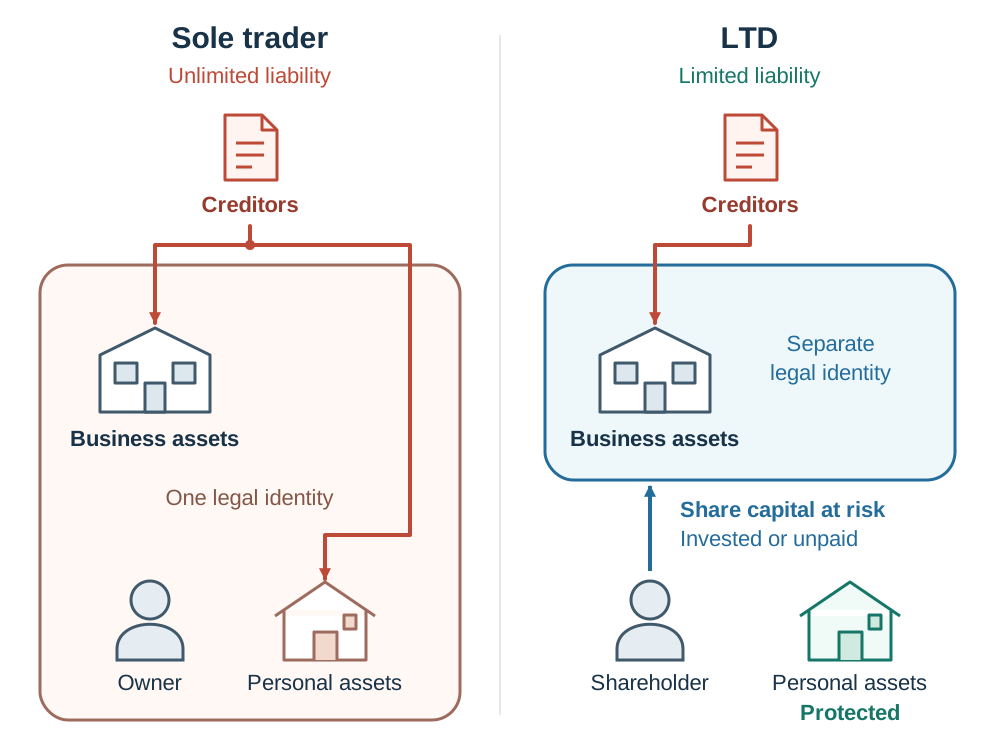
- Liability: Unlimited liability. The business has no separate legal identity from the individual. If the business cannot pay its debts, personal assets such as the owner's home, car, and personal bank accounts can be legally seized to satisfy creditors.
- Control: Total managerial autonomy. The owner makes all operational decisions instantly without consulting others.
- Finance & Tax: Restricted to personal savings, retained earnings, or personal bank borrowings. Trading profits are taxed under personal Income Tax (at 20% or 40%, plus USC and PRSI).
Partnership
A partnership is an agreement between 2 and 20 individuals who carry on a commercial enterprise together with a view to making a profit, governed by the Partnership Act 1890. While an informal agreement is legally valid, partners typically draft a formal Deed of Partnership to define capital contributions, profit-sharing ratios, and voting arrangements.
- Liability: Joint-and-several unlimited liability. Each partner is personally liable for all accumulated debts of the business, including financial debts entered into by other partners without their prior approval.
- Control & Finance: Decision-making and daily workload are shared across partners with complementary skills, though disagreements can create delays. Capital is raised by pooling the personal resources of all partners.
Private Limited Company (LTD)
A limited company is a business that exists legally in its own right, completely separate from the people who own it (separate legal personality). In Ireland, it is incorporated by filing Form A1 and a single-document Constitution with the CRO under the Companies Act 2014.
- Types under the Companies Act 2014: The standard private company is the company limited by shares (LTD), which has no objects clause and can engage in any lawful commercial activity. A Designated Activity Company (DAC) is a private company whose constitution contains an explicit objects clause restricting it to specified commercial activities.
- Ownership & Liability: An LTD can have between 1 and 149 shareholders. It offers limited liability, meaning shareholders can only lose the capital they invested or agreed to pay on their shares. Their personal assets are legally protected.
- Control & Management: Day-to-day management is delegated to a board of directors. An LTD may have a single director, provided a separate person is appointed as company secretary.
- Finance & Tax: Equity is raised by issuing private ordinary shares to investors (though shares cannot be offered to the public). Trading profits are subject to the Corporation Tax rate of 12.5%.
- Disclosure: The company must file annual returns and financial accounts with the CRO, which are accessible to the public.
Public Listed Company (PLC)
Under the Companies Act 2014, a PLC is a public limited company, which is allowed to offer its shares to the public. It becomes a public listed company when its shares are quoted on a stock exchange such as Euronext Dublin. A public listed company is an incorporated business structured to raise substantial equity capital from institutional investors and the general public by offering its shares on an open stock exchange, such as Euronext Dublin.
- Legal Rules: Every public limited company must have at least two directors, a qualified company secretary, and an authorised minimum allotted share capital of €25,000. It must include 'plc' in its registered legal name.
- Finance & Risk: A PLC can raise immense equity capital through a public share issue without bank interest costs. However, it faces intense public scrutiny, must comply with strict stock exchange listing rules, publish fully audited accounts, and faces the risk of hostile takeovers.
Comparison of Commercial Structures
| Feature | Sole Trader | Partnership | Private Limited Company (LTD) | Public Listed Company (PLC) |
|---|---|---|---|---|
| Formation | Easiest; register with Revenue; register business name with CRO only if trading under another name | Simple; verbal agreement or written Deed of Partnership under Partnership Act 1890 | Formal incorporation; file Form A1 and Constitution with CRO under Companies Act 2014 | Complex; formal CRO incorporation, prospectus, and stock exchange listing requirements |
| Liability | Unlimited liability; personal assets can be seized for business debts | Joint-and-several unlimited liability; all partners' personal assets are at risk | Limited liability; investor losses are restricted to their share investment | Limited liability; investor losses are restricted to their share investment |
| Finance | Limited to owner savings, retained profits, and personal bank loans | Pooled capital from 2 to 20 partners and commercial debt | Equity capital from up to 149 private shareholders, retained cash, and bank debt | Substantial equity raised from the public and institutions on an open stock exchange |
| Control | Complete autonomy; owner makes every decision without consultation | Shared control among partners; risk of conflict when partners disagree | Managed by a board of directors accountable to voting shareholders | Controlled by the board of directors; subject to intense scrutiny from public shareholders |
Collaborative Business Models: Franchising and Co-operatives
Beyond traditional commercial formats, businesses regularly use collaborative models to expand quickly or pool regional resources.
Franchising
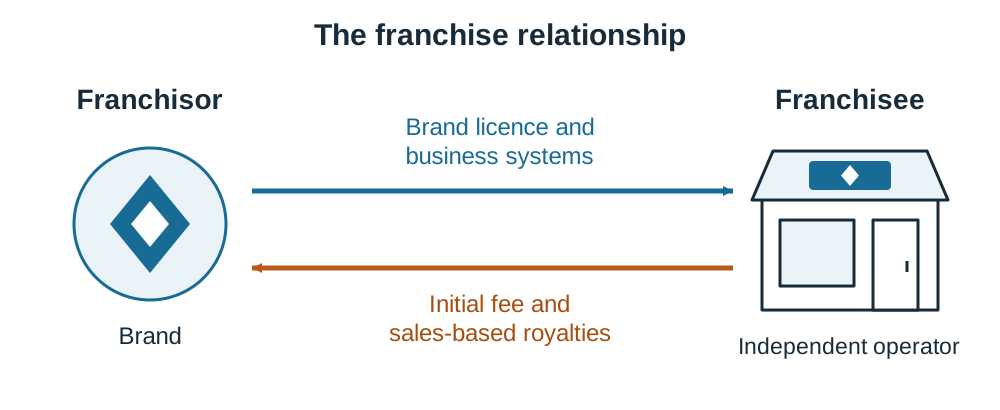
A franchise is a commercial licence where an established business (the franchisor) grants an independent entrepreneur (the franchisee) the right to trade using its established brand name, business format, and operational systems in return for an initial fee and ongoing royalties based on sales turnover. Prominent Irish examples include Supermac's and Insomnia Coffee.
- Franchisor perspective: Achieves rapid geographic expansion without needing to raise capital for individual retail sites; generates reliable royalty revenue. However, if a single franchisee delivers poor service or breaches health standards, the entire national brand reputation suffers.
- Franchisee perspective: Operates with a significantly reduced risk of failure by adopting a proven formula, established menu, and national marketing campaigns. However, they must pay continuous royalties regardless of profit margins and have no freedom to adjust branding, products, or core operational procedures.
Co-operatives
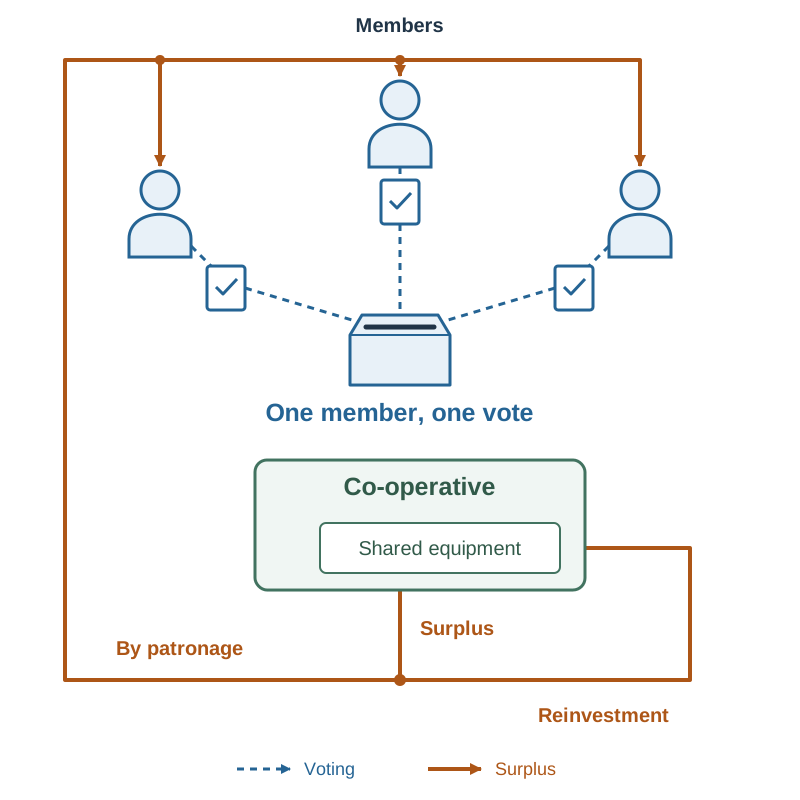
A co-operative is an enterprise owned and democratically controlled by its members—such as agricultural producers, local workers, or consumers—to satisfy a shared economic need.
- Democratic Control: Unlike commercial companies where voting power corresponds to the number of shares owned, co-operatives operate on the foundational principle of one member, one vote. Every member holds equal voting influence regardless of capital invested.
- Surplus Distribution: Any financial surplus is shared among members based on their level of patronage (how much business they conduct through the co-op), or reinvested to improve shared equipment and member services.
- Irish Example: Dairygold Co-operative is owned by thousands of farmer-members across Munster, providing processing facilities for milk, bulk-purchasing of feed, and returning profits directly to local farming communities.
Lifecycle Changes: Growth, Privatisation, and Nationalisation
As an enterprise expands, its operational requirements change. Many successful Irish businesses follow an evolutionary pathway: Sole Trader Partnership Private Limited Company Public Listed Company.
Why Businesses Change Legal Structure
- Accessing Capital: Expanding beyond local markets requires expensive plant machinery, inventory, and marketing. Moving to an LTD allows an owner to sell equity stakes to private investors, while listing as a PLC unlocks public capital markets.
- Securing Limited Liability: As trade contracts, employee payroll, and supplier credit lines expand, owners convert to an LTD to protect personal assets from commercial insolvency.
- Corporate Continuity: Unincorporated businesses cease to exist when an owner dies or retires. An incorporated company has perpetual succession, meaning the company continues to exist as a distinct legal entity regardless of changes in shareholders.
Privatisation
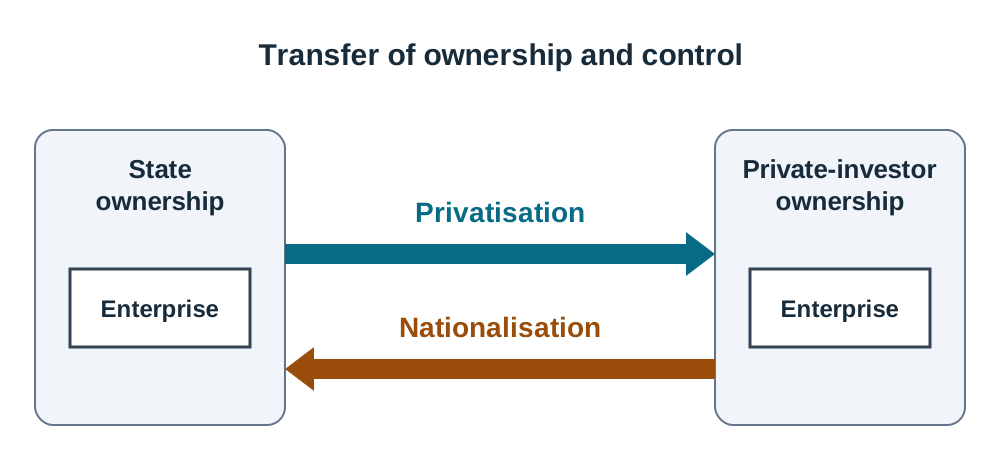
Privatisation is the transfer of ownership and control of a state-owned enterprise to private commercial investors, usually through a public share flotation or direct sale. A notable Irish example is the privatisation of Aer Lingus in 2006.
- Advantages: Delivers a large lump-sum cash return to the State Exchequer to build hospitals, schools, and roads; introduces commercial competition that can drive operating efficiency; eliminates political interference in commercial pricing.
- Disadvantages: Private buyers may eliminate loss-making but socially vital regional services; workforce restructuring often leads to redundancies and poorer working conditions.
Nationalisation
Nationalisation occurs when the government takes ownership and operational control of a privately owned commercial enterprise or asset, bringing it into public ownership.
- Advantages: Protects essential infrastructure from collapse; safeguards critical public services; prevents private monopolies from exploiting consumers.
- Disadvantages: Places major financial burdens onto the taxpayer; state-controlled enterprises can develop administrative inefficiencies without the discipline of commercial market competition.
Worked Contrast: Privatisation vs Nationalisation
- State: Privatisation transfers state-owned firms to private buyers, whereas nationalisation brings privately owned assets into state ownership.
- Explain: In privatisation, the primary driver is introducing private commercial efficiency and raising state funds. In nationalisation, the primary driver is usually protecting strategic public interests or preventing catastrophic market failure.
- Example: The flotation of state airline Aer Lingus in 2006 is an example of privatisation. The government taking ownership of Anglo Irish Bank in 2009 during the banking crisis is an example of emergency nationalisation.
- Evaluation: In my judgement, nationalisation during a systemic financial crisis is justified because allowing a major financial institution to collapse abruptly would freeze national credit, destroy public deposits, and cause far greater economic damage than the state intervention costs.
Corporate Governance and Regulatory Tools
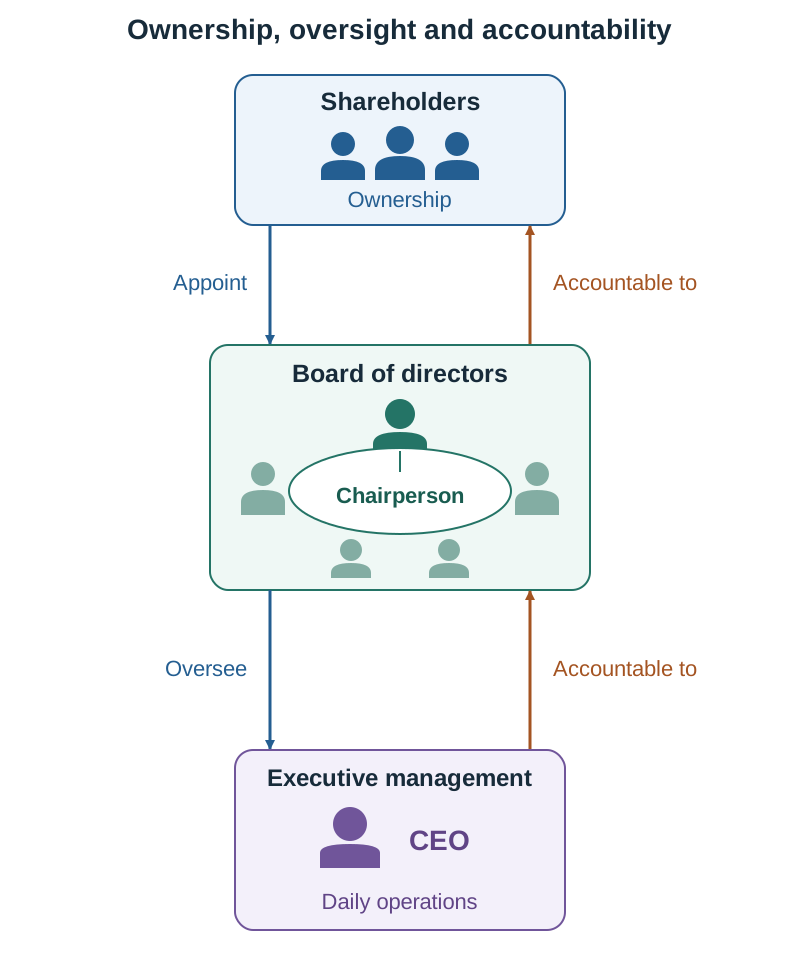
Governance means how an organisation is directed and controlled, and how the people running it are held to account. A clear example of good governance in action is separating the roles of Chief Executive Officer (CEO) and Chairperson of the Board, ensuring that executive management is objectively monitored and that no single individual wields unchecked power.
The Principal-Agent Issue: Ownership vs Control
In a sole trader business, ownership and daily control belong to the same person. In limited companies, there is an operational separation between ownership (shareholders who provide equity) and control (the board of directors appointed to oversee operations). Corporate governance establishes transparent procedures to ensure directors act in the genuine long-term interests of the shareholders and wider stakeholders, rather than inflating their personal executive pay.
Regulation exists to protect stakeholders (customers, employees, investors, creditors and the public), to make sure businesses obey the law, and to keep trust in the business system. Internal regulation is the control a business places on itself through its board, policies, codes of conduct and internal audit. External regulation is imposed from outside by laws and state agencies such as the CRO, CEA, CCPC, HSA and EPA.
Regulatory Tools: Audit, Risk Management, and Compliance
Businesses use three primary tools to maintain internal control and demonstrate external accountability:
1. External and Internal Audit
- External Audit: An independent, qualified registered auditor examines a company's year-end financial statements. The auditor delivers an official report to the shareholders stating whether the accounts show a true and fair view of the company's financial affairs in accordance with the Companies Act 2014.
- Internal Audit: An internal department or committee regularly tests internal spending limits, IT controls, and administrative processes to catch procedural errors, mismanagement, and fraud early.
2. Risk Management
Risk management is the process of identifying potential operational and financial threats to a business, calculating the likelihood and impact of each threat, and implementing controls to mitigate them. Businesses maintain a risk register to track vulnerabilities such as supply chain breakdowns, cyber-attacks, or workplace accidents, and take out commercial insurance or backup data protocols to limit potential losses.
3. Compliance
Compliance means ensuring that the business strictly obeys all mandatory laws, statutory regulations, and internal ethical codes. Companies often appoint a compliance officer to inspect workplace health practices, review marketing campaigns against consumer protection rules, and ensure customer data handling meets the requirements of the General Data Protection Regulation (GDPR).
Regulatory Agencies in Ireland
External regulation is enforced by statutory bodies backed by Irish and EU law:
- Corporate Enforcement Authority (CEA): An independent statutory agency established in 2022 to investigate breaches of company law, hold directors accountable, and apply to the High Court for director restrictions or disqualifications.
- Companies Registration Office (CRO): The central registry that incorporates companies, registers business names, and enforces the timely filing of annual financial returns.
- Competition and Consumer Protection Commission (CCPC): Enforces consumer law, monitors commercial advertising honesty, reviews corporate mergers, and investigates illegal trade cartels.
- Health and Safety Authority (HSA): Enforces safety, health, and welfare standards across all Irish workplaces under the Safety, Health and Welfare at Work Act 2005.
- Environmental Protection Agency (EPA): Regulates industrial pollution licences, monitors water and air quality, and prosecutes illegal waste practices.
Environmental, Social, and Governance (ESG) Reporting
Modern business governance extends beyond basic financial bookkeeping. Stakeholders now expect companies to disclose their environmental and ethical performance through formal ESG reporting.
The Three ESG Factors
- Environmental (E): Examines the impact of business activities on the natural environment. Disclosures include greenhouse gas emissions (carbon footprint), renewable energy consumption, water conservation programmes, and circular-economy measures that eliminate single-use packaging.
- Social (S): Evaluates how the business manages its relationships with people, including employees, suppliers, customers, and local communities. Disclosures include workplace health and safety statistics, gender pay gap reporting, staff training investments, employee diversity and inclusion policies, and supply-chain audits that prevent forced labour.
- Governance (G): Focuses on leadership integrity and board administration. Disclosures include the independence and gender balance of the board of directors, executive remuneration transparency, formal anti-bribery policies, and compliance with data privacy legislation.
Mandatory Standards: The CSRD
In the EU, the Corporate Sustainability Reporting Directive (CSRD) requires the largest companies to publish ESG information using common European standards, checked by an independent assurance provider. Which companies are covered has been changing, so the key exam skill is explaining the three ESG factors.
Connections to Cross-Cutting Themes
- Ethics and sustainability: ESG reporting requires organisations to take direct responsibility for their carbon output and fair treatment of workers.
- Business and financial literacy: Choosing the right ownership structure allows entrepreneurs to manage personal financial liabilities, select suitable equity sources, and evaluate commercial risk.
- Digital transformation: Digital filings on the CRO online portal and digital data tracking make statutory compliance faster and transparent. Keeping an eye on current news stories regarding corporate governance and ESG developments will also directly support your 40% Business Alive Investigative Study.
Key terms
- Unlimited Liability
- A legal condition in unincorporated businesses (sole traders and general partnerships) where owners are personally responsible for all business debts; personal assets can be seized to satisfy unpaid creditors.
- Limited Liability
- A legal protection for company shareholders where financial loss in the event of insolvency is strictly limited to the funds invested or unpaid on their shares.
- Private Limited Company (LTD)
- An incorporated business registered with the CRO under the Companies Act 2014, owned by 1 to 149 shareholders, whose shares cannot be offered to the general public.
- Public Limited Company (PLC)
- A public limited company (minimum €25,000 allotted share capital) that may offer shares to the public; when listed, its shares are traded on a stock exchange.
- Semi-State Enterprise
- An enterprise owned wholly or predominantly by the Irish State but run at arm's length by an independent board of directors, operating as either a commercial or non-commercial body.
- Franchise
- A commercial agreement where a franchisor sells an independent operator (franchisee) the legal right to trade using its brand name, business format, and products in return for upfront fees and royalties.
- Co-operative
- An enterprise owned and democratically controlled by its members for mutual economic benefit, operating under the principle of one member, one vote.
- Privatisation
- The transfer of ownership and control of a state-owned enterprise to private commercial investors, usually through a public share flotation or direct sale.
- Nationalisation
- The acquisition and control of a privately owned business or commercial asset by the government, placing it under public ownership.
- Corporate Governance
- The formal system of rules, relationships, and internal controls by which an enterprise is directed, administered, and held accountable to its stakeholders.
- External Audit
- An independent inspection of a company's financial statements by a qualified registered auditor to verify that the accounts provide a true and fair view of its financial position.
- Corporate Enforcement Authority (CEA)
- The independent statutory Irish body established in 2022 to investigate breaches of company law, hold directors accountable, and enforce the Companies Act.
- ESG Reporting
- The formal disclosure of corporate performance data across Environmental sustainability, Social stakeholder responsibility, and corporate Governance practices.
Check yourself
Is An Post a public sector organisation or a semi-state enterprise? Explain why.
An Post is a commercial semi-state enterprise. It is owned by the State but run at arm's length by its own board of directors, earning its revenue commercially by selling postal and financial services.
What is the primary role of an independent external auditor under the Companies Act 2014?
To examine the company's annual financial accounts and report to the shareholders on whether they provide a true and fair view of the company's financial affairs.
Explain the difference between how voting rights are allocated in a private limited company versus a co-operative.
In a private limited company, voting control depends on capital ownership (one vote per ordinary share held). In a co-operative, democratic equality applies where each member gets one vote regardless of the money they have invested.
What is the primary purpose of a risk register within business risk management?
To identify potential operational or financial threats to the firm, calculate their likelihood and severity, and outline specific control procedures to prevent or mitigate losses.
State which statutory Irish body was established in 2022 to investigate company law offences and prosecute rogue directors.
The Corporate Enforcement Authority (CEA).