

International trade is the exchange of goods and services across national borders. Ireland is a small, open economy with a domestic market of roughly five million people. Because our home market is limited and we lack many natural resources, cross-border trade is essential for employment, economic growth, and living standards. This guide covers why Irish businesses trade globally, the difference between visible and invisible trade, how to calculate national trade balances, protectionist barriers, Ireland's key trading relationships including the EU and Northern Ireland, and the challenges of trading internationally.
The Irish Open Economy: Exporting and Importing
An open economy actively trades goods and services with other nations with minimal restrictions. By contrast, a closed economy restricts foreign commerce and attempts complete self-sufficiency. Ireland operates one of the most open economies in the world.
Why Irish firms export
- Small domestic market: With a population of around five million, the home market is quickly saturated. Indigenous Irish firms in food production or building materials reach a sales ceiling in Ireland and must export to grow. Notable examples of successful indigenous exporters include Kerry Group, Glanbia, and Kingspan.
- Economies of scale: Selling into larger overseas markets lets Irish manufacturers expand production runs. Higher output spreads fixed overheads across more units, lowering unit costs and making firms more price-competitive.
- Higher profitability and risk diversification: Expanding abroad opens access to hundreds of millions of affluent consumers. Spreading sales across multiple countries protects an enterprise from falling revenues if the domestic Irish economy experiences a downturn.
Why Ireland imports
- Natural resource and climate limits: Ireland has very limited fossil fuel reserves, so it imports almost all its oil and most of its energy, along with many raw materials. Our temperate climate cannot support commercial crops such as citrus fruits, tea, or coffee. Importing fills these essential gaps in consumer goods and raw industrial inputs.
- Consumer choice: Importing gives consumers access to goods not produced domestically, from German cars to consumer electronics from Asia.
(Note: While foreign-owned multinationals account for the majority of Ireland's pharmaceutical and computer software exports, their operations are driven by Foreign Direct Investment (FDI), which is examined as a distinct topic.)
Trade Flows: Visible and Invisible Trade
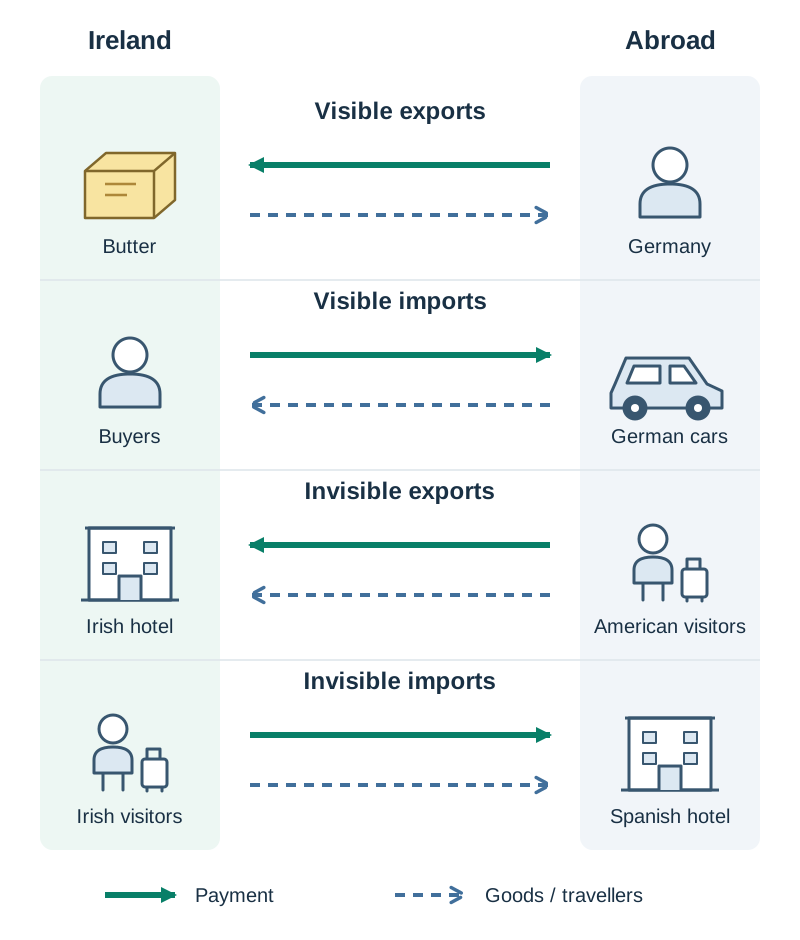
Cross-border transactions are divided into visible trade (physical goods) and invisible trade (services). When classifying trade flows, the easiest rule is to follow the money rather than the physical movement of people:
- Visible exports: Tangible, physical goods produced in Ireland and sold abroad. Money flows into Ireland. Examples include Kerrygold butter sold in Germany or Irish beef sold to France.
- Visible imports: Tangible, physical goods bought by Irish residents or businesses from foreign suppliers. Money flows out of Ireland. Examples include cars imported from Germany or machinery from the United States.
- Invisible exports: Intangible services provided by Irish firms or residents to foreign customers. Money flows into Ireland. Examples include American tourists staying in Killarney hotels or a Dublin software company licensing apps to Japanese clients.
- Invisible imports: Intangible services bought by Irish residents or businesses from foreign providers. Money flows out of Ireland. Examples include an Irish family holidaying in Spain or an Irish firm paying IT consulting fees to an American provider.
Calculating National Trade: Balance of Trade and Balance of Payments
Balance of Trade and Balance of Payments measure the trade of the whole country, not of a single business. In Ireland, these official statistics are published by the Central Statistics Office (CSO).
Key distinction: Balance of Trade covers goods only (visible trade). Balance of Payments covers goods and services (visible and invisible trade).
1. Balance of Trade (Visible Trade Only)
- If visible exports exceed visible imports, there is a Balance of Trade surplus.
- If visible imports exceed visible exports, there is a Balance of Trade deficit.
2. Balance of Invisible Trade
3. Balance of Payments (Overall National Trade)
The Balance of Payments is the difference between Ireland's total exports (visible + invisible) and total imports (visible + invisible).
Alternatively, combine the two balances:
Economic impact of trade balances
- Surplus: A surplus means more money is entering the Irish economy than leaving. It supports jobs in exporting firms and increases the Government's tax revenue, which can be spent on public services and infrastructure.
- Deficit: A deficit means import spending exceeds export earnings. Prolonged deficits can lead to job losses and borrowing. Governments can tackle a trade deficit by helping businesses export through state bodies such as Enterprise Ireland, or by promoting import substitution, where domestic goods replace foreign imports.
Protectionism and Barriers to Free Trade
Protectionism refers to government actions designed to restrict foreign imports in order to shield domestic firms, jobs, and wages from international competition.
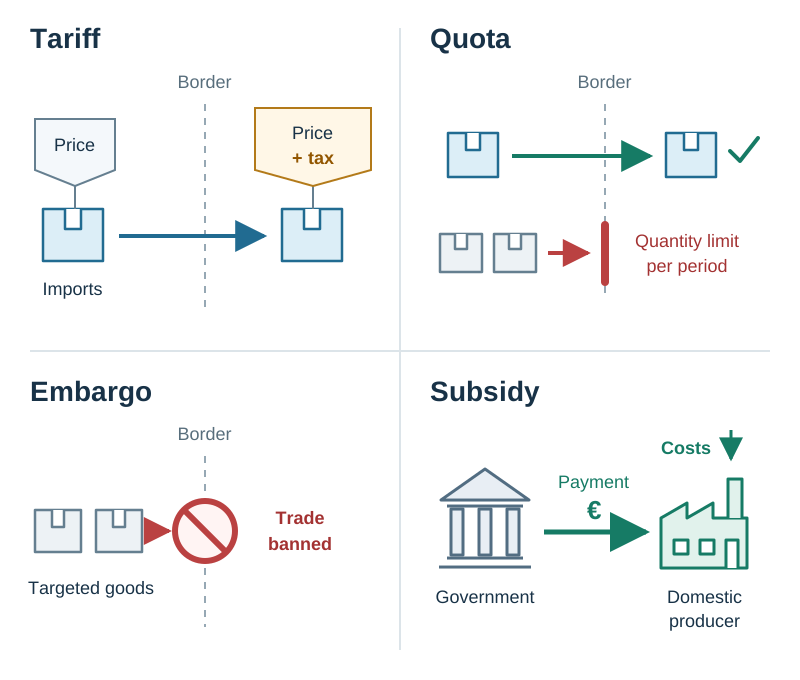
Governments enforce protectionism through four main mechanisms:
| Barrier | Mechanism | Purpose & Example |
|---|---|---|
| Tariff | A customs tax added to the selling price of imported goods. | Makes foreign goods dearer so consumers buy domestic alternatives (e.g. EU tariffs on Chinese electric vehicles). |
| Quota | A physical limit on the quantity or volume of a good allowed into a country over a set period. | Caps import supply directly to protect domestic producers (e.g. annual volume limits on non-EU agricultural produce). |
| Embargo | A complete legal ban on the import or export of specific goods or trade with a specific nation. | Imposed for political, ethical, or safety reasons (e.g. historical bans on British beef during the BSE outbreak). |
| Subsidy | Direct financial payments, grants, or tax reliefs given to domestic producers. | Lowers production costs so domestic firms can compete against cheaper imports (e.g. Common Agricultural Policy payments to farmers). |
A trading bloc removes or reduces these barriers between its members. Many blocs, such as the EU, also charge a common external tariff on goods from outside the bloc.
Trading Relationships That Matter Most to Irish Businesses
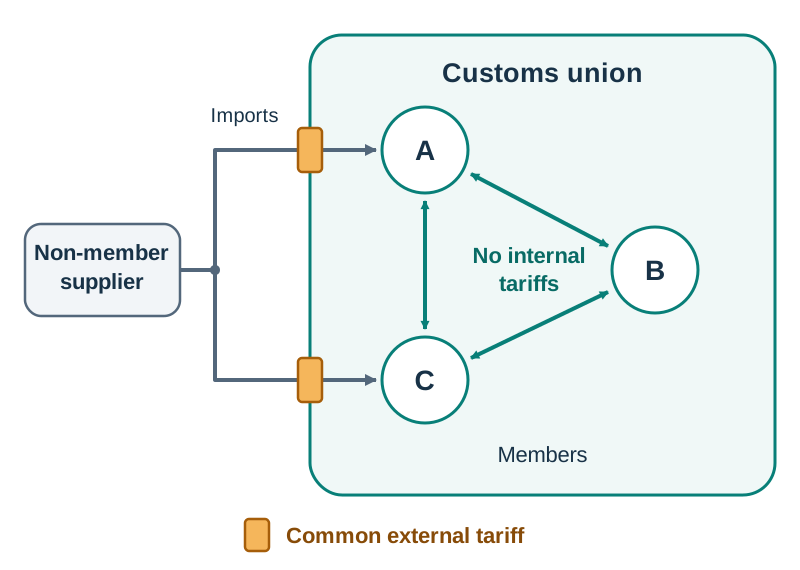
A trading bloc is a group of countries that remove or reduce trade barriers like tariffs and quotas between themselves, and usually charge a common external tariff on goods from non-members.
The European Union (Single Market and Customs Union)
The EU is Ireland's most important trading bloc. Goods, services, capital, and people move between the 27 member states without tariffs, quotas, or customs checks (the Four Freedoms). All members apply the same common external tariff on imports from non-member nations. The EU negotiates trade deals on behalf of all member states, meaning Irish exporters benefit from EU deals with countries such as Canada (CETA) and Japan.
The Eurozone (Economic and Monetary Union - EMU)
21 of the 27 EU member states use the euro. Selling to buyers within the eurozone removes exchange rate risk entirely. However, exchange rate risk still applies when trading with EU members outside the eurozone, such as Poland, Sweden, and Denmark.
Trade on the island of Ireland (Republic of Ireland and Northern Ireland)
A sale from a business in the Republic to a customer in Northern Ireland is international trade because it crosses into another jurisdiction. Northern Ireland is part of the UK and uses sterling. Under the Windsor Framework, Northern Ireland continues to follow EU Single Market rules for goods. Goods move across the border without customs checks or tariffs, protecting all-island supply chains. For example, milk produced on farms in Northern Ireland is regularly processed in creameries in the Republic. However, Irish firms selling into Northern Ireland still face exchange rate risk.
The United Kingdom
The UK left the EU in 2020. Trade now operates under the EU-UK Trade and Cooperation Agreement. Qualifying goods face no tariffs or quotas, but Irish exporters now must complete customs declarations and may face border inspection checks. The UK uses sterling, so exchange rate volatility is an ongoing risk.
The United States
The US is Ireland's single largest export market for goods, particularly pharmaceuticals and medical technology. Because there is no free trade agreement between the EU and the US, the US sets its own import tariffs, posing potential policy risks for Irish exporters. The US is part of the USMCA (United States-Mexico-Canada Agreement) trading bloc.
The World Trade Organisation (WTO)
The World Trade Organisation (WTO) sets rules for international trade, settles disputes between member countries, and works to prevent trade wars.
Evaluating Ireland's Membership of the European Union
The specification asks you to evaluate Ireland's EU membership from three perspectives: the economy, businesses and consumers:
1. The Irish economy
- Benefits: Historically, Ireland received billions of euros from EU Structural and Cohesion Funds to build modern infrastructure such as motorways. Today, our membership of the Single Market makes Ireland an attractive location for US multinationals seeking an export base in Europe.
- Disadvantages: The European Central Bank (ECB) sets a single interest rate for the entire eurozone, which may not suit Ireland's specific economic conditions. Low interest rates in the early 2000s, for example, fuelled the domestic property bubble. Ireland is also now a net contributor to the EU budget, paying in more than it receives, and Irish fishing waters are shared under the Common Fisheries Policy.
2. Irish businesses
- Benefits: Tariff-free access to roughly 450 million consumers across 27 countries. Common technical and product standards remove the need to redesign products for each separate market.
- Disadvantages: Indigenous firms face direct competition on their home turf from large continental firms that enjoy superior economies of scale. Complying with EU rules, such as the GDPR (an EU regulation on handling personal data) and environmental rules, increases overhead costs.
3. Irish consumers
- Benefits: Greater variety of consumer goods in shops at competitive prices. EU consumer protection directives provide robust rights, and mobile phone roaming charges have been abolished across member states.
- Disadvantages: The common external tariff increases the price of certain goods imported from outside the EU, such as non-EU agricultural produce or electric vehicles.
Sample evaluative judgement
On balance, EU membership has been positive for Ireland. Tariff-free access to 450 million consumers is indispensable for an economy of five million people, and it remains a primary reason international firms locate here. While the loss of independent control over interest rates and net contributor costs are genuine drawbacks, they are far outweighed by the scale of export markets and foreign investment.
Factors to Consider When Trading Internationally
The Leaving Certificate specification identifies six key factors every Irish business must evaluate before entering overseas markets:
- Taxes and tariffs: Exporters must check the target country's customs duties, local VAT, and corporate tax rules. Tariffs raise the shelf price of goods and damage competitiveness.
- Costs: Transport, freight insurance, market research, overseas marketing, and establishing distribution channels add substantial expenses.
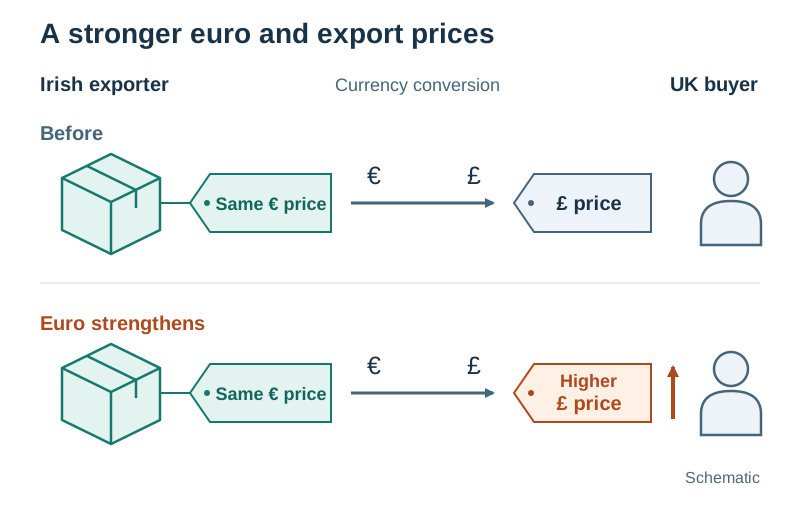
- Exchange rates: A strengthening euro makes Irish exports more expensive in non-euro markets such as the UK and US, reducing sales volume or squeezing profit margins.
- Regulation: Exporters must comply with local safety, packaging, and health standards. For instance, Irish medical device manufacturers selling into the US market require clearance from the US Food and Drug Administration (FDA).
- Competition: Irish firms must compete against well-funded local businesses and multinational giants with lower manufacturing cost bases.
- Language and culture: Marketing campaigns and product packaging must be tailored to local tastes, social conventions, and business etiquette.
Comparing benefits and challenges
While international expansion brings risks like transport costs and currency volatility, the benefits of market size and economies of scale are critical for Irish businesses. Many firms manage these risks by exporting to eurozone partners first before tackling distant non-EU markets.
Globalisation and Interdependence
Globalisation is the growing interdependence and interconnectedness of the world's economies, cultures, and populations, driven by cross-border trade, technology, and movements of capital and people.
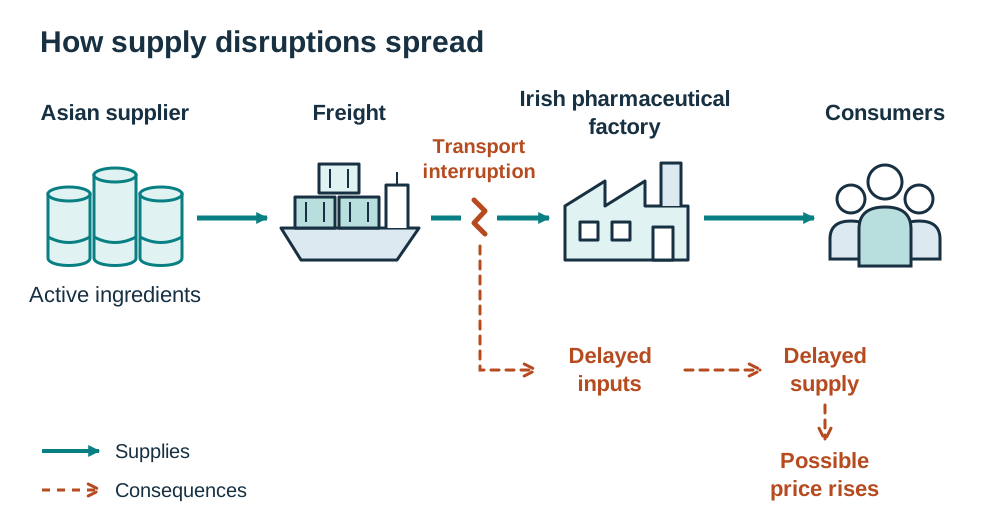
Interdependence occurs when nations and businesses rely on one another for essential goods and services. For example, Irish pharmaceutical facilities depend on active chemical ingredients imported from Asia. In 2021, when the container ship Ever Given blocked the Suez Canal, global supply chains stalled, demonstrating how a disruption thousands of miles away can delay shipments to Irish firms and drive up consumer prices.
Positive impacts of international trade for Irish firms
- Access to large consumer markets and lower unit costs through economies of scale.
- Increased domestic employment and higher corporation tax revenues for public services.
- Wider variety of products and competitive pricing for Irish shoppers.
Negative, social, and environmental impacts
- Political and financial risks: Exporters are exposed to foreign political instability, abrupt tariff changes, and the risk of foreign customers defaulting on payments.
- Carbon emissions: Moving freight over long distances by air and sea generates significant greenhouse gas emissions.
- Labour concerns: Globalisation can tempt firms to shift manufacturing to low-wage economies where worker protection and health standards are weak.
- Cultural displacement: Traditional local businesses and cultural products can be crowded out by global brands.
Key terms
- Open Economy
- A national economy that actively participates in international trade with minimal restrictions on cross-border imports and exports.
- Visible Trade
- The importing and exporting of tangible, physical products such as food, machinery, and pharmaceuticals.
- Invisible Trade
- The importing and exporting of intangible services such as software licensing, tourism, and financial consulting.
- Balance of Trade
- The difference in value between a country's visible exports and visible imports over a given period.
- Balance of Payments
- The difference in value between a country's total exports (visible and invisible) and total imports (visible and invisible).
- Import Substitution
- Replacing imported goods with domestically manufactured products to reduce spending abroad and narrow a trade deficit.
- Protectionism
- Government policies and trade barriers designed to restrict imports to shield domestic businesses and jobs from foreign competition.
- Tariff
- A customs duty or tax placed on imported goods to make them more expensive for consumers.
- Quota
- A physical limit on the quantity or volume of a specific good permitted into a country over a defined time period.
- Embargo
- A complete legal ban on the trade of specific goods, or all commerce, with a designated country.
- Subsidy
- Financial assistance, grants, or tax reliefs paid by a government to domestic producers to lower costs and boost competitiveness.
- Trading Bloc
- A group of countries that remove or reduce trade barriers such as tariffs and quotas between themselves, and usually charge a common external tariff on goods from non-members (e.g. the EU).
- Common External Tariff
- A uniform customs duty applied by all members of a customs union (such as the EU) on goods imported from outside the bloc.
- Globalisation
- The growing interconnectedness of world economies and cultures driven by cross-border trade, technology, and investment.
- Interdependence
- A mutual reliance where countries and businesses depend on one another for supplies of essential goods, services, and raw materials.
- Key Business Acronyms
- WTO: World Trade Organisation; EMU: Economic and Monetary Union; CAP: Common Agricultural Policy; FDI: Foreign Direct Investment; CSO: Central Statistics Office; ECB: European Central Bank; IDA: Industrial Development Agency.
Check yourself
An American multinational hires a Dublin engineering firm to design a data centre. How is this transaction classified in Ireland's national trade accounts?
It is an invisible export. An Irish firm provides a service to a foreign client, bringing foreign money into the Irish economy.
A Cavan cheese producer sells cheddar to a supermarket chain in Newry, Northern Ireland. Is this international trade, and what is one business risk involved?
Yes, it is international trade because it crosses into a different jurisdiction (the UK). While the Windsor Framework ensures no customs duties or border checks for goods, the Cavan producer still faces exchange rate risk because the transaction is handled in sterling.
Given Visible Exports of €70bn, Invisible Imports of €40bn, Total Exports of €100bn, and Total Imports of €90bn, calculate the Balance of Trade and Balance of Payments, labelling each as a surplus or deficit.
Visible Imports = Total Imports (€90bn) - Invisible Imports (€40bn) = €50bn. Balance of Trade = Visible Exports (€70bn) - Visible Imports (€50bn) = €20bn surplus. Balance of Payments = Total Exports (€100bn) - Total Imports (€90bn) = €10bn surplus.
Distinguish between a tariff and a quota.
A tariff is a customs tax added to the price of an imported product to make it more expensive, whereas a quota is a physical quantity limit on the volume of a good allowed into the country over a given time.
Explain how a weakening British Pound against the Euro affects an Irish business exporting food to the UK.
A weaker pound means Irish food products become more expensive for UK shoppers paying in sterling. This reduces consumer demand and sales volumes, or forces the Irish exporter to lower its euro prices and accept narrower profit margins.