

Risk is the chance that something goes wrong and causes a business a loss. Risk management means spotting these risks, deciding how serious each one is, and taking steps to reduce the chance or the damage. Insurance is one way to manage risk: the business pays a regular premium, and the insurer pays out if an insured loss happens.
The Nature and Importance of Risk Management
Every firm faces commercial uncertainty. In business, risk is the chance that an adverse event will cause financial loss, physical damage, operational shutdown, legal liability, or reputational harm. You cannot eliminate every hazard, but good managers practise active risk management. They spot potential hazards early, evaluate how severe they are, and put clear procedures in place to minimise the fallout.
Commercial Benefits of Risk Management
Handling risk methodically brings several practical benefits:
- Protecting solvency and cash flow: Severe shocks like warehouse fires or customer lawsuits drain working capital fast. Effective controls and insurance payouts keep cash moving, so the business pays its daily bills.
- Safeguarding reputation: Strict workplace safety rules, robust quality checks, and clean digital security stop accidents and data breaches before they shatter customer trust.
- Lowering insurance costs: Insurers reward careful firms. When a business proves it takes prevention seriously by fitting monitored sprinklers or holding regular staff safety drills, it earns lower premiums and avoids extra penalty charges called loadings.
- Meeting statutory duties: Documented safety audits help the business satisfy Irish laws like the Safety, Health and Welfare at Work Act 2005 and GDPR, protecting the company from courtroom penalties and hefty fines.
Entrepreneurial Risks and Personal Pressures
Starting an enterprise exposes the founder to distinct personal and commercial threats:
- Personal financial liability: Sole traders and general partners have unlimited liability. If their venture collapses, their domestic assets, including family savings, transport, and the home, can be taken to settle unpaid debts.
- Loss of regular income: Founders trade a predictable monthly salary, employer pensions, and paid holidays for unpredictable trading returns.
- Harder access to capital: Commercial banks hesitate to lend to unproven startups without trading track records, often demanding personal property as security.
- Well-being and mental pressure: Long weeks, irregular income, and heavy workloads create severe mental and physical strain.
- Shifting market demand: A new concept might struggle to win customers, or established rivals might cut prices aggressively to squeeze the new entrant out.
- Damage to commercial credit: Business failure can ruin an entrepreneur's credit rating, making future funding difficult to secure.
Take an everyday example. If Aoife leaves her salaried nursing position to set up an artisan bakery as a sole trader and runs up unpaid supplier bills of €40,000, she must clear every cent from her personal bank account. Had she formed a private limited company, her financial exposure would stop at the money she paid for her shares.
Corporate Governance and Risk Control
Well-run organisations treat risk management as a central part of corporate governance, which is the system by which enterprises are directed and held accountable:
- The risk register: Directors review this document regularly. It details every operational risk, its probability and severity, and the specific manager tasked with mitigating it.
- Internal audit: Independent staff check operational habits, confirming that rules like dual signatures on large bank transfers or IT access permissions are followed.
- Compliance checks: These verify that the enterprise obeys employment, tax, and environmental standards, supporting the Governance pillar of its ESG reporting.
Categories of Business Risk and the Risk Matrix
Commercial hazards arise inside daily operations and outside in the wider economic environment. Common business risks include:
- Technological risks: Failures across digital systems, including ransomware attacks, e-commerce server crashes, customer data leaks, and stolen trade secrets.
- Production risks: Mechanical breakdowns, equipment wear, or shipping delays that halt manufacturing lines and leave orders unfilled.
- Staffing risks: Embezzlement (staff stealing company funds), accounting fraud, high staff turnover, or losing key technical experts who hold specialist operational skills.
- Premises risks: Physical destruction caused by fire, flood water, roof leaks, severe winter weather, or burglary.
- Financial risks: Sudden cash deficits caused by bad debts from unpaid customer accounts, spiking interest rates on commercial loans, or sharp currency swings that hit export revenues.
- Compliance risks: Legal fines and courtroom sanctions caused by ignoring health and safety regulations, employment contracts, or consumer protection statutes.
- Strategic risks: Market shifts that threaten the enterprise business model, such as demographic changes, aggressive new competitors, or sluggish product development.
Prioritising Hazards with the Risk Matrix
Managers assess threats systematically using a risk matrix. This plots two variables against each other:
- Probability: What is the likelihood of the hazard happening? (Low, Medium, or High).
- Severity: How serious will the financial or operational damage be? (Low, Medium, or High).
| Probability / Severity | Low Severity | High Severity |
|---|---|---|
| High Probability | Routine overhead (e.g. broken staplers or minor office waste; accept and replace) | Immediate danger: eliminate or curb (e.g. sawdust piling up near hot electric saws; apply risk prevention) |
| Low Probability | Minor incident (e.g. a delayed parcel delivery; accept the minor disruption) | Catastrophic loss (e.g. factory fire; apply risk transfer through insurance) |
Risk Management Strategies and Choosing Insurance
Enterprises manage their exposure using four practical strategies: avoidance, prevention, spread, and insurance.
1. Risk Avoidance
A business eliminates a hazard completely by choosing not to enter a risky market or halting an activity altogether. For instance, a local haulage firm might refuse to transport frozen goods, removing the risk of ruined inventory from freezer compressor failures.
2. Risk Prevention
The firm continues the business operation but installs safeguards to lower the chance of an accident or soften its impact. Common steps include:
- Writing and enforcing a clear Safety Statement, running regular staff safety workshops, and providing personal protective gear like steel-toe boots and goggles.
- Installing physical protections such as smoke alarms, industrial sprinkler systems, fire doors, and CCTV networks.
- Using financial controls, such as running formal credit checks on new trade buyers and requiring two managers to sign off on electronic payments.
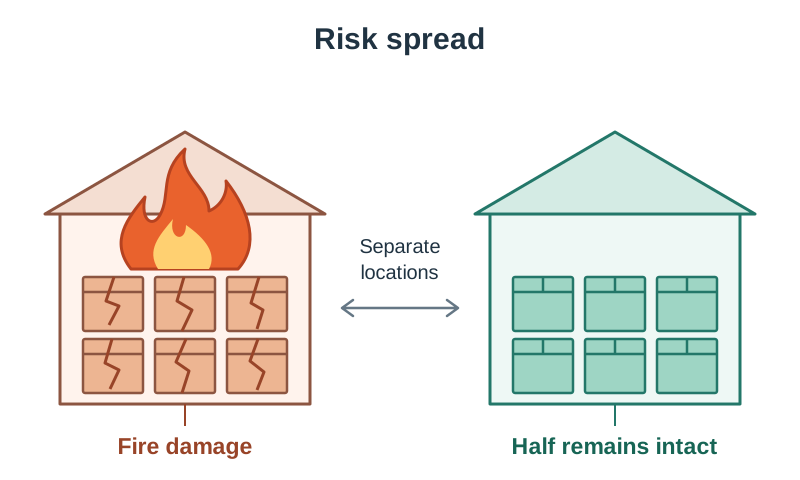
3. Risk Spread
The enterprise divides its assets, operations, or markets across different areas so a single crisis cannot sink the whole firm. Practical examples include:
- Storing finished stock across two separate warehouses in different towns, so a fire at one site leaves half the inventory intact.
- Buying key components from three independent suppliers instead of relying on a single factory.
- Selling products in multiple overseas territories so a recession in one market does not dry up all sales.
4. Choosing Suitable Insurance Products
Taking out insurance, known as risk transfer, moves financial liability to an insurance company in return for a regular fee called a premium. When shopping for cover, a prudent manager should follow these guidelines:
- Target actual exposures: Match policies to the real hazards of the trade. A courier needs goods in transit cover; an architectural practice needs professional indemnity.
- Insure for full reinstatement value: Always cover premises and equipment for what it would cost to rebuild or buy them fresh today. Underestimating values triggers the Average Clause.
- Use an independent broker: Brokers are licensed specialists who assess a company's risks and gather quotes from multiple underwriters to secure the best cover and terms.
- Review the policy excess: The excess is the agreed sum the business pays out of pocket before the insurer covers the rest of the bill. Accepting a higher excess cuts your annual premium, but the firm must keep cash ready to pay it if an accident occurs.
- Declare every material fact: Fill out proposal forms with total honesty to honour utmost good faith.
- Cut premiums through active prevention: Showing clear evidence of security alarms or staff training removes extra penalty fees called loadings.
- Switch providers when renewal quotes climb: Insurance is a competitive financial product. Comparing quotes at renewal often reveals cheaper options with lower excesses. When switching, confirm that cover dates match up seamlessly so no gap in protection opens up.
Insurable vs Uninsurable Risks
Not every hazard can be handed to an insurance company:
- An insurable risk is an accidental event whose probability can be calculated from past statistical records, and where any damage can be calculated in money (like a fire, burglary, or workplace accident).
- An uninsurable risk cannot be priced mathematically, or it involves ordinary commercial trading risks. Examples include falling customer sales due to changing fashion, weak management decisions, or a competitor opening across the road. A firm must manage these internally through careful research, cost control, and strategic planning.
The Legal Principles of Insurance
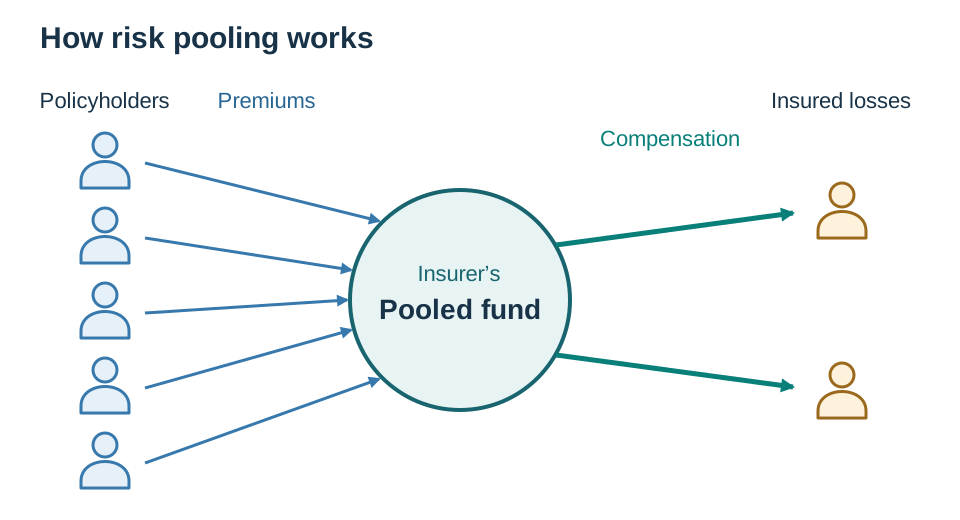
Insurance relies on risk pooling. Insurers gather premiums from many policyholders into a large central fund, using that reserve to compensate the unlucky few who suffer losses. Every insurance contract is governed by five legal principles. Lacking insurable interest makes a contract void from day one. Breaking utmost good faith lets the insurer cancel cover and reject claims. Indemnity, subrogation, and contribution decide exactly how payouts are calculated.
1. Insurable Interest
The policyholder must gain a financial advantage from the safety of an item or person and suffer a direct financial loss from its damage, destruction, or death. You can insure your own business workshop and inventory, but you cannot insure your rival's premises to collect cash if it burns down.
2. Utmost Good Faith (Uberrima Fides)
Both sides must be completely honest and disclose all material facts before signing the agreement. A material fact is any detail that would influence an underwriter when deciding whether to offer cover and what premium to charge. For example, if an enterprise fails to mention on its proposal form that its stockroom flooded two winters ago, the insurer can cancel the policy and reject any future flood claim.
3. Indemnity
A claimant must not make a profit from an insurance payout. The insurer restores the policyholder to their exact financial position immediately before the loss occurred. This rule applies to property, commercial vehicles, and liability covers. It does not apply to life assurance or personal accident policies. You cannot put an exact financial price on human life or health, so those contracts pay out an agreed lump sum instead.
Overinsurance happens when an asset is insured for more than its real market or replacement value. Under indemnity, overinsuring is a waste of money. The insurer only pays for the actual damage. If a commercial van worth €25,000 is insured for €35,000 and written off, the insurer pays €25,000. The extra premium paid for that extra €10,000 of cover is gone for good.
4. Subrogation
Subrogation supports indemnity. Once an insurer has paid compensation, it takes over the policyholder's right to sue any negligent third party who caused the loss, up to the amount it paid. If it pays for a total loss, it also becomes the owner of the salvage. The business cannot keep both the full payout and the scrap, as that would give it a profit and breach indemnity.
5. Contribution
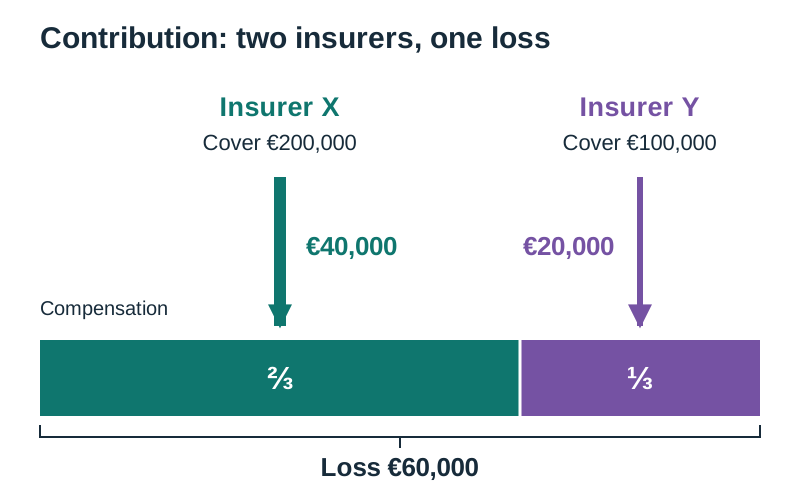
Contribution also upholds indemnity. It applies when an asset is insured against the same danger with two or more insurance firms. The policyholder cannot claim the full repair bill from both companies. Instead, each insurer pays a proportional share of the loss.
For example, suppose an engineering plant is insured for €200,000 with Insurer X and €100,000 with Insurer Y (giving total cover of €300,000). A machine fire causes €60,000 in damage:
- Insurer X pays:
- Insurer Y pays:
- Total payout received: €60,000. The factory owner gets the exact repair bill settled and cannot collect €60,000 from both insurers.
Underinsurance and the Average Clause
Underinsurance happens when a firm insures property or equipment for less than its true rebuild or replacement cost. Businesses sometimes do this to save on premiums, or they forget to raise their cover as inflation pushes replacement prices higher.
Under indemnity, an underinsured company is treated as its own insurer for the uncovered fraction. When a partial loss occurs, the insurer applies the Average Clause to scale down the settlement.
The Average Clause Formula
Worked Step-by-Step Problem
A joinery workshop with a true rebuild cost of €600,000 is insured for only €450,000. An electrical short-circuit in the drying room causes €80,000 in fire damage.
- Check the proportion of cover:
- Calculate compensation:
- Practical outcome: The insurer pays €60,000. The joinery must pay the remaining €20,000 from its own cash reserves because it chose to insure only three-quarters of the building's true value.
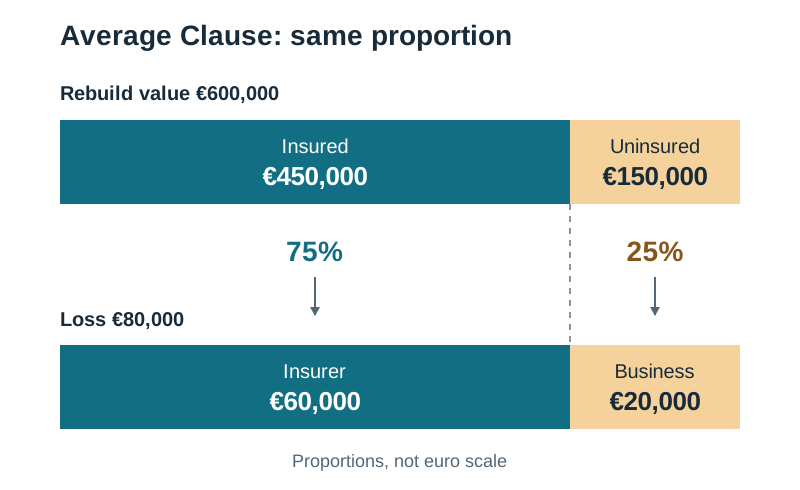
What about a total loss? If the workshop burns to the ground, the formula caps out at the policy limit: . The insurer pays the full €450,000 sum insured, leaving the owners with a €150,000 shortfall to rebuild.
Commercial Policies and Industry Terminology
Enterprises select specific commercial policies based on legal duties and daily operational risks:
Standard Commercial Policies
- Commercial Motor Insurance: Mandatory under the Road Traffic Act 1961 for any vehicle used on Irish public roads. Third-party cover is the legal baseline, while comprehensive policies also cover damage to the company's own vans or trucks.
- Employer's Liability Insurance: Covers legal fees and compensation awards if an employee suffers injury or illness while doing their job. Although not explicitly compulsory by Irish statute, it is an operational essential because employers owe a common-law duty of care and face strict duties under the Safety, Health and Welfare at Work Act 2005.
- Public Liability Insurance: Covers claims and legal costs if a customer, delivery driver, or passerby suffers personal injury or property damage on company premises.
- Product Liability Insurance: Protects the firm against compensation claims if a product it made, supplied, or sold causes illness, poisoning, injury, or property damage.
- Buildings and Contents Insurance: Pays for structural repairs to owned premises and replaces stock, tools, and office fittings damaged by perils like fire, storm, or burst water mains.
- Consequential Loss Insurance (Business Interruption): Replaces lost gross profit and pays continuing fixed costs, such as rent, bank loan repayments, and core staff wages, while regular trading is stopped following an insured disaster.
- Fidelity Guarantee Insurance: Covers direct cash or stock losses caused by fraudulent or dishonest acts by staff members.
- Goods in Transit Insurance: Covers raw materials, goods, and tools against theft or accidental destruction while being carried in company vans or by third-party hauliers.
- Cyber Insurance: Covers data restoration bills, extortion payments, forensic fees, and customer legal liabilities following malware, ransomware, or cloud server breaches.
The Insurance Cycle and Industry Roles
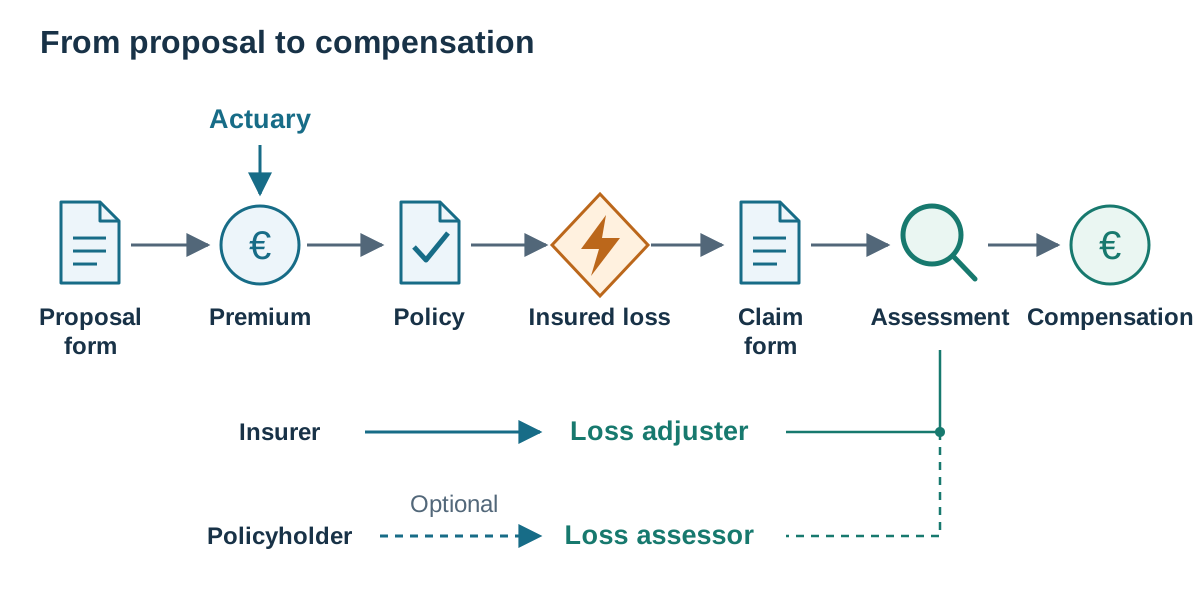
The insurance journey follows a regular path: the applicant completes a proposal form disclosing all material facts; the insurer calculates the premium; the insurer issues the policy document; if damage occurs, the policyholder files a claim form; an expert inspects the site; and the insurer pays compensation.
- Actuary: A statistician who examines historical claim patterns to calculate the mathematical probability of future losses and set underlying premium rates.
- Assessor: A specialist who examines physical damage after a claim and works out the monetary settlement. In the Irish insurance market, an expert hired by the insurance firm is called a loss adjuster, while an independent professional hired by the policyholder to fight their corner is called a loss assessor.
Key terms
- Risk Management
- The planned approach of identifying hazards facing an enterprise, measuring their likelihood and impact, and applying controls to minimise financial loss.
- Risk Avoidance
- A strategy where a business stops a hazardous commercial activity entirely to eliminate exposure to loss.
- Risk Prevention
- Putting safety gear, staff training, and physical controls in place to lower the chance or severity of an accident.
- Risk Spread
- Dividing assets, operational sites, or supply chains across multiple locations so a single catastrophe does not ruin the enterprise.
- Insurable Interest
- The legal rule that a policyholder must gain a financial benefit from an asset's safety and suffer direct monetary loss from its damage or destruction.
- Utmost Good Faith
- The legal requirement that both the applicant and the insurer disclose all material facts honestly before entering an insurance agreement.
- Indemnity
- The principle that an insurance settlement must return the insured to their exact pre-loss financial position, barring any profit.
- Overinsurance
- Insuring an asset for more than its true value, which wastes premium money because indemnity caps payouts at the actual financial loss.
- Subrogation
- The rule that an insurer, after paying compensation, takes over the claimant's right to sue a responsible third party; after paying for a total loss it also owns the salvage.
- Contribution
- The rule stating that when an asset is insured across multiple insurers, each pays a proportional share of the loss up to the total damage.
- Average Clause
- A policy condition that reduces partial loss payouts in direct proportion to the percentage of underinsurance on the asset.
- Premium
- The fee paid by a policyholder to an insurance company to purchase financial protection against agreed perils.
- Policy Excess
- The initial out-of-pocket amount the policyholder agrees to pay towards any claim before the insurance company covers the remainder.
- Loading
- An extra charge added to an insurance premium to account for higher-than-average operational risks.
- Actuary
- A statistician who evaluates loss probabilities using past data to calculate risk levels and set base premium rates.
- Assessor
- A specialist who inspects physical damage after a claim and calculates the monetary compensation due.
- Loss Adjuster
- An independent claims expert appointed and paid by the insurance company to inspect an incident and negotiate an equitable settlement.
- Unlimited Liability
- A legal condition where an entrepreneur is personally on the hook for all business debts, placing personal assets at risk if the firm fails.
Check yourself
A printing press worth €500,000 is insured for €350,000. An electrical short-circuit causes €60,000 in damage. Calculate the compensation payable.
Compensation = (€350,000 / €500,000) €60,000 = 0.70 €60,000 = €42,000. The business owner must fund the remaining €18,000.
Select the correct option: (i) Choosing a higher policy excess results in a (higher / lower) premium. (ii) The expert who calculates compensation after an accident is an (actuary / assessor). (iii) Reclaiming losses from a negligent third party uses (contribution / subrogation).
(i) lower; (ii) assessor; (iii) subrogation.
Why does subrogation prevent a business from keeping a written-off commercial van after receiving full compensation from the insurer?
Once the insurer pays for the total write-off, ownership of the scrap vehicle passes to the insurer. If the business kept and sold the salvage while keeping the full payout, it would make a profit from the incident, which breaches indemnity.
What is the primary difference between an insurable risk and an uninsurable risk?
An insurable risk is accidental, can be measured in money, and its likelihood can be calculated from past data (e.g. fire). An uninsurable risk stems from normal trading or unpredictable events where probability cannot be calculated (e.g. fashion changes, poor management, new competition).
Why should a business consider switching insurance providers when its policy comes up for annual renewal?
Switching allows the firm to compare the market to lower its premium, negotiate a smaller policy excess, or secure better claims cover. It avoids automatic renewal price increases while ensuring there is no gap in coverage.